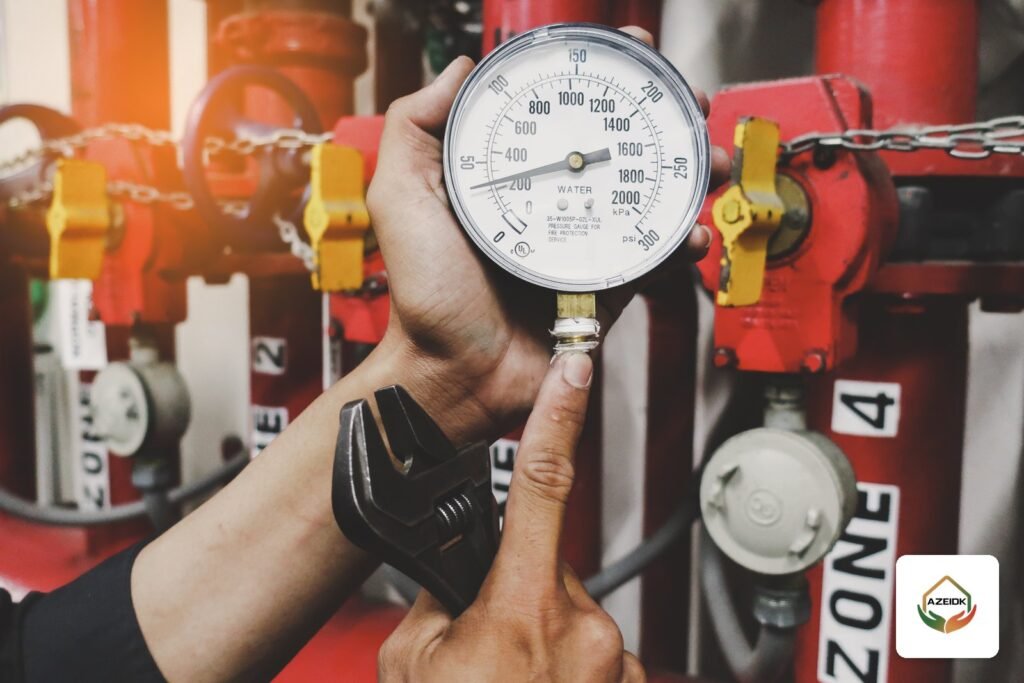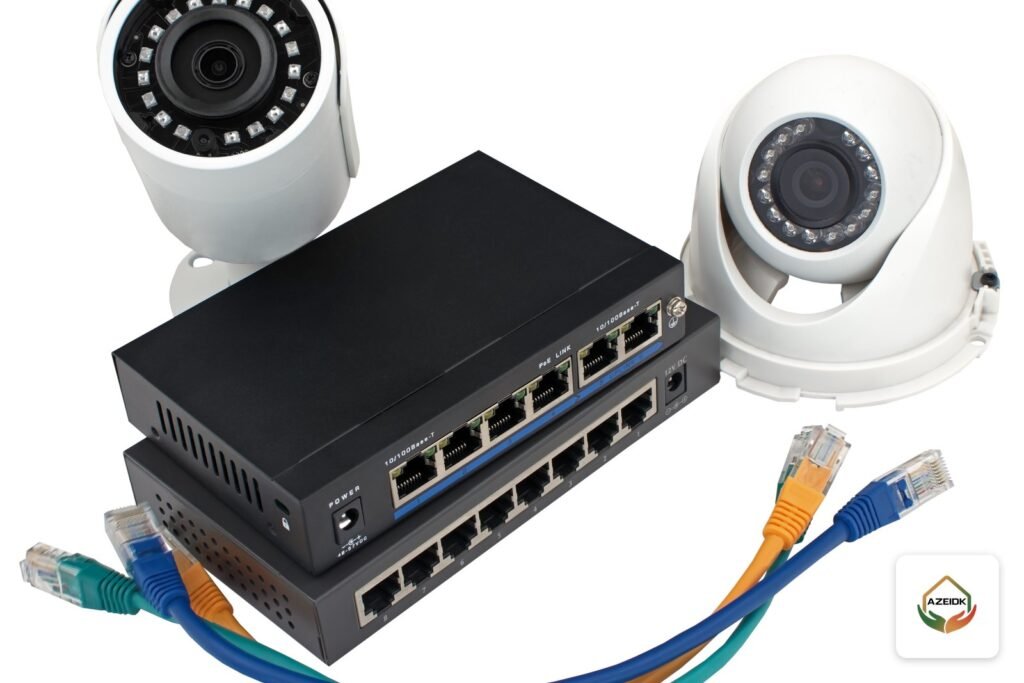
The Saudi Residential Building Code (SBC 1101 and SBC 1102), read together with the SBC 801 Fire Code, sets the frame for designing villas and apartment buildings, and the safety requirements owners ask about come from it. Safety systems for compounds, villas and residential buildings in Saudi Arabia come in two layers. The fire layer covers fire alarm, sprinklers and fire hose cabinets where the design calls for them, fire extinguishers, and emergency lighting and exits. The security layer covers CCTV, access control and gates, intercom and intrusion alarm. What a specific building must have is set by its occupancy classification, height and area under the Saudi Building Code, by the approved design and by Civil Defense requirements.
The short answer: under the residential building requirements issued by the Ministry of Municipalities and Housing, a villa is classified as occupancy group R3 and an apartment building as R2. Those requirements refer to the Residential Building Code for structural, electrical and mechanical work and require SBC 801 for fire prevention and protection. The residential code alone does not settle detectors, extinguishers and exits; it is read with SBC 801 and the approved design. The full sector view is on our residential developments page.
This page is AZEIDK’s hub for the residential sector. It walks through each system, the official Civil Defense and Salamah steps, what we supply and install, and then points you to the detailed article for each case.
Key takeaways
- A private villa, an apartment building and a compound differ in unit count, shared areas and who runs the property, and that is what changes the scope of systems.
- The Saudi Residential Building Code carries the numbers SBC 1101 and SBC 1102 and covers R3 residential buildings such as villas; apartment buildings are classified R2 and follow the Saudi Building Code requirements for that occupancy plus SBC 801.
- The technical reference is the Saudi Building Code: SBC 801 for fire protection and SBC 201 for general building. The 2024 edition has been mandatory since 30 June 2025.
- Whether sprinklers are required, and which alarm system, depends on classification, height and area. There is no single answer for all residential buildings.
- CCTV is governed by the Law on the Use of Security Surveillance Cameras and its Executive Regulation, which bans audio recording without Public Security approval.
- Whether an activity needs a Salamah licence, and how it is issued, is determined on the Salamah platform itself.
In this article
- Compound, villa or apartment building: why the systems differ
- Saudi Residential Building Code: what are SBC 1101 and SBC 1102?
- Safety requirements for residential buildings: what a villa or apartment building owner needs
- Safety systems for compounds, villas and residential buildings, one by one
- Civil Defense and Salamah steps for residential buildings
- What AZEIDK provides for residential projects
- Detailed articles by need
- Free tools before the site visit
- Common mistakes on residential projects
- Frequently asked questions
- Summary
Compound, villa or apartment building: why the systems differ
A private villa usually has one owner household, and the main risk is a night fire while the family sleeps, so early detection and audible alarm in and around bedrooms come first. An apartment building adds shared corridors, a common stair, an electrical room and a roof serving every flat, so a central alarm and a clear escape route matter more. A compound is a whole community with gates, internal roads, a clubhouse, a pool and sometimes restaurants or shops, run by a management company or owners’ association. That is where a security room tying cameras, gates and intercom together becomes necessary.
| Type | Typical fire layer | Typical security layer | Who runs it |
|---|---|---|---|
| Private villa | Interconnected smoke alarms or a small conventional panel; extinguishers in kitchen and corridors | Cameras on entrances and boundary wall, villa intercom, intrusion alarm | Owner |
| Apartment building | Building alarm panel, emergency lighting in stair and corridors, extinguishers, hose cabinets and sprinklers as designed | Building intercom, access control at the entrance, cameras at entrances and parking | Owner or property manager |
| Compound | Systems per building by classification, plus shared facilities such as the clubhouse and any commercial kitchen | Gates and parking barriers, plate recognition, perimeter cameras, access control, IP intercom, security room | Management company or owners’ association |
The table shows what recurs on projects, not a mandatory list. The binding list for your building comes from the approved design.
Saudi Residential Building Code: what are SBC 1101 and SBC 1102?
The Saudi Residential Building Code is part of the Saudi Building Code family and appears in official documents under one name with two numbers, SBC 1101 and SBC 1102. The Saudi Council of Engineers describes its guideline for the code as covering R3 class residential buildings, and the Saudi Building Code National Committee announced that enforcement of the residential code would start on 1 July 2021.
The residential building requirements published by the Ministry of Municipalities and Housing in 2024 show how the code is applied in practice:
| Building type in the requirements | Occupancy group | What the requirements refer to |
|---|---|---|
| Villas (detached, semi-detached and attached) | R3 | Structural requirements from SBC 1101, electrical from SBC 1102, mechanical from the Residential Building Code, fire protection from SBC 801 |
| Apartment buildings (more than one floor, height not above 23 m) | R2 | The Saudi Building Code requirements for R2 occupancy, plus SBC 801 for fire protection |
| Mixed residential-commercial and residential-office buildings | R2 with M, A2 or B for the non-residential parts | The requirements of each occupancy, plus SBC 801 for fire protection |
These requirements exclude hotels, serviced apartments, high-rise towers and some other building types, each of which has its own rules. For residential towers see fire safety in residential towers, and for how the general code, the fire code and Civil Defense requirements relate, see SBC 801 vs SBC 201 vs Civil Defense requirements.
Safety requirements for residential buildings: what a villa or apartment building owner needs
Safety requirements for residential buildings do not come from a single document. The Ministry of Municipalities and Housing requirements make SBC 801 binding for fire prevention, protection and firefighting provisions, require the fire protection designer to be approved by the General Directorate of Civil Defense, and list fire detection and alarm systems among the building’s electrical requirements. The detail for each building comes from its approved design.
Detectors and fire alarm
The first owner question is usually standalone smoke alarms or a panel-based system. In a villa, interconnected smoke alarms may be enough where the design allows it; in a multi-flat building the design normally calls for a central alarm panel covering corridors and the stair. The difference and the limits of each are covered in standalone battery smoke alarm vs fire alarm system.
Fire extinguishers
Extinguisher type, number and location are part of the fire protection design under SBC 801. At home, selection starts with the kitchen, the electrical panel and the exit on each floor; see the home fire extinguisher guide.
Exits and escape routes
The ministry requirements call for the exit routes and stairs to be identified, set a minimum clear width of 0.9 m for the main stair and landing in villas with reference to SBC 1101 for stairs, and limit the sill height of an upper-floor bedroom window intended for emergency escape. In an apartment building the shared stair becomes the main escape route, so emergency lighting, exit signs and fire doors are needed where the design places them. Details are in emergency exit requirements in Saudi Arabia.
| Item | What the owner checks | Reference |
|---|---|---|
| Building classification | Villa (R3), apartment building (R2) or mixed use | Residential building requirements |
| Fire protection designer | Approved by the General Directorate of Civil Defense | Residential building requirements |
| Detectors and alarm | Interconnected alarms or a panel, as shown on the approved drawings | SBC 801 and the approved design |
| Extinguishers | Type, number and locations as designed | SBC 801 and the approved design |
| Exits and stairs | Exit routes, stair width, emergency escape window in upper bedrooms | SBC 1101 and the residential building requirements |
| Operation and licensing | Whether the activity needs a Salamah licence | Salamah platform |
Safety systems for compounds, villas and residential buildings, one by one
Fire alarm
In a villa, interconnected home smoke alarms are sometimes enough; in other cases a conventional panel is required. Multi-unit buildings and large compounds usually use an addressable system that pinpoints the device and simplifies interfaces with lifts, doors and pumps. The decision follows the building’s classification in SBC 801, with NFPA 72 as the technical reference for details the designer adopts. Villa specifics are in the villa fire alarm article listed below.
Sprinklers, hose cabinets and fire pumps
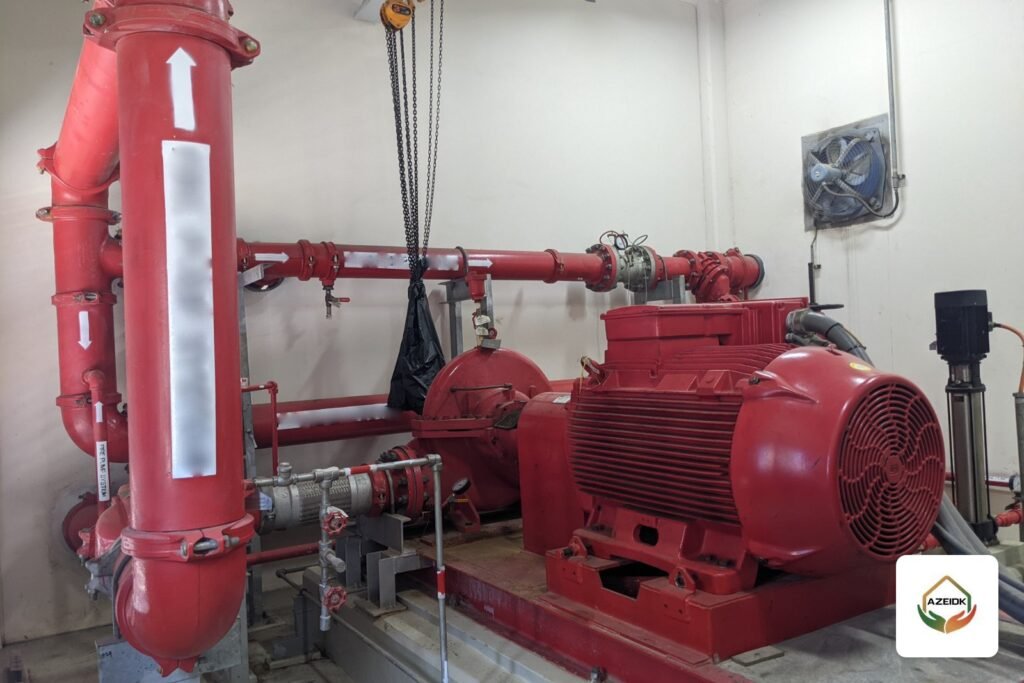
Must a villa or apartment building have sprinklers? It depends on occupancy, height and area, and a high-rise needs sprinklers throughout, as our article on when sprinklers are mandatory under SBC 801 explains. When the design calls for a water-based network, it brings fire hose cabinets, valves, the fire department connection, water storage and a fire pump room.
Fire extinguishers
Extinguishers appear in most residential designs, with the type matched to the hazard: dry powder for general use, CO2 near electrical panels and a wet chemical unit for cooking oils in kitchens. For a first estimate of quantity and spacing, use the fire extinguisher calculator, then have the designer review it.
Emergency lighting and exits
In apartment buildings and compounds the stair and shared corridors are often the only escape route, so emergency lighting that works on power failure and clear exit signs are needed, with fire-rated doors where the design places them. See the emergency lighting and exit signs guide for the equipment.
CCTV
The Law on the Use of Security Surveillance Cameras was issued by Royal Decree No. M/34, and its Executive Regulation was published in June 2023. It bans enabling audio recording without approval from the General Directorate of Public Security, requires recordings to be kept for the period set in the conditions document or until investigation procedures end, whichever is longer, and requires a privacy mask on outdoor rooftop cameras whose coverage extends beyond the site, building or residential block boundary. The owner confirms the required period for their activity with the competent authority, and AZEIDK sizes recorder storage for that period. To size storage for your camera count and retention period, use the CCTV storage calculator.
Access control and gates
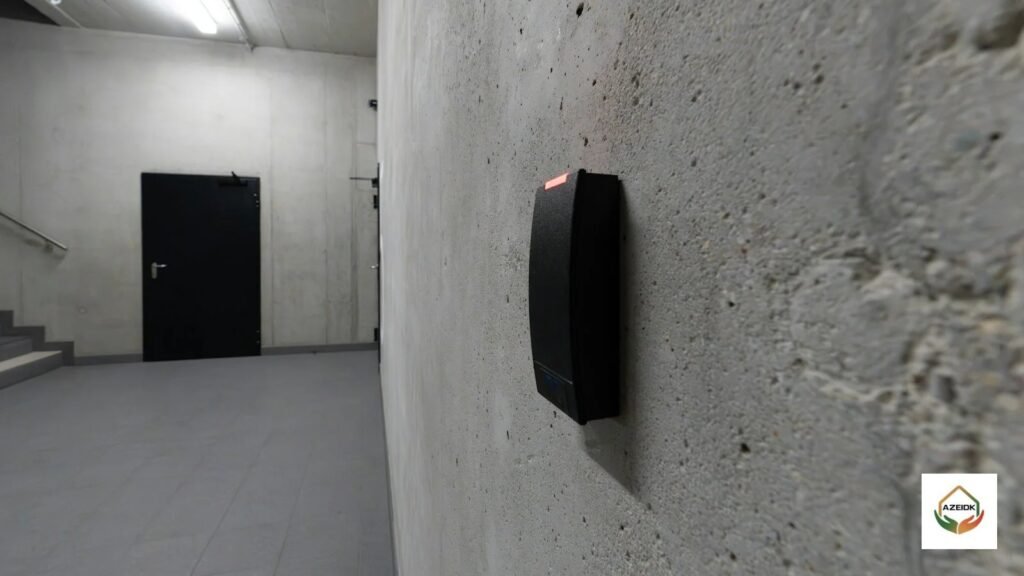
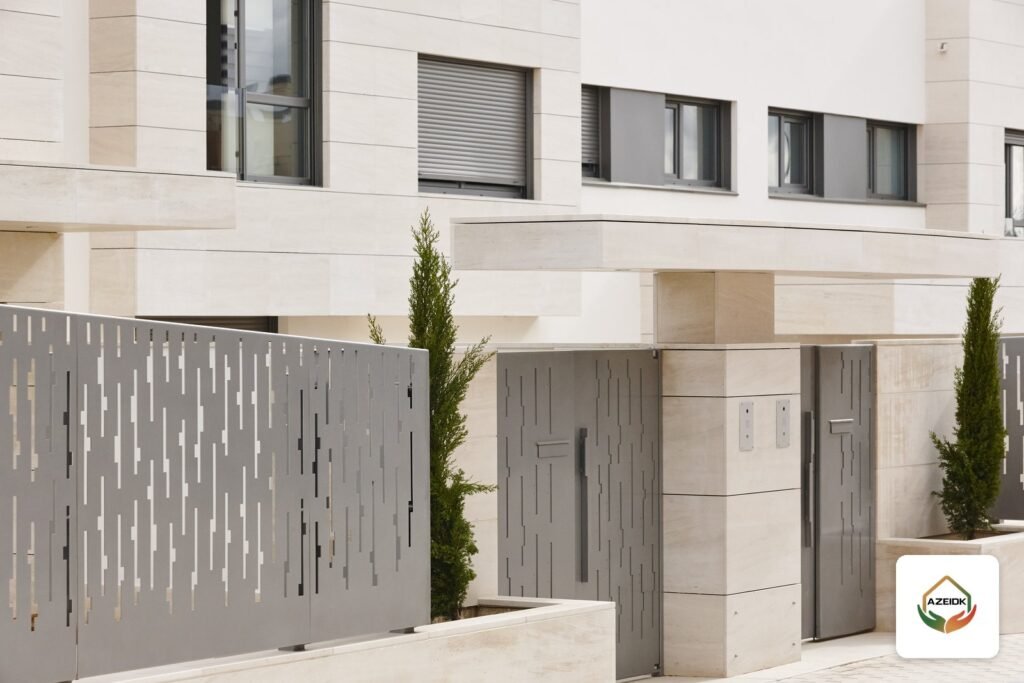
In a compound, safety starts at the gate: parking barriers, pedestrian gates, licence plate recognition and separate rights for residents, visitors, domestic staff and deliveries. In an apartment building a card or face reader at the main entrance is usually enough. The basic design rule: every electronic door or gate on an escape route is tied to the fire alarm so it releases on alarm.
Intercom
A villa intercom is a door station and an indoor monitor. A building intercom uses a door station with buttons or a keypad serving every flat. In a compound the intercom becomes an IP network linking the gate, the security room and each unit.
Intrusion alarm
For villas and units left empty for long periods, motion and door contacts with a wireless alarm panel add something cameras alone do not: an instant phone alert the moment someone breaks in.
Civil Defense and Salamah steps for residential buildings
The official path has two stages that should not be confused:
- Design: the building is designed to the Saudi Building Code (SBC 201 and SBC 801), with fire system drawings in the project file. This is where sprinklers, alarm type and the number of exits are decided. See our SBC 801 fire protection code guide.
- Operation and licensing: the Salamah platform of the General Directorate of Civil Defense is the channel for safety licensing of facilities and activities. The owner or investor registers and uses the “investor journey” service to see the activity’s classification and whether it is licensed directly or after inspection.
- Documents: for direct activities, a safety equipment invoice from a qualified safety company or a technical report from an engineering office approved on the platform is uploaded. For indirect activities, the safety company completes requirements, installation and the maintenance contract, then Civil Defense inspects before issuing.
- Findings and renewal: inspection findings are corrected and the application resubmitted. The licence has a validity period and is renewed on the platform before it expires; keeping the systems under a maintenance contract keeps the facility ready for any inspection.
Does your property need a Salamah licence? An owner-occupied villa is not the same as a building let for rent, a compound with facilities and commercial activity, or furnished apartments. The classification on the platform decides. We do not quote fees here; check the platform for any fees or periods that apply to your activity. Before the inspection, use the Salamah inspection checklist, and read the Salamah certificate guide for the platform details.
What AZEIDK provides for residential projects
We work on this sector from design to maintenance, keeping fire and security responsibilities separate and their operation connected:
- Fire alarm: addressable and conventional panels, detectors and accessories from Context Plus, under our fire alarm solutions.
- Fire fighting: TYCO and Victaulic sprinklers, American Fire Control valves, fire pumps and Falcon Gold fire hose cabinets, under our fire fighting solutions.
- Fire extinguishers: Falcon Gold types, with extinguisher maintenance and refilling by our maintenance team.
- Emergency exits and fire doors: under our fire-rated doors and emergency exit solutions.
- Security and surveillance: Hikvision, Dahua and EZVIZ cameras; intercom and access control from Hikvision, Dahua and ZKTeco; BFT parking barriers; intrusion alarm from Ajax and Hikvision, under our security and surveillance solutions.
- Services: engineering design and calculations, supply and installation, testing and commissioning, Civil Defense approval support including the Salamah technical report, and maintenance contracts.
AZEIDK holds ISO 9001, ISO 14001 and ISO 45001 certificates covering the design, supply, installation and maintenance of fire, surveillance and low current systems. The full sector view is on the residential developments page.
Detailed articles by need
- Residential compound security systems: planning gates, cameras, intercom and the security room as one system.
- Intercom for villas and buildings: the types and how to choose the door station and monitor.
- Intercom installation cost factors: what moves the price before you ask for a quote.
- Fire alarm for villas and small residential buildings: interconnected alarms or a panel, and where to install.
- Fire safety in residential towers: high-rise requirements and phased evacuation.
- Ajax intrusion alarm design for villas and shops: sensor layout and scenarios.
- Fire systems maintenance contract for residential buildings: what the contract covers and how to compare offers.
Free tools before the site visit
The AZEIDK tools page has three tools for this sector: the fire extinguisher calculator for a first quantity estimate, the CCTV storage calculator to pick disk capacity for your retention period, and the Salamah inspection checklist to review readiness before a Civil Defense visit. Results are estimates; the final figures depend on the design and inspection.
Common mistakes on residential projects
- Cameras and gates from one contractor, fire alarm from another, with no interface, so gates stay locked during an alarm.
- Home smoke alarms bought for a multi-flat building whose design calls for a central panel.
- Skipping stair emergency lighting because the building is small.
- Rooftop cameras looking into neighbours’ homes without masking, contrary to the Regulation.
- Handing over a compound without admin passwords, as-built drawings and a maintenance contract, which later stalls renewal.
Frequently asked questions
What is the Saudi Residential Building Code?
It is the code numbered SBC 1101 and SBC 1102 within the Saudi Building Code, covering R3 residential buildings such as villas. The ministry’s residential requirements refer to it for the structural, electrical and mechanical work in villas.
Is the residential code enough for fire requirements in a villa?
No. The residential building requirements make SBC 801 binding for fire prevention and protection work and require a Civil Defense approved designer for it.
What safety systems does a villa need in Saudi Arabia?
The baseline is smoke detection and audible alarm around bedrooms, plus extinguishers in the kitchen and corridors. Anything more, such as a panel or sprinklers, is set by the villa’s classification and approved design.
Do apartment buildings need sprinklers?
It depends on occupancy, height and area under SBC 801. High-rise buildings need sprinklers throughout; for low-rise buildings the approved design decides.
Does a villa need a Salamah licence from Civil Defense?
The activity’s classification on Salamah decides. A private villa differs from a rented building, furnished apartments or a compound with commercial activity, so start with the platform’s investor journey service.
How long must compound CCTV recordings be kept?
The Regulation requires keeping them for the period set in the conditions document or until investigation procedures end, whichever is longer. Confirm the period for your facility with the competent authority, then size storage with the calculator.
Can building or compound cameras record audio?
No, not without approval from the General Directorate of Public Security under the Executive Regulation.
Must electronic gates and doors be linked to the fire alarm?
Yes, sound design requires this for any electronically locked door on an escape route, so it releases automatically on alarm and does not trap residents.
Who issues the technical report Salamah asks for?
An engineering or technical office approved on the platform, after inspecting the facility. AZEIDK issues this report as part of its Civil Defense approval support.
Summary
Start from the property type: private villa, apartment building or compound. Let the design to the Saudi Building Code set the fire systems, connect the security layer to them rather than run it apart, check the licence position on Salamah, and tie it all to a maintenance contract that keeps the systems ready for inspection and renewal.
Planning a villa, building or compound? Send us the architectural plan with the number of units and floors, and we will define the fire and security systems and the Civil Defense path with you. Contact the AZEIDK team
Related guides
- Fire Alarm Maintenance: Periodic Inspection and Testing Under NFPA 72 and SBC 801
- Evacuation Plans for Facilities in Saudi Arabia: Preparing a Fire Evacuation Plan and Evacuation Plan Board for Civil Defense
- 3PUMP Fire Pump Packages (Electric + Diesel + Jockey): Models from 500 to 1500 GPM, What Non-Listed Means and When to Ask for UL/FM
- FM200 Calculation for a Room: Formula, Design Concentration, Temperature Factor and Cylinder Size