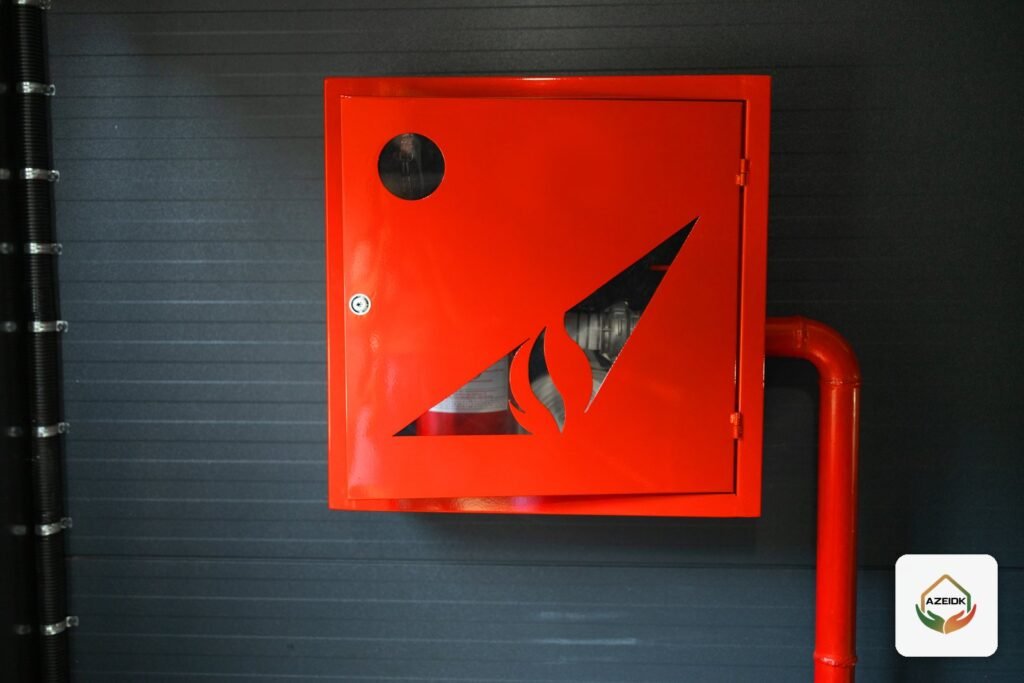
Fire system maintenance for apartment buildings and residential compounds is the responsibility of the owner, or of the owners association when the flats are individually owned. A good contract lists the systems actually installed (fire alarm, sprinklers, fire pumps, extinguishers, hose cabinets and CCTV), sets visits based on each system’s standard, states who pays, and defines how a technician is called out in an emergency.
This guide is written for building owners, property managers and owners associations: what differs from a commercial facility, which recurring problems the contract must address, and how the cost is shared between units. For the scope of AZEIDK solutions for residential projects, see Residential Developments.
Key takeaways
- Where a jointly owned property has three or more owners of separated units, the Real Estate Units Ownership, Division and Management Law requires them to form an owners association, whose funds are spent on managing the property and maintaining common parts.
- Fire systems in corridors, stairs, the pump room and the roof are in practice common parts, so their maintenance contract belongs in the association budget.
- The General Directorate of Civil Defense follows fire protection requirements during maintenance and operation, under the Implementing Regulations of the Saudi Building Code Implementation Law.
- Visit frequencies come from each system’s standard (NFPA 25 for sprinklers and pumps, NFPA 72 for alarms, NFPA 10 for extinguishers), not from a fixed number.
- Most problems in apartment buildings come from daily use: covered detectors, blocked hose cabinets and pump rooms turned into storage.
In this article
- Who is responsible for fire system maintenance in an apartment building?
- Which systems does a building maintenance contract usually cover?
- What problems recur in apartment building fire system maintenance?
- How is the maintenance cost shared between flat owners?
- Which clauses does a residential maintenance contract need?
- Does a residential building need a Salamah licence?
- Should CCTV and intercom be added to the same contract?
- What does AZEIDK offer building owners and associations?
- FAQ
- Conclusion
Who is responsible for fire system maintenance in an apartment building?
If one owner holds the whole building and rents out the flats, that owner decides and signs the contract. If the flats were sold as separate units, the relationship is governed by the Real Estate Units Ownership, Division and Management Law, issued by Royal Decree No. M/85 dated 2/7/1441H and published by the Real Estate General Authority (REGA). Article 12 states that once a jointly owned property has three or more owners of separated units, they must form an owners association to manage the property and register it with the Authority.
The law also sets the path for decisions and money. A manager, who may or may not be an owner, runs the property (Article 19). The manager prepares an annual budget covering management and common-part maintenance, approved by the general assembly (Article 20). Association funds are spent on managing the property and maintaining common parts (Article 24), and each owner must maintain their own unit (Article 27).
On the safety side, the Implementing Regulations of the Saudi Building Code Implementation Law give Civil Defense the role of following fire protection requirements through construction, maintenance and operation. The technical reference is the Saudi Fire Protection Code SBC 801, with NFPA standards used as technical references for inspection and testing where the designer or project documents adopt them.
Which systems does a building maintenance contract usually cover?
It depends on height and design. A small block may have only extinguishers and a conventional alarm; a residential tower usually has sprinklers, standpipes, fire pumps and an addressable alarm. Start the contract with a site inventory, not a template. For tower-specific requirements, see Fire Safety in High-Rise Residential Buildings.
| System | Where it is in the building | Examples of periodic work and frequency | Reference |
|---|---|---|---|
| Fire alarm (panel, detectors, call points, sounders) | Entrance, corridors, stairs, plant rooms, sometimes inside flats | Visual inspection of most devices every six months; annual functional test of detectors, call points and notification appliances; semiannual battery tests (charger, voltage and ohmic) with replacement or load testing every three years | NFPA 72, Chapter 14 |
| Sprinklers and piping | Basement parking and corridors; inside units in towers | Annual visual inspection of sprinklers and pipework | NFPA 25 |
| Control valves | Pump room, riser bases and floors | Position check weekly, monthly or quarterly depending on locking and supervision; annual operation | NFPA 25 |
| Fire pumps (electric, diesel, jockey) | Pump room next to the tank | No-flow run weekly for diesel and weekly or monthly for electric as the standard allows; annual flow performance test | NFPA 25 |
| Hose cabinets, standpipes, fire department connection | Stairs, corridors, facade | Quarterly inspection of the fire department connection; standpipe flow test every five years | NFPA 25 |
| Fire extinguishers | Corridors, entrance, electrical and generator rooms | Monthly inspection, annual maintenance, hydrostatic test every 5 or 12 years by type | NFPA 10 |
| CCTV and intercom | Entrances, parking, lifts | Per manufacturer instructions and the contract | Manufacturer O&M manual |
These are minimums, to which manufacturer and authority requirements are added. If the building has no handover documents or as-built drawings, ask for an assessment of the existing systems before pricing.
What problems recur in apartment building fire system maintenance?
A factory or mall has a daily safety officer. In an apartment building, responsibility is spread between residents, the caretaker and the manager, so certain problems recur and should be written into the contract:
- Covered or removed detectors: residents cover a smoke detector while cooking or painting, or remove it after a false alarm. The contract should require every missing or faulty device to be logged in the visit report, and the association should circulate a notice to residents.
- Blocked hose cabinets: cabinets are locked, used for storage or have the hose removed. The technician should check and photograph them on every visit.
- Neglected pump room: it becomes a store, the controller is left in manual, or suction valves are closed after plumbing work. This is the most critical point because it disables sprinklers and hose cabinets together. Each visit should confirm the controller is in automatic and the valves are open.
- Expired or missing extinguishers: agree a numbered inventory showing each location and service date.
- Stair doors held open: where stair doors are fire-rated by design, wedging them open defeats their smoke-containment role. Add them to the visit checklist.
- Access to flats: where detectors or sprinklers are inside units, agree in advance how residents are notified, the access times, and how units that could not be tested are recorded.
- Resident alterations: a new false ceiling or partition can block a sprinkler or detector. The contract should require the technician to report any change that affects coverage.
How is the maintenance cost shared between flat owners?
Article 26 of the law states that each owner contributes to common-part maintenance and management costs in proportion to the area of their unit against the total area of separated units, with different shares possible in mixed-use properties. Article 24 requires each owner to pay their contribution. In practice:
- Make the fire system contract a separate line in the annual budget prepared by the manager and approved by the general assembly.
- Separate the fixed amount (scheduled visits) from variable amounts (parts and repairs) so each unit’s share is clear.
- Agree a spending limit the manager can approve for urgent repairs without waiting for a meeting.
- Decide who maintains devices inside flats. The law makes owners responsible for their own units, so state the position explicitly in the contract and the association resolution.
For choosing between a comprehensive and non-comprehensive contract, see Comprehensive vs Non-Comprehensive Fire Maintenance Contracts. Older buildings with worn systems are often better served by a non-comprehensive contract with a repair cap; in new compounds, a comprehensive contract makes the annual contribution easier to fix.
Which clauses does a residential maintenance contract need?
Contracting party and signing authority
Name the association or owner, who signs on its behalf (the manager) and the general assembly resolution. Attach the system and quantity schedule from the site survey.
Visit schedule and reports
A schedule linking each activity to its frequency and standard, and a written report after each visit, delivered to the manager and kept in the building file, with photos, repairs done and items awaiting approval.
Emergency response
NFPA 25 does not set a technician arrival time, so the contract should set a 24-hour emergency number, response times by priority (continuous alarm, water leak, pump failure), who informs residents when a system is impaired, and the interim measures during the impairment.
The building file
Records, reports and drawings should belong to the association, not the contractor, so the maintenance history survives a change of manager or company. For how to evaluate and switch providers, see Fire Maintenance Companies in Riyadh.
Does a residential building need a Salamah licence?
In the sources we reviewed, the Civil Defense licence issued through the Salamah platform relates to commercial facilities and activities, and we found no provision addressed to the residential building itself. Ground-floor shops or offices each hold their own licence and may be asked for a maintenance contract depending on their activity’s risk level. Maintaining the building’s own systems remains necessary, because Civil Defense follows maintenance and operation. Confirm current requirements with Civil Defense or on the platform before relying on any general rule.
Should CCTV and intercom be added to the same contract?
In compounds, one contract covering fire and security systems is usually easier to manage, provided each system has its own scope. For CCTV: recording integrity, retention, hard disk health and night image quality; see CCTV and Security Systems Maintenance. For intercom and access control: lock operation and, where the project is designed to release locks on fire alarm, testing that interface during the annual alarm test. AZEIDK Saudi supplies Hikvision and Dahua cameras and Hikvision, Dahua and ZKTeco intercoms.
What does AZEIDK offer building owners and associations?
AZEIDK provides preventive and periodic maintenance for fire alarm and firefighting systems, fire pumps, extinguishers and hose cabinets, plus CCTV and low-current systems, with a report after each visit. Work normally starts with a site survey and system inventory, followed by a proposed visit schedule and pricing that separates fixed and variable costs. AZEIDK holds ISO 9001, ISO 14001 and ISO 45001 certificates with a scope covering the design, supply, installation and maintenance of fire, alarm and surveillance systems. Available products include Falcon Gold extinguishers and hose cabinets, Context Plus alarm panels and Jack Pump and 3PUMP fire pumps; the datasheet for any replacement product can be requested before approval.
FAQ
Who signs the fire maintenance contract in a building with several owners?
The owners association through its manager, after the general assembly approves the cost in the annual budget, under the Real Estate Units Ownership, Division and Management Law.
How many visits per year does a building need?
There is no fixed number. The schedule follows each system: pumps and valves need weekly or monthly attention, alarms semiannual and annual work, extinguishers monthly and annual checks.
How is each flat’s share of the cost calculated?
By the unit’s area as a share of the total area of separated units, unless shares differ in a mixed-use property, as Article 26 of the law states.
Is a smoke detector inside a flat the owner’s or the association’s responsibility?
The contract and association resolution decide. If it is part of the building system connected to the panel, it is clearest to include it in the association contract with an agreed access procedure.
What should we do if the system fails at night?
Call the emergency number in the contract and do not silence the panel or stop the pump without the technician’s guidance. The contract should set response times and who informs residents.
Conclusion
Fire system maintenance for apartment buildings uses the same standards as any other building, but the management is different: a collective decision, a budget shared between units, and residents who affect system readiness every day. A contract that lists the systems, ties visits to standards, and states who pays and who informs residents protects occupants and keeps the building file complete for any inspection.
Managing an apartment building or compound? Send us the number of floors, the installed systems and the last maintenance report if you have one, and we will arrange a survey and a proposed visit schedule that fits the association budget. Talk to the AZEIDK team