An FM200 calculation for a room uses the total flooding equation in NFPA 2001: agent weight in kilograms equals the net volume divided by the agent’s specific vapour volume, multiplied by the design concentration over (100 minus the concentration). The specific volume depends on the lowest expected room temperature, the result is corrected for altitude, and the cylinder is chosen so the weight sits inside the manufacturer’s fill limits.
Below is each step with one illustrative worked example. The final design is prepared by a qualified designer with the listed system’s own software, which is what the AZEIDK engineering design and calculations team does for Context Plus HFC-227ea systems.
Key takeaways
- Equation: W = (V / S) × (C / (100 − C)), with specific volume S = k1 + k2 × T. For HFC-227ea, k1 = 0.1269 and k2 = 0.000513 (m³/kg, T in °C).
- Use the lowest expected temperature to size the agent, then check the actual concentration at the highest temperature against exposure limits.
- Design concentration comes from the listed system’s manual and the adopted edition of the standard.
- Altitude reduces the agent quantity. The Fike manual, for example, gives factors of 0.89 at 1,000 m and 0.78 at 2,000 m.
- Cylinder size comes from the manufacturer’s fill table. Context Plus cylinders, for example, are filled between 30 and 70 lb/ft³.
In this article
- What is the FM200 calculation formula in NFPA 2001?
- How do you work out the net room volume?
- Design concentration: where does the percentage come from?
- Temperature factor: why use the lowest temperature?
- Altitude correction
- Worked example (illustrative only)
- How to size an FM200 cylinder within fill limits
- FM200 calculation software: what the hand formula does not cover
- Common mistakes in agent quantity calculations
- Frequently asked questions
- Summary
What is the FM200 calculation formula in NFPA 2001?
FM-200 is a trade name for HFC-227ea (heptafluoropropane). Design manuals size the agent with the equation below, which is the same in NFPA 2001 and in the international standard ISO 14520:
W = (V / S) × (C / (100 − C))
- W: required agent weight, kg.
- V: net hazard volume, m³.
- C: design concentration, % by volume.
- S: specific vapour volume of the agent at the design temperature, m³/kg.
The C / (100 − C) term explains why the quantity climbs quickly with concentration. Raising the concentration from 7% to 9% increases the weight by about 31%, not just 29%, because part of the room air is pushed out as the agent discharges.
How do you work out the net room volume?
Take net volume from the drawings and confirm on site:
- Gross volume: length × width × height, from the structural slab or the raised floor surface to the ceiling, depending on where the protected space is bounded.
- Protected voids: if the designer protects the raised floor void or the ceiling void, their volume is added and they get their own nozzle layout.
- Deductions: the Fike manual allows deduction only for solid, non-permeable, non-removable objects such as concrete columns. Racks, cabinets and movable equipment are not deducted.
- Additions: volume that stays open to the room, such as undampered ductwork or openings that cannot be closed, is added to the protected volume.
The calculation is always completed by a room integrity test.
Design concentration: where does the percentage come from?
Design concentration starts from the minimum extinguishing concentration proven by test for the fuel, multiplied by a safety factor for the fire class. Since the 2012 edition of NFPA 2001 (Section 5.4.2.5, per an SFPE bulletin), the minimum design concentration for Class C (energized electrical) hazards is the minimum extinguishing concentration × a 1.35 safety factor instead of 1.2, and Class A may not be lower than the heptane extinguishing concentration. Figures therefore differ between references and editions:
| Reference | Class A (solids) | Class B (heptane) | Notes |
|---|---|---|---|
| Fike HFC-227ea manual (Rev. 3, Dec 2015) | 6.25% (Class A and C per NFPA 2001) | 8.7% | A 2015 manual value; not sufficient on its own for a Class C design under the current edition |
| ISO 14520-9:2019 | 7.9% | 9.0% | 8.5% for higher hazard Class A |
| Exposure limits (ISO 14520-9:2019) | NOAEL = 9.0%, LOAEL = 10.5% | The actual concentration in occupied spaces is checked against these | |
Server and electrical rooms are Class C hazards, and a design to the current NFPA 2001 applies the 1.35 factor, so do not carry 6.25% over without checking the system’s current listed manual. The practical rule: take the concentration from the design manual of the listed system being installed, under the edition named in the project specification. NFPA 2001 is a technical reference adopted by the designer and consultant; approval in Saudi Arabia goes through Civil Defense under the Saudi Fire Protection Code SBC 801.
Temperature factor: why use the lowest temperature?
Specific volume rises with temperature: S = k1 + k2 × T. The Fike manual and ISO 14520-9:2019 give k1 = 0.1269 and k2 = 0.000513 for HFC-227ea. At 16°C, S is about 0.1351 m³/kg; at 30°C, about 0.1423 m³/kg.
The lower the temperature, the smaller S and the more agent is needed, so the Fike manual bases the quantity on the lowest expected ambient temperature. The same manual asks for the expected concentration at the maximum temperature, as a necessary step to evaluate exposure and egress time limits. In air-conditioned server rooms, set both limits with the HVAC engineer rather than by estimate.
The table below is calculated with the same equation and gives kilograms of agent per cubic metre before altitude correction. It is illustrative only:
| Concentration | At 16°C | At 21°C | At 30°C |
|---|---|---|---|
| 6.25% | 0.493 kg/m³ | 0.484 kg/m³ | 0.469 kg/m³ |
| 7.0% | 0.557 kg/m³ | 0.547 kg/m³ | 0.529 kg/m³ |
| 7.9% | 0.635 kg/m³ | 0.623 kg/m³ | 0.603 kg/m³ |
| 9.0% | 0.732 kg/m³ | 0.718 kg/m³ | 0.695 kg/m³ |
Altitude correction
At altitude the agent expands more, so less weight reaches the same concentration. The Fike manual lists these correction factors:
| Altitude (m) | 0 | 1,000 | 1,500 | 2,000 | 2,500 | 3,000 |
|---|---|---|---|---|---|---|
| Correction factor | 1.00 | 0.89 | 0.82 | 0.78 | 0.72 | 0.70 |
Coastal sites such as Jeddah and Dammam are close to 1.00. For elevated sites, take the elevation from site data and the factor from the listed system’s own table.
Worked example (illustrative only)
Assumed figures, not for construction or submittals:
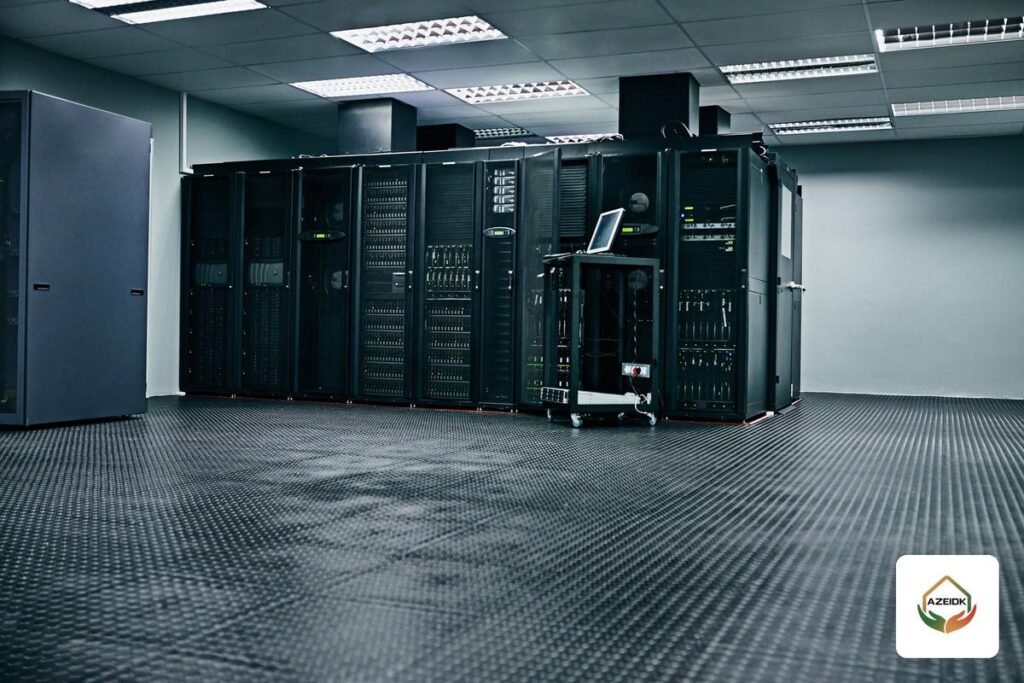
- Volume: server room 6 × 5 × 3 m = 90 m³, no protected voids, nothing deductible.
- Concentration: 7.0% (assumed for this example).
- Lowest temperature: 16°C, so S = 0.1269 + 0.000513 × 16 = 0.1351 m³/kg.
- Weight: W = (90 / 0.1351) × (7 / 93) = 666.1 × 0.0753 ≈ 50.1 kg.
- Altitude: at sea level it stays 50.1 kg. At 1,000 m it would be 50.1 × 0.89 ≈ 44.6 kg.
- Check at maximum temperature: assuming 30°C and a 50.2 kg fill, the actual concentration is about 7.35%, below the 9.0% NOAEL.
The check uses C = 100 × W × S / (V + W × S), and matters most after rounding up to a larger cylinder.
How to size an FM200 cylinder within fill limits
Once the weight is known, choose the clean agent cylinder whose fill range contains it. The Context Plus HFC-227ea systems datasheet sets maximum fill at 70 lb/ft³ (about 1,121 kg/m³) and minimum fill at 30 lb/ft³ (about 481 kg/m³), with 360 psi operating pressure at 21.1°C and a 0 to 54.4°C temperature range. Other references differ (Fike: 481 to 1,080 kg/m³; ISO 14520-9:2019: 1,150 kg/m³ maximum at 25 bar). The governing value is the manufacturer’s figure for the listed cylinder.
| Context Plus model | Max fill | Min fill | Valve size |
|---|---|---|---|
| CP90035-E | 35 lb (15.9 kg) | 16 lb (7.3 kg) | 1 in |
| CP90070-E | 71 lb (32.2 kg) | 31 lb (14.1 kg) | 1 in |
| CP90150-E | 152 lb (68.9 kg) | 69 lb (31.3 kg) | 1-1/2 in |
| CP90250-E | 253 lb (114.8 kg) | 109 lb (49.4 kg) | 1-1/2 in |
| CP90375-E | 379 lb (171.9 kg) | 163 lb (73.9 kg) | 2-1/2 in |
| CP90560-E | 561 lb (254.5 kg) | 241 lb (109.3 kg) | 2-1/2 in |
| CP901200-E | 1,211 lb (549.3 kg) | 519 lb (235.4 kg) | 4 in |
In the example, 50.1 kg sits within the CP90150-E range and exceeds the CP90070-E maximum. One large cylinder versus several on a manifold is covered in FM200 system price in Saudi Arabia. The same fill weight is what the cylinder goes back to during an FM200 recharge after discharge.
FM200 calculation software: what the hand formula does not cover
The equation gives only the total agent weight. Engineered systems need a two-phase pipe flow calculation, done with the manufacturer’s listed software. Context Plus states that its software covers flow, piping and nozzle details, unbalanced designs and ceiling and floor voids. It typically works out:
- Discharge time: NFPA 2001 limits halocarbon discharge to about 10 seconds unless the AHJ requires otherwise, measured as the time to discharge 95% of the agent mass needed for the minimum design concentration. The Fike manual sets 6 to 10 seconds.
- Pipe sizes, nozzle orifice sizes and agent split between the room and voids.
Pressure relief venting, hold time and the release sequence also sit outside the equation; see the NFPA 2001 guide. A Novec 1230 design calculation follows the same form but with its own FK-5-1-12 constants from that system’s manual, so HFC-227ea constants never carry over.
Common mistakes in agent quantity calculations
- Using the HVAC design temperature (such as 21°C) instead of the lowest expected temperature, which undersizes the agent.
- Copying a concentration from another project or an older edition without checking the listed system’s manual.
- Skipping the maximum temperature check after rounding up to a larger cylinder.
- Choosing a cylinder whose fill range does not contain the weight, or confusing nominal cylinder size with agent fill weight.
Frequently asked questions
How is an FM200 calculation done, in short?
Net volume, concentration from the listed manual, S at the lowest temperature, W = (V / S) × (C / (100 − C)), then the altitude factor.
How many kg of FM200 per cubic metre?
It depends on concentration and temperature. At 7% and 16°C it is about 0.557 kg/m³ before altitude correction; at 9% about 0.732 kg/m³. These are illustrative figures, not design values.
How do you size an FM200 cylinder?
Pick the cylinder whose fill range brackets the calculated weight, or split it across equal cylinders on a manifold.
Is free FM200 calculation software from the internet enough?
Not for construction. Flow and nozzle calculations must use the software listed with that system.
Can the concentration be raised as a safety margin?
In occupied spaces the concentration at the highest temperature must stay within exposure limits, so extra agent is not a free margin.
Summary
An FM200 agent calculation is a chain: correct net volume, concentration from the listed system’s manual, specific volume at the lowest temperature, altitude correction, then a cylinder within fill limits and a concentration check at the highest temperature. The hand equation helps check quotations; the design that is built is done with the listed software.
Have a server room or electrical room that needs an FM200 calculation? Send us the drawings, room dimensions, protected voids and site location, and we will prepare the calculation and select suitable Context Plus cylinders. Talk to the AZEIDK team
Related guides
- Network Switch Types: Unmanaged, Managed, PoE and Layer 3, and How to Size Ports and Speed
- UL, FM and LPCB Certification for Fire Protection Equipment: A Verification Guide
- Flame Detectors (UV / IR / IR3) in Industrial Facilities
- Fire Protection Systems in Saudi Hospitals: Risks and Technical Solutions