Residential compound security systems in Saudi Arabia are often built in pieces: one contractor for CCTV, another for barriers, a third for villa intercoms. After handover the guard runs three programs and visitors enter with no record. This article explains how gates, intercoms, cameras and access control fit into one compound design, from the perimeter wall to the villa door. For our full scope on residential projects, see Residential Developments and Real Estate.
The short answer: split the compound into layers (perimeter, main gate, roads and amenities, unit entrances), define what each user group may access, then choose devices that share one network and one security room.
For the full picture of the fire and security systems compounds, villas and residential buildings need and the Civil Defense requirements that apply, see our safety systems guide for compounds, villas and residential buildings.
Key takeaways
- A compound has several security layers, all managed from one place.
- User groups, not the number of doors, drive the access control design.
- The main gate combines barriers, licence plate recognition (LPR), visitor intercom, guard house and cameras.
- Gates and electric locks must not block evacuation. Their release is coordinated with the fire alarm system per the approved drawings.
- Handover needs a documented permission list and a maintenance plan, not just passwords.
In this article
- Why is compound security different from securing one building?
- Layers of residential compound security systems: from the wall to the villa door
- Who enters the compound? Residents, visitors, domestic staff and deliveries
- The main gate: parking barriers, plate recognition and turnstiles
- Intercom: from the villa door to the guard house and the phone
- CCTV in a compound: camera locations and what Saudi law regulates
- One design: network, security room and a unified platform
- Evacuation and fire alarm: gates must not trap anyone
- Delivery sequence with the developer and handover to the owners’ association
- Common mistakes in compound security
- What AZEIDK supplies for compound projects
- Frequently asked questions
- Conclusion
Why is compound security different from securing one building?
An apartment building has one entrance and one intercom. A compound has a long wall, vehicle and pedestrian gates, internal roads, amenities and dozens of villas or several buildings, each with its own entrance.
Three things differ. Users are many and varied: residents daily, domestic workers with limited access, visitors once. Distances can exceed copper cable limits, so fibre or intermediate switches are needed. And after handover a small management or owners’ association team must run everything from one room.
Layers of residential compound security systems: from the wall to the villa door
The easiest way to design residential compound security systems is to work from the outside in, with each layer answering its own question: who reached the wall, who came through the gate, and who may enter this building.
| Layer | Typical systems | Design decisions |
|---|---|---|
| Perimeter (wall) | CCTV along the wall, intrusion alarm where needed | Camera spacing, night lighting, who receives alarms |
| Main gate | Parking barriers, plate recognition camera, visitor intercom, pedestrian gate or turnstile, guard house | Number of lanes, separating resident and visitor lanes, how visitors are logged |
| Roads and amenities | Cameras at junctions and shared parking, access control for clubhouse, pool and gym | Amenity opening hours and who may use them |
| Villa or building entrance | Video intercom (outdoor door station and indoor monitor), card or face reader at building entrances | Link to the guard house and mobile app, permissions per unit |
| Security room | Recorder, management software, display screens, guard master station | One platform or several, recording retention, backup |
Who enters the compound? Residents, visitors, domestic staff and deliveries
Before choosing any device, list each user group and what it may access. This list is what gets programmed later, and missing it causes most post-commissioning problems.
| Group | Suggested credential | Access limits |
|---|---|---|
| Resident and car | Plate recognition or card, face recognition at the pedestrian gate | Permanent for the tenancy, revoked on move-out |
| Domestic worker and driver | Card or face linked to a unit | Pedestrian gate and their unit only, with set hours if the resident wants |
| Visitor | Intercom call from the gate to the resident, or a temporary code depending on the device | One visit or a short period, with entry time logged |
| Delivery | Logged by the guard or via intercom | Collection point at the gate, kept off internal roads where possible |
| Maintenance contractors | Temporary card issued by the management office | Contract days, hours and work areas only |
Credential choice is covered in our guide to access gates for people and vehicles. A resident should use the same credential everywhere.
The main gate: parking barriers, plate recognition and turnstiles
The main gate takes the largest share of the budget. A common layout has at least two vehicle lanes: a resident lane that opens on plate or card, and a visitor lane past the guard window.
Parking barriers (boom gates)
A barrier is selected by lane width and duty. Options available from AZEIDK include the Hikvision DS-TMG520 straight boom and DS-TMG423-B fence boom, and BFT barriers such as MOOVI for driveways up to 6 m and MICHELANGELO for driveways up to 8 m.
Licence plate recognition (LPR / ANPR)
A plate recognition camera opens the barrier for registered residents’ plates. The Hikvision DS-TMC407-EH combines an ANPR capture unit and a fence boom in one unit. Read accuracy depends on mounting angle, lighting and approach speed, as explained in our article on the licence plate recognition camera for car park entrances.
Pedestrian gate
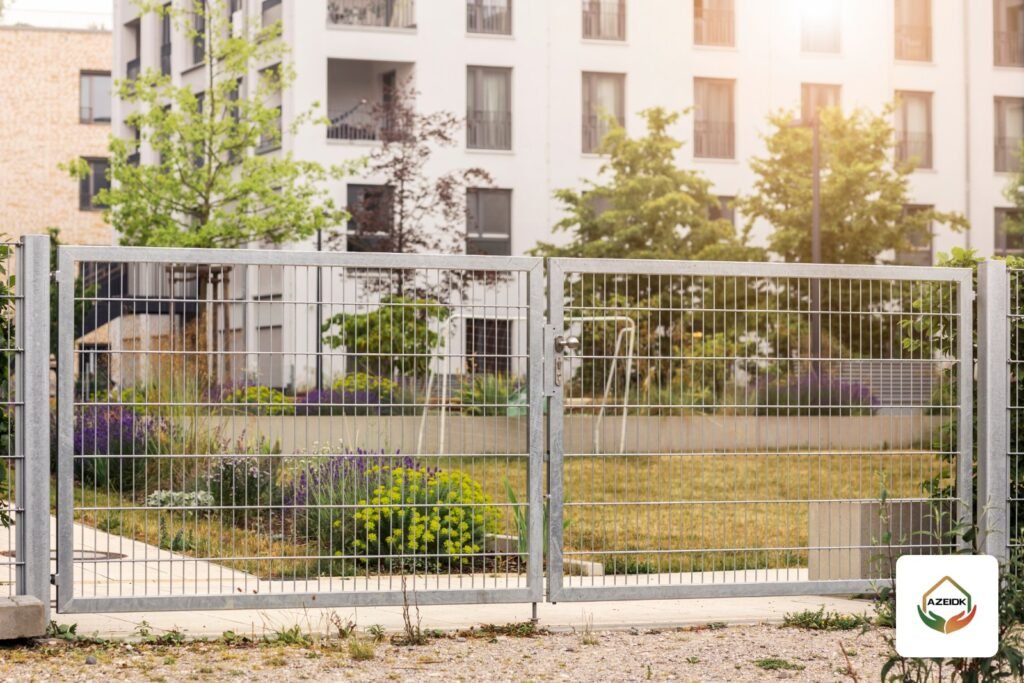
Add a pedestrian gate with a card or face reader, or a turnstile for heavy foot traffic, plus a side door for wheelchairs and bulky items.
Intercom: from the villa door to the guard house and the phone
In a compound the guard must be able to call a resident from the gate, the resident must be able to call the guard, and residents should be able to open for a visitor from their phone. That needs an IP intercom on the compound network with a master station in the security room.
Available units include the Dahua VTO3311Q-WP villa door station (network and Wi-Fi), the Dahua VTO9541D-S3 for building entrances, which supports face, card, fingerprint and password verification, the Hikvision DS-KD8005-IME1 modular door station, and the Hikvision DS-KIS604-S(B) kit. Intercom types and mobile apps are covered in our guide to intercoms for villas and apartment buildings, so we do not repeat them here.
Intercom and access control should be compatible, so visitor images and door logs appear where the guard watches the cameras.
CCTV in a compound: camera locations and what Saudi law regulates
Camera layout follows the same layers: the gate first, with cameras that identify faces and plates, then the wall, shared parking, junctions and amenities. The compound system does not extend inside private homes.
The Security Surveillance Cameras Use Law was issued by Royal Decree No. M/34 dated 7/3/1444 AH; its executive regulation was published in June 2023. According to Okaz’s report on the regulation, it sets coverage locations for those subject to the law, including facility entrances and car park entrances and exits, requires Public Security approval before audio recording is enabled, and allows recordings to be released only on official request from the competent authorities. Check your compound’s classification before design. For details see our article on the Saudi Security Surveillance Cameras Law.
One design: network, security room and a unified platform
Three things turn gates, intercoms, cameras and access control into one system:
- A dedicated security network: a fibre backbone between the security room and distribution points across the compound, with PoE switches near cameras and intercom units, separate from the residents’ internet network.
- One management platform where possible: software that shows cameras, intercom calls and access events, ideally with devices from one brand or proven compatible brands.
- An equipped security room: display screens, a recorder sized for the required retention period, and UPS backup for critical devices at the gate.
At AZEIDK we handle this integration as part of our security and surveillance solutions, from drawing review through programming and handover.
Evacuation and fire alarm: gates must not trap anyone
Every electric lock or pedestrian gate on an exit route must be coordinated with the fire alarm system, usually by a panel signal to the access controller that releases locks and gates, plus a manual release. The binding reference is the Saudi Building Code and the drawings approved by Civil Defense. Test this function before handover and after any programming change.
Delivery sequence with the developer and handover to the owners’ association
On new projects, integration is won or lost during infrastructure works. Lay ducts and small equipment rooms with the roads and wall, before the asphalt. Install the main gate and security room first, since they serve the compound during sales and partial occupancy, then add units in phases.
At handover to the management or owners’ association, ask for as-built drawings, an equipment list with serial numbers, the permission schedule, administrator accounts, and a preventive maintenance plan.
Common mistakes in compound security
- Buying cameras, intercoms and barriers from different contractors with no integration specification, leaving the guard with three programs.
- One vehicle lane for both residents and visitors, causing morning queues.
- Domestic worker cards with no time limits that are never cancelled when a contract ends.
- Running compound cameras and residents’ internet on the same network.
- Not testing gate and door release on fire alarm and on power failure.
- Handing over the system without a documented permission schedule, so the knowledge is lost at the first change of management company.
What AZEIDK supplies for compound projects
AZEIDK supplies and installs Hikvision and Dahua cameras, barriers from Hikvision, Dahua, ZKTeco and BFT, and intercom and access control units from Hikvision, Dahua and ZKTeco, with design, programming and maintenance. AZEIDK holds ISO 9001, ISO 14001 and ISO 45001 certificates, with a scope that covers CCTV, access control and low current systems.
Frequently asked questions
What is an access control system and how does it work in a compound?
A reader, a controller and software that decide who a door or barrier opens for, and when. In a compound it is programmed by user group and logs every entry.
How much does a car park barrier gate cost?
There is no fixed price. It depends on boom length and type, duty, and whether plate recognition, civil works and cabling are included.
What is the difference between a barrier and a turnstile?
A barrier is a boom that controls vehicles. A turnstile controls pedestrians, one person at a time. A compound main gate usually needs both.
Can the compound gate be linked to licence plate recognition (LPR)?
Yes. The camera opens the barrier when a plate matches the residents list. The Hikvision DS-TMC407-EH combines camera and boom in one unit.
Must electric doors and gates open automatically on fire alarm?
Doors and gates on evacuation routes must not block exit, and their release is linked to the fire alarm system per the Saudi Building Code and the Civil Defense approved drawings.
Face, fingerprint or card: which suits a residential compound?
Cards are easy to issue and cancel but get lent and lost. Fingerprints need contact. Face recognition is faster at gates and suits residents and permanent staff.
What does an access control system for a compound cost in Saudi Arabia?
It depends on the number of gates, reader type, platform, network length and civil works, and is priced after a site survey.
Conclusion
Residential compound security systems work when designed as layers managed from one room, with each group’s permissions written down before any device is bought. After handover, the system stays good only as long as permissions are updated and devices maintained.
Planning a new compound or unifying the systems in an existing one? Send us the master plan with unit and gate counts, and we will propose one integrated design. Talk to the AZEIDK team
Related guides
- Fire Pump Types: Electric, Diesel and Jockey, End-Suction, Split-Case and Vertical Turbine, and NFPA 20 Basics
- CCTV and Access Control Brands in the Saudi Market
- Sprinkler Head Types: K-Factor, Temperature Rating and Response
- Context Plus FP Conventional Fire Alarm Panels: Choosing Zone Count and Applications