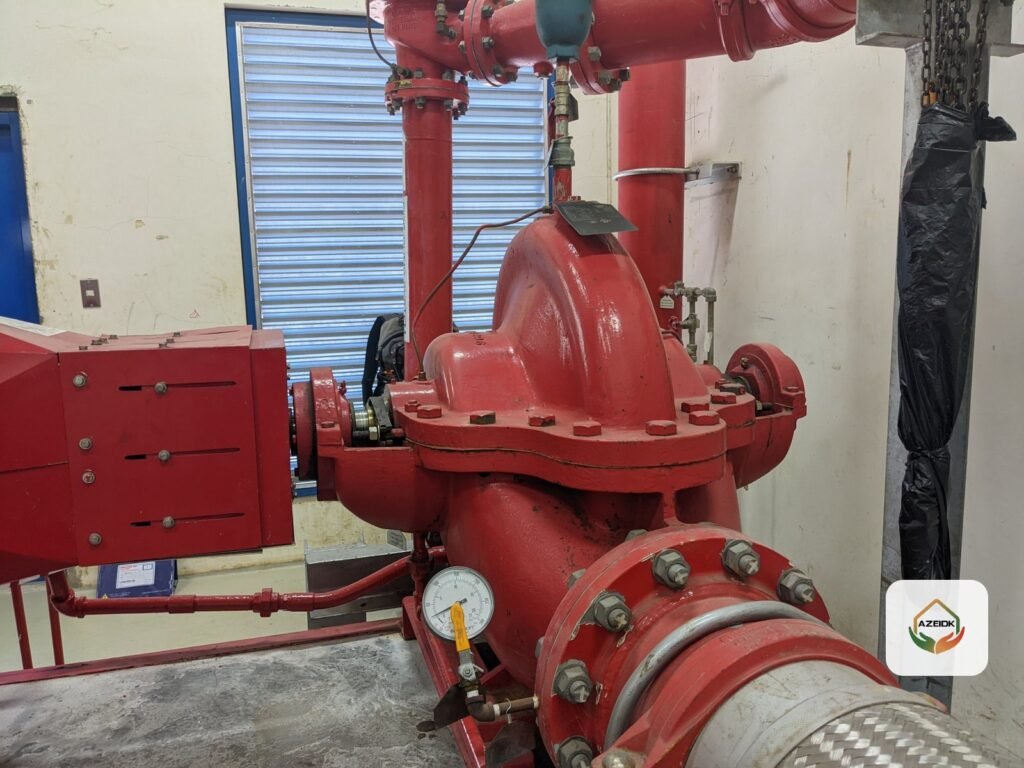
A 3PUMP fire pump package is a single supply that combines a main electric-driven fire pump, a standby diesel-driven pump and a jockey pump for pressure maintenance, each with its own LS controller. Four models are documented in official datasheets: 500 GPM at 8 bar, 750 GPM at 9 bar, 1000 GPM at 10 bar and 1500 GPM at 10 bar. All four are Non-Listed versions; UL/FM versions are available on request.
This article explains what each package contains, how to read the datasheet (submittal) before you ask for a quotation, what Non-Listed means in practice, and when you should insist on a listed version. Full details and the PDF datasheets are on the AZEIDK 3PUMP fire pump packages page, and the other pumps we supply are in the fire pumps category.
Key takeaways
- Each documented 3PUMP package has a main electric pump, a standby diesel pump of the same model, a jockey pump and three individual LS controllers (made in Korea).
- Only four models are documented: 3P 4×3-10.2, 3P 5×4-10.2, 3P 5×4-10.2L and 3P 6×5-12.4, all end suction.
- The datasheets are titled “NON-UL TECHNICAL SUBMITTAL”: these models are not UL listed or FM approved.
- NFPA 20 calls for the fire pump, controller and diesel engine to be listed for fire protection service; if the project specification adopts that, ask for the UL/FM version.
- The documented datasheets are at 415 V, 50 Hz, while the public grid in Saudi Arabia runs at 60 Hz; confirm the frequency version and its curve in the technical offer.
In this article
- What does a 3PUMP fire pump package include?
- Which models are available from 500 to 1500 GPM?
- How do you read the datasheet before requesting a quote?
- What does Non-Listed mean for a fire pump package?
- What should you confirm for a project in Saudi Arabia?
- Common mistakes when buying a fire pump package
- Frequently asked questions
- Conclusion
What does a 3PUMP fire pump package include?
The AZEIDK product page describes a complete set on a common base with three pumps, each with a different job:
- Main electric pump: starts first when system pressure drops because a sprinkler or hose cabinet is in use.
- Standby diesel pump: same model, flow and pressure as the main pump; it covers electric pump failure or loss of power.
- Jockey pump: makes up small leaks and holds system pressure so the main pump does not start unnecessarily.
Per the datasheets, main and standby pumps in all four models share the same construction: cast iron casing, bronze impeller, stainless steel shaft and a mechanical seal. The jockey pump is from the RV10 series with a stainless steel impeller and shaft. The datasheets also list Pacific pressure switches and ONTOR/GALA valves. For the differences between electric, diesel, jockey and end suction pumps in general, see fire pump types and NFPA 20 basics; we do not repeat them here.
Which models are available from 500 to 1500 GPM?
The table below is taken from the four official datasheets published on the product page. No other models are documented at present; any other flow or pressure is defined in the project’s technical offer.
| Rated flow and pressure | Pump model | Electric motor | Diesel engine | Jockey pump |
|---|---|---|---|---|
| 500 GPM at 8 bar | 3P 4×3-10.2 | 75 HP | POWER 4102, 84 HP | RV10-10: 40 GPM / 8.5 bar / 4.0 kW |
| 750 GPM at 9 bar | 3P 5×4-10.2 | 100 HP | POWER 4105BZ, 108 HP | RV10-10: 30 GPM / 9.5 bar / 4.0 kW |
| 1000 GPM at 10 bar | 3P 5×4-10.2L | 150 HP | POWER 6102BZQ, 150 HP | RV10-12: 40 GPM / 10.5 bar / 4.0 kW |
| 1500 GPM at 10 bar | 3P 6×5-12.4 | 250 HP | POWER 6120Ti, 240 HP | RV10-12: 40 GPM / 10 bar / 4.0 kW |
The electric motors in the datasheets are 415 V, 50 Hz, three-phase, with Class F insulation. The POWER diesel engines are 12 V systems running at 3000 rpm. For the 1500 GPM model the datasheet lists more than one 250 HP motor make, so the actual motor is fixed in the technical offer.
How do you pick the right model?
Start from the hydraulic calculation, not the model table: the highest flow demanded by sprinklers and hose cabinets, and the pressure needed at the pump discharge after friction losses, elevation and available suction pressure. Then compare that duty point with each model’s curve. If the calculation is not ready yet, our engineering design and calculations service fixes the flow and pressure before a package is chosen.
How do you read the datasheet before requesting a quote?
Each of the four files is laid out as a ready-to-complete submittal, with fields for project name, client, consultant, contractor, date and revision. In order, it contains:
- Technical data sheet: model, flow, pressure, materials, drivers and controllers.
- Performance curves: one for the electric pump at 2950 rpm and one for the diesel pump at 3000 rpm for the 500, 750 and 1000 GPM models; a single 2950 rpm curve for the 1500 GPM model.
- Electric motor data: efficiency, power factor and current tables by frame size.
- Diesel engine data and jockey pump data, with RV10 curves and dimensions.
- Controller drawings: 415 V incoming supply, a pressure switch for each of the electric, diesel and jockey pumps, and alarm contacts for the electric motor and the diesel pump.
What do the “PASS” values on the curve mean?
Each curve shows two values: pressure at 150% of rated flow and pressure at shutoff (churn). NFPA 20 expects a pump to deliver 150% of rated flow at no less than 65% of rated pressure, with shutoff pressure not exceeding 140% of rated pressure. The values declared on the curves are:
| Model | Pressure at 150% (electric / diesel) | Minimum (65%) | Shutoff (electric / diesel) | Maximum (140%) |
|---|---|---|---|---|
| 500 GPM / 8 bar | 7.00 / 6.89 bar | 5.2 bar | 9.42 / 9.56 bar | 11.2 bar |
| 750 GPM / 9 bar | 7.60 / 7.52 bar | 5.85 bar | 10.15 / 10.31 bar | 12.6 bar |
| 1000 GPM / 10 bar | 8.00 / 7.96 bar | 6.5 bar | 10.90 / 11.06 bar | 14 bar |
| 1500 GPM / 10 bar | 8.50 bar (single curve) | 6.5 bar | 10.88 bar | 14 bar |
These are the manufacturer’s declared curve values, not an independent test certificate. The real check is the field performance test at acceptance, covered in fire pump testing in Saudi Arabia.
What does Non-Listed mean for a fire pump package?
“Non-Listed” or “Non-UL” means the model is not UL listed for fire protection service and not FM approved. The heading “NFPA PERFORMANCE” in the data table describes the curve shape and rating points only; it is not a listing or an approval. A listing is granted by a third party after testing a specific model and size, and is verified in that body’s own directory, as explained in fire pump UL and FM approval.
The decisive point is that NFPA 20 calls for fire pumps, controllers and diesel engines to be listed for fire protection service, while jockey pumps do not have to be listed. In Saudi Arabia the Saudi Fire Protection Code SBC 801 applies, and NFPA standards are technical references the designer adopts in the project specification. So whether a Non-Listed package is acceptable on a given project is not the supplier’s call. It depends on the project specification, the consultant’s approval, the reviewing authority and, where relevant, the insurer’s requirements.
When should you ask for the UL/FM version?
- When the specification or bill of quantities calls for a “UL Listed” or “FM Approved” pump, or for full NFPA 20 compliance.
- When the consultant asks for a listing certificate naming the pump model, controller and driver.
- When the insurer has requirements for listed equipment.
In these cases request the UL/FM version from 3PUMP; the technical offer confirms the model, specifications and approvals. You can also compare the listed pumps AZEIDK supplies in Jack Pump or WATEX?.
What should you confirm for a project in Saudi Arabia?
Before you accept an offer, confirm these points in writing:
- Frequency and voltage: the documented datasheets are 415 V, 50 Hz, while the public grid in Saudi Arabia runs at 60 Hz with 380 or 400 V three-phase. Frequency changes the speed of the electric motor (and the jockey motor) and therefore the pump curve, so ask for the version that matches the site supply, with its own curve.
- Certificate of conformity: the SASO Technical Regulation for Fire Control Materials and Equipment requires a certificate of conformity for fire pumps through the SABER platform. See SABER conformity certificate steps.
- Start and stop settings: jockey, main and diesel pump pressures are set to suit the system; see jockey pump sizing and pressure settings.
- Scope of supply: what is and is not in the package, such as the diesel fuel tank, suction and discharge valves and flow meter, should be written into the offer, not assumed.
Common mistakes when buying a fire pump package
- Choosing on flow alone: a 1000 GPM at 10 bar package does not suit a project that needs higher pressure at the same flow.
- Treating “NFPA PERFORMANCE” as a listing: rating points on a curve do not make a model UL listed or FM approved.
- Submitting a Non-UL file where the specification demands UL/FM: this usually ends in a rejected submittal and a delayed order.
- Ignoring frequency: a 50 Hz curve does not represent electric pump performance on a 60 Hz supply.
- Leaving the submittal fields blank: a datasheet sent without project data and revision number weakens the file with the consultant.
Frequently asked questions
What is in a 3PUMP fire pump package?
A main electric pump, a standby diesel pump of the same model, a jockey pump and three individual LS controllers, per the official datasheets.
Which 3PUMP models are documented?
Four: 500 GPM at 8 bar, 750 GPM at 9 bar, 1000 GPM at 10 bar and 1500 GPM at 10 bar, all end suction.
Are 3PUMP packages UL listed or FM approved?
The four documented models are Non-Listed. UL/FM versions are available on request, with approvals confirmed in the technical offer.
Will a Non-Listed package be accepted on my project?
That depends on the project specification, the consultant and the reviewing authority. If listing or full NFPA 20 compliance is required, ask for the UL/FM version.
Do these packages run on 60 Hz power?
The published datasheets are 415 V, 50 Hz. Ask for the version that suits your site supply, and its curve, in the technical offer.
Conclusion
A 3PUMP fire pump package brings the electric, diesel and jockey pumps and their controllers into one supply, with four documented models from 500 to 1500 GPM. Choose the model from the hydraulic calculation, read its curves and data, decide early whether the specification allows a Non-Listed version or requires UL/FM, and confirm frequency and the certificate of conformity before ordering.
Have a calculated flow and pressure for your project? Send them with the project specification, and we will propose the matching 3PUMP model and tell you whether a Non-Listed or UL/FM version fits. Contact the AZEIDK team
Related guides
- Parking Barrier and Turnstile Maintenance: Common Faults (Boom, Sensors, Loops, Motor), Periodic Checks and Contract Scope
- Fire Extinguisher Refilling in Saudi Arabia: When It Is Needed, What Happens in the Workshop and How to Accept the Unit
- Inspection, Testing and Maintenance of Fire Protection Systems in Saudi Arabia
- Kitchen Fire Extinguisher (Wet Chemical Class K): Why Dry Powder Falls Short on Oil Fires, Where to Place It and How It Works With the Hood System