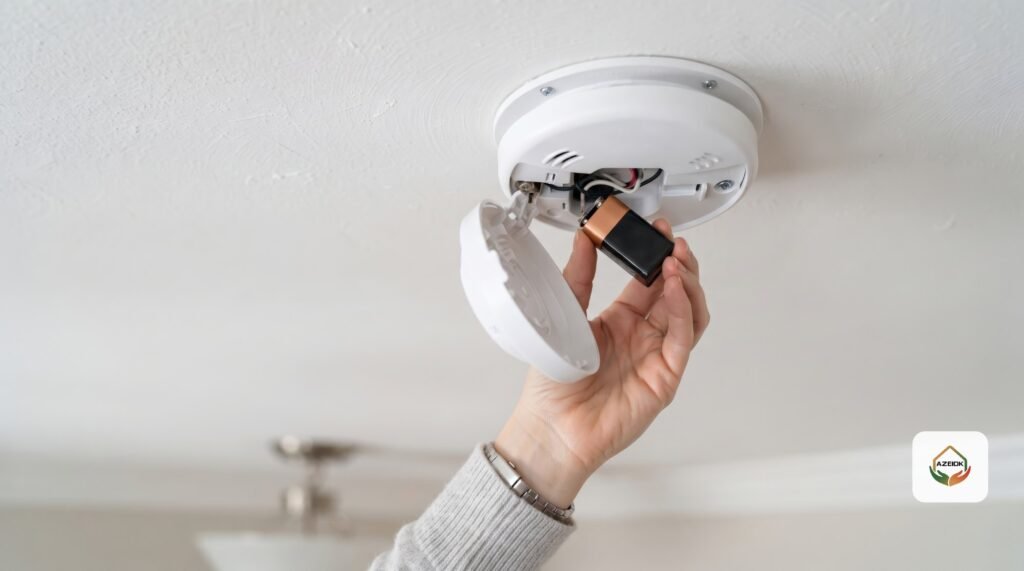
A battery smoke alarm (a standalone smoke alarm) is usually enough for the bedrooms and hallways of an apartment or small villa: it senses smoke and sounds its own sounder with no panel or cabling. A building where the code or the Civil Defense-approved design calls for a fire alarm system, or a shop that needs a Salamah licence, needs a panel-based system. A standalone device does not replace it.
This guide explains the practical difference between the two, the published specifications of the FG SD-425 standalone photoelectric smoke alarm, the rules for RadioLINK wireless interconnection, and where a standalone alarm ends and an engineered system begins.
Related reading: Fire Alarm System Installation in Saudi Arabia: Stages, Cabling and Pre-Approval Checks
Key takeaways
- A standalone alarm detects and sounds by itself. It sends no signal to a panel, a security room or anyone outside the home.
- Per its product page and the FG alarm catalogue, the SD-425 is a photoelectric unit powered by a 9V battery that lasts about one year, with an alarm of at least 85 dB at 3 m.
- The U.S. Fire Administration (USFA) advises alarms inside and outside each bedroom and on every level, interconnected, tested monthly and replaced every 10 years.
- The product page for the RadioLINK Ei168RC base limits compatibility to Ei140RC series alarms. The SD-425 is not among them.
- Domestic alarms do not replace a fire alarm system required by the code or by the Civil Defense-approved design.
In this article
- Battery smoke alarm vs panel-based fire alarm system: what is the difference?
- What are the SD-425 specifications?
- Where should you install smoke alarms in an apartment or villa?
- Should smoke alarms be interconnected, and what are the RadioLINK rules?
- When is a battery smoke alarm enough, and when do you need a full system?
- How do you test the alarm, and when should you change the battery?
- Common mistakes with home smoke alarms
- Frequently asked questions
- Conclusion
Battery smoke alarm vs panel-based fire alarm system: what is the difference?
On site, people call both devices “smoke detectors”, but they do different jobs. NFPA 72 calls the standalone device a smoke alarm and covers it in Chapter 29, “Single- and Multiple-Station Alarms and Household Fire Alarm Systems”. A smoke detector in the technical sense is a sensor that reports to a fire alarm control panel. The panel drives the sounders and strobes, identifies the zone and supervises the circuits for faults.
A standalone alarm puts three things in one housing: the smoke sensor, the power source (a battery, or mains with battery backup) and the sounder. That is why homes use them so widely: one goes up in minutes with no wiring. The same design sets the limits. It alerts nobody outside the premises, shows no fault on any panel and cannot trigger other systems such as door release or HVAC shutdown.
| Item | Standalone smoke alarm (battery) | Panel-based fire alarm system |
|---|---|---|
| Where it sounds | Its own sounder, or all alarms if they are interconnected | Sounders and strobes throughout the building, driven by the panel |
| Locating the fire | By listening for the alarm that is sounding | The panel shows the zone (conventional) or the exact device (addressable) |
| Fault supervision | A low-battery warning on the unit, where fitted | The panel monitors circuits and batteries and reports faults |
| Interfaces | Very limited | Through panel outputs and modules, as designed |
| Wiring | None, or wireless interconnection | Fire alarm cable, a panel and secondary power |
| Typical use | Apartments, small villas, single rooms | Buildings where the code or approved design requires an alarm system |
What are the SD-425 specifications?
AZEIDK lists the FG SD-425 standalone photoelectric smoke alarm under conventional fire alarm products. It uses infrared optical sensing inside a dedicated chamber: when smoke enters, the particles reflect infrared light towards the sensor and the unit goes into alarm. The figures below are taken from the product page and the FG Catalog Alarm 2025:
| Item | Published value |
|---|---|
| Power | DC 9V battery; optional 9V battery plus AC 110–220V version |
| Battery life | About one year |
| Standby current | ≤ 10 µA |
| Alarm current | ≤ 45 mA (≤ 75 mA for the wireless type) |
| Sensitivity | 0.08–0.16 dB/m |
| Alarm sound level | ≥ 85 dB at 3 m |
| Alarm indication | Sounder plus flashing red LED |
| Operating temperature | 0 to +50 °C |
| Humidity | ≤ 95% RH, non-condensing |
| Size | Ø 142 × 40.5 mm, ceiling mounted |
Note what the page does not state: it names no test standard or listing, and it gives no protocol details for the wireless type. If a consultant or owner asks for a specific certificate, request it from AZEIDK before supply rather than assuming it. The 50 °C upper limit also matters: do not fit the unit in an unconditioned roof room or annex that gets hotter than that in summer.
Where should you install smoke alarms in an apartment or villa?
The U.S. Fire Administration’s home guidance is simple to apply:
- One alarm inside each bedroom and one outside each sleeping area, such as the corridor to the bedrooms.
- Alarms on every level of the home.
- Mount them on the ceiling or high on the wall.
- If an alarm keeps sounding during cooking, move it away from the kitchen or bathroom. Do not take the battery out.
NFPA 72, 2022 edition (Section 29.11.3.4 as amended by NFPA Tentative Interim Amendment TIA 22-3), sets more detailed rules on distance from stationary or fixed cooking appliances: smoke alarms are not installed within a 10 ft (3.0 m) radial exclusion area around the appliance, with a limited, conditional allowance for 6 to 10 ft where the device is listed for resistance to cooking nuisance alarms. A smoke alarm therefore does not belong in the kitchen itself. Where a kitchen needs protection, a heat detector on a panel system may be used. For a full villa layout, see Fire Alarm Systems for Villas and Small Residential Buildings.
Should smoke alarms be interconnected, and what are the RadioLINK rules?
USFA advises interconnection: when one alarm sounds, they all sound. A fire in a ground-floor room then wakes people asleep upstairs. An alarm that is not interconnected only warns whoever is close enough to hear it.
Wireless interconnection with the RadioLINK Ei168RC base
AZEIDK supplies the RadioLINK alarm base Ei168RC, listed among Context Plus fire alarm accessories. The product page gives these rules:
- The base is for Ei140RC series alarms. It mounts behind the alarm and links it wirelessly, or in a hybrid wired and wireless system.
- It is mains powered, with a rechargeable backup battery and a low-battery indicator.
- It transmits, receives and repeats RadioLINK signals. When one alarm triggers, every alarm in the system sounds.
- It accepts remote Test, Silence and Locate commands from Ei RF devices.
- House coding limits the link to your own devices so a neighbour’s system cannot set yours off.
- You can extend an existing wired system by fitting a base to one existing alarm and bases to the new ones, with no new cabling.
AZEIDK’s RadioLINK+ module page gives a limit of 12 RadioLINK/RadioLINK+ devices per system. The key practical rule: add only the alarms that the base’s product page lists as compatible (the Ei140RC series) to a RadioLINK system. The SD-425 is not among them, so it is not linked to the Ei168RC base. To interconnect several SD-425 units with each other, ask AZEIDK how the wireless type in the catalogue is linked before you buy. For panel-based wireless systems, see Wireless Fire Alarm Systems: When They Suit Existing Buildings.
When is a battery smoke alarm enough, and when do you need a full system?
In Saudi Arabia the regulatory reference is the Saudi Fire Protection Code, SBC 801, part of the Saudi Building Code. The 2024 edition has been mandatory since 30 June 2025. Designers adopt NFPA 72 as the technical reference. No single threshold applies to every building. The requirement depends on occupancy classification, area, storeys and number of units, and on the design approved by the Civil Defense. We therefore quote no specific trigger here. The final decision belongs to the design engineer and the authority.
In practice, a standalone alarm is usually enough for:
- A single-family apartment or villa where the approved design does not call for a panel system.
- Adding bedroom protection to an existing home that has no alarm system.
- A single room or small annex where the owner wants a local warning.
You need a panel-based fire alarm system in these cases:
- The code or the Civil Defense-approved design requires an alarm system, which is often the case for commercial and multi-unit buildings, depending on classification and size.
- The facility’s Salamah licence requires an alarm system. See our Salamah certificate guide.
- You need central monitoring that shows alarm location and faults, or interfaces with other systems.
- A shop or unit sits in a building with an existing system. The ceiling detectors belong to the building system, and a domestic alarm cannot replace them.
AZEIDK’s pages for Ei domestic devices state that they are not designed to be a critical component of a BS 5839-1 system, nor a necessary part of an evacuation or other life-safety procedure. For buildings that need a panel, see our fire alarm systems page.
How do you test the alarm, and when should you change the battery?
A battery alarm is worth nothing once the battery is flat or removed. USFA recommends:
- Test every alarm monthly.
- Replace 9V batteries at least once a year, and replace the backup battery in mains-powered alarms just as often.
- Replace the whole alarm every 10 years.
This matches the SD-425’s published battery life of about one year. Write the installation date inside the unit, pick one fixed day each year to change every battery in the home, and follow the device’s operating manual for testing and cleaning.
Common mistakes with home smoke alarms
- Removing the battery because of cooking alarms: move the alarm away from the kitchen instead of silencing it for good.
- One alarm in the living room only: people asleep behind closed doors on another floor will not hear it.
- Adding incompatible alarms to a wireless system: the Ei168RC product page lists Ei140RC series alarms only.
- Treating a domestic alarm as a substitute for a required system: it is not accepted where the approved design calls for a panel system.
- Fitting it in a hot, unconditioned space: this exceeds the SD-425’s published limit of 50 °C.
- Keeping an alarm beyond 10 years: sensor reliability falls with age.
Frequently asked questions
Is a battery smoke alarm enough to license a shop?
Do not rely on it. The Salamah platform and the Civil Defense set licence requirements by activity and area. If the shop is inside a building with a fire alarm system, the ceiling detectors belong to the building system.
How many alarms does a villa need?
Per USFA, at least one inside each bedroom, one outside each sleeping area and one on every level.
Can the SD-425 connect to a RadioLINK base?
No. The Ei168RC product page limits compatibility to the Ei140RC series and does not list the SD-425. To link SD-425 units with each other, ask AZEIDK about their wireless type and how it is linked.
How often should I change the battery?
At least once a year for 9V alarms. Test monthly and replace the whole alarm every 10 years.
Should I put a smoke alarm in the kitchen?
No. Cooking causes nuisance alarms. Keep smoke alarms away from cooking appliances. If the kitchen needs protection, use a heat detector on a system.
Conclusion
A battery smoke alarm is a simple, low-cost way to protect bedrooms and hallways at home. It works better when the alarms are interconnected, tested monthly and given new batteries every year. It remains a local warning device, though, not a fire alarm system. When the code, the approved design or the facility licence requires a system, you need a control panel with detectors wired to it, not domestic alarms.
Not sure whether standalone alarms are enough or you need a panel system? Send us the building type and the number of floors and rooms, and we will propose a suitable solution with the technical specifications for each device. Contact the AZEIDK team
Related guides
- FM-200 Fire Extinguisher (Clean Agent): For Server Rooms and Electrical Panels, 1 to 12 kg Sizes, and When You Need a Fixed System
- Fire Alarm Panel Faults (Fault Messages): What Each Message Means, What the Technician Checks and When to Call Maintenance
- Restaurant and Café Fire Safety in Saudi Arabia: Systems and Requirements
- Fire Systems Handover Documents: As-Built Drawings and O&M Manuals