A house fire can start at night or in an empty room, and early warning is what gives the family time to get out. But a villa fire alarm system, or one for a small residential building, is nothing like a tower or mall system: rooms are few, the kitchen, majlis and annex sit close together, and the occupants are the ones who live with the devices every day.
This guide explains what sets alarm requirements in a villa, the difference between interconnected domestic smoke alarms and a conventional panel system, where to install devices, wired and wireless interconnection, and the maintenance the owner carries out.
Key takeaways
- The regulatory reference is the Saudi Fire Protection Code (SBC 801) and the building’s approved design; NFPA 72 is used as a technical reference.
- NFPA advises a smoke alarm inside every bedroom, outside each sleeping area and on every level, including the basement.
- Interconnecting alarms so that all sound when one activates raises protection, and can be wired or wireless.
- According to the Context Plus product pages, domestic alarms are not an essential component of a BS 5839-1 system, so larger or multi-unit buildings may need a panel-based system.
- NFPA advises testing every alarm monthly and replacing it at ten years.
In this article
- What sets alarm requirements in a villa?
- Two main options: interconnected domestic alarms or a panel system
- Where to install smoke alarms in a villa
- Interconnection: wired or wireless
- When does a villa or small building need a panel?
- Power and owner maintenance
- Common mistakes in villa alarms
- Frequently asked questions
- Conclusion
What sets alarm requirements in a villa?
The regulatory frame is the Saudi Building Code, which includes the Saudi Fire Protection Code (SBC 801) with a chapter on fire protection systems. The 2024 edition of the Saudi Building Code has been mandatory since 30 June 2025, as explained in our SBC 801 guide. What applies to a particular villa depends on its occupancy classification, number of floors and units, and the design approved by the authority.
NFPA 72 is the technical reference for alarm systems and devotes Chapter 29 to single- and multiple-station alarms and household signaling systems. Designers may rely on it for details the code does not settle, without treating it as automatically mandatory.
AZEIDK offers conventional and addressable fire alarm solutions, including the Context Plus products listed on its Saudi site, and the solution can be matched to the building’s size and use.
Two main options: interconnected domestic alarms or a panel system
In small residential buildings, the choice usually lies between two approaches:
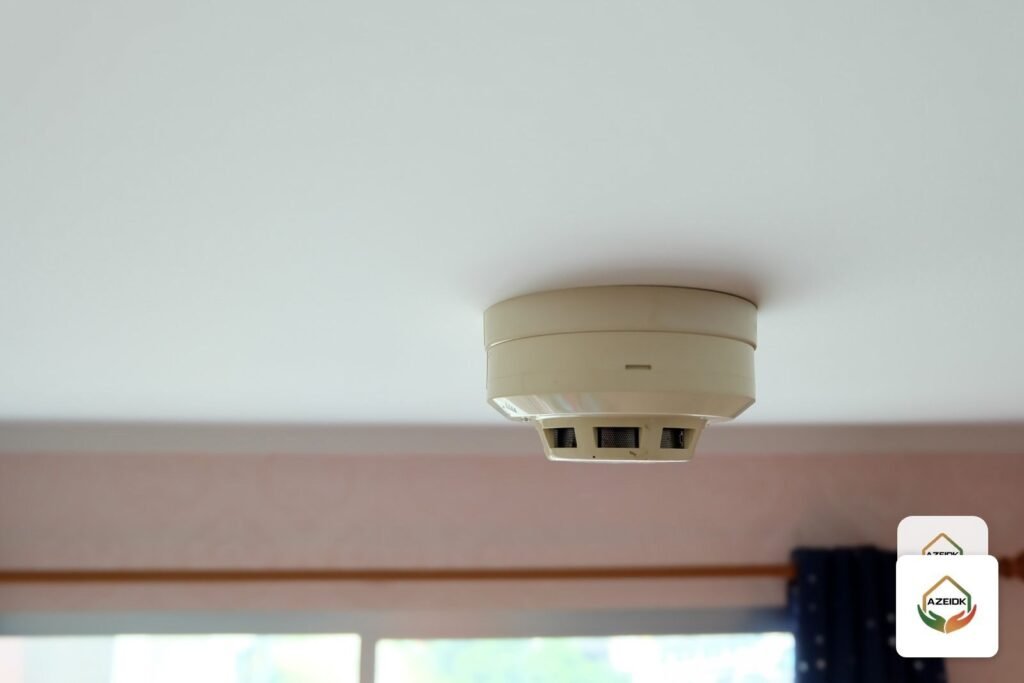
- Domestic smoke alarms (single- and multiple-station alarms): each unit detects smoke and sounds the alarm itself, and units can be interconnected so all sound when one activates. Our guide on choosing between a battery smoke alarm or a panel fire alarm system explains when a standalone alarm is enough and when you need a full system.
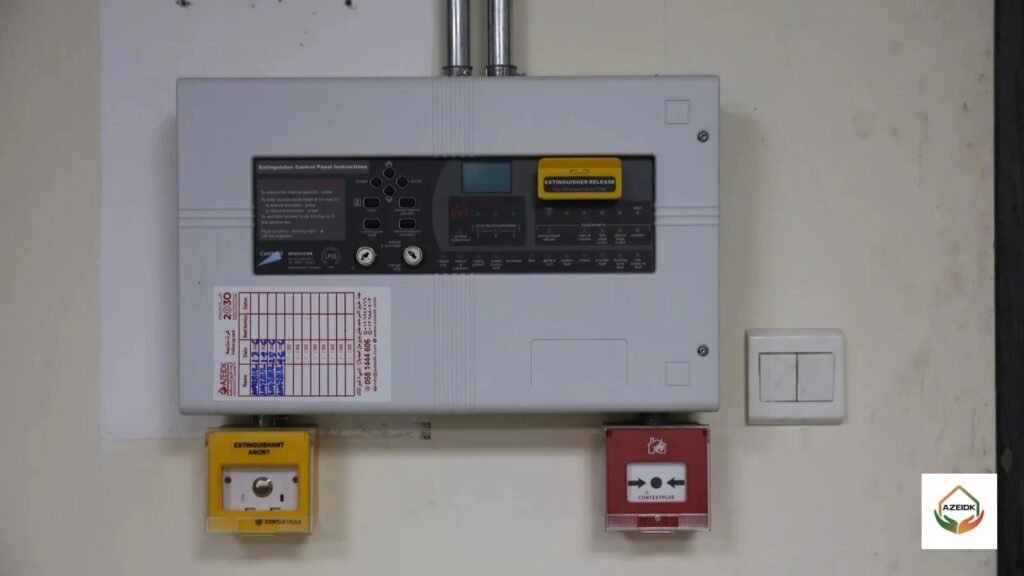
- A panel-based system (conventional fire alarm panel): detectors, manual call points (break glass) and bells or sounders wired to a central control panel that shows which zone raised the alarm.
| Item | Interconnected domestic smoke alarms | Conventional panel system |
|---|---|---|
| Detection and warning | In the unit itself | Detectors sense; the panel drives the sounders |
| Locating the fire | The unit that started the alarm | The zone shown on the panel |
| Power | Mains with battery backup, or battery only, depending on model | Panel supply with standby batteries sized to the load |
| Expansion | Add units, wired or wireless, depending on the system | Add detectors to zones up to panel capacity |
| Typical use | Villas, flats and small homes | Larger or multi-unit buildings, or where the approved design requires it |
Where to install smoke alarms in a villa
NFPA publishes general guidance for homes. The main points:
- One alarm inside every bedroom, and one outside each sleeping area in the corridor leading to the rooms.
- One on every level, including the basement; large villas may need more.
- Mount on the ceiling or high on a wall.
- Keep alarms at least 3 metres from the cooker, and away from the kitchen generally, to reduce false alarms.
- Alarms with strobe lights and bed shakers are available for people who are deaf or hard of hearing.
NFPA notes that ionization alarms respond faster to flaming fires and photoelectric alarms respond faster to smouldering fires, and recommends using both. In kitchens, laundry rooms and generator rooms, the designer or manufacturer specifies the suitable detector type, which may be a heat alarm rather than a smoke alarm.
Interconnection: wired or wireless
NFPA recommends interconnecting alarms so all sound when one activates, because an alarm in a distant room may not be heard in the bedrooms. In existing villas, running cables between rooms is often difficult, which is where wireless options help. Context Plus accessories supplied by AZEIDK include:
- RadioLINK+ wireless modules (Ei600MRF and Ei200MRF): plug into the rear of compatible alarms and link up to 12 devices wirelessly in a network; each module has its own lithium battery. Ei600MRF is for compatible smoke and heat alarms, Ei200MRF for compatible carbon monoxide alarms.
- RadioLINK alarm base Ei168RC: a mains-powered base with a rechargeable backup battery that links Ei140RC series devices wirelessly or in a hybrid system, and extends an existing wired system without new cables.
- Relay bases Ei128R and Ei128RBU: isolated relay contacts switch lighting, strobes or signals when a linked domestic alarm activates; 230 V mains, and the Ei128RBU has a backup battery lasting up to two months in a power cut.
These devices use house coding so neighbouring systems do not trigger them. The product pages themselves state that they are domestic units, not designed as an essential component of a BS 5839-1 system or as part of evacuation and life-safety procedures in buildings that require one.
When does a villa or small building need a panel?
Design tends towards a panel-based system in cases such as:
- The approved design or the authority requires a fire alarm system for the building’s classification.
- A small residential building with several flats, entrances and shared corridors.
- The owner wants to see the alarm zone from one place, or link the alarm to other building systems.
- Large annexes, a basement or enclosed parking that need clear zoning.
Here conventional panels suit small buildings, including Context Plus FP panels from one to 14 zones; we explain zone selection in our Context Plus FP panel guide. Residential towers have entirely different requirements, covered in our high-rise residential fire safety guide.
Power and owner maintenance
NFPA’s home guidance is simple:
- Test every alarm at least once a month using the test button.
- Replace alarms when they are ten years old.
- Follow the manufacturer’s instructions on batteries and cleaning.
In panel systems, the programme covers the panel, batteries, detectors and sounders on a schedule set by the designer and the maintenance contract. For AZEIDK’s offer to developers and building owners, see the residential developments page.
Common mistakes in villa alarms
- One alarm in the living room only: not enough to wake people asleep in distant rooms or on another floor.
- Alarms that are not interconnected: each sounds alone and is not heard outside its own room.
- A smoke alarm close to the kitchen: repeated false alarms push occupants to remove the battery.
- Removing an alarm for painting or cleaning and forgetting it: the area stays unprotected without anyone noticing.
- Mixing incompatible devices: modules and bases work with the specific models named on each product page.
- Relying on domestic alarms where a system is required: if the approved design calls for a fire alarm system, domestic alarms do not replace it.
Frequently asked questions
How many smoke alarms does a villa need?
Under NFPA guidance: one in every bedroom, one outside each sleeping area, and one on every level including the basement. Large villas may need more depending on area and layout.
Is wireless interconnection reliable?
Wireless systems such as RadioLINK+ use house coding and repeat signals between devices. Check model compatibility and installation distances against the manufacturer’s instructions.
Does a single-family villa need a fire alarm panel?
That depends on the approved design and the authority’s requirements. In many cases interconnected domestic alarms are enough, while larger or multi-unit buildings need a panel-based system.
Where should the alarm go near the kitchen?
NFPA advises keeping smoke alarms at least 3 metres from the cooker. In the kitchen itself, choose the detector type the manufacturer recommends, which may be a heat alarm.
When should alarms be replaced?
NFPA advises replacing domestic smoke alarms at ten years, testing them monthly until then.
Conclusion
A villa alarm starts with two questions: what the approved design requires under SBC 801, and where the occupants sleep. Then come alarms inside and outside bedrooms and on every level, interconnection so the alarm is heard everywhere, and monthly testing. When the building grows or has several units, a conventional panel system becomes the better choice.
Planning a fire alarm for a villa or small residential building? Send us the layout and the number of floors and rooms, and we will propose a suitable solution and devices with datasheets. Talk to the AZEIDK team