Villa and building owners in Saudi Arabia often ask for the intercom price as a single figure, then receive quotations that differ widely. The reason is that the final cost is not set by the device alone. It depends on the number of apartments and entrances, the number and type of indoor monitors, the technology (IP or 2-Wire), the condition of the existing cabling, and what you want the intercom to control: locks, gates, cameras and a mobile app.
This guide explains what pushes the cost up or down and what a quotation should include so you can compare offers fairly. If your project covers several systems, see AZEIDK low current systems, because the intercom is usually designed together with the network, CCTV and access control.
To see the other systems compounds, villas and residential buildings need and the steps to obtain the Salamah certificate, read our safety systems guide for compounds, villas and residential buildings.
Short answer: the intercom price is driven by the number of units, door stations and indoor monitors, then by the technology and cabling, then by locks, integration and programming. In a new building, compare IP and 2-Wire on cabling and switches; in an occupied building, 2-Wire can avoid rewiring. Only compare two quotations when they cover the same scope line by line.
Key takeaways
- The number of apartments sets the number of indoor monitors, which is often the largest line in a multi-unit building.
- A building door station differs from a villa unit: button panel or touch-screen directory, card reader or face recognition.
- IP needs one network cable per device and PoE switches. 2-Wire carries power and signal over two wires and can reuse existing cabling.
- Conduits, cabling, locks and gate wiring may sit outside a “supply only” offer. Ask about them explicitly.
- A good quotation names every model, attaches the datasheet, and states warranty, programming and training.
In this article
- Why is there no fixed intercom price for every building?
- Apartments and entrances: what raises the cost of a building intercom?
- Indoor monitors: quantity, size and features
- IP or 2-Wire: is an IP intercom more expensive than analogue?
- Is cabling included in the intercom price?
- Locks, gates and integration with other systems
- What should an intercom quotation include?
- Common mistakes when comparing intercom quotations
- Frequently asked questions
- Conclusion
Why is there no fixed intercom price for every building?
An intercom is a system, not a device. In a villa it is usually one outdoor door station and one or two indoor monitors. In an apartment building it is a door station at the main entrance, a monitor in every apartment, sometimes extra door stations for the car park or rear entrance, plus power supplies, switches or distributors, and lock connections.
The price therefore has five layers: devices, cables and conduits, locks and gates, installation and programming, and warranty and after-sales support. A quotation that does not separate these layers is hard to compare.
| Item | What raises the cost | What lowers it |
|---|---|---|
| Number of units | Many apartments mean more monitors and more points | A villa with one monitor or a ready kit |
| Door station | Touch-screen directory, face recognition, several entrances | Single-button or small button panel |
| Indoor monitors | Larger screens, touch, extra monitors on other floors | One basic monitor per unit |
| Technology and cabling | New cabling in an occupied building, extra switches | Conduits laid at shell stage, or reuse of existing cable |
| Integration | Maglock, garage gate, cameras, access control | Main entrance release only |
Apartments and entrances: what raises the cost of a building intercom?
In a building, the number of indoor monitors grows with the number of apartments, since every unit needs at least one. This is where most of the gap between a villa quote and a building quote comes from.
The second factor is entrances. A single entrance needs one door station. A car park entrance, an outer gate or a rear door each need their own door station, lock and cabling.
The door station type also changes the cost. Examples from the AZEIDK intercom catalogue:
- Hikvision DS-KD8005-IME1: a KD8 Series modular door station with a 5 MP camera, linking up to 1,000 indoor stations and 2,000 users, supporting up to 99 sub door stations, rated IP65 and IK08.
- Dahua VTO9541D-S3: a 10.1-inch touch screen, unlocking by face, fingerprint, card or code, capacity of 100,000 faces and 100,000 cards, and two lock outputs.
These units suit buildings and compounds and cost differently from a basic villa unit. Before requesting a quote, decide whether you really need face recognition or whether a number directory and cards are enough.
Indoor monitors: quantity, size and features
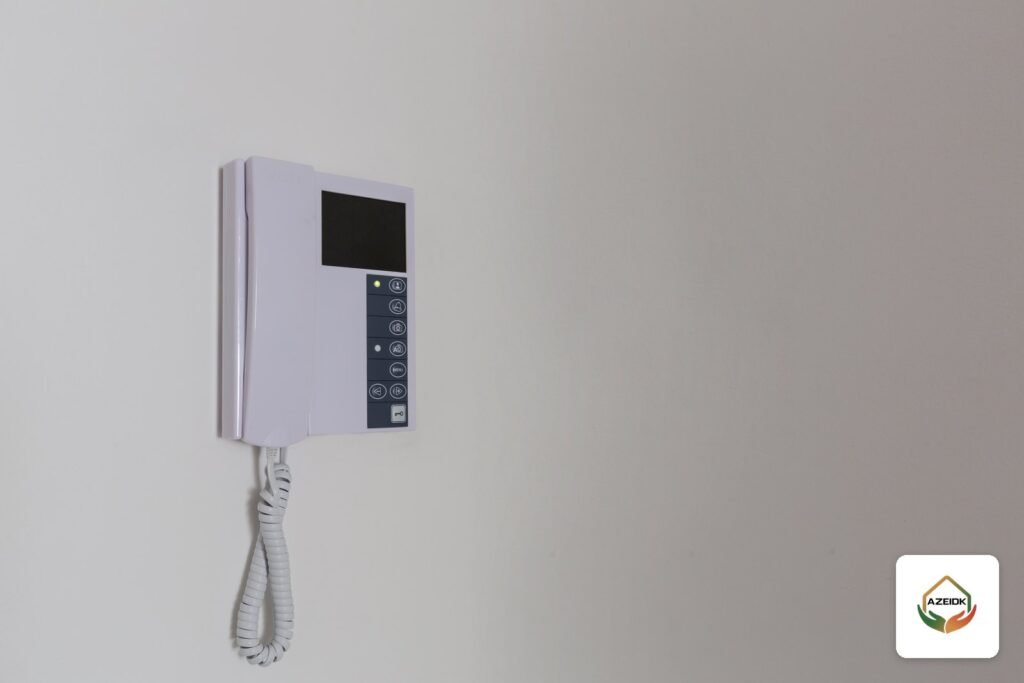
In a villa the owner may want a monitor in the majlis and another upstairs or in the kitchen. Each extra monitor is a device, a cable point and a port on the switch or distributor. In a building the monitor specification is multiplied by the number of apartments, so a small difference per monitor becomes a large difference in the total.
Features that affect the price: screen size and type (touch or buttons), Wi-Fi and app support, number of cameras it can display, and alarm inputs. One example is the Hikvision DS-KIS604-S(B) villa kit: per the version (C) datasheet it includes a DS-KV8113-WME1(C) 1080p door station, a DS-KH6320-WTE1 7-inch touch indoor station, a 4-port PoE switch and a 16 GB memory card. Version (B) contents are confirmed with the quotation.
IP or 2-Wire: is an IP intercom more expensive than analogue?
There is no single answer. The right comparison is the cost of the complete system including cabling, not the price of the device.
IP system: runs on one network cable per device, usually powered by PoE from the switch. Many units in the AZEIDK catalogue accept standard PoE or 12 VDC, such as the Dahua VTO3311Q-WP, which can also connect over 2.4 GHz Wi-Fi. In a new building the cables go easily into conduits, and IP opens the way to cameras, access control and the app, but it adds switches, network cabling and backup power to the bill.
2-Wire system: carries power and signal over two wires. Dahua states that its 2-Wire hybrid system reaches up to 200 m between door station and indoor monitor and can reuse existing cables, so only the equipment is upgraded. That cuts chasing and rewiring in occupied buildings.
| Criterion | IP intercom | 2-Wire intercom |
|---|---|---|
| Cable | Network cable per device | One pair, existing cable can be reused |
| Power | PoE from the switch or 12 V supply | Over the same two wires from the distributor and power supply |
| Extra quotation lines | PoE switches, network cabling, network setup | Distributors and system power supply |
| Best fit | New buildings and integration with other systems | Existing buildings and upgrades of old systems |
| Check | Network design and PoE port count | Distances and device limits per datasheet |
For clarity: the AZEIDK intercom catalogue does not currently list 2-Wire equipment, so ask which option suits your building when you request a quotation. The technical differences are covered in Intercom for Villas and Apartment Buildings in Saudi Arabia.
Is cabling included in the intercom price?
It depends on the wording. Some offers are supply only, some are supply and install without cabling, and some cover everything. Ask about each of these items:
- Conduits and back boxes: laid at shell stage, or surface trunking?
- Cable type and estimated length from the telecom room or distributor to each apartment.
- Switches or distributors, power supplies and the cabinet they sit in.
- Backup power (UPS) if the system must run during power cuts.
- Making good after chasing in occupied buildings: who pays?
A site visit before pricing settles these points, which is why AZEIDK offers a technical site inspection and assessment before the scope is fixed.
Locks, gates and integration with other systems
Releasing a door from the monitor or phone needs an electric or magnetic lock, its power supply and an exit button. Every door station has relay limits: the DS-KD8005-IME1, for example, has two relay outputs rated at 30 VDC and 2 A each. If the lock or gate motor needs more, an interposing relay or controller is required, and that is an extra line.
Other cost items: linking the intercom to the garage gate, card access control, CCTV or a guard room. On doors along escape routes, lock release must be coordinated with the fire alarm system; the wiring is explained in Access Controller Wiring: Maglock, Exit Button and Fire Alarm Release.
What should an intercom quotation include?
| Quotation line | Why it matters |
|---|---|
| Brand and model for each device | Without them you cannot compare specifications or check the datasheet |
| Quantities: door stations, monitors, switches or distributors, locks | Shows whether the monitors cover every apartment |
| Cabling, conduits and cable type | The line most often left out and claimed later |
| Installation, programming and app activation | Programming and account setup take time and skill |
| Testing, handover and training | Residents know how to answer calls and release doors |
| Warranty period and coverage | Devices only, or labour too? |
| VAT and payment terms | Avoids gaps between the quote and the invoice |
Common mistakes when comparing intercom quotations
- Comparing a supply-only offer with a supply, install and cabling offer, and picking the cheaper one on paper.
- Accepting a line that says “building video intercom” with no models or quantities.
- Forgetting the second entrance or car park gate, then adding it after finishes at a higher cost.
- Choosing IP without counting switches, PoE ports and backup power.
- Wiring a lock or gate directly to an output that cannot carry the current.
- Specifying face recognition at every entrance without a real need.
For components and how to choose a video intercom by building type, read Video Intercom Systems for Buildings and Compounds. Brands available: Hikvision, Dahua and ZKTeco.
Frequently asked questions
What raises the cost of an intercom for an apartment building?
The number of apartments, because it sets the number of monitors, then the number of entrances and door station type, then cabling, locks and links to gates and cameras.
Is cabling included in the price?
Not always. Some offers are supply only or installation without cabling, so ask for cables and conduits to be written as a separate line with the cable type.
Is an IP intercom more expensive than analogue?
It depends on the building. In a new building compare network cabling and switches; in an existing one, 2-Wire can save rewiring because it uses the wires already there.
How do I compare intercom quotations?
Compare models, quantities and included items: cabling, locks, programming, warranty and VAT. Two offers are only comparable if they cover the same scope.
Can the intercom be connected to my phone?
Yes, on devices that support it. The Dahua VTO3311Q-WP, for example, unlocks by app, card or indoor monitor, which needs an internet connection and account setup.
Can one intercom serve more than one door?
Yes, on systems that support multiple door stations; the Hikvision DS-KD8005-IME1 supports up to 99 sub door stations. Each extra door still adds a unit, a lock and cabling to the quote.
Conclusion
The real intercom price is the sum of devices, cabling, locks, programming and warranty. Fix the number of apartments, entrances and monitors first, choose IP or 2-Wire based on the building’s condition, and ask for a detailed quotation with models and quantities so the comparison is fair.
Preparing an intercom quote for a villa or building? Send us the number of apartments and entrances and the cabling condition, and we will propose the system and models with datasheets and a clear scope. Contact the AZEIDK team
Related guides
- Dahua in Saudi Arabia: Cameras, Intercom and Turnstiles from AZEIDK
- Concealed Sprinkler (Concealed Sprinkler Head): Cover Plate, Temperature Ratings and Suspended Ceiling Installation
- Falcon Gold Fire Cabinet: Types, Sizes and How to Select One
- Fire Hose Cabinets: Types, Sizes and Components (Class I, II and III)