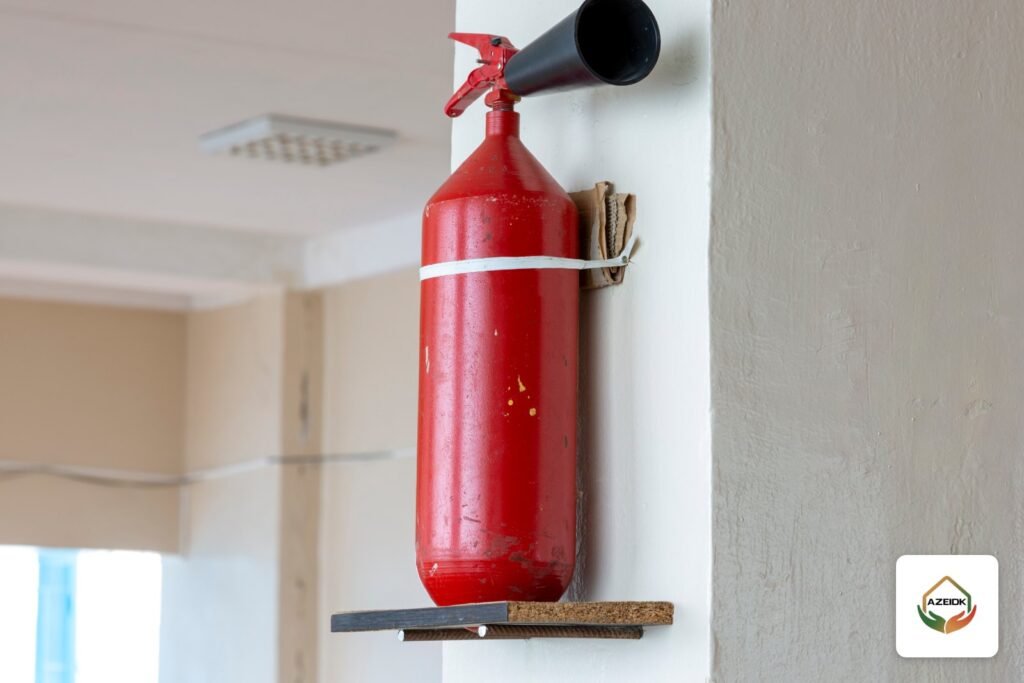
Many house fires start small: a pan of oil on the hob, a poor extension lead behind the TV, or a heater too close to a curtain in the majlis. In the first minute, a home fire extinguisher in the right place can stop them. The questions are which type, what size, where to hang it and how to tell it still works.
This guide answers them room by room, then covers mounting and a two-minute monthly check. AZEIDK supplies portable extinguishers and accessories through its technical supply service.
Key takeaways
For most Saudi homes the right choice is a multi-purpose ABC dry powder extinguisher, hung near the exit of the corridor or majlis at a height everyone can reach. Kitchen oil fires need their own approach, and water must never be used on them. Check the gauge, pin and seal once a month.
- Saudi Civil Defense stresses having extinguishers at home and learning to use them, and points to dry powder units for their effect on many types of household fire.
- Pick a size the adults in the house can lift and operate.
- Hang the extinguisher near the exit, not above the cooker or right next to the hazard.
- For an oil fire: turn off the heat, cover the pan with a tight lid, and never pour water on it.
- An extinguisher used even for a few seconds needs recharging, even if some powder is left.
In this article
- Which home fire extinguisher suits a Saudi house?
- The right size: a weight your family can carry
- Kitchen fire extinguisher: what to do with an oil fire
- Where to put the extinguisher and how high
- Powder, electrical fires and CO2 at home
- The two-minute monthly check
- Using the extinguisher: decide before you move
- A smoke alarm comes before the extinguisher
- Common mistakes with home extinguishers
- Frequently asked questions
- Conclusion
Which home fire extinguisher suits a Saudi house?
A typical home holds three kinds of fire risk: ordinary solids such as sofas, carpets, curtains and wood (Class A); flammable liquids such as petrol in the store room or LPG (Class B); and energised electrical equipment. A multi-purpose ABC dry powder extinguisher covers all of these with one unit, which is why it is the first choice for most homes.
Its drawback is the heavy powder residue left on furniture and appliances, a fair price against a spreading fire. For the difference between ABC and BC powder and where each belongs, see our dry powder extinguisher guide.
Among the products AZEIDK lists is the Falcon Gold 6 kg dry powder extinguisher, model FDP6. Its datasheet gives 70% ABC powder, an 8 m throw and a gross weight of 8.5 kg. A Falcon Gold 1 kg dry powder unit is also available for cars and small spaces.
The right size: a weight your family can carry
The capacity printed on an extinguisher is the agent weight only. The Falcon Gold 6 kg unit weighs 8.5 kg with cylinder and valve. Some family members may struggle with that, so ask who is usually at home and whether they can lift and operate it.
A practical rule we suggest: one medium unit in the corridor or near the majlis, and a smaller one where quick access is hard, such as the car. Floor area, storeys and use change the need.
| Location | Main hazard | Suggested extinguisher | Mounting note |
|---|---|---|---|
| Kitchen | Cooking oil, appliances | ABC powder by the kitchen door, plus a tight lid for pans | On the way out, away from the cooker |
| Corridor and living room | Furniture, extension leads | Medium ABC powder | Near the stairs or exit door |
| Majlis | Sofas, carpets, curtains, heaters, charcoal and incense | ABC powder | By the majlis door, visible to guests |
| Laundry or store room | Appliances, cleaning products, fuel | ABC powder | Outside the room, at the door |
| Car | Electrics and fuel | 1 kg powder | Fixed in a bracket so it cannot move while driving |
Kitchen fire extinguisher: what to do with an oil fire
Water on a burning pan of oil makes it erupt and spread. A former assistant director general of Saudi Civil Defense, quoted by Okaz in December 2025, said the right method is to cut off oxygen with a fire blanket, a powder extinguisher or a wet chemical extinguisher.
At home the simplest step comes first: turn off the heat, cover the pan with its metal lid or a tray, and leave it covered until it cools. If the fire spreads beyond the pan, use the extinguisher from a safe distance, aimed at the base of the flames, not straight down onto the oil surface from close range, so the oil does not splash.
Wet chemical (Class K) extinguishers are designed mainly for commercial kitchens. If your home has a large kitchen or a deep fryer in regular use, read our kitchen fire extinguisher guide before deciding.
Where to put the extinguisher and how high
The key rule in all public guidance is to keep the extinguisher near an exit. A unit next to the cooker or heater may end up behind the fire itself.
NFPA 10, the standard for portable extinguishers, gives clear heights. It targets buildings but is a useful home reference (details in our NFPA 10 portable extinguisher guide):
- An extinguisher with a gross weight up to 18.14 kg (40 lb) is mounted so its top is no more than about 1.5 m above the floor.
- The gap between the bottom of the extinguisher and the floor is at least 4 in (about 10 cm).
- Extinguishers are placed where they are visible and easy to reach, along normal routes.
At home, do not hide it in a cupboard or block it with furniture, and fix it on a solid wall bracket where everyone sees it daily.
Powder, electrical fires and CO2 at home
A fire in the distribution board or a live appliance needs an extinguisher that does not conduct electricity. ABC powder is suitable, and the Falcon Gold 6 kg datasheet lists electrical fires among its classes. Isolate the power first if safe.
A CO2 extinguisher leaves no residue on equipment, but it displaces oxygen, and using it in a small closed room can endanger the user. The hazards are covered in our CO2 extinguisher guide.
The two-minute monthly check
NFPA 10 sets a visual inspection at intervals of no more than 31 days. At home you can do it yourself on a fixed day each month:
- Location: the extinguisher is in its place and nothing blocks access.
- Gauge: the needle is in the green. Left in the red means low pressure; past the green to the right means overpressure. Either way the unit needs checking.
- Safety pin and seal: the pin is in place and the plastic tamper seal is intact.
- Body: no rust, dents or leakage around the valve.
- Hose and nozzle: not cracked and not blocked by dust or insects.
- Label and service tag: operating instructions are readable and the last service date is visible.
It does not replace yearly maintenance by a technician, or the internal examination and hydrostatic test when they fall due. Annual maintenance and recharging are covered in our fire extinguisher maintenance guide.
Using the extinguisher: decide before you move
Public guidance says fight it only if it is confined to a small area and not growing, everyone else is out, Civil Defense has been called, and the room is not filling with smoke. Otherwise get out at once and close the door behind you.
Operation comes down to four steps: pull the safety pin, aim the nozzle at the base of the fire, squeeze the lever steadily, and sweep from side to side. A small unit empties in seconds.
Emergency numbers as announced by Civil Defense: 911 in the Makkah, Madinah, Riyadh and Eastern regions, and 998 in the rest of the Kingdom.
A smoke alarm comes before the extinguisher
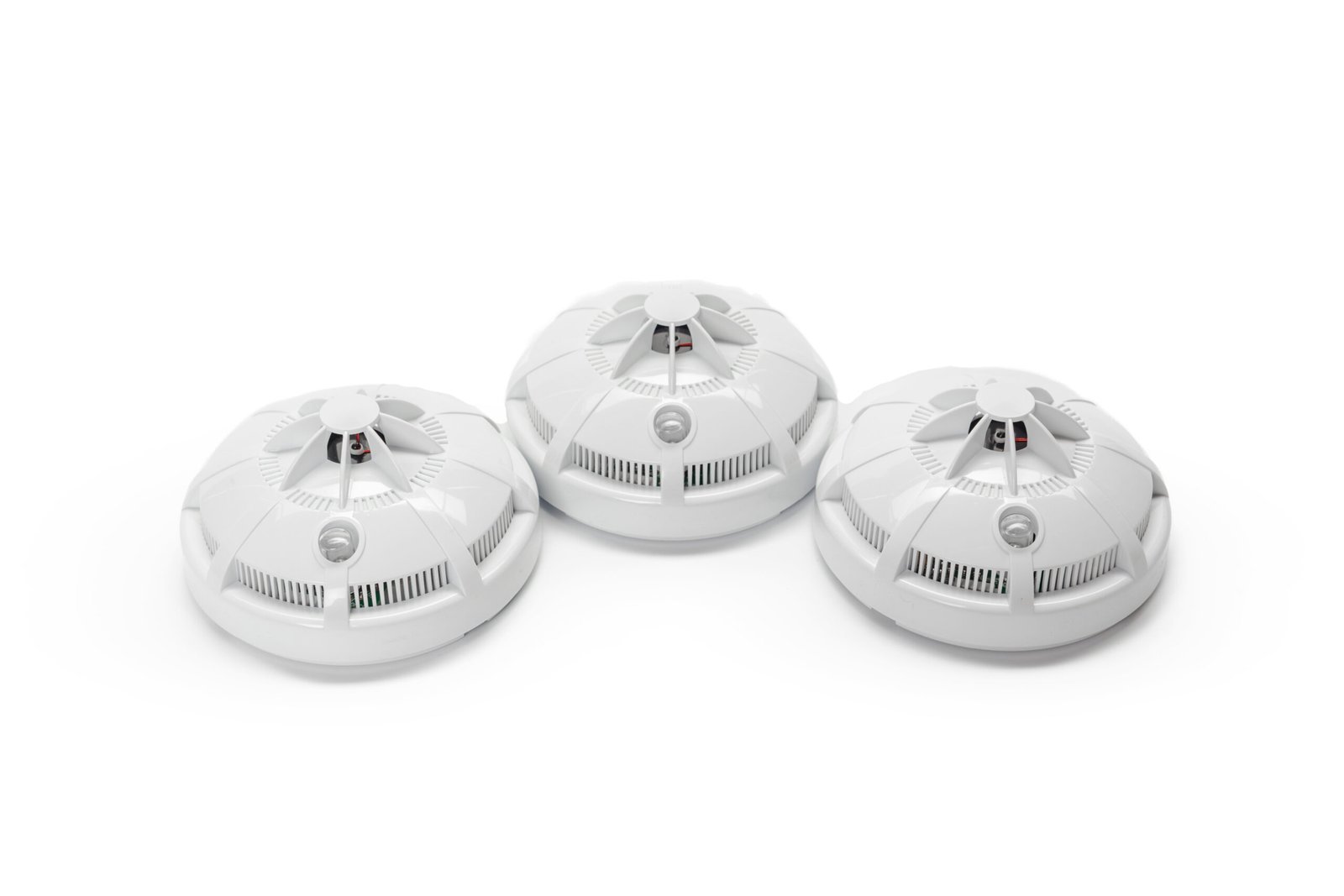
An extinguisher helps only if someone sees the fire early, and a fire may start at night while everyone is asleep, or in an empty room. A battery smoke alarm in the corridor outside the bedrooms completes what the extinguisher does. For when a standalone alarm is enough and when you need a panel system, see our battery smoke alarm vs fire alarm system comparison.
Common mistakes with home extinguishers
- Buying a large, heavy unit that nobody at home can carry.
- Hanging it above the cooker or next to the heater, so it ends up behind the fire.
- Hiding it in a cupboard or a locked store room.
- Putting it back after partial use without recharging.
- Pouring water on a burning pan of oil.
- Buying an unbranded unit with no clear manufacturer data and no certificate of conformity.
- Ignoring the gauge for years because the unit has never been used.
Frequently asked questions
What is the best extinguisher type for a home and a car?
A multi-purpose ABC dry powder extinguisher suits most homes because it covers furniture, liquids and electrical fires. For a car, a small powder unit fixed in a bracket, such as 1 kg, is enough.
How can I tell from the gauge if the extinguisher is still good?
The needle should sit in the green zone. If it is in the red or past the green, the pressure is wrong and the unit needs checking by a maintenance technician.
Where should I mount the extinguisher and how high?
Near the exit from the kitchen, corridor or majlis, not beside the hazard. Under NFPA 10, the top of a lighter unit is no more than about 1.5 m above the floor and the bottom is at least about 10 cm above it.
Which extinguisher is right for an electrical fire at home?
ABC powder is suitable for live appliances. CO2 leaves no residue but can be dangerous in a small closed room. Isolate the power at the board if you can do so safely.
When should I recharge the extinguisher?
After any use, even a few seconds, when the gauge leaves the green zone, or if the seal is broken. The technician decides at the periodic service whether it needs recharging or replacing.
How long does a fire extinguisher last?
There is no fixed life for all units. NFPA 10 ties it to internal examination and hydrostatic testing by type: a stored-pressure powder unit with a mild steel shell has an internal examination every 6 years and a hydrostatic test every 12 years, alongside annual maintenance and the manufacturer’s instructions.
Does the extinguisher need a SASO certificate of conformity?
Yes. Portable extinguishers fall under the SASO Technical Regulation for Fire Control Materials and Equipment, conformity is required before they are placed on the market, and the certificate is registered on the SABER platform.
How do I use a fire extinguisher?
Pull the safety pin, aim at the base of the fire, squeeze the lever and sweep from side to side. Keep your back to the exit and leave at once if the fire does not go out.
Conclusion
A home fire extinguisher is not a complicated decision: ABC powder in a size your family can handle, hung near the exit in the corridor and majlis and on the way out of the kitchen, a tight lid for oil pans, and a smoke alarm in the bedroom corridor. For extinguisher maintenance in apartment buildings and residential compounds, AZEIDK offers preventive and periodic maintenance contracts with its own maintenance team.
Equipping your home or building with new extinguishers? Tell us the number of floors and rooms and how the space is used, and we will suggest the types and sizes available with the datasheet for each model. Talk to the AZEIDK team
AZEIDK supplies fire extinguishers of all common types and sells them to individuals and businesses from its branches in Saudi Arabia.
Related guides
- Business Wi-Fi Network Design: How to Size Access Points, Placement, PoE Switches and Central Management
- AFC OS&Y Gate Valves: Types and Valve Position Supervision in Saudi Projects
- Time Attendance System Faults: Fingerprint Not Recognised, Device Offline, Wrong Date and Time
- School and Educational Facility Fire Safety: A Practical Guide