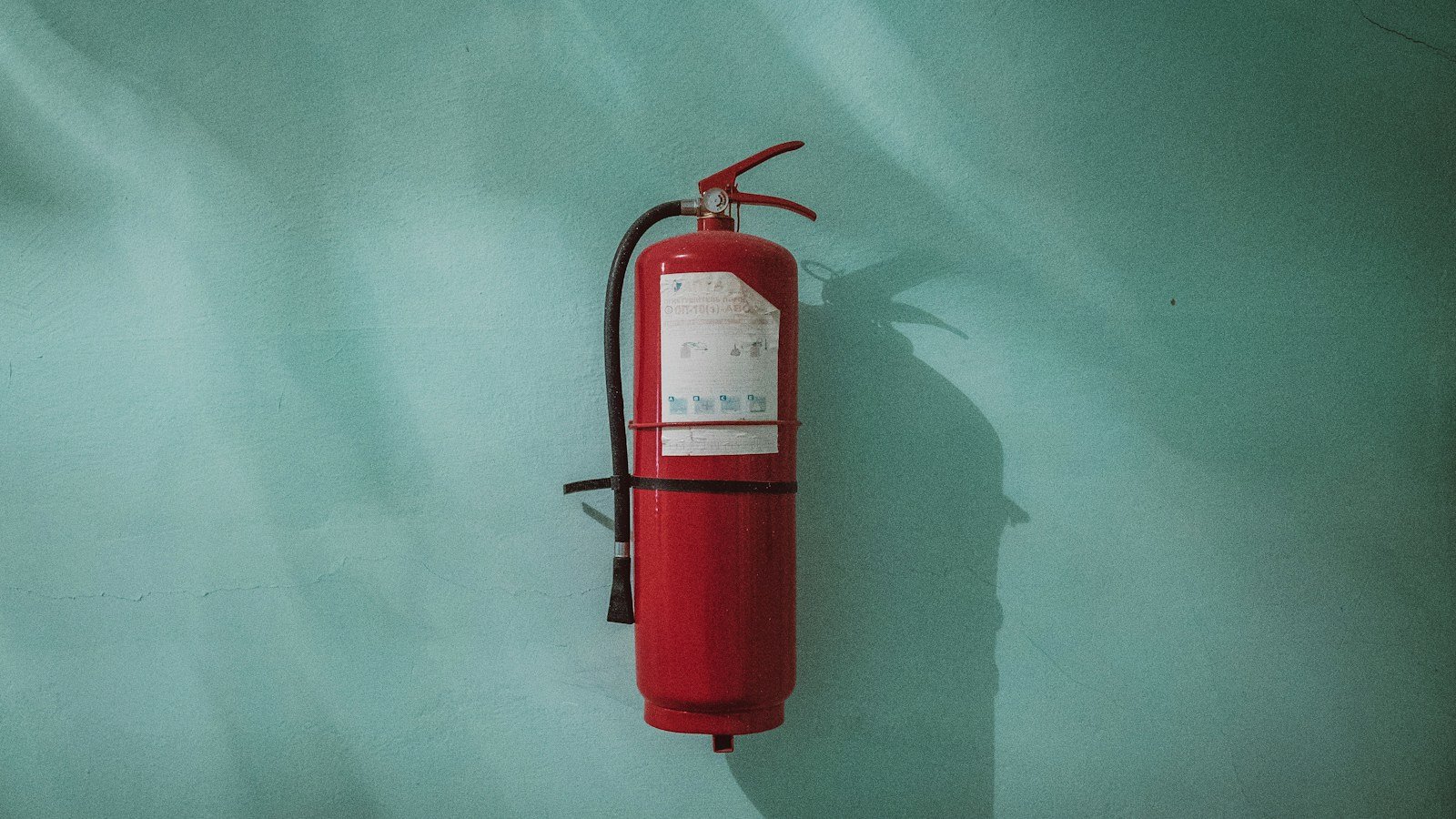
Fire extinguishers are the protection closest to hand, but they only work if each unit suits the fire expected in its room, is visible and reachable, is checked monthly and serviced annually, and staff know when to use it and when to leave. This guide covers what a facility manager needs in practice; the detailed tables of the standard are in our NFPA 10 portable extinguisher guide.
Key takeaways
- Choose by what can burn in each room: multipurpose dry chemical for offices and corridors, carbon dioxide for electrical equipment, wet chemical for commercial kitchens.
- NFPA 10 does not permit dry chemical extinguishers to be installed for delicate electronic equipment.
- NFPA 10 requires a manual inspection when a unit enters service, then at intervals not exceeding 31 days; trained facility staff can do this check.
- Annual maintenance, internal examination and hydrostatic testing are technical work for a qualified service agency, at intervals that vary by type.
- Train staff in the PASS method and one clear rule: fight only a small, contained fire with a safe way out.
Choose the type by fire class and room
Every extinguisher plan starts with one question: what can burn here? Class A covers ordinary solids such as paper, wood and cloth, Class B flammable liquids, Class C energized electrical equipment, Class D combustible metals and Class K cooking oils in commercial kitchens. Applied to typical rooms:
| Area | Expected fire | Typical extinguisher | Practical note |
|---|---|---|---|
| Offices, corridors, meeting rooms | A | Multipurpose dry chemical or water | Minimum 2-A rating in light and ordinary hazard |
| Electrical rooms and panels | C | Carbon dioxide | No water or foam units next to energized panels |
| Server and telecom rooms | C, with delicate electronics | Carbon dioxide or halogenated agent | NFPA 10 does not permit dry chemical for this equipment |
| Commercial kitchens | K | Wet chemical | Within 30 ft (9.1 m) travel of cooking equipment; supplements hood suppression |
| Workshops, generator rooms, fuel stores | B | Dry chemical or foam | The International Fire Code requires extinguishers where flammable liquids are stored or used |
| Parking garages | A and B | Multipurpose dry chemical | Moved to the extra hazard examples in NFPA 10 (2026) |
| Laboratories, metal workshops | D | Dry powder for the specific metal | Confirm suitability for the metal itself |
See our guides on electrical room fire protection, data center fire protection and commercial kitchen fire suppression. The rating on a unit, such as 2-A:10-B:C, states its capacity per class and drives quantity and spacing.
How many extinguishers, and where?
Class A quantity follows floor area and hazard, then actual travel distance is checked on the drawing. In the 2018 International Fire Code (IFC) model, Table 906.3(1) limits travel distance to the nearest unit to 75 ft (22.9 m) at any hazard level, and one extinguisher covers no more than 11,250 sq ft (about 1,045 m2). In long corridors and partitioned warehouses, travel distance often requires more units than area alone. Confirm the values in the Saudi Fire Protection Code (SBC 801) edition adopted for the project.
The key installation rules in Section 906 of the same code:
- Units are in conspicuous locations with ready access, immediately available for use, along normal paths of travel unless the fire code official decides otherwise.
- They are not obstructed or obscured; where obstruction cannot be avoided, a means such as signs shows their location.
- Hand-held units hang on their brackets or sit in extinguisher cabinets, and cabinets are not locked except in the cases the code allows.
- Units up to 40 lb (18 kg) gross weight are mounted with the top no more than 5 ft (1.52 m) above the floor, heavier units no more than 3.5 ft (1.07 m), with at least 4 in (102 mm) between the bottom and the floor.
- Wheeled units are in a conspicuous designated location.
Good practice: place units near exits, keep positions consistent on similar floors, and shield outdoor units from direct summer sun, checking the temperature range on the label.
Monthly checks: a list for facility staff
NFPA 10 requires a manual inspection when a unit is first placed in service, then at intervals not exceeding 31 days. It is a quick check that trained facility staff can carry out, recorded with the date and the inspector’s initials on a tag, checklist or electronic log. A practical list for each unit:
- In its designated place, and the right type for that place.
- Visible, not blocked by stock or furniture, with its sign in place.
- Pressure gauge in the operable range.
- Safety pin and tamper seal intact.
- No visible damage, corrosion or leakage; hose and nozzle sound and clear.
- Operating instructions legible.
- Fullness of self-expelling units, such as carbon dioxide, checked by weighing or hefting.
- Record the check, and report any used, missing or damaged unit at once for replacement.
Electronic monitoring is permitted, but any non-manual method needs approval from the authority having jurisdiction (AHJ), usually Civil Defense. The 2026 edition also adds an optional performance-based inspection program under conditions, as our NFPA 10 2026 edition news explains.
What annual service and hydrostatic testing involve
Annual maintenance
Every unit receives maintenance at intervals of not more than one year, by a trained service technician with the proper tools, as a task separate from the monthly check. It includes an external examination for obvious damage and a check of when internal examination or hydrostatic testing is due, recorded on a tag attached to the unit.
Internal examination and hydrostatic test
In an internal examination the unit is emptied and its shell and parts examined per the manufacturer’s service manual. A hydrostatic test is a pressure test of the cylinder: the agent is removed, the cylinder is filled with water and pressurized to the test pressure inside a protective cage or behind a shield, and any pressure drop indicating a leak is watched for. The test is recorded on a label showing its date and test pressure, or stamped on high-pressure cylinders such as carbon dioxide.
Intervals vary by type: stored-pressure dry chemical units with mild steel or aluminum shells are internally examined every 6 years and hydrostatically tested every 12, while carbon dioxide units are examined and tested every 5 years. The full table for all types, including the 2026 change for foam units, is in our NFPA 10 guide.
Train your staff: when and how to use an extinguisher
The US Fire Administration (USFA) advises using an extinguisher only when every condition is met: others have been alerted and the fire department called, the fire is small and contained, you can operate the unit, you have a clear escape route, and you are safe from smoke. If unsure, alert others and get out. The technique is summed up as PASS:
- Pull the pin, with the nozzle pointing away from you.
- Aim low, at the base of the fire.
- Squeeze the lever slowly and evenly.
- Sweep the nozzle from side to side.
Good practice: train new staff on joining, repeat hands-on training with the types actually in their work areas, name an extinguisher lead per floor or shift, and link training to the evacuation plan and drills.
Common mistakes and what drives cost
- One extinguisher type everywhere, ignoring kitchens and server rooms.
- Units behind doors or stock, or inside locked rooms.
- Monthly checks done on paper without reading the gauge or hefting the unit.
- A partly used unit put back without recharging.
- A missed hydrostatic test because the annual tag looks recent.
- Staff who have never handled an extinguisher.
Budget lines to plan for: the unit count and mix, including any wheeled, Class D or Class K units; cabinets and signs; the service agency contract; recharge after every use; the years in which internal examinations and hydrostatic tests fall; and staff training time. Spreading test years instead of bunching them evens out the budget.
How AZEIDK helps
AZEIDK’s technical supply service covers firefighting and safety equipment and verifies that proposed products comply with project requirements and approved documents. The AZEIDK product directory lists Falcon Gold carbon dioxide, dry powder and foam extinguishers, recessed extinguisher cabinets and hose reel cabinets, introduced on our Falcon Gold page.
Extinguishers and other extinguishing equipment need a certificate of conformity under the Saudi Standards, Metrology and Quality Organization (SASO) technical regulation, as our SABER conformity news explains. For the wider picture, see our guide to fire protection systems in Saudi Arabia.
FAQ
When should staff use an extinguisher, and when should they leave?
The US Fire Administration advises using an extinguisher only when others have been alerted and the fire department called, the fire is small and contained, the person is physically able to use the unit, has a clear escape route and is safe from smoke. If in doubt, staff should alert others and leave the building.
Who can carry out the monthly extinguisher check?
The monthly inspection is a quick visual check that trained facility staff can perform, recording the date and their initials. Annual maintenance, internal examination, recharging and hydrostatic testing are done by trained technicians of a qualified service agency with the proper tools and equipment.
Which extinguisher suits an electrical or server room?
Choose a unit rated for Class C, whose agent does not conduct electricity, such as carbon dioxide. In server rooms and other delicate electronic equipment areas, NFPA 10 does not permit dry chemical extinguishers to be installed, because the powder damages equipment and prolongs downtime. These rooms usually need fixed protection as well.
Should an extinguisher be recharged after brief use?
Yes. A unit used even for a few seconds can lose pressure or agent and cannot be relied on for the next fire. Remove it at once, put a temporary replacement in place, and send it to the service agency for recharging and examination before it returns, recording this in the extinguisher log.
Can extinguisher cabinets be locked?
Under Section 906.8 of the International Fire Code model, cabinets that house portable extinguishers shall not be locked. The exceptions are extinguishers subject to malicious use or damage, provided a means of ready access is kept, and certain detention and mental health care areas where staff carry keys. Agree any locking arrangement with the consultant and Civil Defense.
Do fire extinguishers need a certificate of conformity in Saudi Arabia?
Yes. The SASO Technical Regulation for Fire Control Materials and Equipment covers fire extinguishing equipment, and a covered product cannot be placed on the market without a certificate of conformity from a SASO-approved body. Its annex lists GSO ISO 7165 for the performance and construction of portable extinguishers.
Need a clear extinguisher plan for your facility? Send your drawings and activity type, and the AZEIDK team will help you set types, quantities and locations. Contact the AZEIDK team