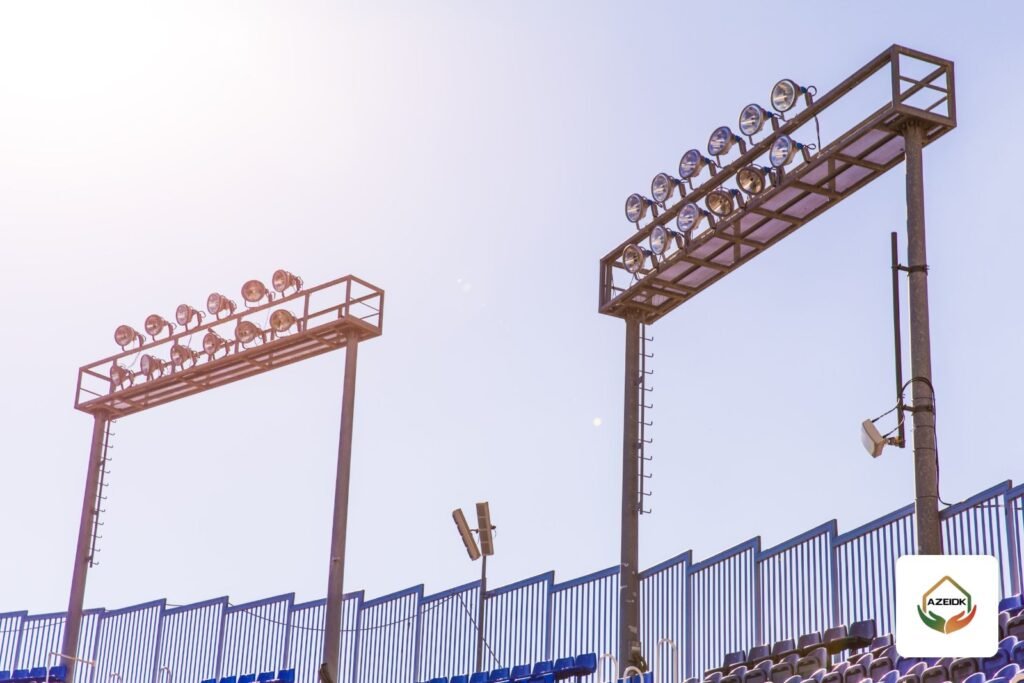
Low current systems for stadiums and sports facilities have to work on two very different days: a normal day with training, staff and maintenance, and a match or event day when thousands of spectators pass the gates in a short time and then leave together. Cameras, gates, PA, network and the control room must handle the second day without failing on the first. This guide sets out these systems for open stadiums, covered arenas and sports complexes in Saudi Arabia, and points to the detailed AZEIDK articles for each one.
AZEIDK designs, supplies and installs low current systems, security and surveillance systems and network and communication systems, and links them to the fire systems in the same project. For fire protection and evacuation in these venues, see fire protection for stadiums and event venues.
Key Takeaways
- Design starts from the peak day: number of gates, crowd routes and entry and exit time.
- Cameras cover the perimeter, gates, stands, corridors and car parks, managed from one control room.
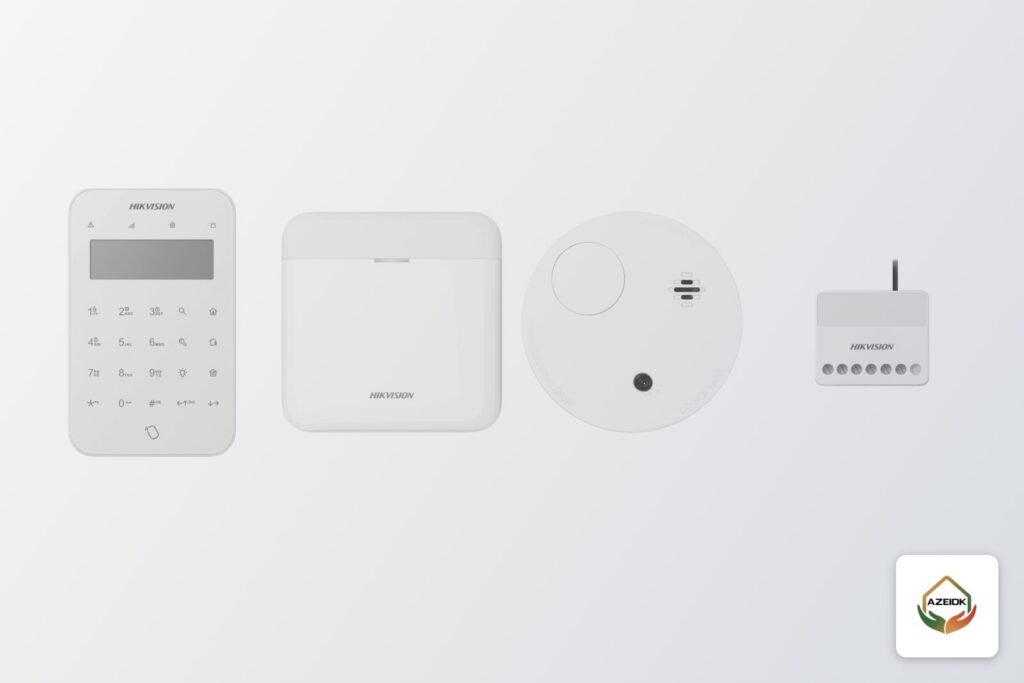
- Entry gates, metal detection and ticketing work together and release automatically on evacuation.
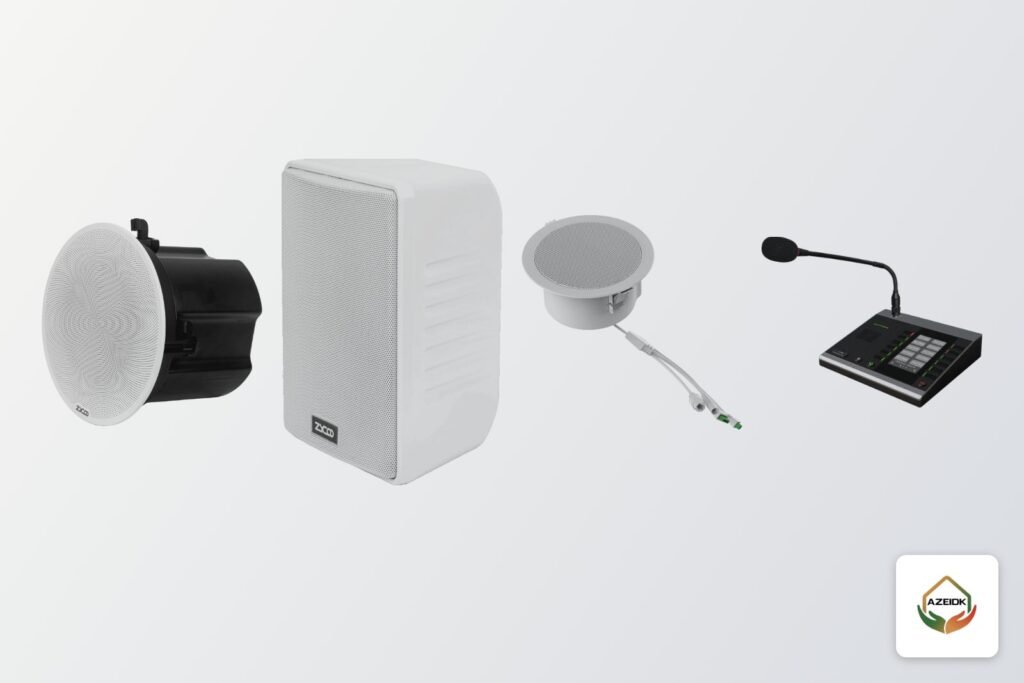
- PA in the stands needs high intelligibility against echo and noise, and links to the fire alarm.
- Fibre between buildings and a separate logical network per system, with separate public Wi-Fi if provided.
The Systems in a Sports Facility and What Each One Does
| System | Role in the stadium or arena | Detailed article |
|---|---|---|
| CCTV | Perimeter, gates, stands, service corridors and car parks, plus post-event review | Panoramic multi-lens cameras |
| Entry gates | Spectator and staff entry and zone separation | Pedestrian and vehicle gates |
| Metal detection | Screening at spectator gates and private entrances | Walk-through metal detectors |
| PA and voice evacuation | Announcements, crowd guidance and evacuation messages | Voice evacuation in sports halls |
| Car parks | Entry barriers, plate reading and vehicle guidance | Parking management and barriers |
| Network and Wi-Fi | Carries cameras and gates, plus admin and media networks | ELV network design |
| Fire alarm | Independent life safety system linked to PA and gate release | Fire alarm for sports halls |
CCTV: From the Perimeter to the Stands
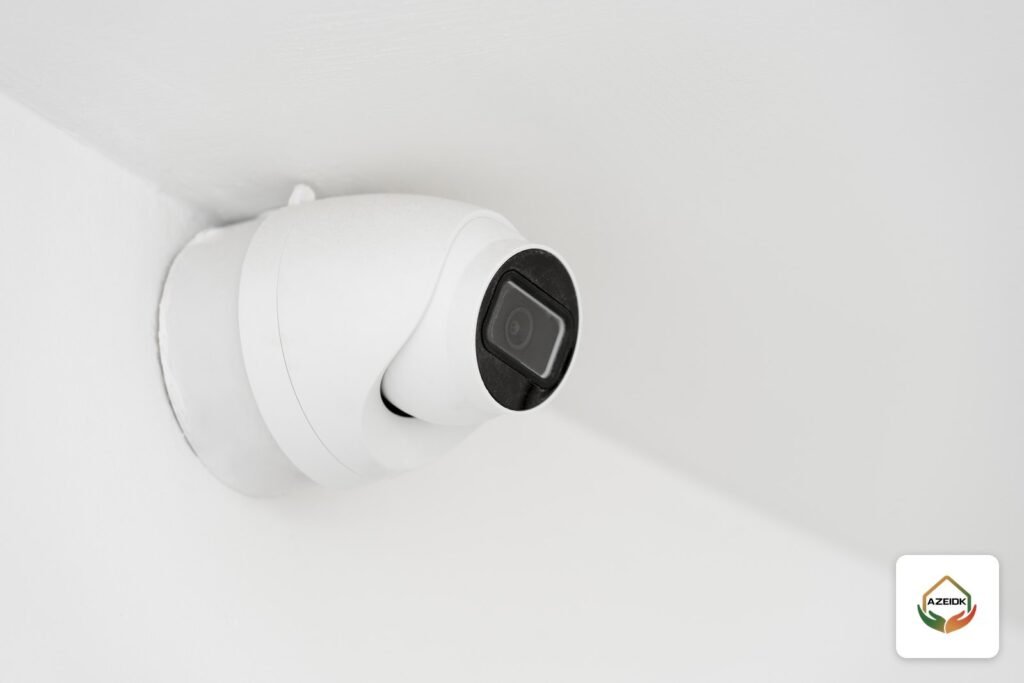
Camera layout in a stadium follows the crowd. On the outer fence and plazas, cameras on CCTV poles and PTZ cameras help follow gatherings. At the gates, fixed cameras are aimed to capture each entry lane. In wide stands, panoramic cameras reduce the number of points needed to cover a whole sector. Service corridors, players’ entrances, equipment rooms and server rooms also need coverage.
Recordings in a venue open to the public fall under the Saudi Security Surveillance Cameras Law for camera locations, retention and who may view footage, and cameras are never placed inside changing rooms or toilets. For smaller halls and clubs, CCTV for gyms covers the daily details.
Gates, Screening and Ticketing
On match day the gates are the narrowest point in the venue. The number of entry lanes is planned from the expected attendance and the time available before the event starts, and spectator entry is kept apart from staff, media and VIP entry. Turnstiles or speed gates read the ticket or card, with metal detection before them where needed. For daily clubs and halls, a member access control system with face or card is usually enough.
One rule does not change: emergency exits are never locked by the access system, and gates release automatically on a fire alarm signal so they do not block the way out. This interface is designed with the fire contractor and tested before handover.
PA in the Stands: Intelligibility Before Volume
Open stands and covered arenas are hard acoustic spaces: echo from roofs and hard surfaces, and loud crowd noise. The goal is a message people understand, not just a louder one. The PA is split into zones (stands, concourses, outdoor plazas, car parks), speakers and angles are chosen per zone, and speech intelligibility is tested before handover, as explained in PA installation and STI testing. If the PA carries evacuation messages, it must meet the requirements for voice evacuation systems and be linked to the fire alarm panel.
Network and Control Room
A stadium or sports complex is usually several buildings and spread-out plazas, linked by fibre to a main telecom room. The network is split logically: one network for cameras and gates, one for administration, one for media, and separate public Wi-Fi that cannot see security devices. In outdoor plazas, weatherproof outdoor access points help.
The security control room brings together camera screens, PA control, gate status and the fire alarm panel or its repeater, so the operations team sees the full picture on event day. Integrating these systems needs joint programming and testing, which is what the programming and systems integration service covers.
Open Stadium, Covered Arena or Club?
In an open stadium the work is mostly perimeter, plazas, car parks and large gates. In a covered arena, sound and detection under high roofs become the challenge, with fewer gates. A daily sports club is closer to a commercial building: cameras for reception and halls, member access control, simple PA and an admin network. In every case, maintenance between events is part of readiness, as covered in fire system maintenance for sports clubs.
Common Mistakes in Stadiums and Sports Facilities
- Sizing gates for normal days instead of event day.
- A loud PA that cannot be understood in the stands because of echo.
- Gates that do not release on fire alarm, or emergency exits locked by access control.
- Public Wi-Fi on the same logical network as security devices.
- A control room without a fire alarm repeater, so the team learns about a fire late.
FAQ
Can cameras, gates and IP PA share one network?
Yes, if the network is split into separate logical networks with rules that block traffic between them and the public network, as explained in the ELV network design article.
Does a normal PA replace voice evacuation in a stadium?
Not automatically. If the PA carries evacuation messages, it must meet the requirements for listed voice evacuation systems and be linked to the fire alarm panel.
How many cameras does a stadium need?
There is no fixed number. The layout and the number of gates, sectors and car parks decide it, and design starts with a site survey.
What should we send for a quote?
Architectural drawings, expected attendance, the list of gates and zones, and the BOQ if available. Details are in how to request a fire and low current systems quote.
Fitting out a stadium, arena or sports club? AZEIDK designs the cameras, gates, PA and network and links them to the fire systems in one design. Request a quote from AZEIDK
Related guides
- Monthly CCTV Check: In-House Checklist for Recording, HDD, Time and Night Image
- Dahua Camera Specifications: WizMind, WizSense, Lite and Full-color, 2/4/5 MP, HDCVI or IP, and Drawbacks
- Fire Systems Maintenance for Wedding Halls and Cinemas: Pre-Season Checks and Records for Salamah Renewal
- Voice Evacuation in Makkah Hotels and Pilgrim Housing: Multilingual Messages and Peak Crowds