Voice evacuation in Makkah hotels and pilgrim accommodation means every guest hears a short instruction they understand when the fire alarm operates, not just a tone. In practice that is a message in Arabic, then English, then the one or two languages most of your guests actually speak, played through speaker zones that match the fire zones so the building can be evacuated in phases at peak occupancy. It all sits on the building’s approved fire alarm system.
Key takeaways
- In a hotel with many nationalities, a single-language message is not enough. Pick languages from real booking data, not guesswork.
- Every added language lengthens the message cycle, so keep each version to a few short sentences and put the key instruction first.
- NFPA 72 Chapter 24 covers emergency voice communication and requires messages to be intelligible, not just audible.
- Phased evacuation in high-rise buildings needs pathway survivability under NFPA 72, and batteries for 24 hours of standby followed by 15 minutes at full load.
- Test every language in every zone at handover, and re-record when the guest mix changes.
In this article
- Why a tone is not enough in Makkah hotels and pilgrim housing
- What do the codes say about voice evacuation in hotels?
- How to choose the languages for voice evacuation messages in Makkah hotels
- Writing and recording the evacuation message in several languages
- Peak density in Hajj and Umrah seasons: zoning and phased evacuation
- Multilingual voice evacuation equipment: what AZEIDK supplies
- Common mistakes in pilgrim hotel voice evacuation
- Testing and handover before the season
- Frequently asked questions
- Conclusion
Why a tone is not enough in Makkah hotels and pilgrim housing
A sounder tells guests something is wrong. It does not tell them what to do. In a hotel near the Haram most guests stay only a few days, do not know where the stairs are, and many read neither Arabic nor English. When people hear a sound they cannot interpret, they stop and ask the person next to them. That hesitation is exactly what a voice system is meant to remove.
Pilgrims also tend to move in groups that follow a group leader. If the leader does not understand the message, the whole group waits. At peak season the rooms, corridors and lobby fill at the same time, so sending people to the right stair at the right moment matters more than turning the volume up.
Our voice evacuation (voice alarm) guide covers how these systems work and what they are made of. This article stays with what is specific to Makkah hotels and pilgrim accommodation: languages, crowd density and phased evacuation.
What do the codes say about voice evacuation in hotels?
Whether a voice system is required depends on occupancy classification, height, area and occupant load under the Saudi Fire Code (SBC 801) and the Saudi Building Code general requirements (SBC 201), together with Civil Defense requirements and the consultant’s specification. The 2024 edition of the Saudi Building Code became mandatory on 30 June 2025.
The Saudi Building Code is based on the International Codes (I-Codes) published by the International Code Council. In that model an emergency voice/alarm communication system is required, for example, in high-rise buildings and in assembly buildings with an occupant load of 1,000 or more. Many hotels in Makkah’s central area are towers, but whether the requirement applies to your building is for the consultant and Civil Defense to confirm.
On languages, we found no provision in the references we reviewed that sets a number of languages for an evacuation message. What NFPA 72 does require is that voice messages are intelligible in the spaces the design identifies. A message half the guests cannot understand fails that goal in practice, so the number of languages becomes a design decision agreed by the owner and consultant and recorded in the approval file. Preparing that file is part of our Civil Defense approval support.
How to choose the languages for voice evacuation messages in Makkah hotels
Start with last season’s booking data, or with the contracts the hotel holds with Hajj groups and Umrah agents. They show which nationalities stay most, and the languages follow from that. The list might include, for example, Urdu, Indonesian, Turkish, Persian or French, but the right list is your hotel’s own.
There is more than one way to deliver several languages, and each has limits:
| Method | How it works | When it fits | Watch out for |
|---|---|---|---|
| One message, languages in sequence | Arabic, then English, then one or two more, in a single repeating file | Most hotels with mixed guests | Cycle length: the more languages, the longer before the Arabic instruction repeats |
| Language by zone or floor | A different message per speaker zone | When whole groups of one nationality are housed on specific floors | Group allocation changes between seasons, so programming must be updated |
| Live announcement from the control room | A staff member who speaks the language uses the fire microphone | After the recorded message, to direct particular groups | Needs trained staff on every shift and does not replace the recorded message |
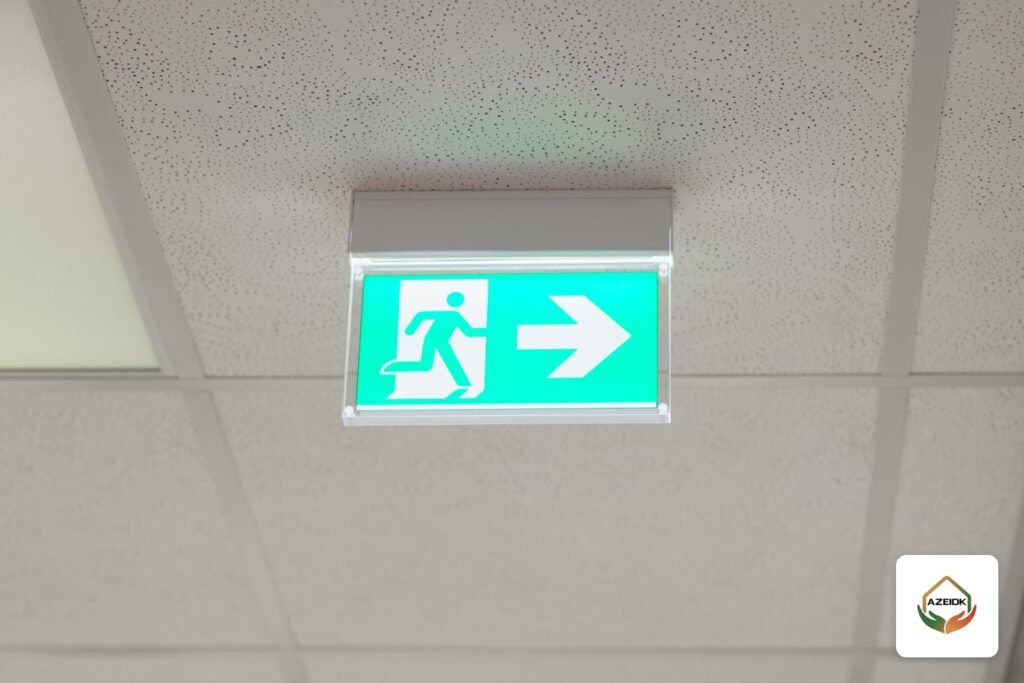
| Visual guidance | Illuminated exit signs, arrows and symbols on doors and stairs | Always, since it works with any language | Cannot tell guests which stair to use during phased evacuation |
Our recommended rule: two fixed languages (Arabic, then English) plus one or two from guest data in the general message. If the hotel needs more, assign them by zone or use them in live announcements, rather than a long message people stop listening to before it ends.
Writing and recording the evacuation message in several languages
A good message is short and starts with the action. You will usually need three separate messages, each in every approved language:
- Alert message: for unaffected zones, asking guests to stay where they are, get ready and wait for instructions.
- Evacuate message: for the fire zone and adjacent zones, asking guests to leave by the nearest emergency exit and not use the lifts.
- All clear message: announces the end of the emergency and is broadcast only on the emergency team’s decision.
When writing and recording:
- One instruction per sentence, starting with a clear verb: “Leave your room now”, “Use the stairs”, “Do not use the lift”.
- Do not use technical names such as “Zone 4” or “Stair B” unless guests can read them on the signs.
- Record each language with a native speaker at a calm pace, and check the translation with someone of that nationality, not a translation app.
- Start each cycle with a short alert tone, then the languages in the same order every time, so guests learn when their language is coming.
- Keep the written script for each language in the handover file, with the recording date and the name of the reviewer.
Peak density in Hajj and Umrah seasons: zoning and phased evacuation
In a full hotel tower, evacuating every floor at once fills every stair at the same moment. That is why many of these buildings are designed for phased evacuation: the fire zone and adjacent zones leave first, while other floors hear the alert message and wait their turn. This only works if speaker zones match the fire zones in the engineering design and calculations, and a cause and effect matrix links them to the fire alarm panel.
NFPA 72 (2025 edition) requires pathway survivability when a voice system uses partial evacuation or in-building relocation: Level 2 or 3 (two-hour rated cable or protection) in two-hour construction, or Level 4 in one-hour construction, with alternatives set out in the code. Cable selection follows the level, as our fire alarm cable and circuit integrity guide explains.
For secondary power, NFPA 72 requires the voice system to run for 24 hours in standby, then 15 minutes at maximum load. Designers usually add a margin for battery ageing. Note that a four-language message does not change amplifier load, but it does lengthen the broadcast time needed to deliver the full instruction.
Points specific to high crowd density:
- The lobby and hotel entrances need their own speaker zone, because they fill when buses arrive and when guests leave for prayer.
- The control room or security desk needs a fire microphone with priority over every audio source, and a remote paging station at reception helps.
- Group leaders should be briefed on arrival about the alarm tone and the meaning of the alert message, so they do not start evacuating before their turn.
- The written evacuation plan must match what the message says: the same assembly points and the same stairs.
Multilingual voice evacuation equipment: what AZEIDK supplies
AZEIDK works on both sides of this scope: the fire alarm system that triggers the event, and the audio system that broadcasts the message. On the audio side AZEIDK supplies the DSPPA PAVA9500, a rack-mounted voice alarm host combining an 8-zone, 500 W amplifier on 100 V lines, a message player and zone control, with main/backup amplifier switching.
From the manufacturer’s data, the points that matter for a multilingual hotel:
- Voice messages are stored as WAV files on an SD card, so you can load one file per language or a combined multilingual message.
- Eight dry contact inputs and eight outputs link to the fire alarm panel, so the message can be selected by zone.
- Speaker lines are monitored for open circuit, short circuit and earth faults, with a system fault relay and an emergency mode relay.
- Mains supply of 220–240 V AC with a 24 V DC input for batteries, and a PAVA9500E expansion unit that adds eight more zones.
The standard adopted for the project (NFPA 72, or EN 54-16 with BS 5839-8) determines which listings or approvals the controller and speakers need, so check the manufacturer’s documents against the consultant’s specification before the submittal. Other equipment is listed under public address and audio systems. AZEIDK’s scope covers technical selection, supply, installation, programming and testing as part of its hotel and hospitality solutions.
Common mistakes in pilgrim hotel voice evacuation
- A message in six or more languages, so guests wait a full minute to hear their own.
- Machine translation never checked by a native speaker, so the instruction arrives with a different meaning.
- A message that names an exit or assembly point not shown on the wayfinding signs.
- Speaker zones that no longer match fire zones after fit-out changes or floors converted to suites.
- Lobby music that keeps playing during the alarm because emergency priority was never programmed.
- Languages updated for a new season without re-testing intelligibility in each zone.
Testing and handover before the season
Speech intelligibility is the real test. It is usually measured with the Speech Transmission Index (STI) to IEC 60268-16, which defines the method but sets no pass value for a given building; the target comes from the adopted standard and the consultant’s specification. In a multilingual hotel there is one more practical check: a speaker of each language listens in the corridor, the room and the lobby and confirms they understood.
NFPA 72 Chapter 14, or the adopted British standard, sets the periodic inspection and testing requirements. A full test of messages and zones before each Hajj season is good practice, because hotels often carry out maintenance and refurbishment between seasons. AZEIDK’s testing, commissioning and handover service covers testing each zone, its link to the fire alarm panel, and the handover documents.
Frequently asked questions
Is voice evacuation mandatory in Makkah hotels?
It depends on occupancy, height, area and occupant load under SBC 801, SBC 201 and Civil Defense requirements. In the International Codes model that the Saudi code is based on, it is required in high-rise buildings, and many central-area hotels are towers. Your consultant confirms the requirement for your building.
How many languages does an evacuation message need in a pilgrim hotel?
We found no fixed number in the references we reviewed. The practical recommendation is Arabic, then English, then one or two languages from actual guest data. Further languages can be assigned by zone or used in live announcements.
Can the message languages change from one season to the next?
Yes, on systems that store messages as audio files, such as the DSPPA PAVA9500, which keeps them on an SD card. Any change needs intelligibility re-tested in the zones and the handover file updated.
Can the hotel’s existing sound system be used for evacuation?
Only if it is designed and approved for voice alarm duty, with monitored speaker lines, emergency priority over music and paging, and calculated standby power. An ordinary commercial sound system does not become a voice alarm system just by connecting it to the fire alarm panel.
What is the difference between the alert and evacuate messages?
The alert message asks people in unaffected zones to stay and get ready. The evacuate message asks people in the fire zone and adjacent zones to leave now. Separating the two is the basis of phased evacuation in crowded towers.
Who records the messages in guests’ languages?
Native speakers, using a script reviewed by the owner and the hotel’s safety officer. Choose a calm, clear voice, and keep the written script for each language with the recording date.
Conclusion
Voice evacuation in Makkah hotels and pilgrim housing works when every guest understands the instruction within a few seconds. Choose languages from your guest data, keep the message short, match speaker zones to fire zones and the evacuation plan, and test every language in every zone before the season.
Preparing a hotel or pilgrim accommodation for the season? Send the drawings and the expected guest mix, and the AZEIDK team will review speaker zoning, languages and the fire alarm interface. Talk to the AZEIDK team
Related guides
- Fire Extinguisher in Arabic: A Reverse Glossary of Fire Protection Terms for Procurement in Saudi Arabia
- Salamah Application Rejection Reasons: Common Civil Defense Licensing Mistakes and How to Fix Them Before Resubmitting
- Retrofitting a Sprinkler System in an Occupied Existing Building
- How to Verify UL, FM and LPCB Listings for Fire Equipment, Step by Step