Voice evacuation commissioning is the last step of a sequence that starts much earlier: dividing the building into speaker zones, running speaker lines in the right cable, installing amplifiers with a standby amplifier, linking the system to the fire alarm panel, and finally measuring speech intelligibility with the Speech Transmission Index (STI) before handover. Loudness alone is not enough. A message nobody can understand in an echoing corridor or a car park does not do its job. This article covers each stage and what is checked at acceptance.
Key takeaways
- Speaker zones follow evacuation zones and fire alarm zones, not just room layout.
- 100 V speaker line loads are calculated against amplifier power, and lines are monitored for short circuit, open circuit and earth fault.
- The fire alarm interface plays the evacuation message in the right zones automatically.
- Speech intelligibility is measured as STI, and IEC 60268-16 defines the measurement method.
- Annex D of NFPA 72 (2010 edition) gives an advisory acceptance criterion: an average of at least 0.50, with at least 90% of measurement points at 0.45 or more.
In this article
- How does PA installation differ from voice evacuation installation?
- What voice evacuation commissioning depends on before work starts
- Stage 1: speaker zoning
- Stage 2: speaker lines and cabling
- Stage 3: installing the main unit and amplifiers
- Stage 4: the fire alarm interface
- Stage 5: the STI speech intelligibility test
- Stage 6: final tests and handover
- Frequently asked questions
- Conclusion
How does PA installation differ from voice evacuation installation?
A public address (PA) system handles announcements, background music and paging. A voice evacuation system broadcasts emergency messages during a fire and gives them priority over any other audio. Many projects combine both in one PAVA system, and installation then falls under emergency system requirements: line monitoring, standby power, the fire alarm interface and message intelligibility.
When a voice evacuation system is required and why is covered in our article on voice evacuation alarm systems. This article is about delivery on site.
What voice evacuation commissioning depends on before work starts
Before procurement, the contractor collects the information the design and installation are built on:
- Architectural drawings and ceiling types (suspended or concrete) to choose speaker types and fixings.
- Fire alarm zones and the building’s approved evacuation plan.
- The nature of each space: offices, corridors, halls, car parks, plant rooms, and expected noise levels.
- The equipment room location and available cable routes between floors.
- Whether music and announcements are needed alongside emergency messages.
Stage 1: speaker zoning
A speaker zone is a group of speakers playing the same message at the same time. In phased evacuation, for example, the affected floor gets the evacuate message, adjacent floors an alert message and the rest of the building a standby message. Speaker zones are therefore drawn to match fire alarm zones and the evacuation plan, then subdivided where the space changes in character (offices, corridors, car parks, kitchens).
This is also when the designer identifies what NFPA 72 calls acoustically distinguishable spaces (ADS): spaces that differ in reverberation, noise or use. Each one is assessed on its own when intelligibility is measured later.
Stage 2: speaker lines and cabling
Most building systems use 100 V lines, with each speaker connected at a set power tap on its transformer. The total tapped power on a zone must stay below the amplifier output with a margin set by the designer. Cabling points to check:
- Fire-resistant cable for circuits that must keep working during a fire, as specified by the consultant and the code. Protected cable types are covered in our article on fire alarm cables and circuit integrity.
- Cable size to suit line length and load, so the far end of the line does not lose level.
- Speaker lines kept apart from power cables in shared trays.
- Every line and zone labelled at both ends for testing and maintenance.
Stage 3: installing the main unit and amplifiers
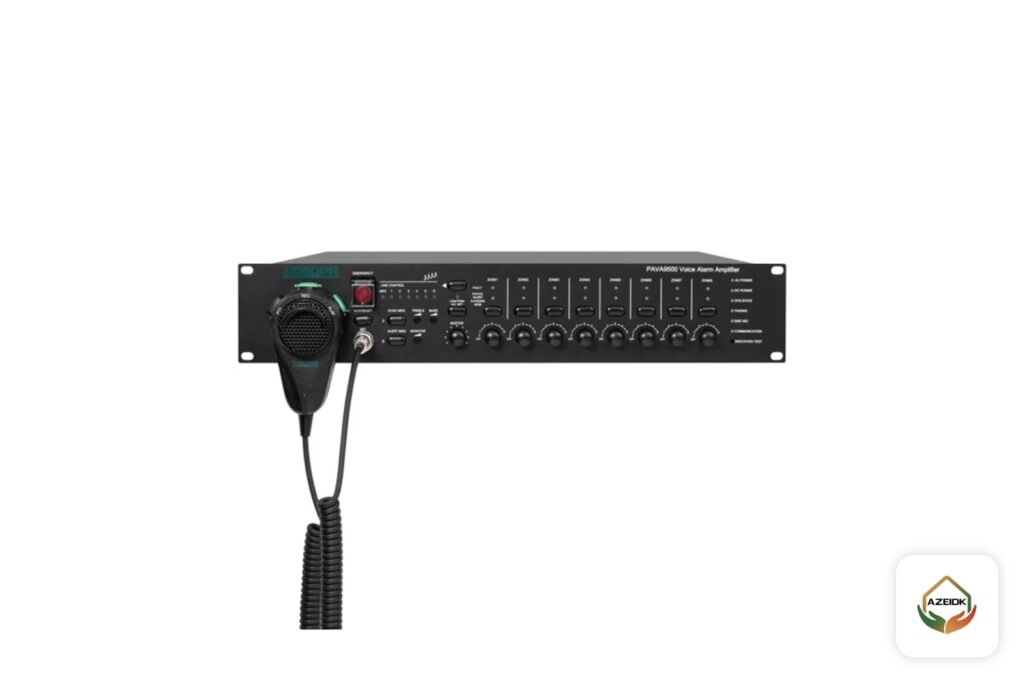
The main unit and amplifiers are installed in a cabinet in a suitable room with adequate ventilation, mains supply and standby batteries. One example is the DSPPA PAVA9500. Its AZEIDK page lists eight speaker zones, at least 500 W output on a 100 V line, speaker line monitoring for earth fault, open circuit and short circuit, main and backup amplifier switching, voice messages stored on an SD card, eight dry contact inputs and eight outputs for the fire alarm interface, and AC 220–240 V and DC 24 V supply. The PAVA9500E expansion unit adds eight more zones.
Project-specific requirements, such as the approvals required for the equipment, are set by the consultant and checked against the datasheet in the submittal. For more on the brand, see the DSPPA brand page.
Stage 4: the fire alarm interface
The simplest interface uses dry contact outputs from the fire alarm panel into the voice evacuation unit’s inputs. Each output represents an alarm zone and triggers a set message in set speaker zones. Larger systems may use a communication protocol between the two systems where both manufacturers support it. Either way, a cause and effect matrix is prepared: an alarm in zone X plays message Y in zones Z.
The matrix is programmed in the fire alarm panel and the voice evacuation unit together under our programming and systems integration service, then tested line by line.
Stage 5: the STI speech intelligibility test
The Speech Transmission Index is a value between 0 and 1 that measures how well speech is understood at a given point. The international standard IEC 60268-16 defines how it is measured, including the shortened STIPA method widely used on site with a handheld meter and a test signal played through the speakers.
According to SDM Magazine’s review of Annex D (D.2.4.1) in the 2010 edition of NFPA 72, the suggested acceptance criterion is an average STI of at least 0.50 in each acoustically distinguishable space, with at least 90% of measurement points at 0.45 or more. The annex is advisory; the value that applies to your project is set by the consultant in the specification, so check the edition in force. This is from the 2010 edition; newer editions have been issued since, the latest being the 2025 edition.
| Item | What is checked |
|---|---|
| Measurement points | A grid of points in each acoustically distinguishable space, at listener ear height |
| Test conditions | The space in near-normal operation (air conditioning running, normal noise) |
| Measured value | STI at each point and the average for the space |
| Corrective action | If the target is missed: adjust speaker taps, positions or quantity, then measure again |
Common causes of failure: a few high-power speakers in a reverberant space, speakers facing glass surfaces, and high background noise in car parks and plant rooms. That is why speaker layout should be reviewed before installation, not after the measurement.
Stage 6: final tests and handover
- Test every speaker zone with the recorded message and live paging from the microphone.
- Test line monitoring: open and short a line and confirm the fault shows on the unit.
- Test changeover to the standby amplifier and to batteries on mains failure.
- Test the cause and effect matrix with the fire alarm panel line by line.
- Hand over the STI report for each space, as-built drawings, the zone and speaker schedule with taps, datasheets and the operating manual.
These tests and documents are delivered under our testing, commissioning and handover service.
Frequently asked questions
What is an STI test?
A measurement with a handheld meter that gives a value from 0 to 1 for how well speech is understood at each point, using the method defined in IEC 60268-16. The higher the value, the clearer the speech.
What STI value should a voice evacuation system achieve?
Annex D of NFPA 72 (2010 edition) suggests an average of at least 0.50 with 90% of points at 0.45 or more in each acoustically distinguishable space. The binding value for your project is set in the specification.
Is turning up the volume enough for people to understand the message?
No. In reverberant spaces more volume adds more blur. The fix is usually more speakers at lower power and a better layout.
How is the PA system linked to the fire alarm?
Through dry contact outputs from the fire alarm panel or a communication protocol, following a cause and effect matrix that sets the message for each zone.
Can a voice evacuation system also play music and announcements?
Yes, in PAVA systems, as long as emergency messages automatically override all other audio and the lines stay monitored.
When should STI be measured?
After installation and finishes are complete and the air conditioning is running, because furniture, ceilings and real background noise all affect the result.
Conclusion
Installing a PA and voice evacuation system starts with speaker zones that match the evacuation plan, then calculated and monitored lines, amplifiers with standby, a documented fire alarm interface, and ends with an STI measurement that proves the message is understood. Planning these points early saves rework after the measurement.
Preparing to install or accept a PA and voice evacuation system? Send the drawings, the number of floors and the alarm zones, and our team will review the zoning and test plan with you. Talk to the AZEIDK team
Related guides
- CCTV Recorder (NVR or DVR): How to Choose Channels, Resolution, Hard Drive and PoE Ports with Hikvision Models
- Self Storage Security and Fire Protection: Alarm, Sprinklers, Tenant Access and CCTV
- Salamah Application Rejection Reasons: Common Civil Defense Licensing Mistakes and How to Fix Them Before Resubmitting
- Hikvision CCTV Settings: NVR Activation, Recording Schedule, HDD and Retention