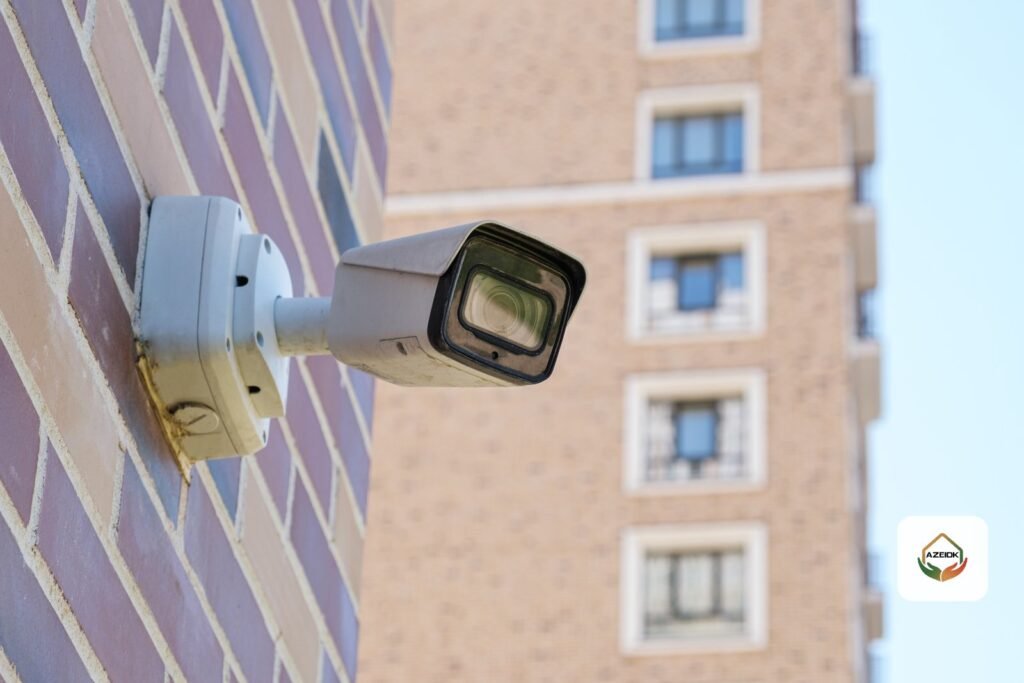
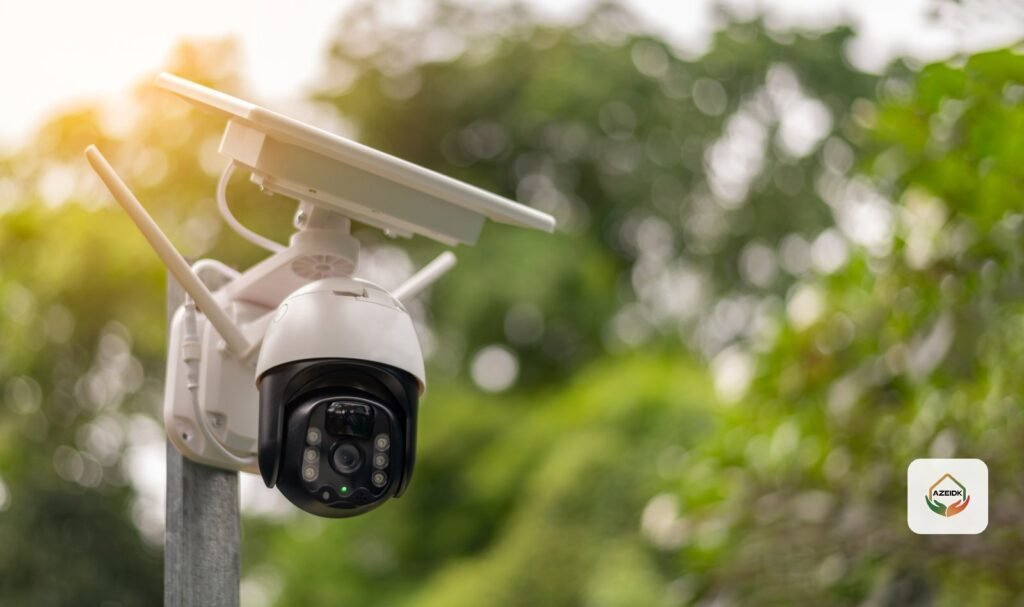
A single panoramic CCTV camera can cover up to 180° horizontally from one mounting point, replacing two or three fixed cameras at a car park entrance, the edge of a yard or a warehouse frontage. It does not replace them when you need a face or a number plate at distance. That is where multi-lens cameras and panoramic-plus-PTZ models come in.
This guide explains how stitched multi-sensor, fisheye and dual-lens cameras work, how to check pixel density before deciding, and which Dahua and EZVIZ models AZEIDK supplies through its security and surveillance systems in Saudi Arabia.
Key takeaways
- A panoramic camera saves mounting points and cabling, but it spreads its pixels across a wide angle, so detail falls off with distance.
- A multi-sensor camera such as the Dahua IPC-PFW81642-A180 (four 4 MP sensors) delivers a stitched 180° image at 16 MP.
- A panoramic PTZ such as the Dahua SDT4E425-8P-GB-APV1 pairs a 180° overview channel with a 25× optical zoom detail channel.
- EZVIZ multi-lens cameras (H80f, H9c, TY7) are Wi-Fi solutions for shops, villas and small yards, not large car parks.
- Base the decision on the pixel density needed at the farthest point that matters; the IEC 62676-4:2025 categories are a useful reference.
In this article
- What is a panoramic CCTV camera and how does it work?
- Panoramic plus PTZ: overview and detail at the same time
- EZVIZ multi-lens cameras for shops, villas and small yards
- Pixel density: when can one panoramic camera replace several?
- Where panoramic cameras fit in Saudi projects
- Mounting, network and storage: what changes with a panoramic camera?
- Checklist before requesting a panoramic CCTV camera quote
- Frequently asked questions
- Conclusion
What is a panoramic CCTV camera and how does it work?
“Panoramic” covers three different designs, each with its own use:
- Multi-sensor 180° (stitched): several sensors and lenses in one housing, each covering part of the scene, combined into one continuous image. Suited to yards, car parks and long façades.
- Fisheye: one very wide lens, usually ceiling-mounted, with software dewarping. Suited to lobbies, halls and open-plan shops.
- Multidirectional: several lenses that can each be aimed independently, for a corridor junction or building corner.
The Dahua WizMind Panoramic Series includes all three sub-series (Multi-Sensor 180°, Multidirectional and Fisheye) with WizMind deep-learning analytics. AZEIDK also lists the Dahua Panorama Series with its official catalogue for project-specific model selection.
Datasheet example: Dahua IPC-PFW81642-A180
The example model on the WizMind Panoramic page is a four-sensor panoramic bullet. According to Dahua’s official datasheet:
- 4 × 4 MP 1/1.8″ CMOS sensors, stitched output of 5520 × 2700 (16 MP).
- Fixed 2.8 mm F1.6 lens; 180° horizontal and 100° vertical field of view.
- IR range up to 30 m.
- Perimeter protection (tripwire, intrusion), vehicle density with parking-limit and congestion alarms, crowd map and people counting, and ePTZ.
- 12 VDC, 24 VAC or PoE+ (802.3at); IP67 and IK10; operating temperature −40 to +60 °C.
Panoramic plus PTZ: overview and detail at the same time
A conventional PTZ leaves the rest of the yard unwatched while it zooms in. Combined cameras solve this with two channels in one unit: a fixed panoramic channel that never loses the scene, and a PTZ channel that moves for detail.
AZEIDK supplies the Dahua 8MP+4MP 25× panoramic PTZ network camera (model SDT4E425-8P-GB-APV1, X-Spans series). Key data from its page:
| Item | Overview channel | Detail (PTZ) channel |
|---|---|---|
| Sensor | 1/2.7″ CMOS | 1/2.8″ CMOS |
| Resolution | 8 MP (4096 × 1860) | 4 MP (2560 × 1440) |
| Lens | 2.8 mm, F1.4 | 5–125 mm, F1.6–F3.6, 25× optical zoom |
| Field of view | H 180°, V 86° | Depends on zoom |
| IR range | 30 m | 100 m |
It supports IVS (tripwire, intrusion, loitering), WizTracking and relay tracking, runs on 12 VDC or PoE+ (802.3at) at up to 25 W, and is rated IP66 for −40 to +65 °C. In practice, when the overview channel detects a person or vehicle, the PTZ channel can be sent to it automatically while the wide view keeps recording.
EZVIZ multi-lens cameras for shops, villas and small yards
At a smaller scale, EZVIZ dual- and triple-lens cameras follow the same idea: a fixed wide lens watches the area while a pan-tilt lens follows the detected person. They are Wi-Fi cameras that record to microSD (up to 512 GB), with EZVIZ CloudPlay also supported on the H80f and H9c, and are managed from the app.
| Model | Use | Lenses and horizontal FOV | Resolution | Notes |
|---|---|---|---|---|
| EZVIZ H80f Multi 2K⁺ | Outdoor | 3 lenses: 2.8 mm (96°), 6 mm (52°), 12 mm (25°) | 2560 × 1440 | 12× hybrid zoom, 340° pan / 70° tilt, 30 m night vision, IP67 |
| EZVIZ H9c Dual 3K | Outdoor | 2.8 mm fixed (110°), 6 mm pan-tilt (56°) | 2880 × 1620 | 350° pan / 80° tilt, 30 m night vision, auto-tracking |
| EZVIZ TY7 Dual 2K⁺ | Indoor | 2.8 mm fixed (92°), 6 mm pan-tilt (51°) | 2560 × 1440 per lens | Dual-band Wi-Fi 6, RJ45 port, 10 m IR |
The H80f’s 12 mm lens narrows the view to 25° horizontally, putting the same pixels across a scene roughly five times narrower than the wide lens at the same distance. That is what gives clearer detail at a gate or the far end of a courtyard.
Pixel density: when can one panoramic camera replace several?
The real question is not “how wide is the view?” but “how many pixels land on the target at the farthest point that matters?”. IEC 62676-4:2025 defines operational categories in pixels per metre (px/m). As summarised in Axis Communications’ white paper on the 2025 edition, they include the following (based on an average face width of 16 cm; the highest, Scrutinize, is 1,500 px/m):
| Category (IEC 62676-4:2025) | Density | Pixels across a face |
|---|---|---|
| Overview | 20 px/m | 3 |
| Outline | 40 px/m | 6 |
| Discern | 80 px/m | 12 |
| Perceive | 125 px/m | 20 |
| Characterize | 250 px/m | 40 |
| Validate | 500 px/m | 80 |
Many specifications still use the earlier detect/observe/recognise/identify (DORI) terms, so make sure the technical offer states which category and which edition it means.
Illustrative example: a quick estimate from datasheet figures
Divide horizontal pixels by the horizontal field of view to get pixels per degree, multiply by 57.3 and divide by distance in metres. The figures below are our own illustrative calculation using this formula and the resolution and field of view in each datasheet, not manufacturer-published values. They assume a target in front of the camera and ignore lens distortion and stitching overlap, so use them only for a first comparison and confirm the design with the manufacturer’s design tool or a site test:
| Camera / lens | At 10 m | At 20 m | At 30 m |
|---|---|---|---|
| IPC-PFW81642-A180 (5520 px over 180°) | ≈ 176 px/m | ≈ 88 px/m | ≈ 59 px/m |
| SDT4E425 overview (4096 px over 180°) | ≈ 130 px/m | ≈ 65 px/m | ≈ 43 px/m |
| H80f 2.8 mm lens (2560 px over 96°) | ≈ 153 px/m | ≈ 76 px/m | ≈ 51 px/m |
| H80f 12 mm lens (2560 px over 25°) | ≈ 587 px/m | ≈ 293 px/m | ≈ 196 px/m |
Reading the table: a 16 MP panoramic camera reaches roughly the Discern level out to about 20 m, enough to follow movement across the whole yard, but it only reaches Characterize for facial detail very close to the camera. A panoramic camera replaces several fixed cameras when the goal is situational awareness, not when the goal is identifying a face or a plate at a specific point.
Where panoramic cameras fit in Saudi projects
- Open car parks: a panoramic camera on a pole or façade to see rows of cars and traffic flow, with a dedicated camera at the gate or barrier for plates.
- Warehouse yards and loading docks: an overview of the whole yard with an integrated PTZ to follow a truck or person. Zoning advice is in our warehouse CCTV guide.
- Lobbies, showrooms and open shops: a ceiling fisheye or an indoor dual-lens camera such as the TY7.
- Villas and small shops: an H9c or H80f to cover the courtyard and entrance with one Wi-Fi camera.
When are separate fixed cameras still better?
- Where you need clear faces at entrances, tills and safes.
- For number plate capture, which needs a dedicated camera with a calculated angle and lens.
- In long racking aisles, where a camera at the aisle end gives higher density along its length.
- Where columns, racking or parked trucks block the view from a single point; a wide angle cannot show what the camera cannot see.
Mounting, network and storage: what changes with a panoramic camera?
Mounting point: a multi-sensor camera is usually best placed mid-way along the long side of the yard or at a corner with a clear 180° view. Choose a height that reduces people and vehicles hiding one another without pushing targets so far away that pixel density drops. A fisheye goes on the ceiling and is set to that mounting mode in software.
Power: both Dahua models run on PoE+ (802.3at), with maximum draw of 25 W for the SDT4E425 and 24.2 W on PoE for the IPC-PFW81642-A180. Include this in the switch power budget.
Recording and storage: a 16 MP stitched image, or two channels in one unit, means a higher bitrate than a standard camera. Both Dahua cameras support Smart H.265+; confirm that the NVR supports the stitched resolution and channel count before purchase. Size storage with our storage and bandwidth calculation guide.
Checklist before requesting a panoramic CCTV camera quote
- Define the goal for each zone: overview, discerning people, facial detail or plates.
- Measure the farthest relevant point from the proposed mounting position and calculate pixel density there.
- Ask for the official datasheet and check horizontal pixels and actual field of view.
- Walk the site to check obstructions and blind angles.
- Confirm that the NVR and video management software support the stitched image and analytics.
- Calculate PoE power, bandwidth and storage for the retention period the project requires.
Frequently asked questions
Is one panoramic CCTV camera enough for a whole car park?
It is often enough to watch general movement in an open car park without major obstructions, but plate capture at the gate needs a dedicated camera.
What is the difference between a panoramic and a fisheye camera?
A stitched panoramic camera uses several sensors for a 180° image and is usually wall- or pole-mounted. A fisheye uses one very wide lens on the ceiling with software dewarping.
Is a panoramic PTZ better than a standard PTZ?
In yards, usually yes: its panoramic channel stays on the whole scene while the PTZ channel zooms in, so the overview is never lost.
Can an EZVIZ dual-lens camera cover a warehouse?
It suits an office or small entrance. Warehouse yards and large car parks need professional network cameras such as the Dahua panoramic models with an NVR.
How many megapixels does a panoramic camera need?
Do not choose by megapixels alone; calculate pixels per metre at the farthest point that matters. For example, 16 MP across 180° gives roughly 88 px/m at 20 m by this estimate.
Conclusion
A panoramic camera is not a blanket replacement for fixed cameras; it is a tool for covering wide areas from one point. Pair it with a PTZ channel where you need to follow moving targets and with dedicated cameras where you need faces and plates, and base the decision on pixel density rather than field of view alone.
Planning surveillance for a car park or warehouse yard? Send us the site plan, distances and the goal for each zone, and we will propose a layout of panoramic and fixed cameras with datasheets and a storage calculation. Talk to the AZEIDK team
Related guides
- Fire Protection and Safety Companies in Riyadh: A Practical Selection Guide
- NFPA 2001 Guide: Clean Agent Systems Standard, 2025 Edition
- Shurjoint Grooved Couplings for Fire Systems: Couplings, Fittings and Valves, Pressures, Approvals and Selection
- Salamah Certificate from Civil Defense: What It Is and How to Get It on the Salamah Platform