A facility metal detector is not the hobby device used to find gold in sand, but an entrance screening tool: a walk-through gate for visitors and a handheld detector to complete the search after an alarm. It is used at government buildings, event halls, venues and any facility that screens people before entry. This guide explains the difference between the gate and the handheld unit, where each fits, and how they connect with access control and CCTV.
AZEIDK supplies walk-through metal detector gates and handheld detectors as part of its low current systems, integrated with security and surveillance systems, turnstiles and access control to suit each project.
Key points
- The gate screens people as they walk through; the handheld unit locates the item after an alarm.
- Best practice is both: the gate for fast sorting, the handheld for confirmation.
- Gate sensitivity is set for what must be detected; too high means false alarms and slow entry.
- Large metal near the gate, such as metal doors and reinforced floors, affects performance.
- Busy entrances need clear lanes before and after the gate and a tray for personal items.
Walk-through metal detector: how it works
A walk-through gate is a frame that generates a magnetic field and alarms with sound and light when a metal object above the set threshold passes. Many gates split the frame into detection zones at different heights, showing whether the item is at shoulder, waist or foot level, so the officer goes straight there with the handheld unit.
A recognised performance standard is NIJ Standard-0601.02 from the US National Institute of Justice. It sets requirements for detection sensitivity, speed, repeatability and discrimination, and interference tests near a metal wall, over a steel-reinforced floor and beside a moving metal door, which is why placement matters as much as the device.
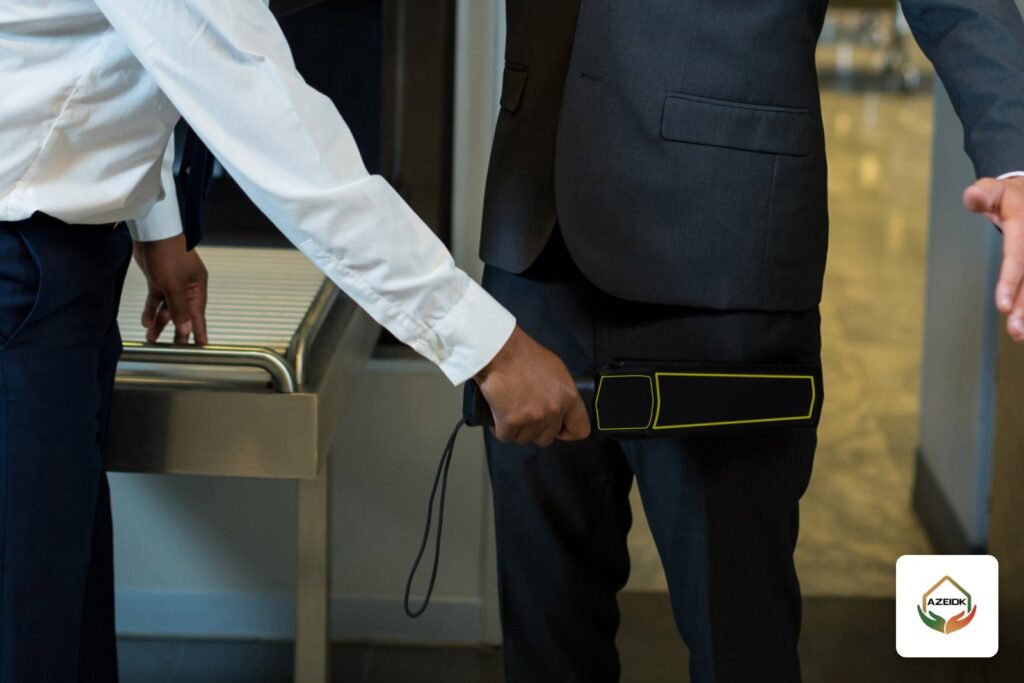
Handheld metal detector: when you need it
A handheld detector is passed close to the body and beeps or vibrates near metal. It is too slow to replace a gate at busy entrances, but it is essential:
- After a gate alarm, to locate the item instead of searching the whole person.
- At small or temporary entrances that cannot take a fixed gate.
- At events with changing entry points and mobile screening teams.
Where metal detector gates are used
| Facility | Typical solution |
|---|---|
| Government buildings and service centres | Gate at the visitor entrance with a handheld unit, before access control |
| Event and conference halls | Gates sized to peak lanes, handheld units for the team |
| Venues and stadiums | Several gates side by side, handheld units at secondary entrances |
| Sensitive industrial facilities | Gate at the personnel entrance, linked to CCTV |
Government buildings in particular need the whole entrance designed: screening, reception, then turnstiles. See access control for government buildings.
Installation and integration
- Location: away from moving metal doors, large metal structures and power cables, on a stable floor.
- Lane: barriers that guide visitors to the gate and a tray for keys and phones before it.
- CCTV: a camera covering the checkpoint to record what happens at an alarm.
- Entry: after screening come turnstiles or access-controlled doors. See also the access gates guide.
- Calibration: set sensitivity at commissioning, test periodically with a test piece and train the screening team.
Frequently asked questions
Walk-through gate or handheld detector?
The gate screens people quickly as they pass; the handheld unit locates metal after an alarm or at small entrances.
Why does the gate alarm for no reason?
Usually sensitivity set too high, or large metal objects or moving doors near the gate.
How many gates does a hall need?
It depends on peak visitor numbers and screening time per person; lanes are calculated when the entrance is designed.
Should the gate be linked to CCTV?
Covering the checkpoint with a camera is recommended to record alarms and entry.
Does a metal detector find non-metal items?
No. It detects metal objects only; non-metal items need other screening methods.
Planning a screened entrance? Tell us the facility type and expected visitors, and AZEIDK will recommend gates, handheld units and integration with CCTV and access control. Contact AZEIDK
See the fire alarm panels and systems AZEIDK supplies.
Related guides
- Barbershop and Women’s Salon Safety Requirements in Saudi Arabia
- Solar Farm Security Cameras: Thermal Perimeter Protection, PTZ and NVR for Remote Sites
- CCTV Poles: Height, Concrete Base, Cable Routing and Earthing for Car Parks and Perimeters
- Fire Sprinkler Pressure Gauges and Fire Pump Pressure Switches: Selecting WIKA 111.10SP, AGF 7500 and PSM-520