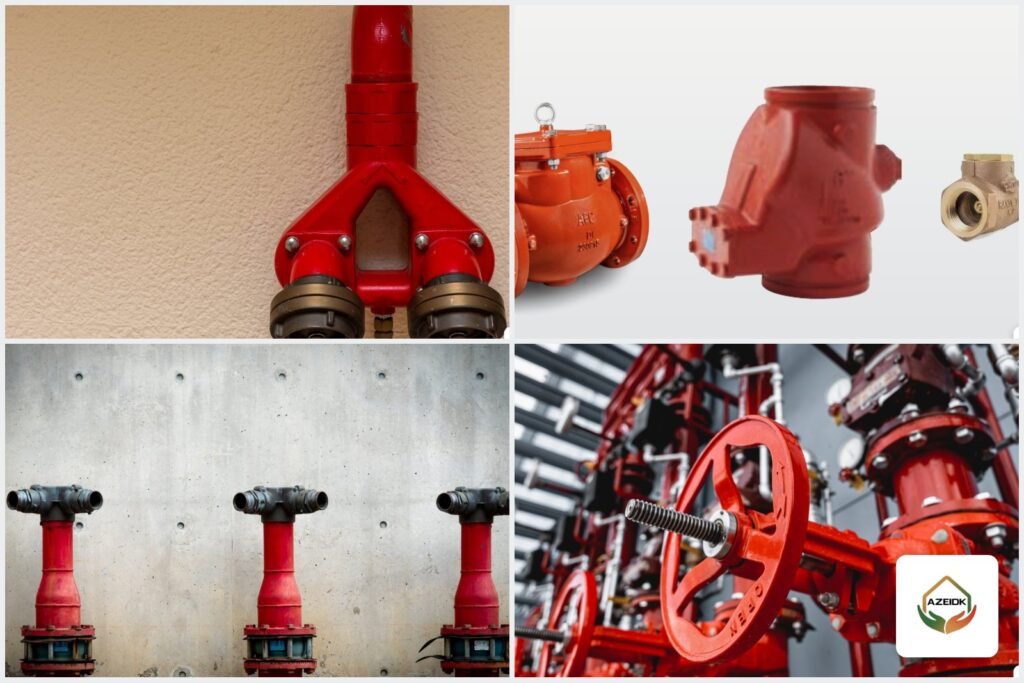
Fire fighting terms are the first thing an owner or buyer meets in a bill of quantities, a quotation or a Civil Defense visit: Siamese connection, check valve, jockey pump, ESFR, PRV. This glossary explains each term in two lines, with the name as it appears in datasheets and drawings, and links to the detailed AZEIDK guide.
Terms are grouped by where they sit in the network: water supply and pumps, valves, sprinklers, special water-based systems, and finally building connections and Civil Defense. For extinguisher names and parts, see the fire extinguisher glossary.
Key points
- Siamese is the common name for the fire department connection on the building facade.
- A check valve stops water flowing back and is fitted on the pump discharge and the Siamese line.
- The jockey pump keeps the network pressurised so the main pump does not start without need.
- ESFR sprinklers are for high-piled storage warehouses; a PRV protects the lower floors of towers.
Water supply and fire pumps
Fire pump
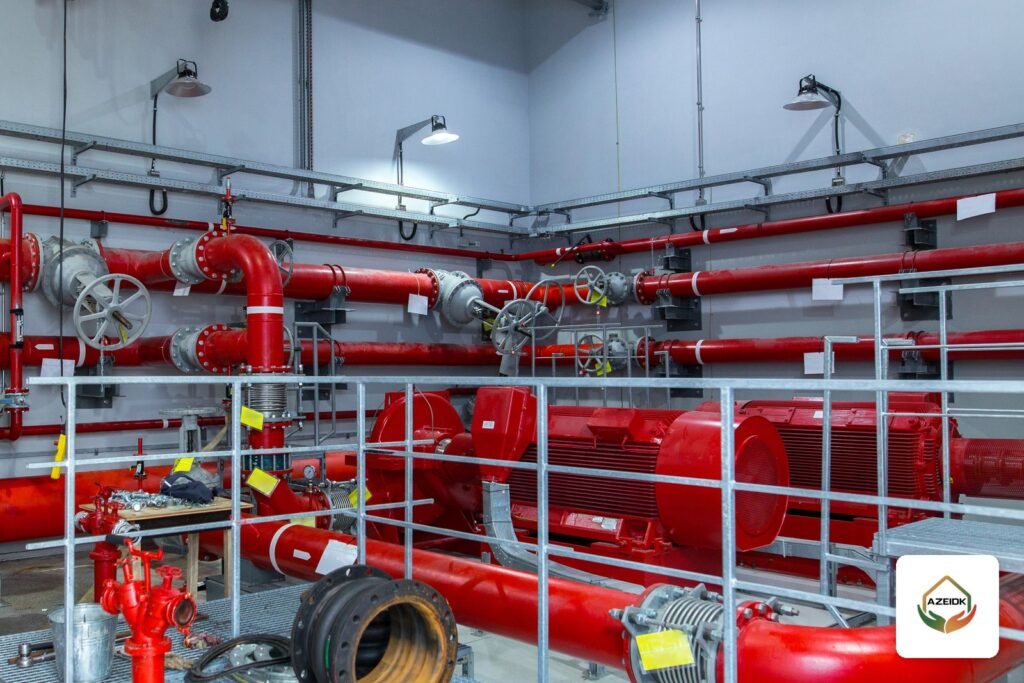
The pump that raises water pressure and flow from the tank to the sprinkler network and hose cabinets as the design requires; many owners in Saudi Arabia call it the “civil defense pump”. A set usually has an electric or diesel main pump, a jockey pump and a controller for each pump. Details are in fire pump types and selection.
Jockey pump
The smallest pump in the fire pump room and the one that runs most often. It keeps the network pressurised in normal times so the main pump does not start because of a small leak or a pressure swing; its start and stop pressures are set from the main pump churn pressure. Details are in jockey pump sizing and pressure settings.
Fire pump controller
Called the “pump panel” or simply “the controller” on site. It decides to start the pump the moment network pressure drops and keeps it running despite faults that would stop any other motor, so it is not treated as an ordinary electrical panel; there are electric and diesel types. Details are in fire pump controller types and selection.
Electric or diesel fire pump
Both do the same job: deliver the flow and pressure the fire network needs. An electric pump depends on a reliable, protected power supply, while a diesel pump carries its own fuel but needs a larger room, batteries, cooling, an exhaust and more frequent test runs. Details are in electric vs diesel fire pumps.
Pressure sensing line
The small pipe that carries discharge pressure to the pressure switch or transducer inside the pump controller, which bases its start decision on it. A leak, blockage or trapped air in it, or a wrongly set relief valve, shows up on site as frequent pump starts. Details are in the pressure sensing line and relief valve.
Fire water storage tank
The water source that sprinklers, pumps and hose cabinets rely on in most Saudi projects. NFPA 22 covers the tank types, and the effective capacity is calculated so the pump does not stop before the design duration ends. Details are in fire water storage tanks to NFPA 22.
Valves
Check valve (non-return valve)
Lets water pass in one direction only and closes automatically when flow stops or reverses. It is fitted on the fire pump discharge, on the bypass line, on the fire department connection line and at every additional water source. Details are in the swing check valve in a fire network.
Alarm check valve
A check valve at the base of the riser in a wet sprinkler system. It stops water flowing back to the supply and gives a mechanical and electrical alarm when any sprinkler opens. Details are in the ACV-300 wet alarm check valve.
OS&Y gate valve
A control valve whose position can be seen at a glance: the stem rises when it opens and drops when it closes. It is usually fitted with a tamper switch that tells the fire alarm panel if the valve is closed. Details are in OS&Y gate and ball valves.
Pressure reducing valve (PRV)
The valve that lowers water pressure to a safe level before it reaches sprinklers or hose outlets on the lower floors of towers and high-rise buildings. It is usually needed when network pressure exceeds the component rating (175 psi for most sprinkler components) or the limit at the hose outlet. Details are in the fire pressure reducing valve.
Zone control valve assembly
A small assembly on the riser at each floor: a supervised valve that isolates the floor, a flow switch that sends the alarm signal, a gauge, a test and drain valve and a check valve. It tells the fire alarm panel which floor a sprinkler is flowing on. Details are in the sprinkler zone control valve assembly.
Test and drain valve
A small part of the sprinkler network, but it is how you prove the waterflow alarm really works when one sprinkler operates, and how a section of the network is drained before maintenance. Details are in the test and drain valve.
Sprinklers
Automatic sprinkler system
A pipe network fitted with heat-operated sprinklers. In the common wet system the pipes are full of water and each sprinkler opens on its own above the fire to control or extinguish it and raise the alarm; the sprinklers do not all open together. Details are in fire sprinklers and automatic sprinkler systems.
ESFR sprinkler
Short for Early Suppression Fast Response. A large-orifice ceiling sprinkler designed for high-piled storage warehouses, able to suppress the fire from the ceiling for many storage arrangements within the limits set by the standard. Details are in the ESFR sprinkler for warehouses.
Upright and pendent sprinklers
The difference is the installed position and deflector shape. An upright sprinkler sits above the pipe with its deflector facing up and suits exposed pipework; a pendent hangs below the pipe and comes through a suspended ceiling. One cannot be fitted in place of the other. Details are in upright vs pendent sprinklers.
Concealed sprinkler
A pendent sprinkler whose body sits above the suspended ceiling, covered by a flat cover plate that drops at a temperature below the sprinkler rating; the deflector then drops and the sprinkler operates. It is chosen for architectural ceilings in hotels, offices and hospitals. Details are in the concealed sprinkler.
Sidewall sprinkler
A sprinkler mounted on the wall close to the ceiling that throws water horizontally into the room. It is used where running pipe over the ceiling is difficult, as in hotel rooms, apartments and corridors. Details are in the sidewall sprinkler.
Water motor gong
A mechanical bell on the outside wall near the alarm valve station. It rings by the force of the water itself, with no electricity, for as long as water flows when any sprinkler operates, taking water from the alarm port of the wet alarm valve. Details are in the water motor alarm gong.
Special water-based systems
Deluge system
A dry pipe network ending in open sprinklers or nozzles. A deluge valve holds the water back and opens only on a signal from a separate detection system or by manual release, so water flows from every outlet at once. Details are in the deluge system and valve.
Pre-action system
A sprinkler system whose pipes stay empty and filled with supervised air. Water enters only after the detection system opens the main valve, or after detection plus an opened sprinkler in the double-interlock type. It is chosen where accidental discharge is costly, such as server rooms and archives. Details are in the pre-action sprinkler system.
Dry pipe valve
The valve that holds water back from a sprinkler network filled with pressurised air and opens when air pressure drops as a sprinkler opens. Its key maintenance item is the trip test, because it can sit for years without operating. Details are in the dry pipe valve trip test.
Drencher system (water curtain)
A network of open nozzles connected to a deluge valve that all discharge at the same moment to form a continuous water layer over a facade, an opening or a tank surface. Its aim is to stop fire spreading from a neighbouring area by cooling the exposed surface, not to put out a fire inside. Details are in the drencher water curtain system.
Building connections and Civil Defense
Fire department connection (Siamese)
Known on the market as the “Siamese”. A water inlet on the building facade or on site where Civil Defense trucks connect their hoses to pump water into the sprinkler or standpipe network. It has 2½-inch capped inlets, a check valve on the incoming line, an automatic drip and a sign naming the system it feeds. Details are in the fire department connection guide.
Wet and dry riser (standpipe)
Two ways of getting firefighting water to floor outlets in multi-storey buildings. A wet riser is always full and connected to a water source and pump; a dry riser is empty until Civil Defense pumps into it through the Siamese connection. Details are in wet and dry risers.
Fire hydrant and landing valve
A hydrant is an outdoor water outlet on the site underground fire main where Civil Defense connects its hoses. A landing valve is a hose valve on the standpipes inside the building, usually in stair cores, for firefighters to connect their hoses on each floor. Details are in fire hydrants and landing valves.
Fire hose cabinet
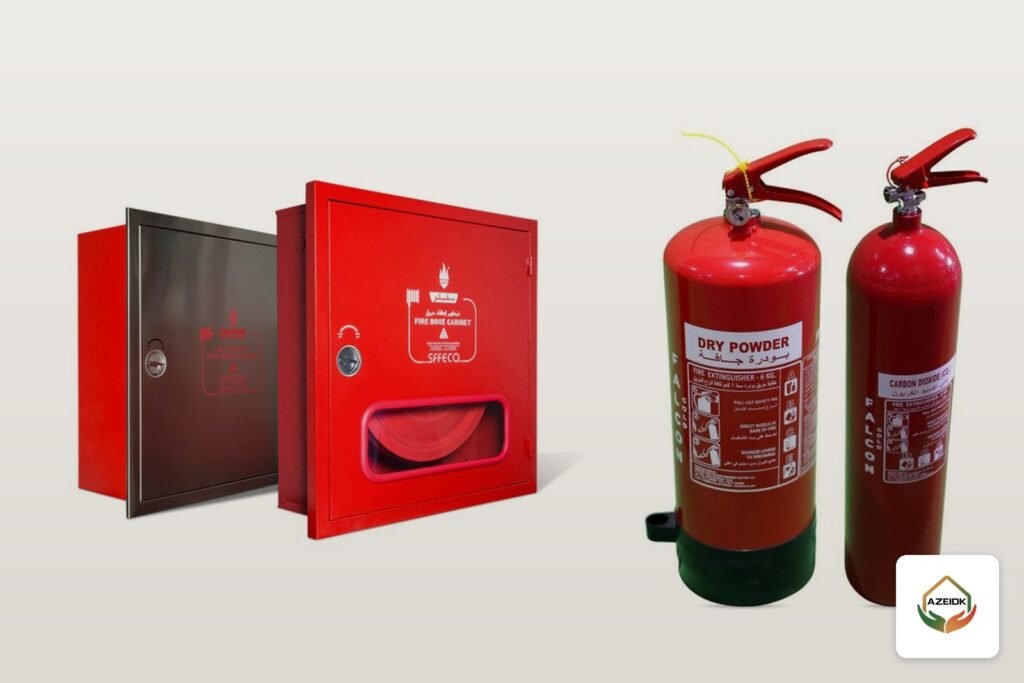
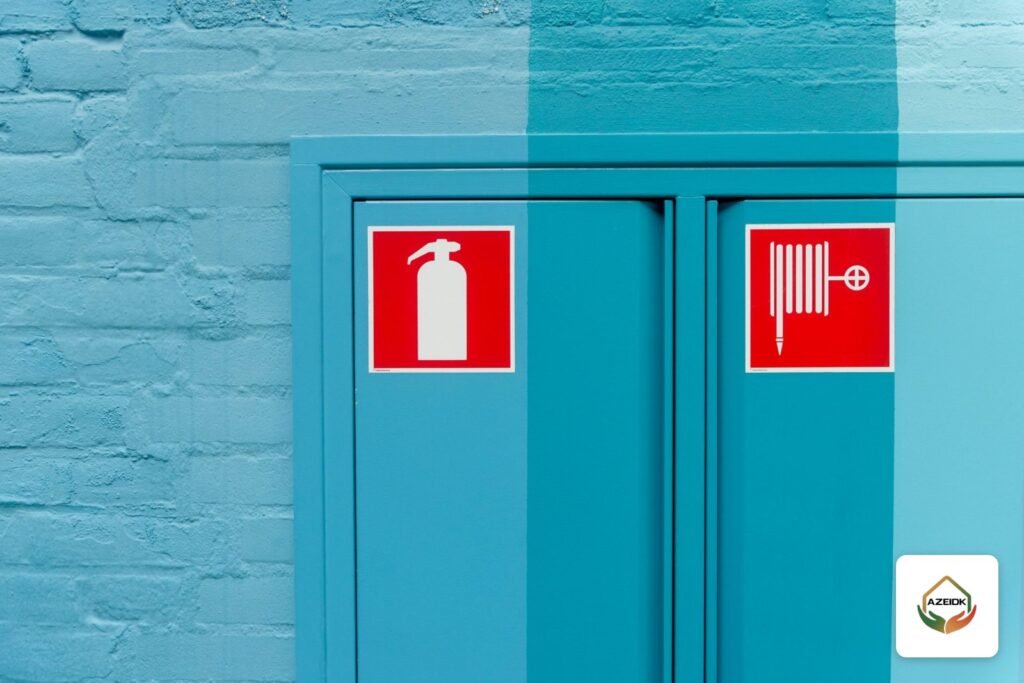
A wall-mounted metal cabinet holding first-aid firefighting equipment: a hose reel or racked hose, a 1.5 or 2.5 inch valve, a nozzle and sometimes an extinguisher. Its type follows the NFPA 14 system class (Class I, II or III) and the mounting method. Details are in fire hose cabinet types and sizes.
Hose reel
The first water-based firefighting tool an occupant reaches before Civil Defense arrives: a semi-rigid hose wound on a rotating reel and permanently connected to the water network; you pull out the length needed and open the nozzle. EN 671-1 sets its lengths, diameters and flow. Details are in the fire hose reel.
Hydrostatic pressure test
Filling the network with water before handover and raising it to 200 psi for two hours with no pressure drop or visible leak, or to 50 psi above working pressure where that exceeds 150 psi; this is the reference value in NFPA 13, NFPA 14 and NFPA 24. Details are in the fire network hydrostatic test.
Fire fighting drawing symbols
The shared language of designer, contractor, consultant and Civil Defense reviewer: each symbol identifies a component and its location and must appear in the legend. The US reference for standard symbols is NFPA 170. Details are in fire fighting drawing symbols.
Frequently asked questions
What is the difference between a Siamese connection and a dry riser?
The Siamese is the inlet on the facade where Civil Defense trucks connect their hoses; the dry riser is the empty vertical pipe inside the building that this inlet feeds.
Is a check valve the same as a wet alarm check valve?
The wet alarm check valve is a special check valve at the base of the sprinkler riser that also gives an alarm when a sprinkler opens; an ordinary check valve only prevents backflow.
Do all sprinklers open together in a fire?
Not in a wet system: each sprinkler opens on its own by heat above the fire. In deluge and drencher systems the outlets are open, so water flows from all of them together.
Where can I find datasheets for these products?
On the product pages and guides linked from each term; datasheets and approval documents for your project can be requested from the AZEIDK team.
Have a bill of quantities with unclear terms? The AZEIDK team reviews the items and proposes suitable equipment through our fire fighting systems, technical selection of systems and equipment and technical supply services. Request a quote
Related guides
- Fire Alarm Spare Parts: Matching Detectors, Sounders and Batteries to Your Existing Panel
- Lift Shaft Pressurization: Required Pressure Difference, a Fan per Shaft, Door Testing and Fire Alarm Interface
- Saudi Quality Mark for Fire Equipment: What It Is and How It Relates to the SABER Certificate of Conformity
- Hikvision Cameras: ColorVu, AcuSense, DarkFighter and Pro Series Explained, and How to Choose the Right Model