Sprinklers, fire pumps and hose cabinets all depend on one water source, and on most Saudi projects that source is a fire water storage tank. If the tank is undersized, or its suction outlet is badly designed, the pump can run dry before the system reaches the duration it was designed for.
This article explains the tank types covered by NFPA 22, how required and effective capacity are calculated, the essential connections and accessories, and what is inspected once the tank is in service.
Key takeaways
- NFPA 22 is the standard for water tanks for private fire protection. Its current edition is 2023, and it covers tank design, construction, installation, maintenance and accessories.
- Required capacity is roughly the sprinkler demand plus hose allowance, multiplied by the duration set by NFPA 13 or the governing standard.
- Water below the anti-vortex plate does not count toward the required capacity.
- Tank level is monitored by a supervisory alarm at the fire alarm panel, and NFPA 25 inspection frequencies depend on whether that alarm exists.
- The Saudi Fire Code SBC 801 and Civil Defense are the reference for acceptance, and larger volumes than the standard’s minimum may be required.
In this article
- The reference framework for fire water tanks
- Tank types and construction materials
- Calculating fire water tank capacity
- Effective capacity and dead storage
- Essential connections and accessories
- Inspecting and maintaining fire water tanks to NFPA 25
- Common mistakes with fire water tanks
- How AZEIDK can help
- Frequently asked questions
- Conclusion
The reference framework for fire water tanks
NFPA 22, the Standard for Water Tanks for Private Fire Protection, sets requirements for the design, construction, installation and maintenance of tanks and the accessory equipment that supplies water-based fire protection systems. It works with three other standards: NFPA 13, which sets sprinkler demand and duration; NFPA 20, which governs the connection between the tank and the fire pump; and NFPA 25, which sets inspection and maintenance once the tank is in service.
In the International Fire Code (2024 edition, per the Clark County Fire Department guideline), Section 507.2.2 refers the installation of fire water tanks to NFPA 22. Because the Saudi Fire Code SBC 801 follows the IFC arrangement, check the corresponding text in the Saudi edition adopted for the project. Civil Defense remains the authority that accepts the design, and NFPA standards are technical references the designer adopts rather than binding texts on their own.
Tank types and construction materials
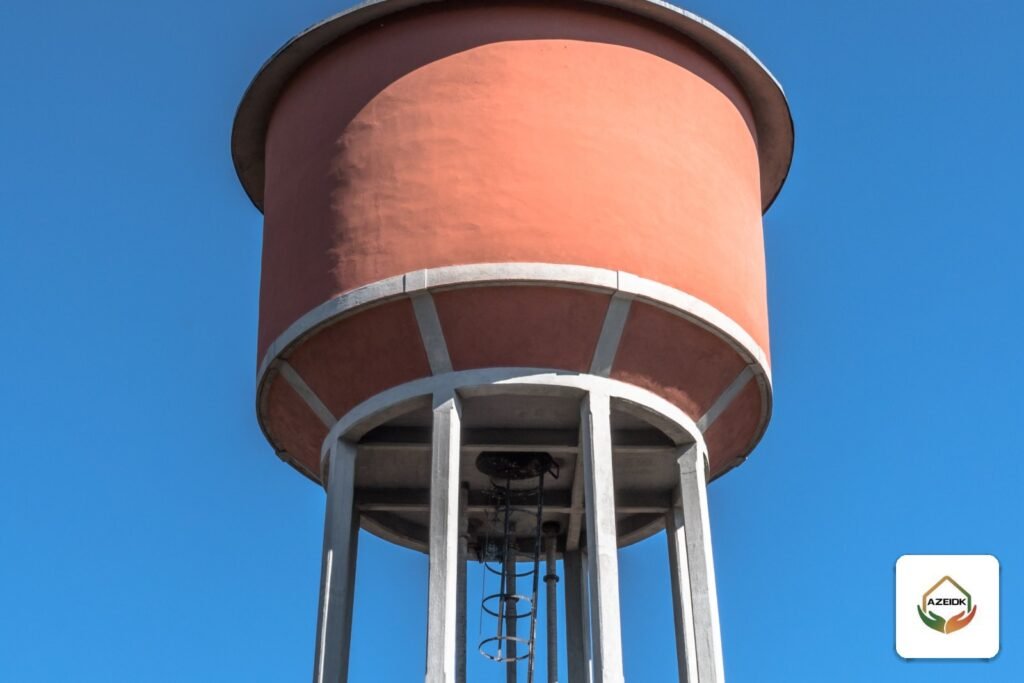
NFPA 22 covers elevated tanks that feed the system by gravity, suction tanks at or below grade that feed a fire pump, pressure tanks, and embankment-supported coated fabric tanks. Materials include welded and bolted steel, concrete and fibreglass-reinforced plastic.
| Type | Common construction reference | Application notes |
|---|---|---|
| Welded steel tank | AWWA D100 | Large volumes in industrial facilities; needs an approved coating and corrosion protection |
| Bolted steel tank | AWWA D103 | Fast site assembly, with care over sealant between panels |
| Concrete tank at or below grade | NFPA 22 concrete tank requirements; AWWA D110 for prestressed tanks | Used in buildings to save space; needs waterproofing and suitable access openings |
| Fibreglass tank (FRP / GRP) | NFPA 22 requirements for fibreglass-reinforced plastic tanks | Corrosion resistant; follow the manufacturer’s guidance on sun and heat exposure |
| Pressure tank | ASME pressure vessel | Limited capacity; used for small systems or as a secondary source |
Tanks are designed for the weight of water plus wind and seismic loads. These loads are calculated to NFPA 22 and the structural code adopted for the project.
Calculating fire water tank capacity
The basic method is simple: add the largest flows needed at the same time and multiply by the duration.
Net capacity = (sprinkler demand + hose allowance) × duration
NFPA 13 sets hose allowance and duration by hazard classification for the density/area method. The values below are as summarised by Open Exam Prep, which does not name an edition; confirm them in the current 2025 edition of NFPA 13:
| Hazard classification | Total hose allowance | Duration |
|---|---|---|
| Light hazard | 100 gpm (about 380 L/min) | 30 minutes |
| Ordinary hazard groups 1 and 2 | 250 gpm (about 950 L/min) | 60 to 90 minutes |
| Extra hazard groups 1 and 2 | 500 gpm (about 1,900 L/min) | 90 to 120 minutes |
NFPA 13 (Section 11.2.3.1.3 of the 2016 edition, as quoted by MeyerFire) permits the lower duration where waterflow and supervisory devices are electrically supervised and monitored at a constantly attended location; otherwise the higher value applies. Where the tank also feeds hose cabinets or hydrants, its capacity must cover everything it supplies at the same time.
Worked example: an ordinary hazard warehouse has a calculated sprinkler demand of 1,500 L/min, a hose allowance of 950 L/min and a 90-minute duration because there is no monitoring at an attended location. Net capacity = 2,450 × 90 = 220,500 L, or about 221 m³, before adding the dead storage below the anti-vortex plate. These figures are for illustration only. Actual demand comes from the project’s hydraulic calculations, and Civil Defense or the insurer may require more.
Effective capacity and dead storage
Not all the water in a tank is usable. Technical references define effective capacity as the water between the overflow level and the top of the anti-vortex plate. Water below the plate is dead storage and does not count. The anti-vortex plate is a horizontal plate above the suction opening that prevents a vortex from forming and drawing air into the pump as the level falls.
Where one tank serves both domestic or daily use and fire protection, the daily-use outlet is set above the fire reserve so normal consumption cannot draw down the reserve. This is a design practice that needs acceptance by the consultant and the authority, and it requires attention to water quality and stagnation.
Essential connections and accessories
- Automatic fill: a float-controlled fill valve from the public supply or another source. NFPA 22 (Section 4.2.1.4 of the 2018 edition, as quoted by MeyerFire) requires the fill to restore the minimum required fire protection volume within 8 hours at most.
- Overflow: a pipe sized for the maximum fill rate, discharging to an open point away from the foundations.
- Drain: to empty the tank for inspection and cleaning.
- Vents: above the top water level, with screens to keep out insects and birds.
- Suction outlet: sized to NFPA 20 for the pump, with an anti-vortex plate and an isolation valve. See our NFPA 20 fire pump guide.
- Level indication and alarm: a level gauge, and a supervised low-level alarm reporting to the fire alarm panel as a supervisory signal.
- Access and safety: inspection manholes, safe ladders and confined-space signs, plus lightning protection for elevated tanks where required.
Where the water level is below the pump, as with underground tanks, a standard horizontal pump on suction lift is not suitable. A vertical turbine pump, or an arrangement that gives positive suction, is used instead. See our fire pump selection guide.
Inspecting and maintaining fire water tanks to NFPA 25
NFPA 25 has a chapter on water storage tanks. QRFS, an equipment supplier, summarises the frequencies in the 2017 edition as follows. The current edition of NFPA 25 is 2026, so confirm these frequencies in it before adopting an inspection programme:
| Item | Frequency |
|---|---|
| Water level, tank with supervised level alarm | Quarterly |
| Water level, no alarm to an attended location | Monthly |
| Exterior, structure, vents, foundation and ladders | Quarterly |
| Painted, coated or insulated exterior surfaces | Annually |
| Interior of steel tank without corrosion protection | Every 3 years |
| Interior of all other tanks, including the anti-vortex plate | Every 5 years |
The interior is checked for corrosion, pitting, coating failure and sediment. In a hot climate, sediment, algae and microbiologically influenced corrosion deserve particular attention because they can carry into the piping. For more, see our guide to inspecting, testing and maintaining water-based systems.
Common mistakes with fire water tanks
- Sizing for sprinkler demand only when the tank also feeds hose cabinets and hydrants.
- Taking capacity from the gross tank volume without deducting dead storage and freeboard.
- Placing the daily-use outlet in a shared tank at a level that draws down the fire reserve.
- Omitting the anti-vortex plate, or installing one that does not match the design.
- Leaving the low-level alarm unconnected to the fire alarm panel.
- Using an overflow pipe smaller than the fill rate, so water rises to the vents.
- Choosing a horizontal pump for a tank whose water level is below the pump.
How AZEIDK can help
Through our engineering design and calculations service, we review tank capacity against the hydraulic calculations and every system the tank feeds, and define the effective capacity and suction arrangement. We also supply Jack Pump fire pumps, including the VTP vertical turbine series for ground tanks and wells where water is below pump level, and the VES end suction series for drawing from a tank that feeds the pump room, matching each model to its listing.
Frequently asked questions
Must the fire tank be dedicated?
A dedicated tank is clearer and easier to approve. A shared tank is accepted on some projects if the fire reserve is protected by the outlet arrangement and the authority agrees.
Does the tank need to be UL listed or FM approved?
NFPA 22 sets design and construction requirements, with materials to recognised standards. An insurer or the project specification may require an approved tank, so check before supply.
What is the difference between gross and effective capacity?
Gross capacity is the whole tank volume. Effective capacity is the water that can be drawn between the overflow and the anti-vortex plate, and it is what you compare with the required volume.
Does a level alarm replace inspection?
No. The alarm reduces how often the level must be checked under NFPA 25, but exterior and interior inspections are still required.
How often is the tank interior inspected?
Every 3 years for steel tanks without corrosion protection and every 5 years for other tanks, according to the 2017 edition of NFPA 25 as summarised by QRFS; confirm in the 2026 edition.
Conclusion
A fire water tank is not a volume picked by estimate. Its capacity comes from hydraulic demand, duration and every system it serves; its effective capacity depends on where the overflow and anti-vortex plate sit; and its reliability depends on automatic refill, level alarms and routine inspection. When these points are documented in the drawings and calculations, approval and operation become clearer for the owner, the consultant and Civil Defense.
Checking the fire tank capacity on your project? Send us the hydraulic calculations and the tank and pump room drawings, and we will review the effective capacity and suction arrangement. Talk to the AZEIDK team
Related guides
- HPE Aruba Instant On Switches in Saudi Arabia: 1930 and 1960 Series and AP25 and AP27 Access Points for Offices and Branches
- Safety Helmet Colours: Hard Hat Colour Code on Work Sites, Standards and When to Replace
- CCTV Camera Shop in Saudi Arabia: AZEIDK GROUP Showrooms for Hikvision, Dahua and EZVIZ Cameras and Recorders, and When You Need an Installer
- Salamah Certificate for Retail Shops: Steps from Lease to Issue and the Link with the Balady Licence