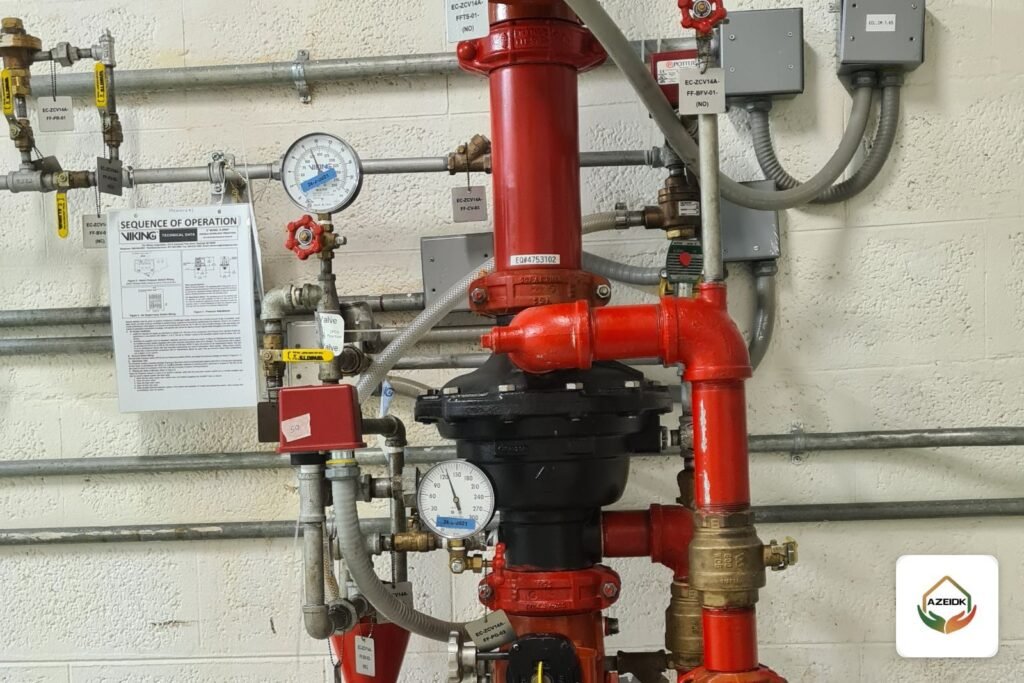
A pre action fire sprinkler system is a sprinkler system whose pipework stays empty of water and is filled with supervisory air. Water enters only after the fire detection system opens the main valve, or, in a double interlock system, only after detection and an operated sprinkler together. It is chosen where accidental water discharge is costly, such as server rooms, archives and museums. This guide explains how the valve works, single vs double interlock, the role of supervisory air and when a pre-action system is the right choice.
Key takeaways
- The pipework is dry and supervised with air; water is held back, usually by a deluge-type valve, until a release signal arrives.
- Single interlock: detection alone fills the pipes, and water then discharges only from sprinklers opened by heat.
- Double interlock: detection and an operated sprinkler are both needed, and the system is designed to dry pipe rules.
- Non-interlock: water enters on detection or on sprinkler operation, whichever comes first.
- The system depends on the releasing panel and the fire alarm working together, so detection testing is part of sprinkler testing.
In this article
- What is a pre action sprinkler system?
- How a pre action fire sprinkler system valve works, step by step
- Single interlock, double interlock and non-interlock
- Supervisory air: why pressurise empty pipes?
- Design rules specific to pre-action
- When to use a pre action system for server rooms and archives
- Components and periodic testing
- FAQ
- Summary
What is a pre action sprinkler system?
In an ordinary wet system the pipes are full of water, so a broken head or a leaking joint discharges immediately. A pre-action system adds a step: water is held at a valve in the valve room, and the pipes above the ceiling carry low-pressure air. If a sprinkler or pipe is damaged, air pressure drops and a supervisory alarm sounds, and in interlocked types no water reaches the room.
Pre-action is one of four main sprinkler system types. For the full comparison of wet, dry, pre-action and deluge systems and where each fits, see our parent guide Sprinkler Systems: Wet vs Dry vs Pre-action vs Deluge. Here we go deeper into pre-action alone, one of the systems AZEIDK designs, supplies and installs as part of its fire fighting systems scope.
How a pre action fire sprinkler system valve works, step by step
- Normal condition: the main valve is closed with supply pressure below it; the pipes above hold air or nitrogen at low pressure, monitored by a pressure switch.
- Detection: a smoke or heat detector in the protected area signals the releasing panel.
- Release: the panel energises a solenoid valve, which vents the main valve’s control chamber; the valve opens and water fills the pipes.
- Alarm: the waterflow alarm operates and the fire alarm panel shows the event. Viking’s preaction manual states that alarms are actuated independently by the detection system and by the flow of water.
- Suppression: sprinklers are closed, so water discharges only from heads opened by the fire’s heat, as in a wet system.
In a double interlock system step 3 changes: the valve opens only when both conditions exist, a detection signal and a loss of air pressure from an operated sprinkler.
Single interlock, double interlock and non-interlock
Viking’s Preaction System Technical Manual, based on NFPA 13 (2007), defines the three types by what admits water to the piping:
| Type | What opens the valve | Sprinkler broken, no fire | Detector false alarm |
|---|---|---|---|
| Single interlock | Detection only | Air pressure drops, supervisory alarm, no water | Pipes fill, no discharge because heads are closed |
| Double interlock | Detection and sprinkler operation | Supervisory alarm, no water | No water |
| Non-interlock | Detection or sprinkler operation | Water enters and discharges from the broken head | Pipes fill |
In practice, single interlock protects against accidental damage while putting water in the pipes early, so it responds faster to a real fire. Double interlock gives the highest protection against accidental discharge, but water only starts moving through the pipes after a head opens, so delivery is slower. This is why the US Unified Facilities Criteria UFC 3-600-01 applies wet system design requirements to single interlock and non-interlock systems, and dry system requirements to double interlock systems.
Supervisory air: why pressurise empty pipes?
The air does not hold the valve shut as in a dry pipe system; it monitors the integrity of the pipework. Any pressure drop indicates a leak, a broken head or an open fitting. Citing NFPA 13 (2007), the Viking manual states:
- Piping and detection must be automatically supervised where the system has more than 20 sprinklers.
- Single interlock systems have a minimum air pressure of 7 psi (0.5 bar).
- Viking recommends a supervisory pressure of 30 psi (2.1 bar) in the closed sprinkler piping of its double interlock systems; the actual setting follows the datasheet of the valve used.
UFC 3-600-01 requires high and low air pressure monitoring on dry pipe and pre-action systems and calls for nitrogen in these systems at the facilities it covers. The air source may be a dedicated compressor or a nitrogen generator, as the project specification requires. Pressure, flow and valve position signals reach the fire alarm panel through monitor modules, as explained in connecting sprinklers to the fire alarm panel.
Design rules specific to pre-action
- Sprinklers per valve: per the Viking manual, no more than 1,000 sprinklers are controlled by one valve in single interlock and non-interlock systems (NFPA 13-2007, 7.3.2.2).
- Double interlock system size: set by one of the options in the standard, including designing the system to deliver water to the system test connection within 60 seconds.
- Detection: detector type and spacing follow the fire alarm design, and detection should operate before heat opens a sprinkler. See choosing fire detectors.
- Clause numbers on your project: numbering has changed between NFPA 13 editions, so check the edition adopted in the project specification with the consultant.
These calculations belong to engineering design and calculations, because choosing double interlock changes the hydraulic calculation and pipe sizes.
When to use a pre action system for server rooms and archives
The Viking manual lists computer rooms, telecommunications facilities, museums, libraries, and coolers and freezers among typical applications. What they share is that accidental water is very damaging, or that water-filled pipes could freeze.
- Server rooms and data centres: often combine a clean agent system for the equipment with sprinklers for the building. Pre-action reduces the risk of leaks over racks. See data center fire protection and FM-200 systems.
- Archives and document rooms: paper is damaged by water but is also a heavy fire load, so confirm with the consultant that the chosen interlock does not delay water more than the hazard allows.
- Freezers: double interlock or dry pipe is the usual choice, as in cold storage fire protection.
Whether sprinklers are required at all is set by the Saudi Fire Code (SBC 801), Civil Defense requirements and the project specification; the system type is a design decision approved by the consultant.
Components and periodic testing
Main components: a supervised OS&Y control valve (see AFC OS&Y gate valves), the pre-action valve with trim, solenoid valve, releasing panel, detectors, air or nitrogen supply, low-air pressure switch, waterflow or pressure alarm switch, manual release station and system test connection.
Viking stresses regular inspection and testing to NFPA 25 and describes quarterly waterflow alarm and main drain tests and an annual trip test. Detection and releasing devices are tested as part of fire alarm system maintenance, and a single maintenance contract covering sprinklers and fire alarm makes that coordination easier.
FAQ
What is a pre action sprinkler system?
A sprinkler system with dry, air-supervised pipes, where a valve opened by fire detection admits water, or detection plus an operated sprinkler in a double interlock system.
How does pre-action differ from deluge?
A deluge system has open heads, so water discharges from every outlet once the valve opens. A pre-action system has closed heads, and water discharges only from heads opened by heat.
Does a pre-action system need a special preaction sprinkler head?
It uses standard listed closed automatic sprinklers. Where dry system rules apply, NFPA 13 sets when upright or dry sprinklers are required; see TYCO DS-1 dry sprinklers.
Single or double interlock for a server room?
Single interlock delivers water faster; double interlock gives more protection against leaks. The decision follows the risk assessment, the project specification and the consultant.
What happens if the releasing panel loses mains power?
The panel runs on standby batteries sized within the fire alarm design, and a manual release station is usually fitted near the valve. Check the datasheet of the panel used.
Can pre-action replace a clean agent system in a server room?
They do different jobs. A clean agent extinguishes a fire inside equipment without water; sprinklers protect the building. Combining them follows the project and consultant requirements.
Summary
A pre action fire sprinkler system holds water behind a valve opened by detection and supervises its pipes with air. Single interlock balances leak protection with speed; double interlock gives maximum leak protection at the cost of delay. Success depends on coordination between the sprinkler and fire alarm contractors from design to testing.
Planning protection for a server room or archive? Send the drawings and the room contents, and our team will propose the system type and interlock. Contact AZEIDK
Related guides
- Jack Pump or WATEX? Comparing the UL-Listed Fire Pumps Available from AZEIDK in Saudi Arabia
- Mosque Speakers in Saudi Arabia: Indoor, Outdoor, Amplifier and Zoning
- Burglar Alarm System Price in Saudi Arabia: What Drives the Cost
- Sprinkler System Acceptance Tests After the Pressure Test: Flushing, Main Drain, Inspector’s Test and Waterflow Alarm Before Handover