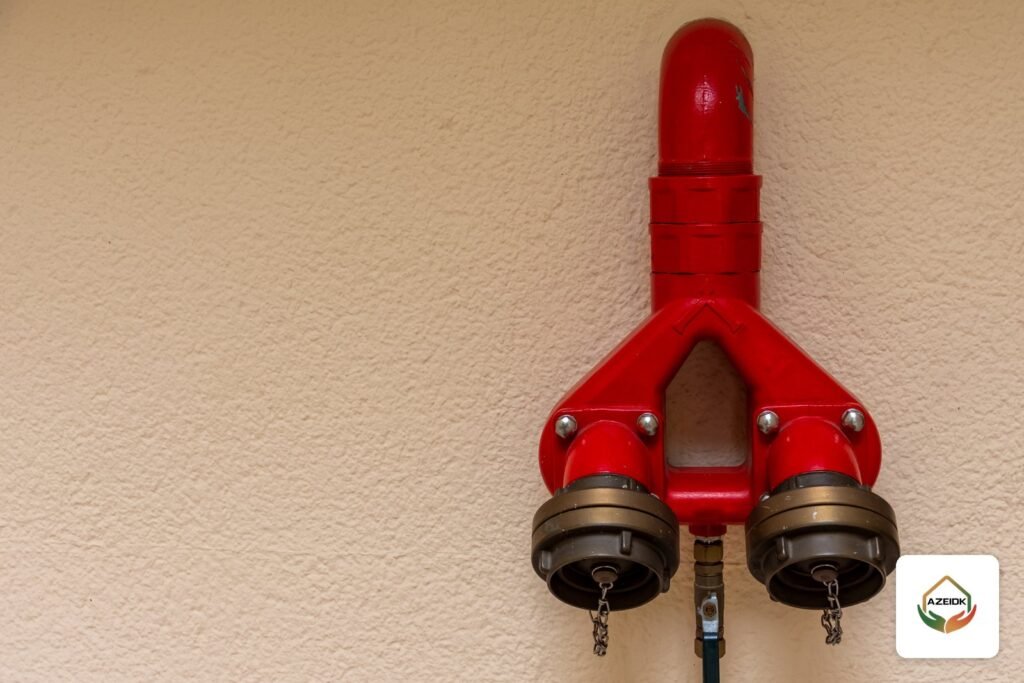
A fire department connection (FDC, often called a Siamese connection) is a water inlet on the building facade or in the yard where Civil Defense pumpers connect their hoses and pump water into the sprinkler or standpipe system. It has 2½ in. capped inlets, a check valve, an automatic drain and a sign naming the system it serves. It always ties in on the system side of the water supply check valve, and no shutoff valve is allowed on its piping.
AZEIDK designs, supplies and installs water-based networks under its fire fighting systems solution. For choosing the check valve itself, see our article on the swing check valve for fire networks.
Key takeaways
- The FDC ties in on the system side of the water supply check valve, never on the suction side of the fire pump.
- NFPA 13 and NFPA 14 require a listed check valve in each FDC and prohibit any shutoff valve on its piping.
- NFPA 13 sets a minimum 4 in. FDC pipe for sprinkler systems, with a riser-size exception.
- The sign uses raised or engraved letters at least 1 in. (25 mm) high and states the required pressure when demand exceeds 150 psi.
- NFPA 25 calls for a quarterly FDC inspection and a 150 psi, 2-hour hydrostatic test of its piping every five years.
In this article
- What is a fire department connection, and why “Siamese”?
- Fire department connection components
- Where does the FDC tie into the fire network?
- How many inlets? Sprinklers and standpipes differ
- Where should the fire department connection be located?
- Required fire department connection sign
- The check valve and automatic drain
- Inspecting and testing the FDC under NFPA 25
- Common FDC mistakes
- Frequently asked questions
- Summary
What is a fire department connection, and why “Siamese”?
The FDC adds a supply from outside the building: Civil Defense crews connect the truck’s hoses and pump water in to make up flow, boost pressure, or charge dry standpipes.
“Siamese” is the common site name because the classic FDC is one body with two inlets side by side in a Y shape. Single-inlet FDCs exist too, as do FDCs with three or more inlets on larger systems.
A hydrant is an outlet the truck draws water from; an FDC is an inlet the truck pumps water into. Hydrants and landing valves are covered in our fire hydrants and landing valves guide.
Fire department connection components
| Component | Function | What to check at handover |
|---|---|---|
| Inlets with swivel couplings | Receive the pumper’s hoses, normally 2½ in. | Thread type matches local Civil Defense hoses; swivels turn freely |
| Internal clapper per inlet | Stops water escaping from an open inlet while the other inlet is in use | Present and moves freely |
| Caps or plugs | Keep dirt and debris out of the inlets | Fitted and undamaged, with gaskets |
| Check valve | Lets water in from the truck and stops system water flowing out through the FDC | Listed and installed where it is easy to reach |
| Automatic drain (ball drip) | Drains water trapped between the inlets and the check valve after use | At the low point of the line, in an orientation the datasheet allows |
| FDC piping | Carries water to the network | Sized to the standard, no shutoff valve |
| Sign | Tells Civil Defense crews which system the FDC feeds | Correct wording, letter size, pressure where needed |
Some modern FDCs use a single large threadless Storz inlet of 4 in. or 5 in. NFSA notes that neither NFPA 13 nor NFPA 14 gives sizing guidance for these listed quick-connect FDCs. Use one only after confirming with the approving authority that local Civil Defense crews carry matching couplings.
Where does the FDC tie into the fire network?
Section numbers below follow the Los Angeles Department of Building and Safety plan check sheets for NFPA 13 (2025) and NFPA 14 (2024); the first is quoted by QRFS from the 2019 and 2022 editions:
- System side: the FDC connects downstream of the water supply check valve (NFPA 13, 16.12.5.1), so pumper water cannot flow back into the supply.
- Not on pump suction: NFPA 13 (16.12.5.9) and NFPA 14 (9.9.3.2) prohibit connecting the FDC to the suction side of a fire pump.
- Listed check valve in each FDC: NFPA 13, 16.12.6.1; NFPA 14, 9.9.2.
- No shutoff valve: nothing that can be closed goes on the FDC piping (NFPA 13, 16.12.6.2; NFPA 14, 9.6.7.1.1 and 9.9.1).
- Pipe size: at least 4 in. for sprinkler systems (NFPA 13, 16.12.4), with an exception that ties the size to the riser.
Pump room and supply valve arrangement is covered in our fire protection valves guide.
How many inlets? Sprinklers and standpipes differ
The National Fire Sprinkler Association (NFSA) explains that on an NFPA 13 sprinkler system the FDC is a supplemental supply and does not have to be sized for a given flow or pressure. On an NFPA 14 standpipe system it can be the supply the system depends on, as with manual dry standpipes that only get water from the pumper.
| System | Role of the FDC | Inlets, as summarised by NFSA |
|---|---|---|
| NFPA 13 sprinklers, riser over 3 in. | Supplemental | One FDC with two 2½ in. inlets |
| NFPA 13 sprinklers, riser 3 in. or smaller | Supplemental | A single 2½ in. inlet is allowed |
| NFPA 14 standpipes | Can be the primary or boosting supply | At least two inlets, one 2½ in. inlet per 250 gpm of demand up to a maximum |
| Combined system | Feeds both | Sized on the greater of the two demands |
Standpipe classes and wet or dry types are explained in our article on NFPA 14 standpipe and hose systems.
Where should the fire department connection be located?
In Saudi Arabia the location is agreed with the approving authority under the Saudi Fire Protection Code SBC 801 and General Directorate of Civil Defense requirements, with the location fixed on the approved fire fighting drawings. Check that:
- The FDC is visible from the street or from the nearest point a fire truck can reach, not hidden behind landscaping, fences or parked cars. “Visible and accessible” is an explicit item in the NFPA 25 quarterly inspection.
- There is enough clear space around it to connect and bend hoses.
- A water source for the truck, such as an outdoor hydrant, is nearby.
- If the FDC feeds only part of the building, a sign says so.
In malls with several facades, an FDC can end up on a rear elevation trucks cannot easily reach; settle this at drawing stage. See what AZEIDK offers this sector on the malls and commercial buildings page.
Required fire department connection sign
NFPA 13 (2022), as quoted in the QRFS signage guide, requires:
- A sign at each FDC with raised or engraved letters at least 1 in. (25 mm) high, on a plate or on the fitting, naming the service, such as AUTOSPKR, OPEN SPKR or STANDPIPE (16.12.5.8.1).
- The pressure required at the inlets to deliver the greatest system demand (16.12.5.8.2). This is not required where demand pressure is below 150 psi (10.3 bar) (16.12.5.8.3).
- Where the FDC serves only part of a building, a sign showing the portions served (16.12.5.6).
For standpipes, NFSA notes that NFPA 14 calls for STANDPIPE wording, or combined wording on a combined system, states whether a manual standpipe is wet or dry, and needs a sign listing the locations served when one FDC feeds several buildings. Where the approving authority requires Arabic or bilingual wording, follow it.
The check valve and automatic drain
Select a listed check valve, rated for network pressure plus pumper pressure, with ends that suit the line: flanged or grooved.
In Saudi Arabia AZEIDK supplies American Fire Control (AFC) swing check valves: the A-3150 flanged and the A-3500 grooved. Check each model’s datasheet before the submittal; the FDC body follows the project’s approved specification.
The automatic drain (ball drip) sits at the lowest point of the line between the inlets and the check valve. A ball seats under pumper pressure and drops when it falls, draining trapped water. Alaska’s Division of Fire and Life Safety notes some models are listed for horizontal mounting only and some for vertical only, so install to the manufacturer’s instructions. The automatic drain is also an item in the NFPA 25 quarterly inspection.
Inspecting and testing the FDC under NFPA 25
The items below are in NFPA 25 Section 13.8 (2017 and 2023 editions), as published by the New York Department of State and QRFS.
Quarterly inspection
- The FDC is visible and accessible.
- Couplings or swivels are undamaged and rotate smoothly.
- Plugs or caps are in place and undamaged, and gaskets are present.
- Identification signs are in place.
- The check valve is not leaking.
- The automatic drain is in place and working.
- Inlet clappers are in place and working.
- The inside of the connection is free of obstructions.
- Visible piping supplying the FDC is undamaged.
Five-year hydrostatic test
Piping from the FDC to the check valve is tested at 150 psi (10 bar) for 2 hours at least once every five years. The 2026 edition of NFPA 25 adds an exemption where the pipe is 10 ft or shorter and can be inspected visually inside and out (13.8.5.2), and the internal check can be done by camera. The edition that applies is the one the project consultant specifies.
Results of each inspection go into the maintenance log. AZEIDK carries out this work under its annual maintenance contracts.
Common FDC mistakes
- Tying the FDC into the fire pump suction instead of the system side.
- A gate or butterfly valve on the FDC line.
- An unlisted check valve, or one buried in a locked room.
- No automatic drain, or one mounted in an orientation its listing does not allow.
- Inlet threads that do not match Civil Defense hoses.
- Missing caps.
- Wrong sign wording, or no pressure shown when demand exceeds 150 psi.
- An FDC behind a fence, planting or parking.
Frequently asked questions
What is a fire department connection?
A building inlet where Civil Defense pumpers pump water into the sprinkler or standpipe system, with a check valve, automatic drain and sign.
What is the difference between an FDC and a fire hydrant?
A hydrant is an outlet the truck takes water from. An FDC is an inlet the truck pumps water into the building’s network.
Can a valve be installed on the FDC line?
No. NFPA 13 and NFPA 14 prohibit any shutoff valve on FDC piping and require only a listed check valve.
Does the FDC connect before or after the fire pump?
It connects on the system side, downstream of the water supply check valve. Connecting it to the fire pump suction is prohibited.
Does an FDC replace a fire pump?
Not on a sprinkler system, where it is a supplemental supply used once Civil Defense arrives. On manual dry standpipes it is the water source, and that is a design decision the consultant approves.
How often is a fire department connection inspected?
Quarterly under NFPA 25, plus a 150 psi, 2-hour hydrostatic test of its piping every five years unless the 2026 exemption applies.
What does an FDC and its installation cost?
It depends on the number and type of inlets, pipe size and run to the tie-in, the check valve type and ends, the sign, and facade work. It is priced after a drawing review.
Summary
An FDC works when four things are right: a tie-in on the system side, a listed check valve with no shutoff valve, a working automatic drain, and a clear sign in a place trucks can reach.
Reviewing fire network drawings or preparing for Civil Defense approval? Send us the drawings and we will check the FDC location, tie-in and check valve with you as part of our Civil Defense approval support. Talk to the AZEIDK team