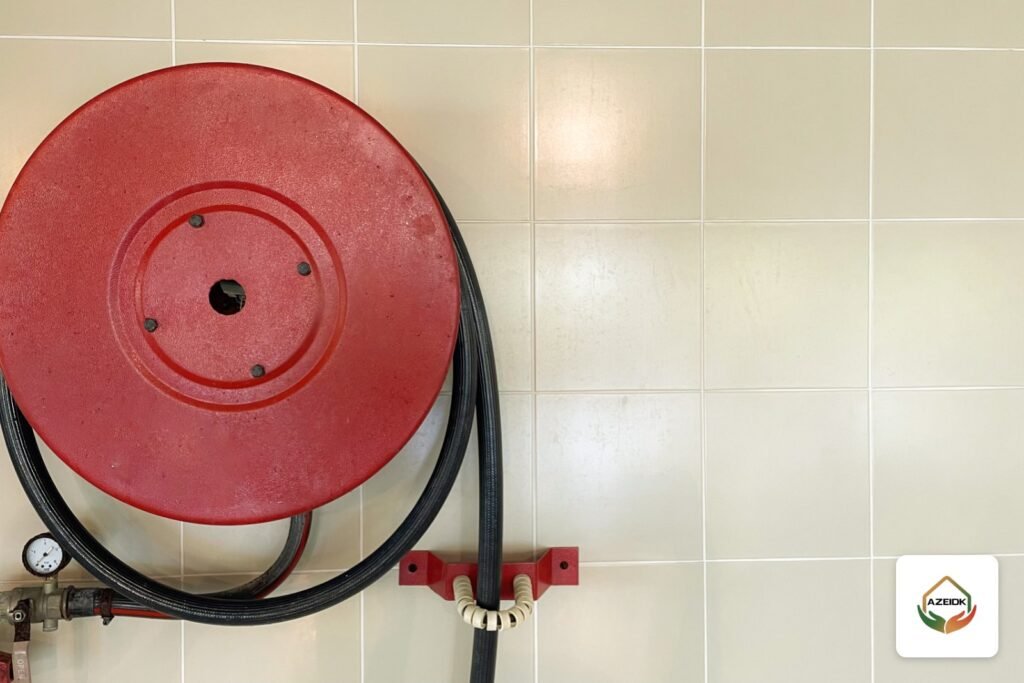
A fire hose reel is the first water-based firefighting tool a building occupant reaches, long before Civil Defense arrives. It is semi-rigid hose on a rotating reel, permanently connected to the water supply. This guide focuses on the reel itself, not the cabinet types: what EN 671-1 requires for hose length, diameter and flow, how the reel is installed inside a fire hose cabinet or directly on a wall, and how it is inspected over its life.
In short: under EN 671-1 a fire hose reel carries semi-rigid hose of 19, 25 or 33 mm bore, in one piece no longer than 30 m. It is installed in a cabinet or on the wall at the positions set by the approved layout, inspected every year by a competent person, and its hose is pressure tested every 5 years under EN 671-3.
AZEIDK supplies hose reels as part of its fire fighting systems in Saudi Arabia, including Falcon Gold hose reel cabinets, whose catalogue values we use as a practical example below.
Key takeaways
- EN 671-1 allows three hose bores for reels: 19, 25 and 33 mm, and the hose must be one piece no longer than 30 m.
- Maximum working pressure in the standard is 1.2 MPa (12 bar) for 19 and 25 mm hose, and 0.7 MPa for 33 mm hose.
- A reel is manual or automatic, and fixed or swinging; a swinging reel must swing at least 170 degrees.
- The Falcon Gold reels supplied by AZEIDK carry a 25 mm by 30 m hose on a 600 mm reel, with a stated working pressure of 12 bar.
- EN 671-3 calls for an annual inspection with the hose fully run out under system pressure, and a hose pressure test every 5 years.
In this article
- Hose reel vs fire hose cabinet: what is the difference?
- Fire hose reel types under EN 671-1
- Lengths, bores and pressures: the standard vs the catalogue
- Installing a fire hose reel in a cabinet or on the wall
- Acceptance testing at handover
- Periodic inspection of fire hose reels to EN 671-3
- Common hose reel mistakes
- Frequently asked questions
- Summary
Hose reel vs fire hose cabinet: what is the difference?
The reel is the part that puts out the fire: a rotating drum, hub, waterway, hose, nozzle and inlet valve. The fire hose cabinet is the steel enclosure that protects the reel and marks its position on the wall. EN 671-1 covers reels with or without cabinets, so a reel can also be wall mounted on its own.
So specify them as two items: the reel (bore, length, type, pressure, nozzle) and the cabinet (material, mounting, doors). Cabinet types, sizes and Class I, II and III are covered in our article on fire hose cabinet types, sizes and components.
Fire hose reel types under EN 671-1
By how the water is opened: manual or automatic
- Manual reel: has a manual inlet stop valve next to the reel. The user opens the valve first, then pulls out the hose. The valve must close clockwise, and a screw-down valve must be fully open within 3.5 turns.
- Automatic reel: water enters through the centre of the reel via an automatic inlet valve that opens as the hose is pulled. It must be fully open within 3 complete reel revolutions. An untrained user cannot forget to open the water.
By how the reel moves: fixed or swinging
- Fixed reel: rotates in one plane, with a hose guide beside it to direct the pull.
- Swinging reel: rotates and swings in more than one plane on an arm, pipe or door. It must swing at least 170 degrees, so it suits cabinets.
Both types appear among the products listed on the AZEIDK site. The Falcon Gold reels in the FG-1001R, FG-2001R and FGV-3001R cabinets are manual swinging reels. The SFFECO reel is an automatic type with rubber hose, a 580 mm reel and 30 m of hose, and its product page lists surface, recessed or semi-recessed mounting.
Lengths, bores and pressures: the standard vs the catalogue
Is the approved length 30 m or 20 m? EN 671-1 sets only an upper limit: one piece of hose, not more than 30 m. The actual length comes from the layout, so that the hose plus the water throw reaches every point of the protected area. The table compares the standard with the Falcon Gold catalogue:
| Item | EN 671-1:2012 | Falcon Gold reel (per catalogue) |
|---|---|---|
| Hose bore | 19, 25 or 33 mm semi-rigid hose to EN 694 | 25 mm |
| Hose length | One piece, not more than 30 m | 30 m |
| Reel size | Two wheels, max. 800 mm diameter; inner drum min. 200 mm for 19 and 25 mm hose | 600 mm diameter, 150 mm wide |
| Maximum working pressure | 1.2 MPa for 19 and 25 mm; 0.7 MPa for 33 mm | 12 bar |
| Burst pressure | Min. 3.0 MPa for 19 and 25 mm | Average up to 45 bar |
| Swing angle | At least 170 degrees for swinging reels | Approx. 170 degrees minimum |
| Nozzle | Three settings: shut, spray, jet | Adjustable jet, spray and shut-off |
| Colour | Reel must be red | Red RAL 3000 on mild steel cabinets |
At 0.2 MPa (2 bar) the jet must reach at least 10 m, and minimum flow depends on the nozzle orifice: a 6 mm nozzle must give at least 24 L/min at 2 bar and 34 L/min at 4 bar. So the submittal should state the nozzle orifice, not just the hose bore.
The Falcon Gold catalogue shows LPCB approval to EN 671-1:2012 under certificate reference 1038a, according to the manufacturer. Verify it for the exact model supplied. Lay-flat 1.5 inch hose is a different product family, covered in our guide to fire hose types, sizes and couplings.
Installing a fire hose reel in a cabinet or on the wall
Inside a fire hose cabinet
This is the most common arrangement in corridors and public areas. The Falcon Gold single-door mild steel hose reel cabinet comes in two models: FG-1001R, surface mounted at 800 x 800 x 230 mm, and FGR-1001R, recessed, with an outer frame of about 880 x 880 mm and a front projection of about 40 mm.
- A wall that can carry the cabinet and the reel full of water, installed level.
- Enough clear space in front for the door and the swinging reel. EN 671-1 requires the cabinet door to open at least 170 degrees.
- Door hand and water inlet direction (top, bottom or side) fixed before ordering, because they change the pipe route.
- Supply pipe connected to the inlet valve per the approved drawings, followed by pressure and leak testing.
- If the cabinet is lockable, the standard requires an emergency opening device protected only by transparent frangible material, and the lock must open with a key.
On the wall without a cabinet
Reels are wall mounted on a bracket in warehouses, car parks and service areas, where appearance matters less than quick access. Keep the reel clear of vehicle and forklift routes. In both cases the approved layout under the Saudi Fire Protection Code SBC 801 sets the reel positions and numbers.
Acceptance testing at handover
Test every reel before handover, not just a sample:
- Open the inlet valve and check for leaks at the joints and the brass waterway.
- Pull out the full hose. The reel should turn freely and stop within one turn when released, which is the braking requirement in EN 671-1.
- Operate the nozzle in all three settings and confirm a steady flow.
- Rewind the hose, close the nozzle and leave the unit ready.
They form part of the testing, commissioning and handover file submitted to the consultant.
Periodic inspection of fire hose reels to EN 671-3
EN 671-3 sets the maintenance regime:
| Level | Who | What it covers |
|---|---|---|
| Routine check | The responsible person on site | Unit in place, unobstructed, visible, no corrosion or leaks. The interval depends on site conditions and fire risk; the standard gives no fixed figure. |
| Annual inspection and maintenance | A competent person | Hose fully run out under system pressure; full length checked for cracking, distortion and wear; reel turns both ways; swing; manual or automatic valve; nozzle; cabinet and doors; brackets secure; steady and sufficient flow. |
| Hose pressure test | A competent person | Every 5 years each hose is pressurised to the maximum working pressure in EN 671-1. |
Records cover date, result, parts replaced and next inspection, with a “checked” label on the unit; a unit needing major repair is labelled “out of order” and the owner informed. This programme can be included in an AZEIDK annual maintenance contract.
Common hose reel mistakes
- Approving the cabinet, not the reel: nozzle orifice, working pressure and valve type go unchecked.
- Hose longer than 30 m or joined from two pieces: breaks the one-piece rule in EN 671-1 and adds pressure loss.
- Isolation valve on the supply line left closed after testing: the reel looks ready but gets no water. Check isolation valve positions after every test or maintenance visit.
- Hose rewound carelessly: it kinks on the next pull.
- Skipping the 5-year test: a visual check cannot find a weakened inner hose wall.
Frequently asked questions
What is the difference between a hose reel and a fire hose cabinet?
The reel is the firefighting device; the cabinet is the enclosure that protects it. A reel can also be wall mounted without a cabinet.
Is the approved fire hose length 30 m or 20 m?
EN 671-1 limits reel hose to one piece of not more than 30 m and does not fix a single length. The designer sets the actual length from the coverage layout; 30 m is the length shown for Falcon Gold reels.
What is inside a hose reel cabinet?
The reel disc, hub, swinging arm, waterway, angle valve, 25 mm hose, adjustable nozzle and inlet and outlet joints. Double-door cabinets add a side compartment for a portable extinguisher.
What is the spacing between fire hose cabinets?
There is no single distance for every building. The designer places them under SBC 801 and the project’s adopted standard so that the hose plus the water throw reaches every point of the protected area.
What is the difference between recessed and surface-mounted cabinets?
A surface-mounted cabinet is fixed on the wall and is easier to install. A recessed cabinet sits in the wall with little projection (about 40 mm on the FGR-1001R) but needs a coordinated wall opening.
Do fire hose cabinets and hoses need SABER conformity?
The SASO Technical Regulation for Fire Control Materials and Equipment covers fire hoses and wall-mounted cabinets, and requires a certificate of conformity and a shipment certificate through the SABER platform. Check each product’s classification on SABER before import.
What does a fire hose reel cabinet cost in Saudi Arabia?
Price depends on material (painted mild steel or stainless steel), surface or recessed mounting, number of doors, reel and valve specification, required approvals and quantity. Send your BOQ for a specific quotation.
Summary
Start with the reel, not the cabinet: hose bore and length within EN 671-1, manual or automatic, fixed or swinging, working pressure and nozzle orifice. Then pick the cabinet and mounting. Then keep up the annual inspection and the five-year hose test. To compare the cabinet models themselves, see our Falcon Gold fire cabinet selection guide.
Have a hose reel BOQ for your project? Send us the layout, mounting type and required approval, and we will check the reel and cabinet against the standard before supply. Talk to the AZEIDK team
Related guides
- Safety Companies in Saudi Arabia: Types and How to Verify an Approved Safety Establishment
- Fire and Security Project Certificates in Saudi Arabia: SABER, UL/FM, LPCB and Local Content
- Cla-Val Fire Pump Valves: 50B Relief Valve, 134-05 Deluge Valve and WC-1 Waste Cone
- Low Current Systems in Saudi Buildings: What They Include and How to Plan Them from Design to Handover