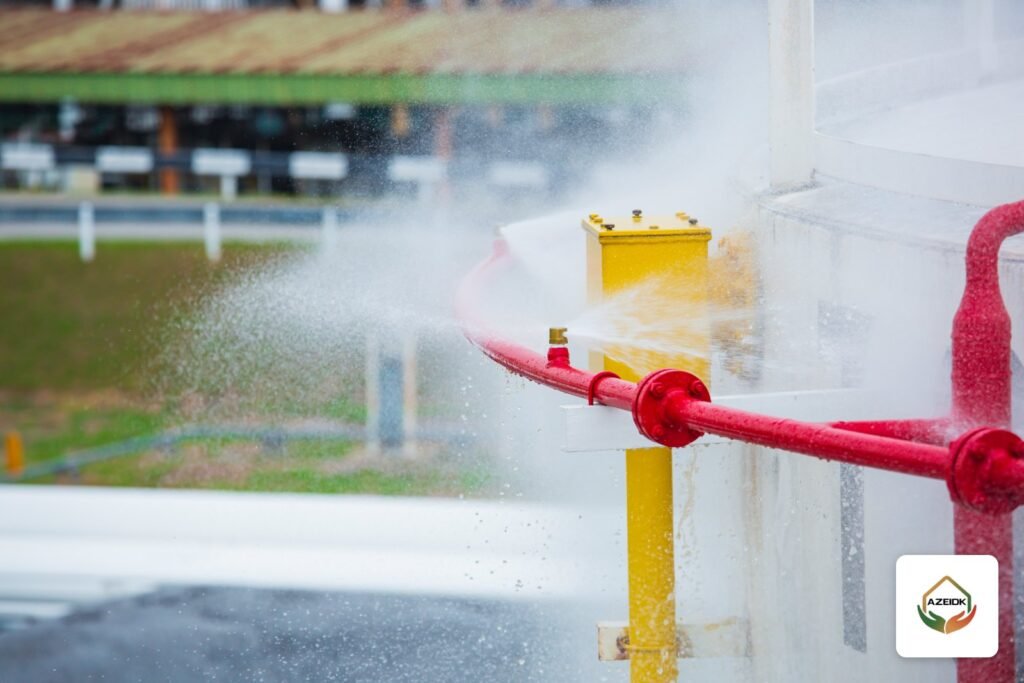
A drencher system, often called a water curtain, is a network of open nozzles connected to a deluge valve. When the valve opens, every nozzle discharges at the same moment and lays a continuous film of water over a facade, an opening or the shell of a tank. Its job is not to put out a fire inside the space, but to stop a fire next door from spreading by keeping the exposed surface cool. This guide explains where drenchers are used, how they work, how they differ from deluge and water spray systems, and what to prepare before design.
AZEIDK designs, supplies and installs these systems as part of its fire fighting systems and supplies the deluge valves they rely on.
Key points
- A drencher is an open-nozzle system with no heat-sensitive element; the whole zone operates at once through a deluge valve.
- Its purpose is exposure protection: cooling a facade, opening or tank exposed to a nearby fire.
- The valve is opened by a detection system (detectors or a pilot line) or by hand.
- Because all nozzles flow together, water demand is high and needs a hydraulic calculation, a suitable fire pump and tank.
- Whether a water curtain is accepted in place of a fire-rated separation is decided by the approving authority on each project.
What is a drencher system?
A drencher is a type of deluge system. Unlike a standard fire sprinkler, the nozzle is always open and has no glass bulb or fusible link, so the pipework downstream of the deluge valve stays dry until the system operates. When the valve opens, water reaches every nozzle in the protected zone at once and forms a curtain or film over the surface being protected.
That is why it is also called a water curtain system. For the general picture of deluge systems and their parts, see deluge system: valve and nozzles.
Where are drenchers used?
- Facades of closely spaced buildings: protecting windows and walls from the heat of a fire in a neighbouring building.
- Fuel and flammable liquid tanks: spray rings around the shell or roof that cool a tank if a nearby tank catches fire.
- Openings in separating walls: openings that cannot be closed by a fire door, where the approving authority accepts it.
- Industrial plants: protecting equipment or steel structures exposed to radiant heat from an adjacent hazard area.
Protecting transformers and equipment with directional spray nozzles usually falls under fixed water spray systems, covered in transformer water spray protection to NFPA 15.
How it works, step by step
- The detection system senses the fire: heat or smoke detectors wired to a release panel, or a pilot line of closed sprinklers.
- The panel signals the deluge valve to open, or an operator opens it manually at the release station.
- Water fills the dry pipework and discharges from all open nozzles together.
- An alarm gong or pressure switch sends a signal to the fire alarm panel.
- The system keeps running until the valve is closed by hand and reset after the incident.
Deluge valves supplied by AZEIDK include the FIRETECH FX and the solenoid-operated Cla-Val 134-05, compared in deluge valve FIRETECH FX vs Cla-Val 134-05.
Drencher vs deluge vs water spray
| System | Nozzles | Main purpose |
|---|---|---|
| Drencher (water curtain) | Open, arranged to cover a surface or opening | Stop fire spread by cooling the exposed surface |
| General deluge | Open, covering a whole area | Flood a high-hazard area with water quickly |
| Directional water spray | Spray nozzles aimed at a specific item | Control or cool a fire on equipment such as transformers |
For wet, dry and pre-action systems, see sprinkler system types: wet, dry, pre-action and deluge.
Design points to prepare
- Water demand: all nozzles flow together, so the total flow of the largest zone operating at one time is calculated and drives fire pump and tank sizing.
- Nozzle layout: spacing and spray angles follow the manufacturer’s listed data for the nozzle, allowing for wind on external facades.
- Zoning: splitting a facade or site into zones, each with its own valve, to limit the water required.
- Drainage: where water goes after operation and during valve testing.
- Governing code: in Saudi Arabia the Saudi Fire Code SBC 801 and Civil Defense requirements apply, and design details usually refer to NFPA standards such as NFPA 13 for exposure protection and NFPA 15 for fixed water spray systems.
AZEIDK supports this stage through its engineering design and calculations service.
Inspection and maintenance
Drenchers follow the NFPA 25 inspection, testing and maintenance requirements for deluge systems, including operating tests of the deluge valve, checking that nozzles are not blocked or painted, and cleaning strainers. Details and frequencies are in the NFPA 25 guide for water-based systems, and the system can be included in annual maintenance contracts.
Frequently asked questions
Is a drencher the same as a fire sprinkler?
No. A standard sprinkler is closed and opens on its own when heat reaches its rating. Drencher nozzles are open and all operate together when the deluge valve opens.
Can a water curtain replace a fire-rated wall or door?
Not automatically. Some codes accept it in defined cases, and the decision rests with the approving authority on each project, so the solution should be presented to Civil Defense before installation.
Where does a drencher get its water?
From the fire protection water supply itself, the fire tank and fire pump, provided the flow and pressure can run every nozzle in the zone together with any other systems required at the same time.
To design or supply a drencher system for your project in Saudi Arabia, contact AZEIDK.
Related guides
- Civil Defense Requirements for Auto Workshops in Saudi Arabia: Extinguishers, Fire Alarm and Oil and Gas Storage Before the Salamah Licence
- Construction Equipment Rental Shop Requirements in Saudi Arabia: Fire Safety and Civil Defense
- Fire Pump Rooms in Saudi Arabia: Components, Design and Installation
- Recycling Plant and Scrap Yard Fire Protection: Thermal Camera Detection, Hydrants and Surveillance