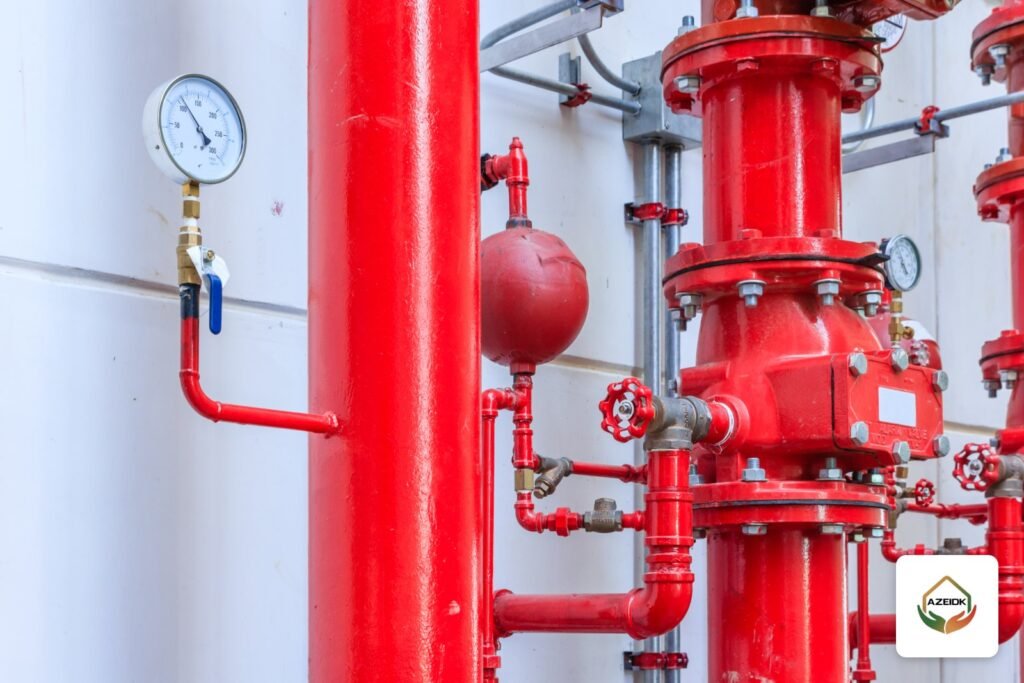
A dry pipe valve trip test means actually operating the valve: system air pressure is bled down until the valve opens and water enters the piping, the trip pressure and water delivery time are recorded, and the system is then drained and the valve reset. NFPA 25 calls for a partial flow trip test every year with the control valve partly open, and a full flow trip test every 3 years or whenever the system is altered.
This is the most important item in dry sprinkler maintenance, because the valve can sit for years without operating once. Below we cover the steps, what to record, how to read the result and what is needed afterwards to return the system to service. The test is carried out under AZEIDK’s preventive and periodic maintenance service for fire fighting systems.
Key points
- The partial flow trip test is annual, with the control valve partly open to limit the water admitted to the piping.
- The full flow trip test is due every 3 years and after any alteration, with the control valve fully open and the quick-opening device in service.
- Record initial air and water pressure and the trip air pressure; for full flow tests also the trip time and the water delivery time to the inspector’s test connection.
- After the test, open the low point drains until water stops, then reset the valve to the manufacturer’s instructions.
- Priming water level and quick-opening devices are checked quarterly.
Why does a dry pipe valve need a trip test?
In a dry system the piping holds compressed air or nitrogen and the valve holds back the water supply. When a sprinkler opens, air pressure drops, the valve trips and water flows into the piping. The valve may stay closed for years, and over that time deposits can build up, the clapper can stick to its seat, or the quick-opening device can fail. Only a real operation shows this.
In Saudi Arabia dry systems are mostly found in cold stores, freezer rooms and areas exposed to freezing. We compare them with other system types in wet, dry, preaction and deluge sprinkler systems. For how the dry system and its valve work, see dry pipe sprinkler system: valve and delivery time.
Dry pipe valve trip test: partial flow vs full flow
| Item | Partial flow | Full flow |
|---|---|---|
| Frequency | Annual | Every 3 years and when the system is altered |
| Control valve | Partly open | Fully open |
| Quick-opening device | Feed closed during the trip, then tested separately | In service |
| Water in the piping | Limited | Fills the piping to the inspector’s test connection |
| Recorded | Initial air and water pressure, trip air pressure | The same, plus trip time and water delivery time |
A partial flow test is not needed in a year when the full flow test is done. NFPA 25 asks for trip testing in warm weather. That is easier in Saudi Arabia than in cold countries, but systems serving freezer rooms that run all year still need the test planned with the facility so water does not sit in piping inside the freezer zone without immediate draining.
These frequencies are reference values from NFPA 25 (2017 edition as summarised by QRFS, consistent with the Minnesota Department of Health guide). In the Kingdom the binding requirements are the Saudi Fire Code SBC 801 and Civil Defense; the NFPA 25 edition in force is set by the contract or the consultant.
Partial flow trip test: step by step
The steps below summarise common practice from the NFPA 25 annex. The valve manufacturer’s manual is the final reference.
- Notify the facility and whoever monitors the fire alarm panel, as the test will operate the waterflow alarm.
- Fully open the main drain to flush debris from the supply.
- Close the control valve until full flow from the main drain stops, leaving it partly open.
- Close the feed to the quick-opening device, if fitted.
- Record air (or nitrogen) pressure and supply water pressure.
- Slowly open the priming level valve or the inspector’s test valve to bleed air pressure.
- Record air and water pressure at the moment the valve trips.
- Close the control valve, open the main drain, then trip test the quick-opening device.
- Open the low point drains until water stops flowing.
- Reset the valve and return the system to service.
During a partial flow test the clapper must latch open. If it does not, the test has failed and the valve needs inspection.
Reading a full flow trip test
A full flow test records the time for the valve to trip after the inspector’s test connection is opened, and the time for water to reach it. Both are compared with the original acceptance test. A longer time is not a pass/fail criterion in NFPA 25, but it is a reason to look for the cause: an air leak slowing the trip, air pressure set too high, a quick-opening device problem, or a weaker water supply.
NFPA 25 also requires the air supply to restore normal system air pressure within 30 minutes when refilling. A slower compressor leaves the system without effective protection for longer after any trip or test.
What goes in the test report
- Air and water pressure before the test.
- Air pressure at trip.
- Valve operation: did it trip, and did the clapper latch open.
- For full flow tests: trip time and water delivery time to the inspector’s test connection.
- Results of the quick-opening device and low air pressure alarm tests.
- Time to restore air pressure after reset.
- Any deficiency and its due date.
Keep these readings with the fire safety log book and maintenance records; their value lies in comparison with the acceptance test and earlier tests.
Other periodic checks on a dry pipe valve
| Item | Reference frequency |
|---|---|
| Air and water gauges | Weekly, or monthly where air pressure is supervised at a constantly attended location |
| Priming water level | Quarterly |
| Quick-opening device | Quarterly |
| Low air pressure alarm | Periodic per manufacturer (quarterly in some editions, annual in the 2017 edition) |
| Automatic air maintenance device | Annual, during the trip test |
| The gauges themselves | Replace, or compare with a calibrated gauge, every 5 years |
Grease and sealants must not be used on the valve seating surfaces. These items also appear in our fire protection maintenance checklist.
Common mistakes
- Running a full flow test without adequate drainage and leaving water in low piping.
- Forgetting to open low point drains afterwards, so a “dry” system holds water.
- Raising air pressure above the manufacturer’s setting to avoid alarms, which delays the trip.
- Not having the acceptance test result on site, so water delivery time cannot be judged.
- Resetting the valve without following the manufacturer’s manual step by step.
If the valve or compressor shows a fault, the repair falls under corrective maintenance and technical support.
Frequently asked questions
How often is a dry pipe valve trip tested?
A partial flow trip test every year and a full flow trip test every 3 years or when the system is altered, per the NFPA 25 reference values.
What is the difference between partial and full flow?
In a partial test the control valve is only partly open to limit water entering the piping; in a full test it is fully open and water delivery time to the inspector’s test connection is measured.
Will the test set off the fire alarm?
It normally operates the waterflow alarm, so the panel monitor and the facility are told before starting.
What happens to the water after the test?
All low point drains are opened until water stops, and the valve is reset to the manufacturer’s instructions.
How quickly must the compressor restore pressure?
NFPA 25 requires the air supply to restore normal system pressure within 30 minutes.
Does a longer water delivery time mean the test failed?
Not by itself, but it calls for finding the cause by comparing with the acceptance test.
Summary
A dry pipe valve only proves itself by operating. A partial trip every year, a full trip every 3 years, pressures and times recorded, then careful draining and reset. That keeps a dry system dry and ready.
Has your dry system valve gone untested for a while? We can arrange an inspection and test visit and record results you can compare at future visits. Contact the AZEIDK team
Related guides
- Dome vs Bullet Camera vs Turret: Which CCTV Form Factor Fits Indoors, Outdoors and Entrances
- Salamah Certificate in Saudi Arabia: What It Is, Who Needs It, Documents and Validity
- Fire Extinguisher Maintenance Contract in Saudi Arabia: Clauses, Monthly and Annual Inspection Schedule, and Owner and Contractor Responsibilities
- Electric Fire Pump Maintenance: Weekly, Monthly and Annual Checks