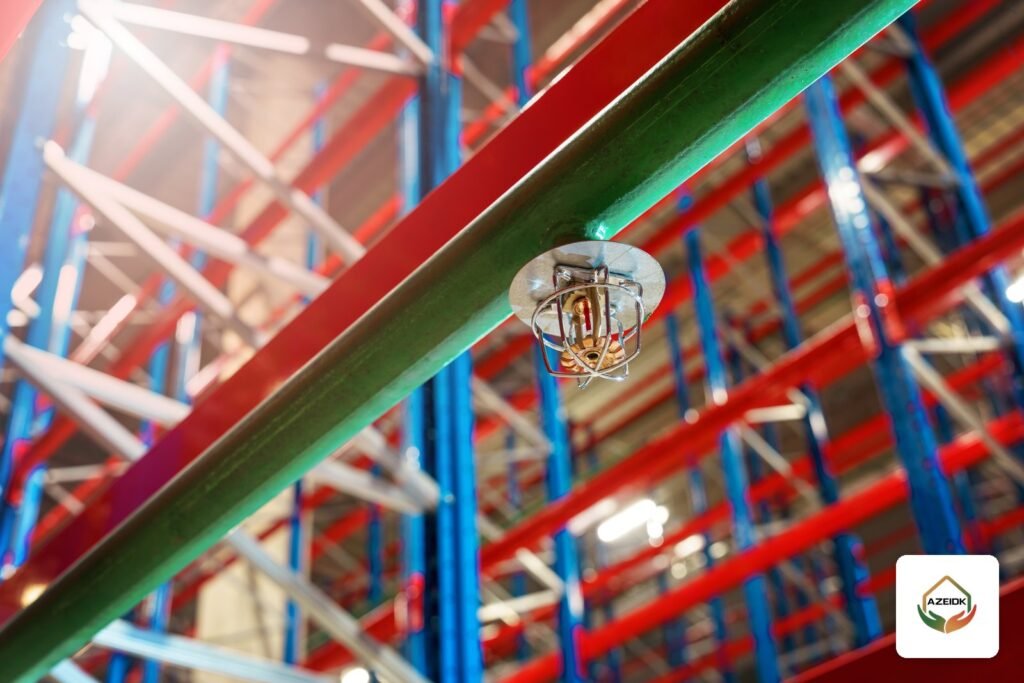
The difference between an upright sprinkler and a pendent sprinkler is the installation position and the shape of the deflector. An upright sprinkler sits on top of the pipe with its deflector facing up, and suits exposed piping in warehouses, plant rooms and car parks. A pendent sprinkler hangs below the pipe with its deflector facing down, and drops through the suspended ceiling in offices, hotels and corridors. One cannot be fitted in place of the other.
This article covers the orientation question only: deflector shape, SSU and SSP markings, distance below the ceiling and obstructions under NFPA 13, and the limits in dry systems. AZEIDK supplies sprinklers in both orientations as part of its fire fighting systems, including the TYCO Series TY-B. For K-factor, temperature rating and response type, see our guide to sprinkler head types.
Key takeaways
- An upright sprinkler has its deflector above the frame; a pendent has it below. Orientation is part of the listing of each model.
- TYCO data sheet TFP151 instructs that pendent sprinklers be installed in the pendent position, and each orientation in the series has its own model number.
- NFPA 13 (2019 edition) places the deflector of a standard spray upright or pendent sprinkler 1 to 12 in. below an unobstructed ceiling.
- On dry pipe systems, NFPA 13 (2022 edition) permits upright sprinklers; pendents are limited to listed dry sprinklers or specific cases in heated areas.
- A recessed pendent sprinkler must be fitted with the recessed escutcheon specified for that model.
In this article
- What is the difference between an upright sprinkler and a pendent sprinkler?
- Why can’t a pendent sprinkler be turned upside down to work as an upright?
- SSU and SSP: how to tell the orientation from the sprinkler itself
- When is an upright sprinkler used?
- When are pendent and recessed pendent sprinklers used?
- Upright vs pendent sprinkler: comparison
- How far below the ceiling does the deflector go under NFPA 13?
- Sprinkler orientation on dry pipe systems
- TYCO TY-B upright and pendent sprinklers from AZEIDK
- Common orientation mistakes
- Frequently asked questions
- Summary
What is the difference between an upright sprinkler and a pendent sprinkler?
An upright sprinkler is screwed into a fitting on top of the branch line. Water leaves the orifice upwards, strikes the deflector and is thrown down towards the floor in an umbrella-shaped pattern. A pendent sprinkler is installed below the pipe or on a drop from it, so water discharges straight down onto the deflector and spreads over the protected area.
The two may look alike in body, glass bulb and K-factor, but the deflector differs in shape and direction, so each has its own model number. In the TYCO Series TY-B, for example, TY3151 is the upright and TY3251 the pendent, both K5.6.
Why can’t a pendent sprinkler be turned upside down to work as an upright?
The deflector creates the spray pattern. An upright deflector is shaped to catch water rising from below and turn it towards the floor; a pendent deflector is shaped to catch falling water and spread it outwards and down. Invert the sprinkler and the water hits the deflector from the wrong side, the pattern changes, and the design density no longer reaches the area it was calculated for.
Data sheets state the orientation explicitly. The TYCO TFP151 data sheet for Series TY-B (May 2020) instructs that pendent sprinklers be installed in the pendent position and uprights in the upright position. The same document notes that the temperature rating is shown on the deflector.
When replacing a sprinkler, order a model that matches in orientation and listing, and check the sprinkler identification number (SIN) stamped on it first.
SSU and SSP: how to tell the orientation from the sprinkler itself
SSU stands for Standard Spray Upright and SSP for Standard Spray Pendent. Both terms have been used across the sprinkler industry for decades to tell the two orientations apart in catalogues and bills of quantities.
Markings on the sprinkler itself are not uniform between manufacturers, so on site rely on three checks together:
- The model number or SIN on the sprinkler, matched against the data sheet.
- The position of the deflector relative to the frame: above it on an upright, below it on a pendent.
- Any orientation marking on the deflector, where present, confirmed against the data sheet.
In the submittal and the bill of quantities, uprights and pendents should appear as separate model numbers, not as a generic line such as “K5.6 sprinkler, 68°C”.
When is an upright sprinkler used?
Uprights are chosen where piping is exposed with no suspended ceiling below it, for example:
- Warehouses and stores with exposed steel or concrete roofs.
- Fire pump rooms, plant rooms and MEP rooms.
- Basement car parks, factories and workshops.
An upright fits directly on the branch line with no drops and no escutcheon, and it is the orientation permitted as standard on dry pipe systems. For warehouses there are dedicated upright storage sprinklers, such as the Victaulic FireLock FL-SR/ST model V3403 (K11.2); their design follows the storage rules rather than general selection.
When are pendent and recessed pendent sprinklers used?
The pendent is the usual choice where a suspended ceiling (gypsum board or tiles) hides the piping, as in offices, hotels, hospitals, shops and corridors. A short drop runs from the branch line to the ceiling, and the sprinkler shows below it with an escutcheon covering the opening.
Recessed pendent sprinklers
In a recessed pendent, part of the sprinkler body sits within the ceiling opening, so less of it projects below the ceiling. It is installed only with the recessed escutcheon specified for its model. TFP151 specifies the Style 10 escutcheon for TY3251 and the Style 40 for TY4251, giving 1/2 in. of recessed adjustment, or up to 3/4 in. of total adjustment from the flush pendent position. The data sheet warns against compensating for insufficient adjustment by under- or over-tightening the sprinkler, and notes that a missing escutcheon may delay sprinkler operation in a fire. Another recessed pendent we supply is the TYCO EC-8C TY4282 corridor sprinkler.
When is a sidewall or concealed sprinkler the better option?
Where running pipe in the ceiling is difficult, as in hotel rooms and corridors in some existing buildings, the usual alternative is a wall-mounted sprinkler, covered in our article on the sidewall sprinkler. Where the architect wants a flat ceiling with no visible sprinkler, the answer is a concealed pendent with a cover plate; see our concealed sprinkler guide.
Upright vs pendent sprinkler: comparison
| Item | Upright | Pendent |
|---|---|---|
| Position | Above the pipe, deflector up | Below the pipe, deflector down |
| Typical ceiling | Exposed piping, no suspended ceiling | Suspended or finished ceiling |
| Typical uses | Warehouses, pump and plant rooms, car parks, factories | Offices, hotels, hospitals, corridors, shops |
| Escutcheon | Not normally needed | Flush, or the recessed escutcheon specified for the model |
| Dry pipe system | Permitted | Listed dry sprinkler, or specific cases in heated areas |
| Common abbreviation | SSU | SSP |
| TYCO TY-B examples | TY1151, TY3151, TY4151 | TY1251, TY3251, TY4251 |
How far below the ceiling does the deflector go under NFPA 13?
NFPA 13 sets the deflector position of standard spray upright and pendent sprinklers according to the ceiling or construction above. The values below come from published summaries of the 2019 edition; the latest edition is 2025, and the designer confirms values and section numbers against the edition adopted for the project:
- Unobstructed construction: deflector 1 to 12 in. (about 25 to 305 mm) below the ceiling. The 12 in. maximum remains in the 2025 edition.
- Obstructed construction (beams or joists): deflector 1 to 6 in. below the structural members and no more than 22 in. (about 559 mm) below the ceiling or roof deck, or a sprinkler in each bay with the deflector 1 to 12 in. below the ceiling.
Obstructions below and around the sprinkler
According to summaries of the 2019 edition, NFPA 13 (Table 10.2.7.1.2) relates the horizontal distance from the sprinkler to an obstruction such as a beam or duct to the allowable height of the deflector above the bottom of that obstruction. The standard requires sprinklers below fixed obstructions wider than 4 ft (about 1.2 m), such as large ducts and cable trays. Where an obstruction 18 in. or less below the deflector prevents the spray pattern from developing, the sprinkler must be positioned according to the obstruction rules of the standard. These values are technical references; the deciding documents are the drawings approved by Civil Defense under the Saudi Fire Code SBC 801. For the standard as a whole, see our NFPA 13 guide.
Sprinkler orientation on dry pipe systems
A dry pipe system is filled with pressurised air, and all water must be drained from it after any test or trip. An upright lets water drain back into the pipe, while the drop of a pendent traps water at a low point where it can freeze.
NFPA 13 (2022 edition, section 8.2.2.2, as quoted by a specialist technical source; check the matching section in the edition adopted for the project) therefore permits only the following on dry pipe systems:
- Upright sprinklers.
- Listed dry sprinklers.
- Pendent and sidewall sprinklers on return bends, where the sprinklers, return bends and branch line piping are in an area kept at or above 40°F (4°C).
- Horizontal sidewall sprinklers installed so that water is not trapped.
- Pendent and sidewall sprinklers in an area kept at or above 40°F (4°C), with a potable water supply and copper or CPVC piping specifically listed for dry pipe applications.
In freezers, cold rooms and outdoor canopies the usual answer is a dry pendent sprinkler; one example is the TYCO DS-1, which is ordered to a specific length for its installation position.
TYCO TY-B upright and pendent sprinklers from AZEIDK
AZEIDK supplies the TYCO Series TY-B in all three orientations. According to data sheet TFP151:
- Upright: TY1151 (K2.8), TY3151 (K5.6), TY4151 (K8.0, 3/4 in. NPT) and TY4851 (K8.0, 1/2 in. NPT).
- Pendent: TY1251 (K2.8), TY3251 (K5.6), TY4251 (K8.0, 3/4 in. NPT) and TY4951 (K8.0, 1/2 in. NPT).
- Recessed pendent: TY3251 with the Style 10 escutcheon and TY4251 with the Style 40.
The data sheet notes that NFPA 13 prohibits 1/2 in. NPT sprinklers with K-factors greater than 5.6 in new construction, and states that TY4851 and TY4951 are intended for retrofit in existing systems only. Uprights and pendents are tightened with the W-Type 6 wrench and recessed pendents with the W-Type 7, at 7 to 14 lb-ft for 1/2 in. NPT and 10 to 20 lb-ft for 3/4 in. NPT. Maximum working pressure is 175 psi for most models and finishes, rising to 250 psi for the K5.6 models in certain finishes; the 250 psi rating applies only to the UL and C-UL Listings and the City of New York approval (Table D of the data sheet). Approvals and finishes vary by model, so check the data sheet for each line item before submittal. For high storage we also supply Victaulic sprinklers, including the V3403 upright and the V4702 ESFR pendent.
Common orientation mistakes
- Fitting a pendent in the upright position, or the reverse, because the two models look alike.
- Ordering sprinklers by K-factor and temperature only, without stating orientation.
- Using a standard pendent on a drop in a dry pipe system in a cold area.
- Fitting a recessed pendent with another model’s escutcheon, or leaving it without one.
- Leaving upright deflectors further below the ceiling than permitted because of hanger or beam depth.
- Adding a wide duct or cable tray under the sprinklers after installation without reviewing coverage.
Frequently asked questions
Can an upright sprinkler be installed upside down as a pendent?
No. The deflector is designed for one direction, and inverting it changes the spray pattern. Order the matching pendent model under its own number.
What do SSU and SSP mean on a sprinkler?
SSU means standard spray upright and SSP means standard spray pendent. To confirm the orientation of a specific sprinkler, check its model number or SIN against the data sheet.
What are the types of fire sprinklers by orientation?
Upright and pendent (including recessed and concealed pendents), plus wall-mounted sidewall sprinklers. For K-factor and temperature classifications, see our sprinkler head types guide.
When should I choose a recessed pendent over a standard pendent?
When the architect wants less of the sprinkler showing below the suspended ceiling without hiding it completely. It must be fitted with the recessed escutcheon specified for that model.
Can a pendent sprinkler be used on a dry pipe system?
Not a standard pendent in areas exposed to freezing. Use a listed dry pendent sprinkler, or one of the specific heated-area cases permitted by NFPA 13.
How far below the ceiling is an upright sprinkler deflector?
Under an unobstructed ceiling, 1 to 12 in. according to summaries of NFPA 13 (2019 edition); the 12 in. maximum also appears in the 2025 edition. Beam and joist construction has different rules set by the designer.
Summary
Uprights for exposed piping and dry pipe systems, pendents for suspended ceilings, recessed pendents where less projection is wanted, and sidewall or concealed sprinklers where the ceiling demands it. The fixed rule is that orientation is part of the model: its own number, its own deflector and its own escutcheon. Getting orientation right in the BOQ and the submittal prevents mistakes that are hard to find once the ceiling is closed.
Reviewing a sprinkler BOQ for your project? Send us the ceiling type in each area, the system type, and the K-factor and temperature rating required, and we will recommend the right upright or pendent model with its data sheet. Contact the AZEIDK team
Related guides
- Fire Extinguisher Selection Guide for Facilities in Saudi Arabia
- WATEX Fire Pumps: The Complete Guide to WATEX Pumps in Saudi Arabia (Models, Approvals, Capacities)
- Emergency Lighting: Luminaire and Exit Sign Types, Maintained vs Non-Maintained, Duration and Testing
- Video Intercom Systems for Buildings and Compounds