A deluge sprinkler system is a network of empty pipes ending in open sprinklers or nozzles. A deluge valve holds the water back and opens only on a signal from a separate detection system in the same area, or on manual release, and then every outlet flows at once. Consultants specify it where a fire can spread faster than closed sprinklers would open one by one, so the whole area has to be wetted together. This article explains what happens inside the deluge valve, the role of detection, the difference between open sprinklers and spray nozzles, and what all this means for design and operation on a Saudi project, as part of AZEIDK fire fighting systems.
Key takeaways
- Every outlet in a deluge system is open: once the valve opens, water flows from all sprinklers or nozzles in the area it serves.
- The decision to discharge comes from detection and the releasing panel, not from the heat element of a sprinkler as in a wet system.
- Water demand is the total flow of all outlets in the zone, which drives pipe sizes, the fire pump and the water tank.
- Open sprinkler design refers to NFPA 13, directional spray nozzles to NFPA 15 and foam-water systems to NFPA 16.
- NFPA 25 calls for an annual full flow test of the deluge valve, so plan drainage from day one.
In this article
- What is a deluge sprinkler system?
- Deluge system components and what each one does
- How does a deluge valve work?
- Detection: who decides to open the valve?
- Open sprinklers and deluge sprinkler nozzles
- When does a consultant specify a deluge system?
- What deluge means for hydraulic calculations and the fire pump
- Inspection, testing and maintenance
- Deluge systems on Saudi projects
- Common deluge system mistakes
- Frequently asked questions
- Conclusion
What is a deluge sprinkler system?
NFPA 13 defines a deluge system as a sprinkler system using open sprinklers or nozzles attached to a piping system, connected to a water supply through a valve that is opened by a detection system installed in the same areas as the sprinklers or nozzles. The key word is “open”: there is no glass bulb or fusible link holding the water back. The outlet is always open and the piping downstream of the valve is dry and at atmospheric pressure.
That is what separates it from a pre-action system. In pre-action, detection fills the pipes, but water only leaves the sprinklers that heat has opened. In a deluge system, water leaves every outlet as soon as the valve opens. For the full comparison of wet, dry, pre-action and deluge, see wet vs dry vs pre-action vs deluge sprinkler systems.
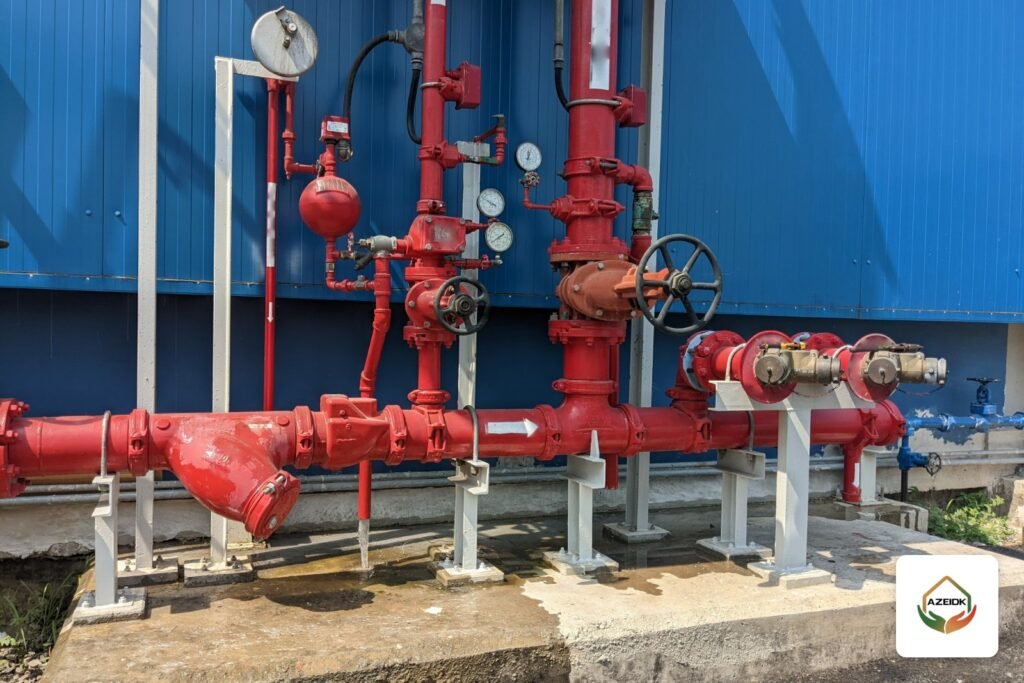
Deluge system components and what each one does
| Component | Role | What the consultant checks in the submittal |
|---|---|---|
| Deluge valve | Holds water back from the network and opens on the release command | Listing or approval (UL/FM), size, working pressure and release method |
| Valve trim | Priming line valve, test valve, alarm pressure switch, drain and gauges | That it matches the datasheet of that specific valve |
| Release device | Electric solenoid valve, hydraulic or pneumatic pilot line, or manual release station | Compatibility with the releasing panel and the valve |
| Detection and releasing panel | Detects the fire and issues the command to open the valve | Detector types, coverage and release logic in the cause and effect matrix |
| Open outlets | Open sprinklers or directional spray nozzles | K-factor, spray angle and layout over the hazard |
| Main control valve | Isolates the deluge valve for maintenance | That it is supervised at the fire alarm panel |
How does a deluge valve work?
Most deluge valves used on projects rely on a priming chamber. Supply water reaches a chamber behind a diaphragm through a charge line, and that pressure keeps the clapper shut against the supply pressure, either directly or through a latch supported by the diaphragm, as in the Victaulic 769N. When the priming chamber is vented, the pressure behind the diaphragm drops, the clapper opens, and water flows into the system and into the alarm line at the same time, operating the alarm pressure switch or water motor gong.
Systems differ in how the priming chamber is vented. The valve’s own datasheet and installation manual define the options:
- Electric release: the releasing panel opens a solenoid valve on the priming line when the detection logic is met. This is the most common arrangement with addressable fire alarm systems.
- Wet pilot release: a small water-filled line carrying closed pilot sprinklers. When one opens from heat, pressure drops and the deluge valve opens.
- Dry pilot release: the same idea with an air-filled line and a pneumatic actuator, used where freezing is a concern or dry pilot lines are preferred.
- Manual release: a manual release station near the valve or on the escape route, available even with automatic release.
After operation, most deluge valves do not reset themselves. They need a manual reset following the manufacturer’s manual: close the supply valve, drain the system, then re-establish the priming chamber. The site operations team should know the reset steps before handover, not after the first operation.
Detection: who decides to open the valve?
A deluge system depends on detection more than any other sprinkler system, because an open sprinkler cannot act on its own. The designer selects detectors for the expected fire, its speed and the environment: heat detectors for general process areas, flame detectors for fast flammable liquid fires, such as the intelligent IR3 flame detectors listed on the AZEIDK site, or a combination based on the hazard study.
Detection and releasing devices are tested under NFPA 72, which requires the system to be secured against accidental release during testing, including disconnecting releasing solenoids. The link between detectors and the release command belongs in the cause and effect matrix, because a programming error can mean a discharge with no fire, or a fire with no discharge.
Open sprinklers and deluge sprinkler nozzles
There are two kinds of outlet in a deluge system. The first is an open sprinkler, like a standard sprinkler without the heat element, distributing water over a floor or ceiling area under NFPA 13. The second is a directional water spray nozzle aimed at a specific surface or piece of equipment with a defined angle and pattern, designed under NFPA 15 for fixed water spray systems.
| Item | Open sprinkler | Directional spray nozzle |
|---|---|---|
| Reference standard | NFPA 13 | NFPA 15 |
| Coverage | Floor or ceiling area | A specific surface or equipment item |
| Selection driver | Hazard classification and coverage area | Protection objective, spray angle and distance to the target |
| Flow data source | Datasheet: K-factor and operating pressure | Datasheet: K-factor, cone angle and spray profiles |
When foam concentrate is added, the system becomes a foam-water deluge system designed under NFPA 16. A foam tank and proportioning come in, such as the WATEX UL foam bladder tank and Safe Guard foam concentrates, and the foam concentration is chosen to match the listing of the system components together.
When does a consultant specify a deluge system?
A deluge system is not chosen because it is “stronger”. It is chosen where closed sprinklers do not fit: the fire may spread faster than sprinklers open one after another, or a whole surface needs cooling or protection from a nearby fire. Typical cases in specifications include:
- Flammable liquid areas where a spill fire can cover a large area quickly.
- Aircraft hangars, where NFPA 409 sets protection by hangar group, often with foam-water systems.
- Exposure protection for equipment or structures next to a fire source, one of the design objectives in NFPA 15.
- Any hazard where the risk study or the owner’s specification calls for the whole area to be wetted on detection.
In industrial plants the decision starts from the hazard study, not from the system type. See factories and industrial facilities for how we tie the process to the detection and suppression choice.
What deluge means for hydraulic calculations and the fire pump
A wet system is calculated over a design area that assumes a limited number of sprinklers open. In a deluge system every outlet in the zone served by the valve flows, so the demand is the total flow of all outlets plus the hose allowance in the adopted standard. In practice:
- Pipe sizes grow, and the fire pump and water tank may be larger than for a wet system over the same area.
- Large hazards are usually split into zones, each with its own deluge valve, so demand stays within the supply.
- Designers check whether two adjacent zones could operate together if detection can trigger more than one valve.
- Drainage for large volumes of water during testing and real operation is planned early.
These calculations are part of our engineering design and calculations service and are based on the actual outlet and valve datasheets, not generic values.
Inspection, testing and maintenance
NFPA 25 calls for an annual full flow test of the deluge valve, as shown in the NFPA 25 requirements table reproduced in the Delaware Administrative Code, alongside a monthly check of the trim valve positions and condition and an internal inspection tied to the annual test, per the adopted edition. Among the proposals for the 2026 edition summarized by NFSA is an annual internal inspection of dry, pre-action and deluge valves. Always confirm the edition adopted for your project and see our NFPA 25 guide for water-based systems.
A full flow test means every outlet discharges, so it needs coordination with facility management: isolate or protect sensitive equipment, prepare drainage, and record trip time and operating pressure. AZEIDK annual maintenance contracts cover fire fighting and fire alarm systems and related equipment.
Deluge systems on Saudi projects
The Saudi Fire Protection Code SBC 801 and Civil Defense requirements set where automatic protection is required, and the design follows the NFPA edition named in the project specification. With the submittal, the consultant expects the datasheets and installation manuals for the deluge valve, outlets and releasing panel, with their listing or approval certificates. AZEIDK supports design and calculations, technical selection of systems and equipment, supply to project requirements, installation, testing and commissioning, and Civil Defense approval support.
Common deluge system mistakes
- Fitting valve trim from a different supplier than the valve itself, which can void the listing or approval.
- Releasing on a single detector in an environment known for false alarms, without reviewing the release logic.
- Forgetting the manual release station, or placing it where the operator cannot reach it safely.
- Calculating demand as if it were a wet system, then finding during the full flow test that the pump falls short.
- Handing over without training the operations team to reset the valve.
Frequently asked questions
What is the difference between a deluge and a pre-action system?
Both rely on detection to open the valve, but deluge outlets are open so all of them discharge, while pre-action uses closed sprinklers and water only leaves those opened by heat.
Is a deluge system suitable for server rooms and archives?
Usually not, because it floods the whole space. These areas are more often protected by pre-action or clean agent systems, depending on the hazard study.
Which NFPA standards cover a deluge system?
Open sprinklers in NFPA 13, directional spray nozzles in NFPA 15, foam-water systems in NFPA 16, inspection and maintenance in NFPA 25, and detection and release in NFPA 72.
Does a deluge valve close by itself after the fire is out?
Most valves need a manual reset following the manufacturer’s manual, after closing the supply valve and draining the system.
Can a deluge system be operated manually?
Yes. Systems are normally fitted with a manual release station that works alongside automatic release from detection.
How often is a deluge valve full flow tested?
Annually under NFPA 25. Confirm the edition adopted for your project.
Conclusion
A deluge system answers a specific hazard: detection decides, and the whole area is wetted at once. Success rests on three things: suitable detection with well thought out release logic, hydraulic calculations that assume every outlet flows, and an operations team that knows how to test and reset the valve.
Need a deluge system for a flammable liquid area or an industrial plant? AZEIDK studies the hazard, designs the system and prepares the approval file. Talk to the AZEIDK team
Related guides
- Jockey Pumps: Sizing and Start/Stop Pressure Settings
- Fire Extinguishers in Dammam and Al Khobar: Supply and Maintenance for Workshops, Warehouses and Industrial Sites
- CCTV Shop in Madinah: Directory of Companies and Shops and How to Check Licensing
- EZVIZ Cameras for Shops and Homes: Models and Applications