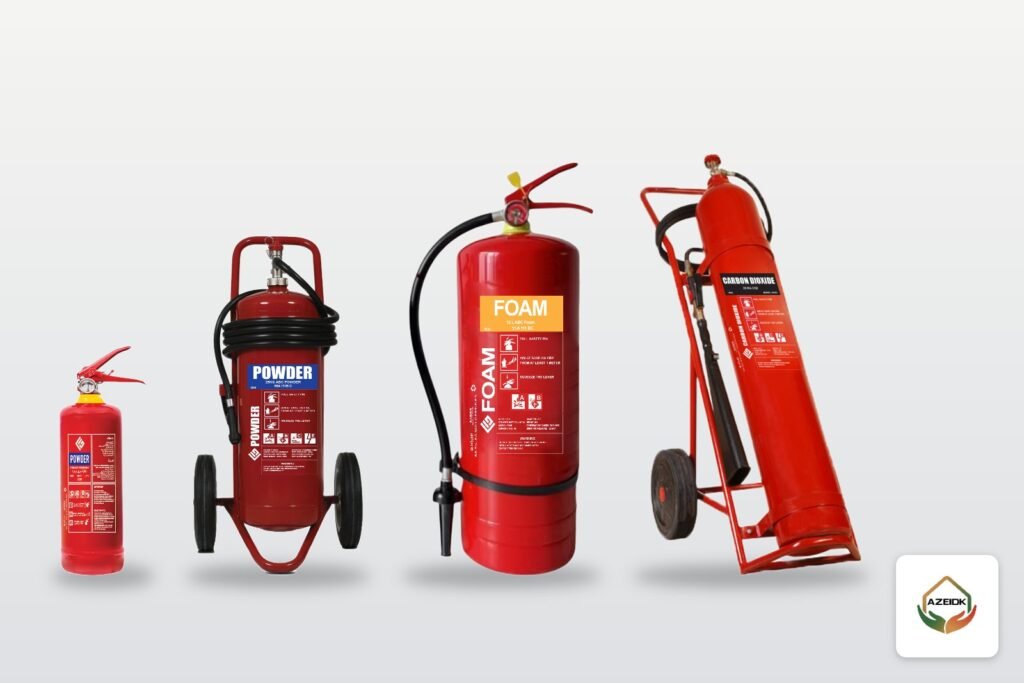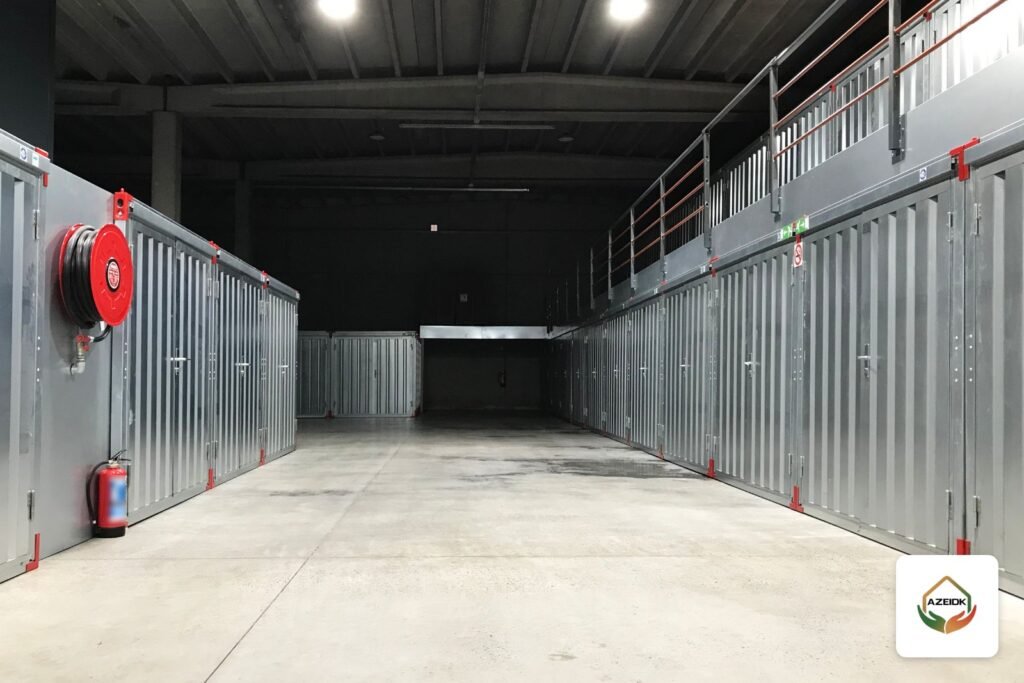
Warehouse fire extinguishers are chosen zone by zone, not as one type for the whole building: ABC dry powder or foam among the racks for cardboard, timber and plastics; CO2 for electrical rooms and panels; foam or powder with a suitable B rating near oils and liquids; and wheeled units for yards and large loading areas. They are then spread so nobody walks more than 22.9 m along the aisles to reach one.
To compare extinguisher types and choose the right one for each hazard, see our fire extinguishers selection guide for facilities in Saudi Arabia.
This guide shows how to split a warehouse into zones, the right type for each, layout rules among racks, and the mistakes that keep coming up at Civil Defense inspections.
Key takeaways
- Split the warehouse into zones: rack storage, loading and unloading, electrical rooms, liquids and oils, offices and the outside yard.
- Class A travel distance is no more than 22.9 m, measured along the aisles, not in a straight line.
- No single extinguisher is credited with more than about 1,045 m².
- Mount units on columns, at aisle ends and near exits, not behind pallets or in blocked aisles.
- The binding references are SBC 801 and Civil Defense requirements; the technical tables come from NFPA 10.
In this article
- Why warehouses need their own extinguisher plan
- Which warehouse fire extinguishers suit each zone?
- How many extinguishers does a warehouse need?
- Layout rules among racks
- Wheeled extinguishers in large warehouses
- Battery charging areas
- Common inspection findings
- Steps to build a warehouse extinguisher plan
- Warehouse extinguishers from AZEIDK
- FAQ
- Conclusion
Why warehouses need their own extinguisher plan
Warehouses are large, with long aisles, high racks and stock that changes with every order. Cardboard, plastics and timber burn fast, and may sit next to oils, cleaning products or batteries. A few units at the entrance are not enough when a worker deep in the building may be tens of metres from the nearest one.
Extinguishers are the first response to a small fire and work alongside the detection, alarm and sprinkler systems set by the design. For fixed protection, see warehouse and high-rack fire protection.
Which warehouse fire extinguishers suit each zone?
| Zone | Main hazard | Suitable type |
|---|---|---|
| Rack aisles, cardboard and timber storage | Class A | ABC powder or foam, sized by A rating |
| Loading docks and yards | Class A, sometimes B | Portable ABC powder, wheeled units for open areas |
| Electrical rooms and panels | Class C | CO2: non-conductive and leaves no residue |
| Oil, paint and liquid storage | Class B | Foam or powder with a suitable B rating |
| Offices inside the warehouse | Class A with electrical equipment | ABC powder or CO2 depending on equipment |
| Generator or diesel room | Class B and C | ABC powder or CO2 per design |
For each type, see fire classes and which extinguisher for which fire.
How many extinguishers does a warehouse need?
The designer sets the hazard level from the type and amount of stock. In the NFPA 10 Class A table each A unit covers about 139 m² in ordinary hazard and about 93 m² in extra hazard, with a minimum single-unit rating of 2-A and 4-A respectively. A 2,000 m² ordinary-hazard warehouse needs at least eight 2-A or four 4-A units by area.
In warehouses, travel distance usually governs: aisles make the walking route far longer than a straight line on plan. The designer draws walking routes and adds units until every point is within 22.9 m. For the full method, see our NFPA 10 guide.
Flammable liquid areas
For flammable liquids up to about 6 mm deep, the table links B rating to travel distance: in ordinary hazard 10-B within 9.1 m or 20-B within 15.25 m; in extra hazard 40-B or 80-B at the same distances.
Layout rules among racks
- Columns and aisle ends: visible from the main aisle and clear of stock movement.
- Near exits and on travel routes: so workers pick up a unit on the way rather than walking toward the fire.
- Signs: high racks block sight lines, so a raised sign above each unit is essential. See fire extinguisher sign.
- Mounting height: under NFPA 10 the top of units up to 18.14 kg sits no higher than about 1.53 m, heavier units no higher than 1.07 m, and the bottom at least 102 mm above the floor.
- Forklift protection: in forklift aisles protect units with a bracket or cabinet, see fire extinguisher cabinets.
Wheeled extinguishers in large warehouses
In open yards, large loading areas and bigger liquid stores, a wheeled unit carries more agent than a hand portable. Place it where the trolley can move easily on level ground. See wheeled fire extinguishers, and protect outdoor units from sun and dust as in outdoor extinguisher covers.
Battery charging areas
Charging forklift and handling equipment batteries is an electrical hazard needing a non-conductive agent; the designer selects the type for the battery technology. For lithium risks, see lithium battery storage in warehouses.
Common inspection findings
- Units only at the entrance and office, nothing deep in the building.
- Units behind pallets or in aisles closed by storage.
- No raised signs above units among high racks.
- Dry powder units protecting delicate electronic equipment (servers or control panels), which NFPA 10 does not permit.
- Layout not updated after racks are rearranged.
- No monthly inspection record or annual service tag; see extinguisher maintenance and recharging.
Steps to build a warehouse extinguisher plan
- Collect the current drawing with rack layout, aisles and exits, and a list of stock and rough quantities.
- Identify special hazard zones: electrical rooms, generator, oils and paints, battery charging and offices.
- Have the designer set the hazard level per zone, then calculate the area-based count per zone.
- Draw walking routes among racks and add units until every point is within 22.9 m for Class A, and within the Class B distance near liquids.
- Choose type and size for each location and confirm each model’s rating on the datasheet.
- Install signs and brackets or cabinets, and train supervisors in the monthly check.
- Review the plan whenever racks or stock types change.
Warehouse extinguishers from AZEIDK
AZEIDK serves the warehouses and logistics sector and supplies through its technical supply service portable dry powder units such as the Falcon Gold 6 kg dry powder extinguisher, wheeled units such as the Falcon Gold 50 kg dry powder, the 25 L foam extinguisher for liquid storage areas, and CO2 units such as the 6 kg CO2 extinguisher, with datasheets for each model. Its own team services extinguishers under maintenance contracts. For licensing, see Salamah licence for warehouses.
FAQ
What is the best fire extinguisher for a warehouse?
There is no single type. ABC powder or foam for storage, CO2 for electrical rooms, B-rated units near liquids and wheeled units for yards.
How many extinguishers does a 1,000 m² warehouse need?
In ordinary hazard at least four 2-A or two 4-A units by area, plus whatever travel distance among racks and special hazards require.
Where should extinguishers go among racks?
On columns, at aisle ends and near exits, visible from the main aisle with a raised sign above.
Do sprinklers replace extinguishers in a warehouse?
No. Extinguishers are for early response and remain required alongside sprinklers under SBC 801 and the approved drawing.
Do I need a wheeled extinguisher?
They help in yards, large loading areas and large liquid stores; the designer decides based on hazard and area.
Conclusion
Zone the warehouse, choose the type for each zone, place units by actual walking distance among racks, and update the layout whenever storage changes.
Fitting out or reviewing a warehouse? Send us the drawing and the type of stock, and we will propose types and quantities with a supply and maintenance quote. Talk to the AZEIDK team
AZEIDK supplies fire extinguishers of all common types and sells them to individuals and businesses from its branches in Saudi Arabia.
Related guides
- Fire Pressure Reducing Valve (PRV): When High-Rise Buildings Need One and How to Set and Test It
- Fire Alarm Log Book and Inspection Report: What to Record and a Periodic Maintenance Report Template
- Fire Pump Rooms in Saudi Arabia: Components, Design and Installation
- CCTV Cameras in Jeddah: Hikvision, Dahua and Bosch, Supply and Installation, Priced per Project