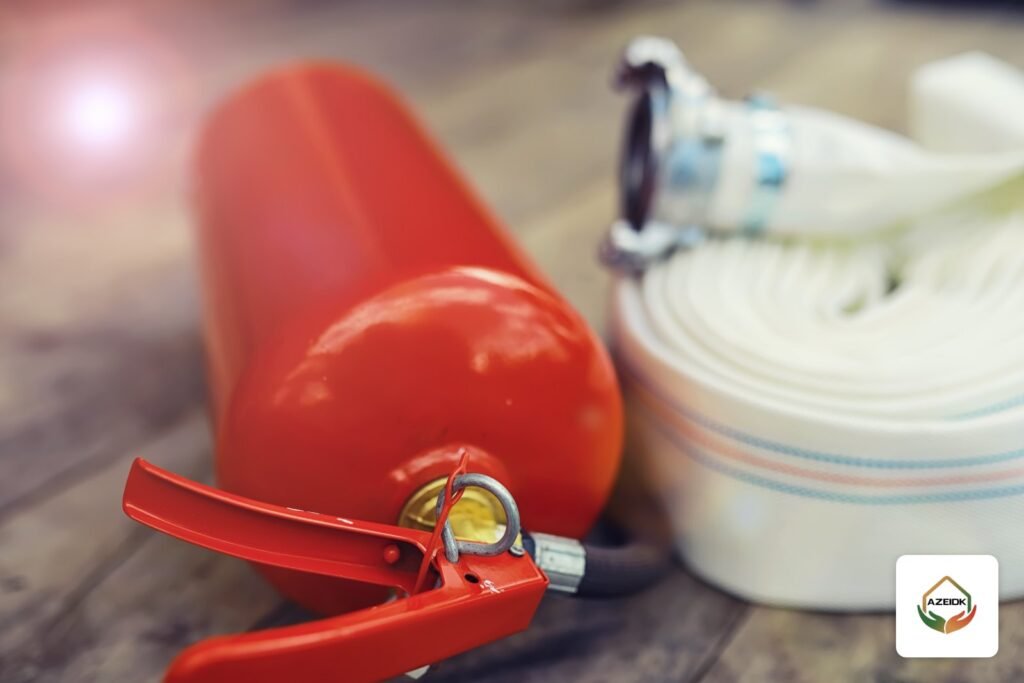
A wheeled fire extinguisher is a large-capacity extinguisher mounted on a two-wheel carriage that one person pulls to the fire and operates through a long hose. You need one where the likely fire is bigger than a hand-portable unit can handle, such as loading yards, open warehouses and flammable liquid stores. It is added to portable extinguishers, never a replacement for them.
This guide explains when to specify a wheeled unit, how to choose between the 25, 50, 75, 100 and 150 kg sizes in the Falcon Gold mobile dry powder extinguisher series supplied by AZEIDK, what hose length and discharge time mean in practice, and where to place the unit on site.
Key takeaways
- Wheeled extinguishers supplement portable extinguishers in high-hazard areas; they do not replace them.
- ISO 11601 defines a wheeled extinguisher as having a total mass above 20 kg and no more than 450 kg, designed to be transported and operated by one person.
- Falcon Gold FDP wheeled series: 25, 50, 75, 100 and 150 kg, 70% ABC powder, 8 m throw, 3 m hose on the 25 kg unit and 5 m on the others.
- Datasheet discharge times run from 25 seconds (25 kg) to 75 seconds (150 kg). That is the operator’s real working time.
- Place it in a fixed, marked location on firm level ground, near but not next to the hazard, and shaded from the sun.
In this article
- Wheeled vs portable fire extinguisher: what is the difference?
- When do you need a wheeled fire extinguisher instead of a portable one?
- Wheeled fire extinguisher sizes from 25 to 150 kg: what the datasheet says
- How to choose the right size
- Powder or foam? Where the 25 L foam extinguisher fits
- Where should a wheeled extinguisher be placed?
- Common mistakes with wheeled extinguishers
- What to ask the supplier before you buy
- Frequently asked questions
- Conclusion
Wheeled vs portable fire extinguisher: what is the difference?
A portable extinguisher is carried by hand, so its capacity stays small. Falcon Gold portable dry powder units, for example, run from 1 kg to 12 kg. A wheeled unit carries far more agent, rolls on wheels, and is discharged through a hose and gun instead of lifting the cylinder.
ISO 11601:2017, Fire fighting, Wheeled fire extinguishers, Performance and construction, draws a clear line: a wheeled extinguisher is an appliance on wheels with a total mass of more than 20 kg and not more than 450 kg, designed to be operated and transported to the fire by one person. In Saudi Arabia the Gulf version, SASO GSO ISO 11601, is listed among the reference standards of SASO’s Technical Regulation for Fire Control Materials and Equipment, together with SASO GSO ISO 11602-2 on inspection and maintenance of portable and wheeled extinguishers.
In practice, portable units are for first response by whoever is nearest. A wheeled unit is for a larger fire that needs more agent and longer discharge, operated by someone trained on it. For ABC vs BC powder and where powder should not be used, see our dry powder extinguisher guide.
When do you need a wheeled fire extinguisher instead of a portable one?
No single number decides it. The need comes from the hazard assessment and the approved design under the Saudi Fire Protection Code (SBC 801), and from Civil Defense requirements at licensing. Typical triggers for adding a wheeled unit:
- Large quantities of flammable liquids: Class B fires spread across the spill area quickly, and a 6 or 12 kg unit may not cover a wide pool.
- Large open areas: loading and unloading yards, open storage and large workshop yards, where travel distances and the potential fire are both larger.
- Concentrated industrial hazards: production lines using oils or solvents, petroleum product stores and filling areas.
- Fuel stations: wheeled units are commonly used on the forecourt and at the tanker unloading point, but the number and type follow the official fuel station requirements and the approved station design. See fuel station safety requirements in Saudi Arabia.
Wheeled units do not suit offices, narrow corridors, floors reached only by stairs, or rooms full of sensitive electronics, because powder leaves residue on equipment. The Falcon Gold datasheet also excludes carbon disulphide fires and flammable metals.
Wheeled fire extinguisher sizes from 25 to 150 kg: what the datasheet says
The Falcon Gold (Emirates Fire Fighting Equipment Factory) mobile series has seven models: FDP25, FDP50, FDP75, FDP100 and FDP150, plus FDP25-DC and FDP50-DC. All use 70% ABC dry chemical powder for classes A, B, C and E, with 15 bar operating and 30 bar test pressure, a cold-rolled steel cylinder, and solid rubber and aluminium alloy wheels. Figures below are from the official series datasheet (Standard Mobile Dry Powder Fire Extinguisher, ref. FXD 041-6):
| Model | Capacity | Discharge time | Hose length | Cylinder diameter | Throw |
|---|---|---|---|---|---|
| FDP25 | 25 kg | 25 s | 3 m | 250 mm | 8 m |
| FDP50 | 50 kg | 42 s | 5 m | 300 mm | 8 m |
| FDP75 | 75 kg | 48 s | 5 m | 390 mm | 8 m |
| FDP100 | 100 kg | 55 s | 5 m | 400 mm | 8 m |
| FDP150 | 150 kg | 75 s | 5 m | 550 mm | 8 m |
| FDP25-DC | 25 kg | 25 s | 3 m | 250 mm | 8 m |
| FDP50-DC | 50 kg | 50 s | 5 m | 300 mm | 8 m |
If FDP25-DC or FDP50-DC appears in your bill of quantities, ask for the datasheet of that exact model with the quotation.
How to choose the right size
50 kg: the balanced mid-size
The 50 kg dry powder unit (FDP50) balances a large agent load with a size that can be pulled across most yards: 5 m hose, 42 seconds discharge and 1,040 mm overall height, which suits many factories, warehouses and loading yards.
25 kg: when mobility matters most
The 25 kg unit is lighter and narrower (250 mm), which suits workshops with tighter aisles and sites where the operator may not be used to heavy equipment. Its hose is only 3 m and discharge lasts 25 seconds, so the operator stands closer and has less time.
75, 100 and 150 kg: large hazards and open yards
Discharge time rises to 75 seconds and diameter to 550 mm on the 150 kg model. These sizes are for wide yards and large liquid stores, provided the ground is firm and level and trained staff are available. The standard assumes one person moves the unit, but pulling 150 kg across sand or gravel is a different matter.
Questions that settle the choice
- How big is the likely fire? (Quantity of liquid, possible spill area, type of material.)
- How far is the unit from the furthest hazard point, and is the route paved and free of kerbs?
- How wide are the doors and aisles it must pass? Compare them with the cylinder diameter and wheel track.
- Who will operate it, and have they practised pulling it, opening the valve and aiming the gun?
- Is powder right for the hazard, or would foam suit a fuel spill better?
Powder or foam? Where the 25 L foam extinguisher fits
ABC powder knocks fire down fast across several classes, but it does not leave a film that stops re-ignition on a fuel surface. So a design for fuel stores may call for a foam unit beside the powder. AZEIDK offers the Falcon Gold 25 L foam extinguisher for solid and flammable liquid fires in factories, warehouses and fuel stores. Its datasheet is supplied with the quotation; request it to confirm foam type, operation and carriage before adding it to the BOQ.
Where should a wheeled extinguisher be placed?
According to the QRFS blog, quoting the 2022 edition of NFPA 10, wheeled extinguishers are kept in designated locations and are not subject to the mounting-height rules for wall-hung extinguishers; the edition adopted for your facility’s design and Civil Defense requirements govern in the end. In practice, a wheeled unit is not hung on a bracket; it gets a fixed, known floor position. Mounting heights and travel distances for portable units are covered in our NFPA 10 portable extinguisher guide. Good practice when choosing that position:
- Near the hazard, not next to it: close enough to reach quickly, far enough to stay reachable if the hazard is burning, and on the way out of the area rather than behind it.
- Firm, level ground: a paved route with no steps, kerbs or potholes between the unit and the hazard.
- Visible and signed: a clear sign and a marked floor bay, with no goods or pallets blocking it.
- Clear of exits: never in an escape route or in front of an emergency door.
- Protected from sun and dust: in open yards, a canopy or cover keeps summer heat off the hose, rubber wheels and labels while keeping access quick.
- Secured, not locked: restrained so it cannot roll on a slope, yet free to pull away instantly.
Common mistakes with wheeled extinguishers
- Relying on one wheeled unit in the yard and dropping the portable extinguishers near hazard points.
- Specifying 150 kg for a site with sandy ground or ramps, so one person cannot move it.
- Keeping the unit inside a store that is locked at night, behind goods, or in an escape route.
- Writing “50 kg extinguisher” in the BOQ without agent, model and hose length.
- Leaving it in direct sun for years until the hose and rubber wheels crack.
- Skipping wheels, hose and gun in periodic checks.
- Buying without checking a valid SABER certificate of conformity, although the technical regulation does not allow this equipment on the market without one.
What to ask the supplier before you buy
- The official datasheet for the exact model, not a different series.
- A valid product certificate of conformity on the SABER platform.
- Capacity, hose length and powder type confirmed in writing on the quotation.
- Who handles periodic maintenance and refilling after any use.
- A layout showing each wheeled unit alongside the portable extinguishers, as part of the Civil Defense file.
Frequently asked questions
Does a wheeled extinguisher replace portable extinguishers?
No. It is an addition for high-hazard areas. Portable units are still needed for first response under the approved design and Civil Defense requirements.
How long is the hose on a 50 kg extinguisher?
On the Falcon Gold FDP50 the hose is 5 m, with an 8 m throw and 42 seconds discharge time per the datasheet.
What sizes does the Falcon Gold wheeled range cover?
From 25 kg to 150 kg: 25, 50, 75, 100 and 150 kg models.
Can one person operate it?
ISO 11601 defines wheeled extinguishers as designed for one person to transport and operate, but larger sizes need paved ground and a trained operator.
Where should it go in a warehouse?
In a fixed, visible, signed position on level ground near the hazard but not next to it, clear of escape routes and shaded from the sun.
Conclusion
A wheeled fire extinguisher is a design decision, not an impulse purchase. Add one where the likely fire exceeds what portable units can handle, size it by hazard, ground and operator, and keep it in a fixed, visible, accessible spot. The Falcon Gold FDP series covers 25 to 150 kg with 3 or 5 m hoses and an 8 m throw.
Need to size and place wheeled extinguishers for your plant or warehouse? Send us the site layout and the materials stored, and our team will propose suitable models with supply and periodic maintenance. Contact the AZEIDK team