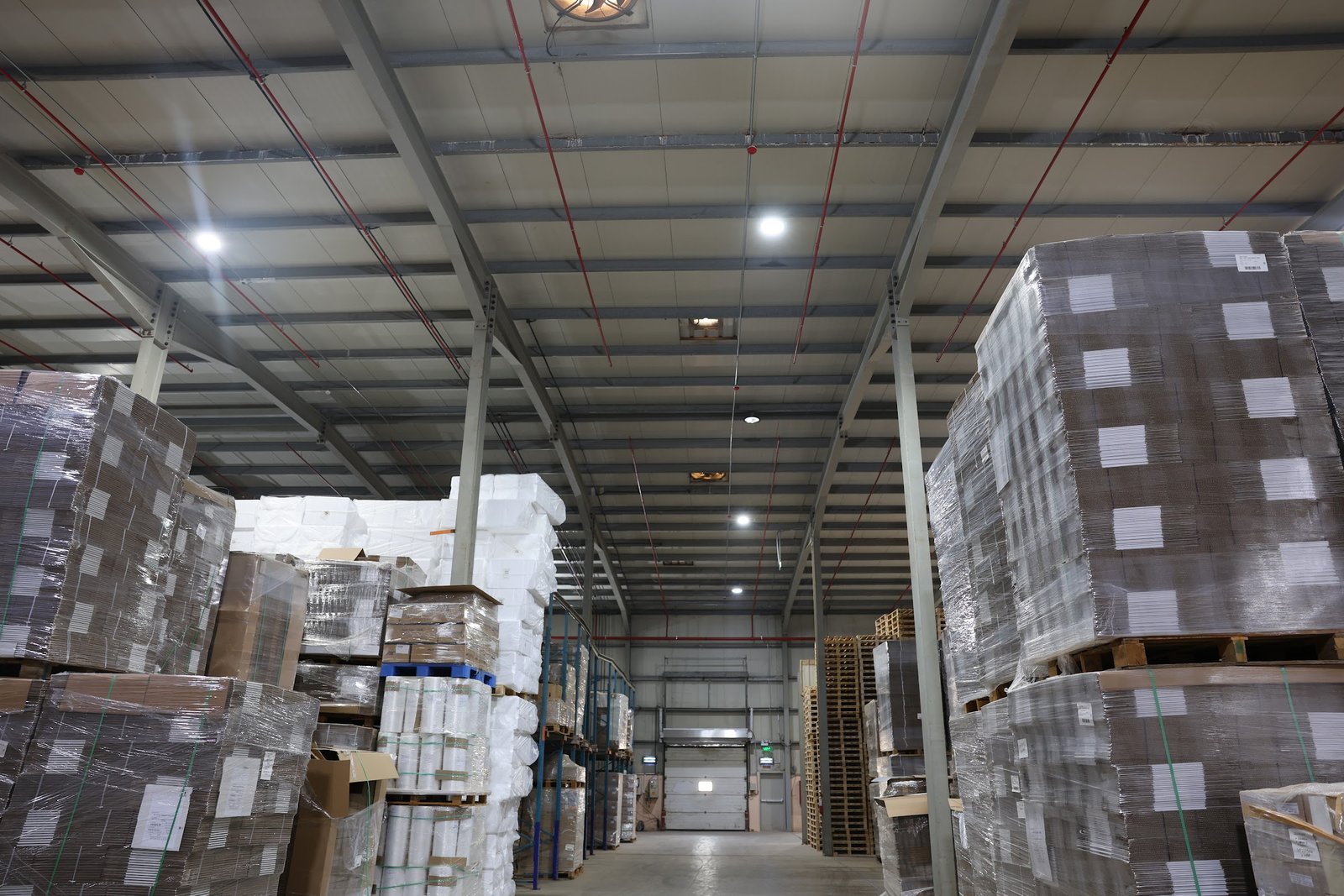
Warehouse and high-rack storage fire protection is designed around three questions: what is stored, how it is stored and how high. Early suppression fast response (ESFR) sprinklers can often protect high-rack storage from the ceiling alone, without in-rack sprinklers, but only within the listing limits of the chosen sprinkler for ceiling height, storage height, commodity and arrangement, and most are listed for wet systems only.
Key takeaways
- Commodity, packaging, storage arrangement and height decide the design before any sprinkler is chosen.
- Each ESFR model has its own listing limits for ceiling and storage height, pressure, system type and roof slope.
- ESFR sprinklers are particularly sensitive to obstructions, and NFPA 13 (2025 edition) tightens the rules for supplemental sprinklers below them, so coordinate lights, ducts and trays early.
- The ESFR design area is 12 sprinklers, four on each of three branch lines, which drives fire pump and water storage demand.
- Earlier editions of NFPA 25 set 30 September 2022 as the deadline for replacing antifreeze in existing systems with a listed solution; the 2023 edition lets some legacy solutions stay in service within limits.
In this article
Why warehouses and high-rack storage are a special hazard
A modern warehouse packs a large fuel load into tall, dense blocks. Fire climbs quickly through the flue spaces between pallets, plastics add heat and speed, and sprinkler water must reach the fuel against a strong fire plume.
In Saudi Arabia, warehouses fall under the Saudi Fire Protection Code (SBC 801) and Civil Defense requirements; SBC 801 has a chapter on high-piled combustible storage (Chapter 32 in the 2018 edition; confirm the numbering in the mandatory 2024 edition). Detailed sprinkler design normally follows NFPA 13 (2025 edition; see our NFPA 13 sprinkler standard guide), and the edition applied to a project is set by SBC 801 and Civil Defense. Insurers applying FM Global data sheets may also require Data Sheet 8-9. See also our news on the Saudi warehousing and high-storage market.
Commodity class and storage arrangement come first
NFPA 13 classifies stored goods from Class I to Class IV and assesses plastics separately; for Group A plastics, it matters whether they are cartoned and whether they are expanded (foamed). One K28 ESFR datasheet, for example, covers Class I to IV commodities, encapsulated or not, and cartoned unexpanded Group A plastics, and does not list expanded plastics. Packaging matters too, since plastic pallets or trays can move goods to a more demanding class.
| Factor | Why it matters | What to document |
|---|---|---|
| Commodity and packaging | Sets the commodity class | Products, cartons, pallets, plastic content |
| Storage arrangement | Racks, pallets and solid piles burn differently | Rack type (single, double or multiple row), solid shelves, flue spaces |
| Storage height | Listings set a maximum | Highest planned top of storage |
| Ceiling height and slope | ESFR listings limit both | Clear height and roof slope |
| Aisles and clearance | Affect fire spread and water delivery | Aisle widths; space from storage to deflectors |
How ESFR sprinklers work
Most sprinklers work in control mode, limiting fire growth. ESFR sprinklers are suppression-mode storage sprinklers: a fast-response element and a large K-factor let them open early and deliver a heavy discharge onto a fire while it is still small.
Manufacturer documents reviewed for this guide show K14, K16.8, K25.2 and K28 (US units); a larger K-factor delivers the required flow at lower pressure.
NFPA 13 sizes the ESFR design area at 12 sprinklers, four on each of the three most hydraulically demanding branch lines. The 2025 edition adds, for the first time, options for storage under ceilings sloped more than 2 in 12; one option enlarges the design area to 18 sprinklers.
Reading an ESFR listing: a worked example
Values come from the specific sprinkler’s listing and the NFPA 13 edition it references. As an illustration only, one manufacturer’s datasheet (June 2026) gives these limits for a K28 pendent ESFR sprinkler under its cULus listing (212°F / 100°C rating) to NFPA 13 (2022 edition):
| Item | Datasheet value |
|---|---|
| System type | Wet pipe only |
| Maximum ceiling height | 14.6 m (48 ft) |
| Maximum storage height | 13.1 m (43 ft) |
| Minimum design pressure | 2.4 bar (35 psi) with a 12-sprinkler design area |
| Hose stream and duration | 950 L/min (250 gpm) for 60 minutes |
| Spacing and coverage | 2.4 to 3.0 m (8 to 10 ft); 5.9 to 9.3 m² (64 to 100 ft²) per sprinkler |
| Roof slope | Up to 2 in 12 |
| Deflector to top of storage | At least 914 mm (36 in) |
| Minimum aisle width | 1.2 m (4 ft) |
Under its FM approval (FM Global Data Sheet 8-9), the same sprinkler covers storage up to 15.2 m (50 ft) under ceilings up to 16.8 m (55 ft). Never copy these values into a design.
ESFR or in-rack sprinklers?
| Approach | How it protects | Typical fit | Watch out for |
|---|---|---|---|
| ESFR at the ceiling | Suppression from the roof | Storage within listing limits, flat or low-slope roof | High flow and pressure; wet system; obstructions and clearance |
| Control-mode ceiling sprinklers: density/area (CMDA) or specific application (CMSA) | Fire control from the roof | Lower storage, or cases beyond ESFR limits | Larger design areas; CMSA also sensitive to obstructions |
| Ceiling plus in-rack sprinklers | Water inside the racks at intermediate levels | Very high storage, solid shelves, higher hazards or roofs beyond ESFR limits | Forklift damage to rack piping; tight rack coordination |
Design checklist for an ESFR warehouse
- Document products, packaging and pallets, and agree the commodity class with the consultant.
- Fix the storage method, rack type and maximum future storage height; measure clear ceiling height and roof slope.
- Select a sprinkler whose current listing covers that combination, and record the datasheet revision and NFPA 13 edition.
- Coordinate lights, ducts, trays and structure with sprinkler positions before installation.
- Keep the required clearance below the deflectors, and mark the maximum storage height on site as good practice.
- Calculate the 12-sprinkler design area plus hose allowance, then size fire pumps and water storage.
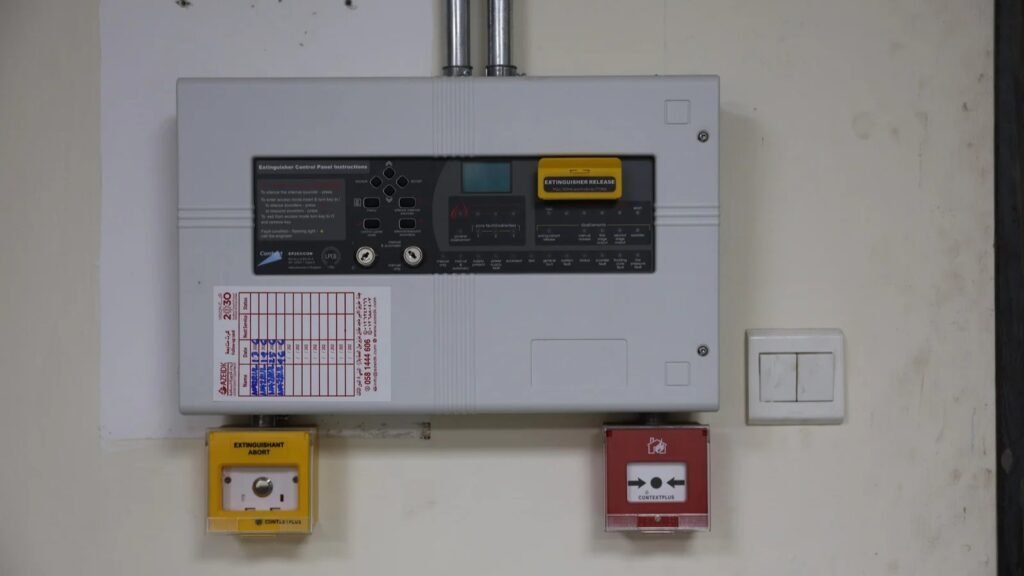
- Connect waterflow and control valve supervisory signals to the fire alarm control panel.
- Check insurer requirements early, then submit for consultant and Civil Defense approval.
Obstructions and clearance: the most common ESFR failure
The National Fire Sprinkler Association (NFSA) describes ESFR and CMSA sprinklers as particularly sensitive to obstructions, and the 2025 edition of NFPA 13 applies stricter spacing rules to supplemental sprinklers installed below obstructions.
Cold stores and freezers
NFPA 13 calls for freeze protection where piping is exposed to freezing, typically a dry pipe or preaction system. Because standard ESFR sprinklers are listed for wet systems, freezer storage needs a specifically engineered solution based on the listing of the sprinkler used. One example is an FM Approved dry pendent ESFR sprinkler (K14, K16.8 or K25.2) fed from wet piping in a conditioned space above the insulated ceiling.
Antifreeze is no shortcut: earlier editions of NFPA 25 set 30 September 2022 as the deadline for replacing antifreeze in existing systems with a listed solution, the 2023 edition lets some legacy premixed solutions remain within concentration limits but not be used for refilling, and listed antifreeze must comply with UL 2901. See our guides to wet, dry, preaction and deluge systems and cold storage fire protection.
Common site mistakes
- Storage raised, or rack levels added, without a new review.
- Packaging switched to plastic while the design assumes cartons.
- Lights, ducts or trays installed under ESFR sprinklers after commissioning.
- Goods stacked into the clearance space below the deflectors.
- Solid shelves or mezzanines added to open-frame racks.
- Fire pumps and tanks sized for an earlier, smaller demand.
See also our article on fire system installation mistakes in warehouses and factories.
Inspection, testing and maintenance
Under NFPA 25 (2023 edition; a 2026 edition has since been issued, so check the edition adopted for the project), ESFR sprinklers are sample-tested or replaced at 20 years and then every 10 years. Good practice adds routine walks through the racks to check storage heights, clearance, new obstructions and damaged sprinklers.
The fire pump annual flow test is compared with its acceptance results (see our fire pump acceptance testing guide), and existing antifreeze systems need an annual concentration test. Our NFPA 25 inspection, testing and maintenance guide covers the full program.
What drives the cost
- Building and storage height, which set sprinkler type, pressure and flow.
- Commodity class and packaging, especially plastics.
- Ceiling-only ESFR versus a design needing in-rack sprinklers.
- Fire pumps, tanks and pipe sizes for ESFR demand.
- Cold zones needing dry, preaction or dry pendent sprinklers.
- Coordination with lighting, air conditioning and racking, and insurer requirements.
How AZEIDK helps
The AZEIDK fire fighting systems solution covers sprinkler networks, fire pumps, supply and installation, testing and commissioning, and maintenance support. Our engineering design and calculations service builds the commodity and hydraulic basis, and assessment of existing systems reviews warehouses whose storage or use has changed.
Victaulic, a global brand in fire sprinklers and grooved network solutions supplied by AZEIDK, appears on our Victaulic page with the V4702 K16.8 ESFR pendent storage sprinkler and FireLock K11.2 storage sprinklers; check each model’s listing in its datasheet.
AZEIDK’s project pages include the Danube & BinDawood Warehouse in Jeddah, where AZEIDK supplied, installed, tested and commissioned the fire protection, alarm and security systems.
FAQ
Do ESFR sprinklers remove the need for in-rack sprinklers?
Often, but not always. Ceiling-only ESFR protection works only where the sprinkler’s listing covers the commodity, arrangement, storage height, ceiling height and roof slope. Solid shelves, very high storage, some plastics or a roof beyond the limits can still require in-rack sprinklers, so the decision comes from the listing tables and an engineering review.
What ceiling height can ESFR sprinklers protect?
It depends on the listing. One K28 pendent ESFR datasheet, for example, lists a maximum ceiling of 14.6 m (48 ft) and storage of 13.1 m (43 ft) at 2.4 bar (35 psi) under NFPA 13 (2022 edition), with higher limits under its FM approval. Always check the current datasheet.
Can ESFR sprinklers be used in freezers or dry systems?
Standard ESFR sprinklers are listed for wet systems, so freezers need a specifically engineered solution based on the listing of the sprinkler used. One option is an FM Approved dry pendent ESFR sprinkler fed from wet piping above the insulated freezer ceiling; dry or preaction systems with other storage sprinklers may also suit.
How do I find my commodity class?
List the product, packaging, pallets and plastic content, then classify it with the consultant using NFPA 13 definitions. Plastic trays, pallets or foam packaging can move goods into a more demanding class. Record the class on the drawings so later stock changes can be checked against the design.
Do I need a new design if storage changes?
At least a new review. Higher storage, extra rack levels, solid shelves, plastic packaging or new obstructions can fall outside the original listing and hydraulic basis. An engineering assessment confirms whether the existing sprinklers, pumps and water supply still cover the new arrangement.
Planning a new warehouse or a racking expansion? Send us the commodity data, storage heights and drawings to review the right design basis. Contact the AZEIDK team