Lithium battery storage in warehouses and shops needs its own defined, engineered area. A damaged or charged battery can go into thermal runaway, release flammable gas and spread from cell to cell. Current international references link protection to state of charge, packaging and storage height, and call for early fire detection and sprinklers designed from a technical report. In Saudi Arabia, the final word belongs to the Saudi Fire Protection Code SBC 801 and Civil Defense requirements.
Key takeaways
- The 2024 International Fire Code (IFC) added a dedicated section on lithium-ion and lithium metal battery storage. The 2021 edition had no such framework, according to Consulting-Specifying Engineer.
- In October 2024 FM released Data Sheet 7-112 on lithium-ion battery manufacturing and storage. It ties protection to state of charge, packaging, storage height and ceiling height.
- NFPA 13 still has no prescriptive protection scheme for lithium-ion batteries, so designers rely on a technical report and insurer guidance.
- Damaged batteries and scooters returned for repair need a quarantine area away from good stock and away from exits.
- For a Saudi facility, SBC 801 and Civil Defense decide. International references are the engineering basis, not a substitute.
In this article
- Why is lithium battery storage different from other goods?
- What do international references say about lithium battery storage?
- State of charge and packaging: two factors that change the design
- How should a lithium battery storage area be laid out in a warehouse?
- E-scooter shops: where is the risk?
- Detection, alarm and sprinklers for a battery storage area
- Lithium battery storage in Saudi Arabia: who sets the requirements?
- Frequently asked questions
- Conclusion
Why is lithium battery storage different from other goods?
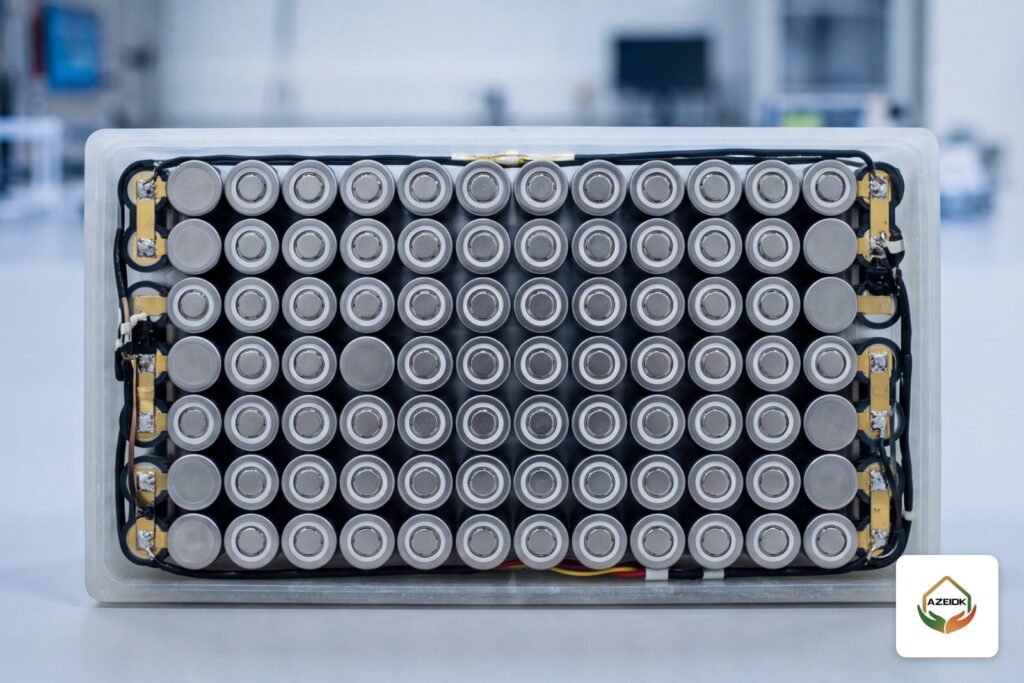
Cardboard and plastic burn when heat reaches them from outside. A lithium-ion battery carries its energy inside. Impact, puncture, overcharging or a manufacturing defect can make a cell heat itself. This is thermal runaway. The affected cell heats its neighbours, and the event spreads through the pack and then to the cartons next to it.
The second problem is gas. During thermal runaway the battery vents flammable gases. That is why current references ask the technical report to assess the explosion (deflagration) risk from gas building up in an enclosed space. The third problem is the warehouse itself: packaging, pallets and high racks give a fire plenty of fuel if detection is late.
So a shipment of e-scooters or tool batteries should not be treated like general goods in a warehouse designed for ordinary commodities. Our warehouses and logistics page sets out what AZEIDK covers for this sector.
What do international references say about lithium battery storage?
Designers use three main references today, each with a different role. The table sums up what we verified in the sources or in publications quoting them directly:
| Reference | Scope | Key points |
|---|---|---|
| International Fire Code (IFC), 2024 edition | New section on lithium-ion and lithium metal battery storage | Operational permit above 15 cubic feet; exception for retail-packaged batteries up to 300 Wh; sprinklers and fire detection for indoor storage areas; technical report assessing explosion risk from vented gas |
| NFPA 855 | Stationary energy storage systems, with a chapter on lithium battery storage | Written hazard analysis by a qualified engineer covering deflagration from gases released during thermal runaway |
| FM Data Sheet 7-112 | Lithium-ion battery manufacturing and storage | Protection by state of charge (above or below 60%), packaging, storage height and ceiling height; in-rack sprinklers or lower storage height may be needed |
| NFPA 13 | Sprinkler systems | No prescriptive protection scheme for lithium-ion batteries yet |
None of these is automatically mandatory in Saudi Arabia. Their value is that they give the designer and consultant a documented basis when the design is submitted to the authority.
State of charge and packaging: two factors that change the design
State of charge (SoC) is the share of energy stored in the battery. The higher it is, the more energy a fire can release. FM 7-112 therefore separates stock charged above 60% from stock below it. The 2024 IFC relaxes some requirements, such as two-hour fire separation and explosion control, where approved procedures show SoC of 30% or less. Sprinklers and fire alarm are still required.
Packaging is the second factor. FM notes that when batteries are stored without cartons, more of them get involved in a fire, so stronger protection is needed. The third factor is geometry: storage height, ceiling height, pile depth and aisle width. Consulting-Specifying Engineer quotes FM 7-112 limits for storage without in-rack sprinklers, including storage up to 15 ft under a ceiling of up to 45 ft and aisles of at least 10 ft. Beyond these limits, or with SoC above 60%, in-rack sprinklers and horizontal barriers are needed.
In practice: ask the supplier for the state of charge during shipping and storage, and get it in writing in the shipment documents. It feeds straight into the designer’s calculations.
How should a lithium battery storage area be laid out in a warehouse?
Start with housekeeping before any system. These are points an engineer usually checks during a technical site inspection and assessment:
- A defined area: give batteries and scooters a clear zone on the layout instead of spreading them among general goods.
- Separation: where indoor storage shares a building with other uses, the 2024 IFC calls for two-hour fire barriers, with specific exceptions.
- Clear exits: battery containers never sit in front of emergency doors or in escape routes.
- Quarantine for damaged units: a swollen, leaking or hot battery, or a scooter returned after an accident, goes to an isolated spot away from good stock, following the manufacturer’s instructions.
- No charging in the storage area: charging is a different activity from storage and is planned in a separate, supervised space.
- Storage height: stock is never raised above the height the sprinkler system was designed for.
E-scooter shops: where is the risk?
A small shop does not hold warehouse quantities, but it packs a showroom, a back store and a repair bench into a tight space. The 2024 IFC exception covers new batteries in original retail packaging up to 300 Wh. Open scooters, used batteries and units in for repair are the harder case.
What we suggest checking in a shop: keep the repair and charging area apart from the store room and the exit, put a fire detector in the back store and not only in the showroom, and provide extinguishers matched to the hazard under NFPA 10. Our NFPA 10 fire extinguisher guide covers type, number and travel distance.
Detection, alarm and sprinklers for a battery storage area
Early detection
The earlier the event is detected, the better the chance of control before it spreads between cells. For indoor storage areas the 2024 IFC requires automatic fire detection and alarm using air-aspirating smoke detection, radiant energy-sensing (flame) detection, or both. Outdoor storage areas need radiant energy-sensing detection. Designing the alarm system and tying it into the building panel is part of AZEIDK’s fire alarm systems scope, and the detector type is chosen after studying the space, its height and the storage arrangement.
Sprinklers
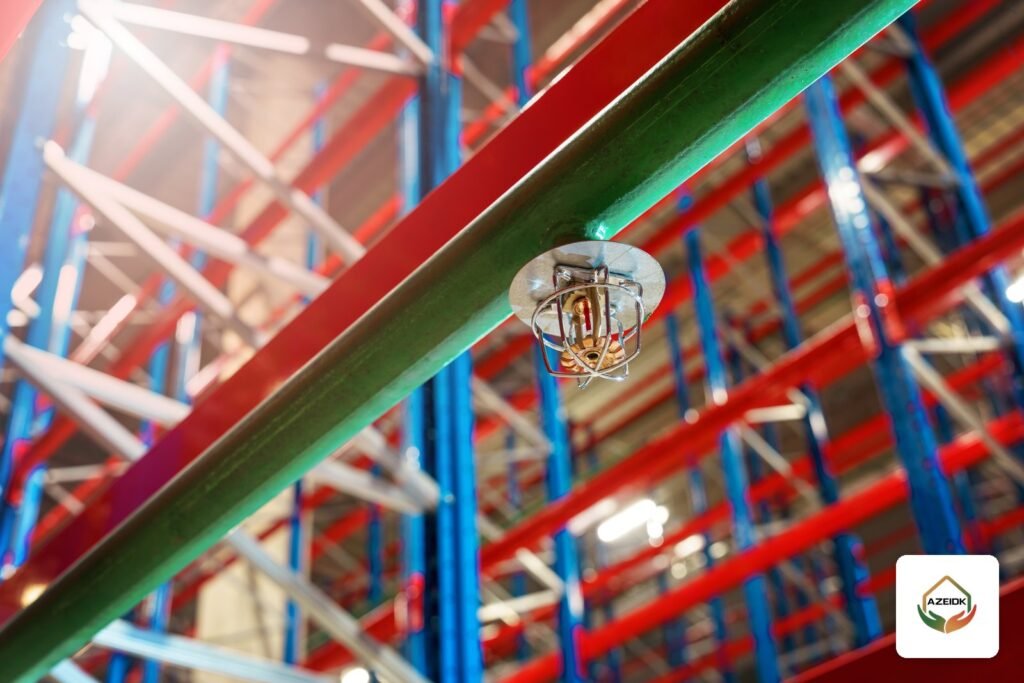
Because NFPA 13 offers no ready scheme, sprinkler design is based on the technical report and references such as FM 7-112. The outcome may be higher-density ceiling sprinklers, in-rack sprinklers or a lower storage height. Our fire fighting systems team checks the capacity of the existing network and fire pump before any change to warehouse storage.
An existing warehouse with a new use
The most common case is a warehouse designed for general goods that starts receiving scooters or batteries. This calls for an assessment of existing systems to see whether sprinklers and alarm suit the new use or need changes.
Lithium battery storage in Saudi Arabia: who sets the requirements?
The binding framework is the Saudi Fire Protection Code SBC 801 within the Saudi Building Code, plus the requirements of the General Directorate of Civil Defense, completed through the Salamah platform. International references such as IFC, NFPA and FM are the designer’s technical basis, and they apply to a project to the extent the authority and the consultant accept them.
Describe the warehouse use accurately in the licensing file: battery type, quantities and storage method. If the building is licensed for a different use, review its status before the stock arrives. Our Civil Defense approval support service helps prepare this file.
Frequently asked questions
Is a standard warehouse sprinkler system enough for lithium battery storage?
Not necessarily. NFPA 13 has no prescriptive scheme for lithium-ion batteries. The design comes from a technical report and references such as FM 7-112, based on charge, packaging and height.
Why does state of charge matter in lithium battery storage?
Stored energy rises with state of charge. FM 7-112 separates above and below 60%, and the 2024 IFC relaxes some requirements where SoC is shown to be 30% or less.
Where should damaged batteries or returned scooters go?
To a quarantine area away from good stock and exits, handled and disposed of according to the manufacturer’s instructions.
Which fire detector suits a battery storage area?
The 2024 IFC names air-aspirating smoke detection or flame detectors for indoor storage, and flame detectors for outdoor storage. The final choice follows a site study and the authority’s approval.
Do these requirements apply to a shop selling a few scooters?
The 2024 IFC exempts new batteries in retail packaging up to 300 Wh, but the repair area and used batteries still need organisation, detection and suitable extinguishers.
Is the IFC mandatory in Saudi Arabia?
The binding references are SBC 801 and Civil Defense requirements. IFC, NFPA and FM are technical references the designer uses with the authority’s acceptance.
Conclusion
Lithium battery storage is as safe as its area is defined, its charge and packaging known, and its protection designed for that specific use: early detection and sprinklers sized for batteries. Know what you actually store, review the existing systems, then update the licence before the stock arrives.
Has your warehouse started receiving batteries or e-scooters? Send us the layout and storage arrangement, and our team will review your fire alarm, fire fighting and Civil Defense requirements. Talk to the AZEIDK team
Related guides
- Smoke Detector Red Light: What Blinking or Steady LED Means, and Remote Indicators
- Falcon Gold Fire Cabinet: Types, Sizes and How to Select One
- Fire Extinguisher Price in Saudi Arabia (KSA): What Drives the Price by Type, Capacity and Approval
- Fire Alarm Commissioning and Acceptance Testing Before Handover