Many Salamah licence applications for warehouses do not stall at data entry on the platform, but at the inspection visit: a fire alarm panel showing faults, racks added after the drawings were approved, or a hose cabinet hidden behind stock. The right time to find these issues is before you apply, not after.
This guide sets out what to review in fire alarm, firefighting systems and documents before a warehouse owner or operator applies on the Salamah platform, based on what the Salamah portal and its guide published by Elm state, and with the reminder that the licensing decision rests with the competent authority alone.
Key takeaways
- Salamah classifies activities as instant (low risk), direct (low to medium risk) and indirect (high risk); a warehouse’s route depends on its registered activity.
- A direct activity needs a safety equipment invoice or a technical report from an entity approved on the platform, depending on the activity.
- An indirect activity needs a contract with an approved safety company and maintenance contracts, followed by a Civil Defense inspection before the licence is issued.
- Alarm and firefighting readiness means systems that actually work and match the approved design and current storage, not systems that are merely installed.
- The licence is valid for one year from final approval and can be renewed in the month before it expires.
In this article
- Start with the warehouse’s activity route on the platform
- What each route requires
- Fire alarm readiness in the warehouse
- Firefighting system readiness
- The readiness file before you apply
- Who is responsible for what?
- Common mistakes before a warehouse application
- How AZEIDK can help
- Frequently asked questions
- Conclusion
Start with the warehouse’s activity route on the platform
Salamah is the General Directorate of Civil Defense’s online portal for issuing, renewing and cancelling facility licences. The platform guide published by Elm states that licences are issued instantly for low-risk activities, that direct activities (low to medium risk) are licensed directly by Civil Defense, and that indirect activities (high risk) go through contracting and inspection. To find which route applies, the platform offers an investor’s journey service.
What matters is that the route follows the registered activity, not floor area alone; we explain the differences in our guide to instant, direct and indirect licensing. The AZEIDK team handles Civil Defense transactions and Salamah licences under its Civil Defense requirements and approvals support service, from preparing the technical requirements and organising the file to following up inspection observations, while the issuing decision stays with the competent authority.
What each route requires
| Route | Risk level | Submitted with the application | After submission |
|---|---|---|---|
| Instant | Low | The data required on the platform | Issued instantly once the data is complete |
| Direct | Low to medium | A safety equipment invoice from an approved safety company, or a technical report from an approved engineering or technical services office, depending on the activity | Licence issued directly by Civil Defense |
| Indirect | High | A contract with an approved safety company, plus maintenance contracts | A verification code by text message after initial approval, passed to the company; then installation, completion of requirements and Civil Defense inspection |
For the indirect route, the platform guide states that safety equipment is installed by the contracted safety company, and that the platform provides a report listing approved companies. Check the company’s approval on the platform before you sign.
Fire alarm readiness in the warehouse
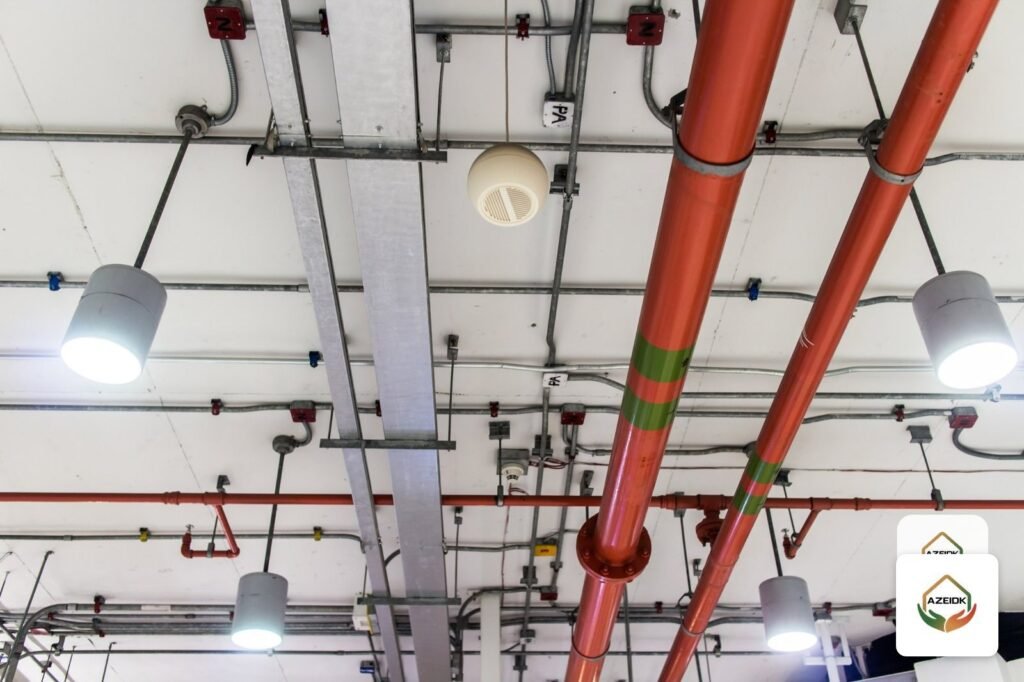
In a warehouse, large open areas, high ceilings and racking all affect alarm performance. Before applying, review:
- Fire alarm panel: in normal condition with no faults or disabled zones; batteries healthy and their installation date known.
- Detectors: suited to the ceiling height in the approved design, and not obstructed by racks or stock added later. In high spaces the design sets the detector type, and reflective beam detectors are common.
- Manual call points (break glass): at exits and on escape routes, visible and not blocked by stock or equipment.
- Sounders and beacons: audible and visible in every part of the warehouse, including attached offices.
- Interface with firefighting: flow switch, valve tamper switch and fire pump signals reach the panel and show on it.
- Test records: results of the latest periodic inspection and test under the adopted maintenance programme, usually based on NFPA 72 as a technical reference.
Firefighting system readiness
A warehouse sprinkler system is designed for a specific storage arrangement: a given height, commodity, packaging and rack layout. Any change after approval can make the system inadequate even if it is in good condition. This article does not repeat design principles, which are covered in our guide to warehouse and high-rack protection with ESFR sprinklers and our article on warehouse and cold room protection. Before applying, check:
- Storage height, rack layout and commodity still match the approved design basis.
- Clearance below sprinklers, with no obstructions added beneath them.
- Control valves open and supervised, and pressure gauges working.
- Fire pumps in automatic mode, with their periodic run records available.
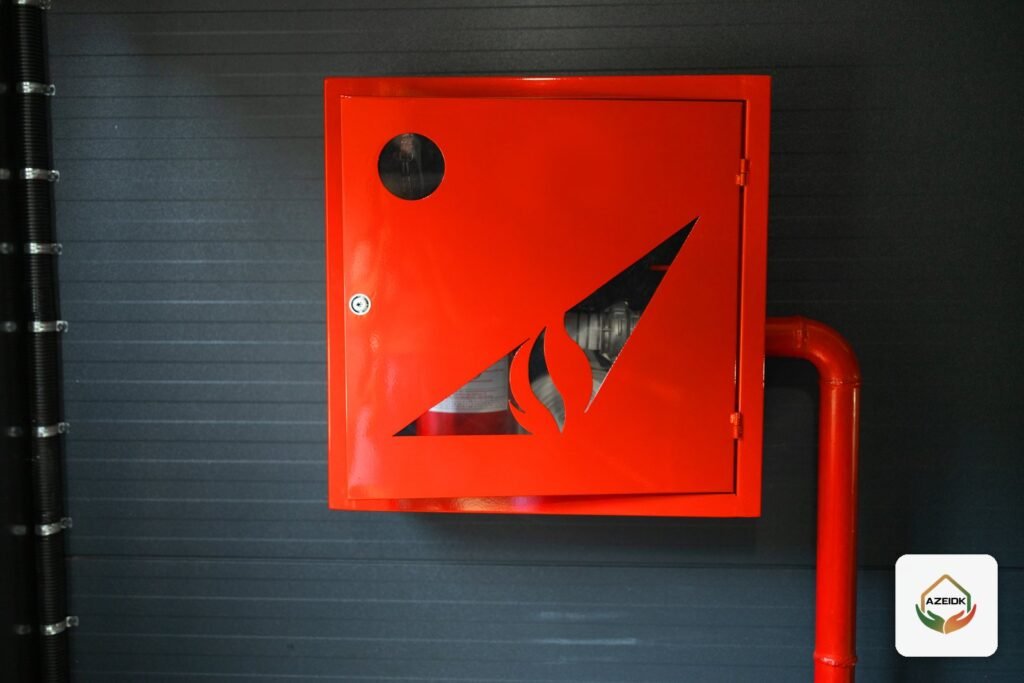
- Hose cabinets and the fire department connection visible and accessible.
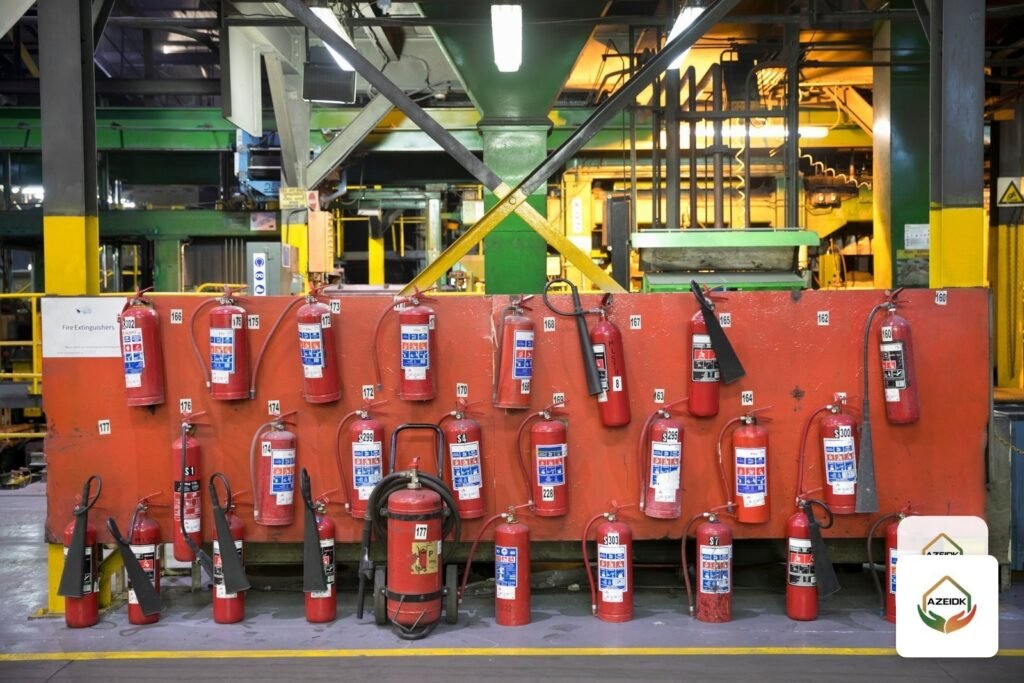
- Fire extinguishers in their designated positions, with valid service tags.
- Periodic inspection and test reports for sprinklers and pumps under the adopted maintenance programme, usually based on NFPA 25 as a technical reference.
The readiness file before you apply
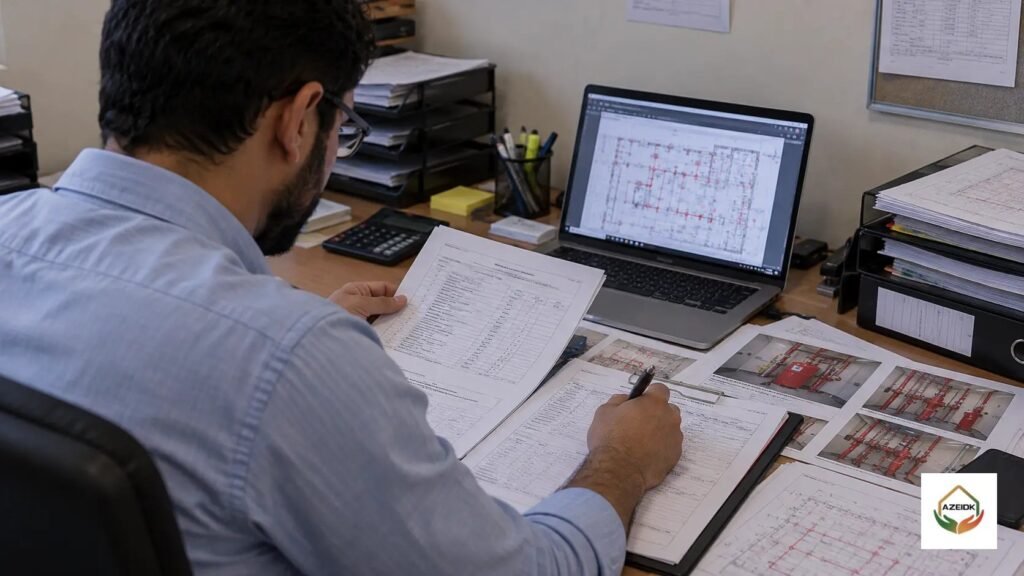
The official documents are set by the platform according to activity and route. The readiness file below makes submission and inspection easier; it is a practical list, not an official one:
| Document | Purpose |
|---|---|
| Approved drawings and as-built drawings | Compare what was approved with what exists |
| Statement of current storage (height, commodity, racking) | Confirm the design basis still holds |
| Maintenance contract and latest visit reports | Show the systems are inspected and maintained |
| Alarm and pump test records | Show the systems actually operate |
| Datasheets for installed devices | Reference for any observation on equipment |
| Current licence and previous inspection observations | Confirm observations are closed before applying |
If you received observations after an earlier visit, start by sorting and fixing them as described in our guide to fixing Civil Defense inspection observations.
Who is responsible for what?
The Salamah guide names four groups that use the platform, each with a different role in a warehouse application:
- The investor or facility owner: registers as a licence applicant, submits and renews the application, and passes the verification code to the contracted company on the indirect route.
- The approved safety company: is approved on the platform, issues safety equipment invoices, provides maintenance contracts and issues safety equipment installation certificates.
- The approved engineering or technical services office: is approved on the platform and issues technical reports.
- Civil Defense: issues the licence and carries out inspection for high-risk activities before issue.
Understanding this split before applying shows who prepares each document, and avoids waiting for a document from a party that does not issue it.
Common mistakes before a warehouse application
- Changing storage without a design review: raising racks or changing commodity after approval is one of the main reasons sprinkler protection becomes inadequate.
- Silencing panel faults instead of fixing them: a silent panel is not a healthy panel.
- A maintenance contract on paper only: a contract without real visits and reports does not prove readiness.
- Blocking access to hose cabinets and exits: temporary stock often becomes permanent.
- Contracting a company not approved on the platform: the indirect route requires an approved safety company.
- Applying before previous observations are closed: it sends the application back to the start.
How AZEIDK can help
The AZEIDK team reviews the warehouse’s alarm and firefighting systems, prepares a gap list with responsibility for each fix, organises drawings and reports, and follows the Salamah transaction and inspection observations through to closure. Physical repairs are not included by default and can be added under a separate quote defining scope and cost. We do not promise licence issuance; the final decision belongs to the competent authority.
Frequently asked questions
Is every warehouse a high-risk activity?
That cannot be assumed. The route depends on the activity registered on the platform, which you can check through the investor’s journey service before applying.
What is the difference between a safety equipment invoice and a technical report?
Both belong to the direct route, and the platform decides which is required for the activity. Invoices are issued by approved safety companies; reports by approved engineering or technical services offices.
Does a maintenance contract guarantee the licence?
No. The contract is a requirement on the indirect route, but the licence is issued after inspection and by Civil Defense decision.
How long is the licence valid?
One full year from final approval, renewable up to one month before expiry. Renewal is covered in our Salamah licence renewal guide.
We raised our racks after approval. What now?
Ask for an engineering review of the sprinkler design basis before applying, because a change in storage height may require changes to the system.
Is installing the systems enough before applying?
Installation alone is not enough. The systems must actually work, match the approved design and current storage, and be backed by inspection and maintenance records, along with the document the platform requires for your route.
Conclusion
A Salamah licence for a warehouse starts with identifying the activity route on the platform, then confirming that alarm and firefighting systems work and match the approved design and current storage, then preparing a file that proves it. Every observation fixed before applying saves an inspection visit and a resubmission. After issue, maintenance records remain an important reference for next year’s renewal.
Preparing a Salamah application for your warehouse? We will review alarm and firefighting systems and documents with you and list the gaps before you apply. Talk to the AZEIDK team