Hospital fire extinguishers are placed according to how sensitive each department is, not just by floor area: foam or ABC dry powder in ward corridors and public areas, CO2 or clean agent (FM-200) in medical equipment rooms, intensive care and server rooms, a small CO2 or foam unit in laboratories, a wet chemical (Class K) unit in the kitchen, and a ceiling-mounted automatic unit in small electrical rooms where needed. The aim is for clinical staff to reach the right extinguisher in seconds without leaving a patient far behind.
To compare extinguisher types and choose the right one for each hazard, see our fire extinguishers selection guide for facilities in Saudi Arabia.
In a hospital many patients cannot evacuate on their own, medical equipment runs without pause, and some departments cannot tolerate powder dust. Choosing extinguishers here therefore takes more care than in any other building. This guide covers the right type for each department, where to mount it, and what the safety officer should check before a Civil Defense inspection.
Key points
- Departments with delicate electronics (ICU, operating theatres, imaging, servers) use CO2 or FM-200, because NFPA 10 does not allow dry chemical to protect that equipment.
- Corridors and public areas: foam or ABC powder, with a travel distance of no more than 22.9 m.
- Kitchen: a Class K unit within 9.1 m of the cooking appliances.
- MRI rooms restrict any metal that enters, so an ordinary extinguisher is never taken inside.
- Binding references: SBC 801, Civil Defense requirements and the approved drawings; NFPA 10 is the technical reference.
In this article
Why hospital extinguishers are different
A hospital fire plan usually relies on protecting patients in place and moving them to a safe area inside the building, not on evacuating everyone outside at once. Early action by staff therefore matters more, and the extinguisher must sit close to the nurses’ station, within reach without passing through patient rooms.
The second issue is what is left after discharge. A powder extinguisher is effective and inexpensive, but its dust spreads through the air and is hard to clean from equipment. In a public corridor that may be acceptable; in intensive care or an operating theatre it can disable equipment connected to patients. For all systems in this sector see our healthcare facilities page.
Hospital fire extinguishers by department
| Department | Main hazard | Suitable type |
|---|---|---|
| Ward corridors and nurses’ stations | Class A (beds, furnishings, paper) | Foam or ABC powder as designed, CO2 near station equipment |
| ICU and operating theatres | Electronic medical equipment | CO2 or FM-200 |
| Imaging and equipment rooms | Delicate electronics | CO2 or FM-200 (with special rules for MRI) |
| Server rooms and digital records | Delicate electronics | FM-200 or CO2 |
| Laboratories | Class B (small amounts of alcohol and solvents) and instruments | Small CO2 or foam depending on materials |
| Kitchen | Class K | Wet chemical Class K |
| Laundry and central sterile services | Class A and electrical equipment | ABC powder or foam, CO2 for panels |
| Electrical, UPS and generator rooms | Class C and B | CO2, and an automatic unit for small rooms |
For fire classes see the fire triangle and fire classes.
Why powder stays away from medical equipment
NFPA 10 section 5.5.6.1 states that dry chemical extinguishers shall not be installed for the protection of delicate electronic equipment. It explains that the residue will probably not be completely and immediately removable, and that multipurpose dry chemical exposed to high temperature or humidity can cause corrosion. The standard requires extinguishers for such equipment to be selected from types specifically listed for it.
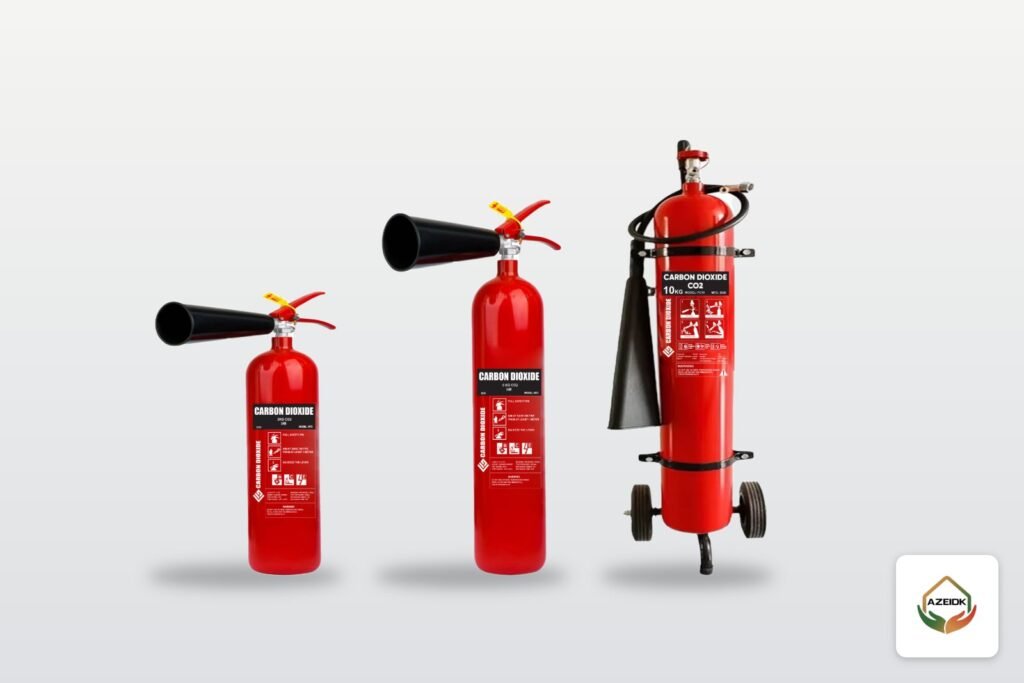
CO2 comes first because it leaves no residue and does not conduct electricity, and FM-200 (HFC-227ea) because it is a clean agent that also handles small Class A fires. See the FM-200 extinguisher. Remember that CO2 lowers oxygen in the space, so use it with care in small closed rooms and ventilate before staff return.
MRI rooms
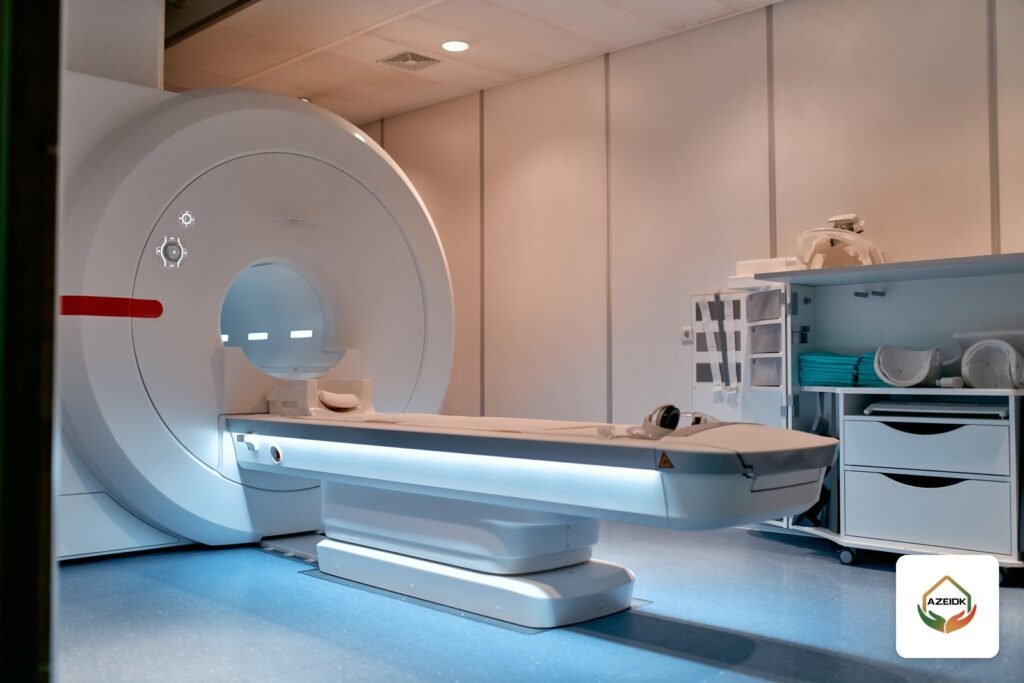
The magnetic field of an MRI scanner pulls any ferromagnetic object with great force, and an ordinary extinguisher has a steel body. An ordinary extinguisher is therefore never taken into the scanner room; standard units stay outside the restricted zone. What may enter the room itself is set by the department’s safety policy and the scanner manufacturer’s instructions, and the designer reviews it with the radiology safety officer.
Layout in wards and corridors
In the NFPA 10 table for Class A hazards, travel distance to the nearest extinguisher must not exceed 22.9 m along the walking path, and the smallest single unit is 2-A for light and ordinary hazard. In long wards travel distance governs, and the usual positions are beside the nurses’ station, at stair doors and beside service rooms.
- Recessed cabinets: beds and wheelchairs move through hospital corridors, and a projecting extinguisher gets in the way and gets knocked. A recessed cabinet solves this. See fire extinguisher cabinets.
- A visible sign above every cabinet, because a unit inside the wall cannot be seen from a distance.
- Automatic units help in small unoccupied electrical rooms. See the automatic ceiling extinguisher.
Monthly checks and staff training
A hospital runs in shifts, and the extinguisher the day team knows may be unknown to the night team. Make the monthly check part of each department’s safety round: is the unit in place, the gauge in the green, the seal intact, the tag current, and nothing blocking it such as beds or trolleys. Record the checks on one form for all departments so they are easy to present at inspection.
In periodic staff training, link each extinguisher type to where it is used: CO2 or FM-200 for ICU and theatre equipment, foam or powder for corridors, Class K for the kitchen. For reading the gauge see the fire extinguisher pressure gauge.
Common faults in hospital extinguishers
- Powder units inside ICU or operating theatres.
- An ordinary extinguisher inside the MRI room.
- Projecting units in bed corridors that get knocked down.
- A kitchen with no Class K unit near the fryers. See the Class K kitchen extinguisher.
- Night shift staff who do not know where the units are or which type each one is.
- Incomplete monthly records. See fire extinguisher maintenance.
Hospital extinguishers available from AZEIDK
Through its technical supply service, AZEIDK supplies extinguishers for clinical and service departments, with the datasheet for each model:
- Falcon Gold portable FM-200 extinguishers: classes A, B, C and electrical, residue free, for server rooms, control rooms and laboratories.
- FG 2 kg CO2: rated 34B per the datasheet, light enough for nurses’ stations and laboratories.
- FG 6 kg CO2: rated 89B, for electrical and equipment rooms.
- FG HT-AT6 automatic extinguisher: 6 kg HFC-227ea, ceiling mounted, operates when its glass bulb bursts at 68°C.
- FG 6 L foam: for corridors and public areas.
- FG 6 kg wet chemical: for the hospital kitchen, rated 13A 75B.
- Falcon Gold recessed extinguisher cabinet: stainless steel or painted steel door, for corridors.
AZEIDK’s own team maintains extinguishers under its periodic maintenance contracts.
FAQ
What is the best fire extinguisher for a hospital?
CO2 or FM-200 for departments with medical and electronic equipment, foam or ABC powder for corridors and public areas, and Class K for the kitchen.
Is a powder extinguisher allowed in an operating theatre?
It is not recommended. NFPA 10 does not allow dry chemical to protect delicate electronic equipment; use CO2 or FM-200.
Which extinguisher suits a medical laboratory?
A small CO2 unit usually covers small amounts of alcohol and solvents and the instruments, or foam depending on the materials used.
Should an extinguisher be placed inside the MRI room?
Never take an ordinary extinguisher inside. What may enter is set by the department’s safety policy and the scanner manufacturer.
Where does the extinguisher go in a patient ward?
Beside the nurses’ station and at stair doors, usually in a recessed cabinet, so no point is more than 22.9 m away.
Who checks hospital extinguishers each month?
The safety officer or the supervisor assigned in each department, who records the check; annual maintenance is done by a qualified technician.
Summary
In a hospital, choose the extinguisher by how sensitive the department is first, then by hazard and area. Keep powder away from medical equipment and train every shift on where the units are, so response stays fast without harming the equipment patients depend on.
Fitting out a hospital or clinic, or reviewing its extinguishers? Send us the drawings and department list, and we will propose types and quantities with a supply and maintenance offer. Contact the AZEIDK team
See the fire extinguishers and fire fighting systems AZEIDK supplies.
Related guides
- Fire Alarm Cause and Effect Matrix: How to Build, Program and Test It
- Fire Alarm Wire: Sizes, Fire-Resistant Grades and What the Consultant Asks Before Supply
- Safety Equipment Installation Certificate: What It Is and How It Differs from the Salamah Technical Report
- Falcon Gold in Saudi Arabia: Fire Cabinets, Doors & Equipment