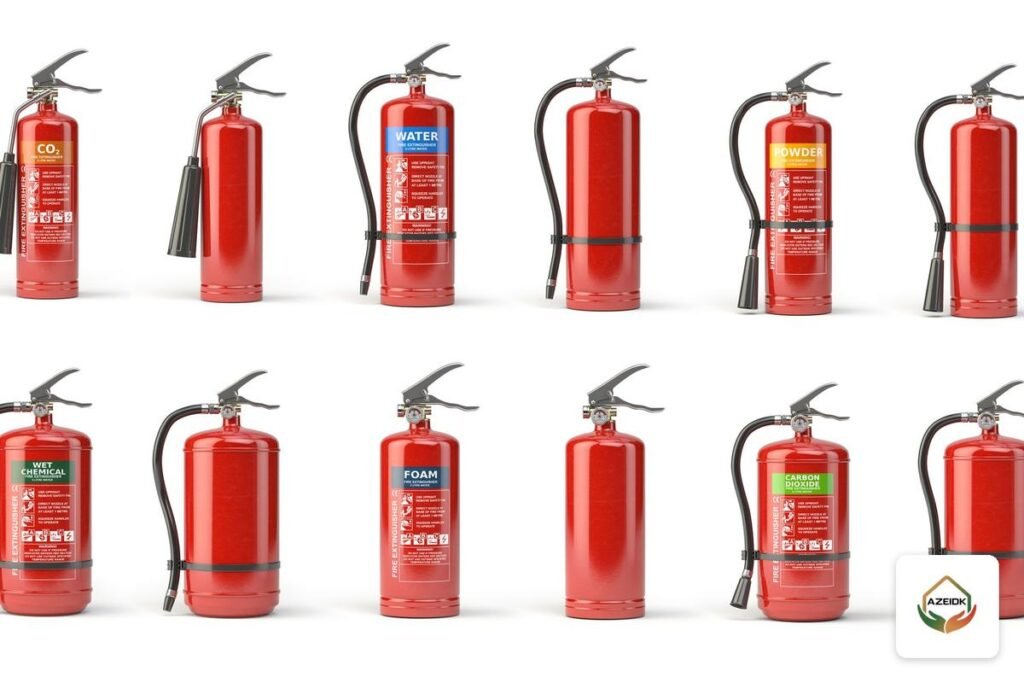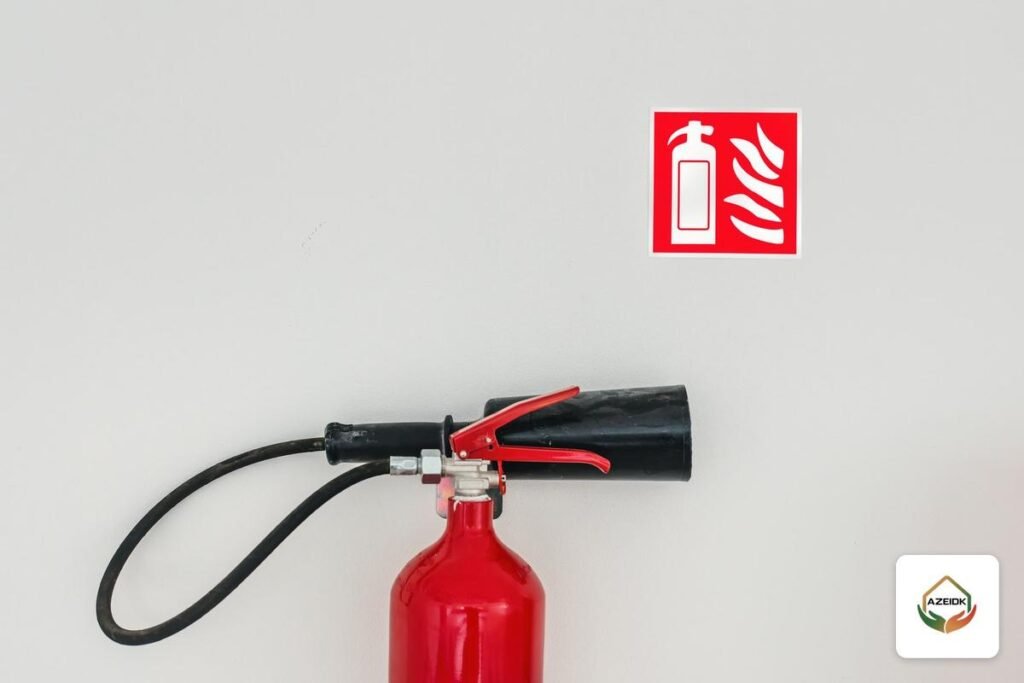
A fire extinguisher sign is a red square with a white symbol (ISO 7010 code F001), mounted close to the extinguisher so people can find it from their normal path of travel. Its size follows the viewing distance. It sits above an extinguisher whose top is no higher than 1.53 m when the unit weighs 18.14 kg or less in total.
This guide is for safety officers, facility managers and contractors in Saudi Arabia. It covers when a sign is needed, how to size it, how high to mount the sign and the extinguisher, and what you can realistically check before a Civil Defense visit. It is part of the fire fighting systems work AZEIDK delivers on Saudi sites.
Key takeaways
- The ISO 7010 symbol for a portable extinguisher is F001: white pictogram on a red square, with a direction arrow added where needed.
- NFPA 10 calls for signs or other means where an extinguisher cannot be seen directly. The sign must be close to the unit and visible from the normal path of travel.
- The SASO safety signs guide links sign height to viewing distance: a 200 mm sign reads from 12 m, a 400 mm sign from 24 m.
- NFPA 10 sets extinguisher mounting height by gross weight: top at 1.53 m maximum up to 18.14 kg, 1.07 m above that, and at least 102 mm clear of the floor.
- We found no published official Civil Defense checklist for extinguisher signs. Work from the code text and your approved drawings.
In this article
- What is a fire extinguisher sign and which symbol does it use?
- When does an extinguisher need a sign?
- What size should the sign be?
- Fire extinguisher sign and extinguisher mounting height
- What does a Civil Defense inspector check on the extinguisher and its sign?
- Common mistakes with extinguisher signs and mounting
- Frequently asked questions
- Summary
What is a fire extinguisher sign and which symbol does it use?
ISO 7010 groups fire equipment signs under the letter F. All of them are square, with a red background and a white symbol. A portable extinguisher is F001, a wheeled extinguisher is F009, and a collection of firefighting equipment is F004. The current edition is ISO 7010:2019 with its later amendments.
The Saudi Standards, Metrology and Quality Organization (SASO) says the same in its occupational safety guide on safety signs and markings, a workplace guide rather than a Civil Defense regulation: fire equipment signs are square, red, with white symbol and text, and they identify the equipment and show where it is.
Direction arrows
When the extinguisher sits behind a column or in a recess that cannot be seen from the corridor, add a direction arrow next to the main sign. The old arrow signs were withdrawn from ISO 7010; the arrow defined in ISO 3864-3 is now used beside the main sign.
Exit, assembly point and no-smoking signs use different colours and shapes. We cover them in our article on safety signs in Saudi Arabia, so they are not repeated here.
When does an extinguisher need a sign?
NFPA 10, the US standard for portable fire extinguishers (latest edition 2026), starts from a simple rule: extinguishers must be visible, easy to reach and located along normal paths of travel, including exit routes. If the unit is clearly visible from the corridor, a sign speeds things up but is not the main solution.
In rooms and locations where visual obstructions cannot be avoided, the standard requires signs or other means to show where the extinguisher is, with two conditions:
- The sign is close to the extinguisher itself, not at the far end of the corridor.
- The sign is visible from the normal path of travel, meaning where people actually walk.
Typical Saudi cases: high-bay racking warehouses, mall showrooms, crowded commercial kitchens, and extinguishers inside a closed extinguisher cabinet. The binding framework in Saudi Arabia is the Saudi Building Code; NFPA 10 is a technical reference the designer adopts. See our NFPA 10 portable fire extinguishers guide for the detail.
What size should the sign be?
ISO 7010 does not fix a single sign size. Size follows the longest distance from which the sign must be read. The SASO guide gives a table linking sign height to the straight-on viewing distance. In summary:
| Sign height | Viewing distance | Typical location |
|---|---|---|
| 100 mm | 6 m | Small rooms and offices |
| 200 mm | 12 m | Office and shop corridors |
| 300 mm | 18 m | Showrooms and long corridors |
| 400 mm | 24 m | Warehouses and workshops |
| 600 mm | 36 m | Large halls and factories |
| 800 mm | 48 m | Hangars and wide open areas |
The pattern in the table is a viewing distance of roughly 60 times the sign height. The guide also says to double the sign and text height where lighting may fall below 100 lux, and to adjust the distance when the sign is seen at an angle.
Photoluminescent or standard sign?
The SASO guide defines a photoluminescent sign as one that charges from light and then glows for a set time after the light goes out. For externally lit signs it asks for at least 100 lux. In corridors that may go dark during a power cut, a photoluminescent sign is a practical choice, as long as it keeps the ISO 7010 colours.
Fire extinguisher sign and extinguisher mounting height
NFPA 10 sets mounting height by the gross weight of the extinguisher (cylinder, agent and valve), not by the agent capacity printed on the label. This is the point technicians most often miss:
| Item | NFPA 10 limit | Site note |
|---|---|---|
| Gross weight 18.14 kg (40 lb) or less | Top of extinguisher no more than 1.53 m (5 ft) above the floor | For example the Falcon Gold 6 kg dry powder unit (8.5 kg) |
| Gross weight over 18.14 kg (except wheeled units) | Top no more than 1.07 m (3.5 ft) | For example the Falcon Gold 6 kg CO2 unit (21.3 kg) |
| Clearance below the extinguisher | At least 102 mm (4 in) | Never stand the unit directly on the floor |
| Sign above the extinguisher | SASO guide: 1.7 m above floor level, 1.6 m where people with disabilities are expected (the guide does not say whether this is to the sign’s edge or centre) | Close to the unit and visible from the corridor |
A datasheet example: the Falcon Gold 6 kg dry powder extinguisher weighs 8.5 kg in total, while the same brand’s 6 kg CO2 unit weighs 21.3 kg. The first can go up to 1.53 m at the top; the second must stay at 1.07 m. Our fire extinguisher bracket guide explains the right holder for each weight, and you can check each model’s weight in the fire extinguishers AZEIDK supplies.
Where to fix the sign relative to the extinguisher
- Directly above the extinguisher on the same axis, so people see the sign from a distance and find the unit below it.
- An extra projecting sign, mounted at right angles to the wall, in long corridors, because a flat sign cannot be read from the end of the corridor.
- A direction arrow at the first point where the extinguisher is out of sight, such as a corridor corner or the end of a rack.
- On the door of a solid extinguisher cabinet, so it is not mistaken for an ordinary cupboard.
What does a Civil Defense inspector check on the extinguisher and its sign?
We searched the published material of the General Directorate of Civil Defense and the Salamah platform and found no official published checklist that sets inspection items for extinguisher signs, their size or their height. So we do not attribute items to the inspector that have not been officially issued. On each project the reference is the approved extinguisher layout, the Saudi Building Code requirements, and what the authority asks for on the day.
What you can do before the visit is a self-check based on NFPA 10 and the SASO guide. This is not a Civil Defense list:
- Each extinguisher is where the approved drawing shows it, and its type suits the hazard at that spot.
- Nothing blocks it: no stock, furniture or curtains in front.
- A sign is fitted wherever the unit cannot be seen directly, close to it and readable from the corridor.
- Mounting height matches the gross weight, and floor clearance is at least 102 mm.
- The gauge needle is in the green, the safety pin and seal are intact, and the inspection tag is current.
- The monthly inspection and annual maintenance records are available.
If your facility is preparing to issue or renew its Salamah licence, AZEIDK’s Civil Defense approval support covers a review of existing systems and the technical report.
Common mistakes with extinguisher signs and mounting
- Sign far from the unit: a sign at the start of the corridor and the extinguisher at the end. The standard asks for the sign to be close to it.
- Small sign in a big space: a 100 mm sign in a warehouse reads from about 6 m only.
- One height for every unit: mounting a heavy CO2 unit at the same height as a dry powder unit.
- Extinguisher on the floor: no holder and no clearance, so it gets knocked, wet or moved.
- Non-standard colours: a green or yellow sign for an extinguisher, easily confused with exit or warning signs.
- Sign covered after fit-out: a later shelf or decor panel hides both sign and unit.
- Moving the unit but not the sign: the sign then points to an empty wall.
Frequently asked questions
What is the ISO 7010 code for a fire extinguisher sign?
F001: a white extinguisher on a red square. A wheeled extinguisher has its own code, F009.
How high should a fire extinguisher be mounted?
Under NFPA 10, the top of the unit is no more than 1.53 m above the floor up to 18.14 kg gross weight, and 1.07 m above that, with at least 102 mm clearance below.
How high should the extinguisher sign be?
The SASO safety signs guide gives 1.7 m above floor level, or 1.6 m where people with disabilities are expected, without saying which point of the sign is measured. Keep it above and close to the extinguisher.
What sign size suits a corridor?
Divide the longest viewing distance by about 60. A 12 m corridor needs a 200 mm sign under the SASO table.
Does every extinguisher need a sign?
NFPA 10 requires one where obstructions to view cannot be avoided. Many designers fit one at every unit for consistency; the approved drawing governs.
Is there an official Civil Defense form for extinguisher inspection?
We found no published official form covering extinguisher sign items. Use the approved drawing and the standards, and ask the authority if in doubt.
Summary
A correct extinguisher sign is a red square with the F001 symbol, sized for the viewing distance, fixed close to the unit and visible from the corridor. The extinguisher below it is mounted at a height set by its gross weight, not its capacity. Check these points against your project drawing before the visit, and do not rely on circulating lists with no official source.
Need your extinguisher layout and signs reviewed before a Civil Defense inspection? The AZEIDK team checks locations, weights and heights and supplies the right extinguishers. Talk to the AZEIDK team
Related guides
- Home CCTV Installation: Wi-Fi or Wired, Where to Place Cameras, and How to Read Offers
- Restaurant and Café Fire Safety in Saudi Arabia: Systems and Requirements
- Fire Hose Reel Guide: Lengths, Bores, Installation and Inspection in Saudi Arabia
- Safety Signs in Saudi Arabia: Assembly Point, Emergency Exit, No Smoking and CCTV Surveillance Signs