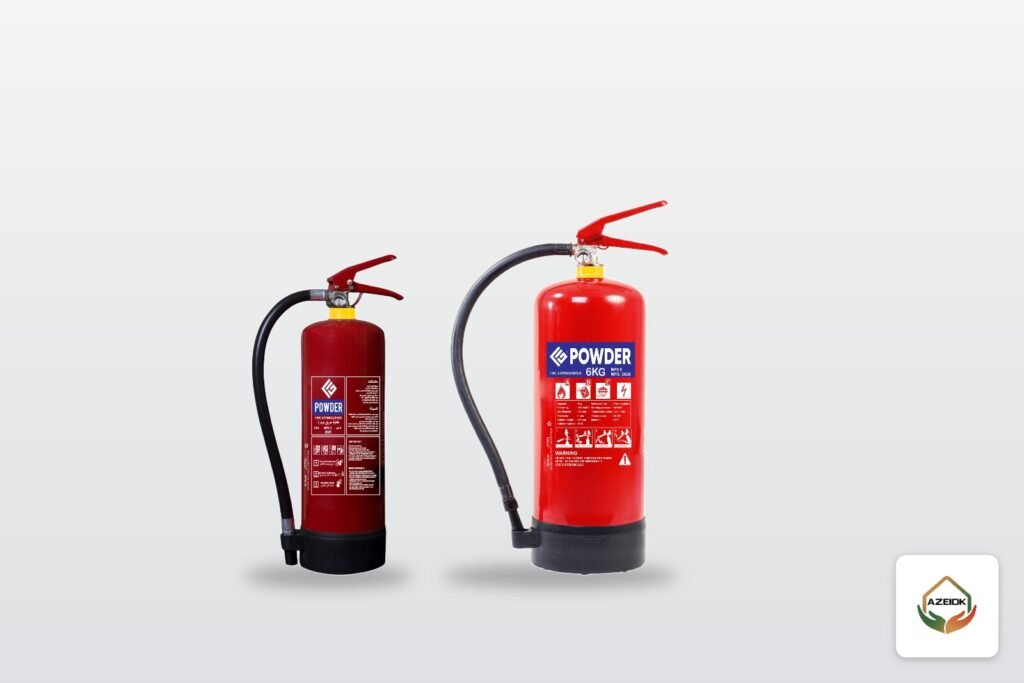
A cartridge operated fire extinguisher keeps its body unpressurised in normal times. The expellant gas is held in a small separate cartridge that is released only when the unit is operated, pressurising the body and driving the agent out. A stored pressure extinguisher holds the agent and expellant gas together under constant pressure in the cylinder, with the pressure shown on a gauge. The difference shows up in operation, inspection, maintenance and recharging, not only in firefighting performance.
To compare extinguisher types and choose the right one for each hazard, see our fire extinguishers selection guide for facilities in Saudi Arabia.
Most dry powder extinguishers listed on AZEIDK’s product pages are stored pressure, but some catalogues offer both designs, including the SFFECO range, which has cartridge operated 6 kg and 9 kg models. This guide explains how each type works, how to tell them apart, how inspection and maintenance differ, and when to choose each one.
Key points
- Stored pressure: expellant gas (usually nitrogen) with the powder in one cylinder, with a pressure gauge.
- Cartridge operated: the body is unpressurised, and the gas (CO2 in SFFECO models) sits in a separate cartridge that is pierced on operation.
- Stored pressure is simpler to use; the cartridge type adds a step users must be trained on.
- Annual maintenance of a cartridge unit includes weighing the cartridge and checking the body interior and the powder.
- Hydrostatic testing for mild steel dry powder units is every 12 years for both types in the US reference table.
In this article
How a stored pressure extinguisher works
The cylinder is filled with powder and then charged with an inert gas; nitrogen is the propellant in SFFECO’s stored pressure models according to the product page. The pressure stays constant inside the unit throughout its life and shows on a small gauge above the valve. Pull the safety pin, squeeze the handle, and the valve opens immediately. Operation is two steps: pull and squeeze.
Because the pressure is permanent, any slow leak from the valve or seal shows on the gauge as the needle moves from green to red. The monthly check therefore relies on the gauge, the seal and an approximate weight. For reading the gauge see the fire extinguisher pressure gauge.
How a cartridge operated fire extinguisher works
The main cylinder holds only powder at atmospheric pressure. Beside it or inside it sits a small cartridge of compressed gas; in SFFECO’s cartridge models (PDC6D and PDC9D) the gas is CO2 according to the product page. On operation, a lever or button pierces the cartridge seal, the gas rushes into the cylinder and pressurises it, and the user then opens the nozzle or gun to direct the powder at the fire.
The piercing method and sequence vary by model, so always follow the instructions on the extinguisher label. What matters for users is that there is an extra step before powder comes out, and that the unit shows no pressure on a gauge beforehand, because the body is not pressurised at all.
Cartridge operated vs stored pressure: comparison table
| Item | Stored pressure | Cartridge operated |
|---|---|---|
| Location of expellant gas | With the powder inside the cylinder | In a separate cartridge |
| Body pressure before use | Always pressurised | Unpressurised |
| Pressure gauge | Fitted | Usually not fitted |
| Operating steps | Pull the pin and squeeze | Pierce the cartridge, then aim and open the nozzle |
| Monthly check | Gauge, seal and weight | Seal, weight and visible cartridge condition |
| Annual maintenance | Gauge, weight and external check | Cartridge weight, internal body check, powder check |
| Typical use | Offices, shops, homes and vehicles | Some industrial sites and larger models |
How to tell the type at a glance
- The gauge: a stored pressure unit has a gauge above the valve; a cartridge unit does not need one because the body is not pressurised.
- A visible cartridge: many models mount the cartridge outside the cylinder on its side, so you can see it directly. Others place it inside the cylinder under the cap.
- The label: it states the operating type and method of use, and it is the most reliable reference.
- The datasheet: it names the propellant: nitrogen for stored pressure or a CO2 cartridge for the other type, as on the SFFECO page.
For the parts of an extinguisher and what each does, see fire extinguisher parts.
How inspection and maintenance differ
For a stored pressure unit, the monthly check relies on the gauge, and annual maintenance covers an external check, weighing and confirming the gauge. In a reference table based on NFPA 10 (2007 edition), stored pressure dry chemical units are emptied and internally examined every 6 years.
A cartridge unit is different because the body can be opened without releasing pressure. Annual service in UK practice under BS 5306-3, as described by Safelincs, includes weighing the cartridge against the weight marked on it, replacing it if it is more than 10 years old, checking the body internally for corrosion, and confirming the powder is dry and fit for reuse. In other words, the internal check of a cartridge unit is part of every annual service, rather than waiting for the 6-year interval used for stored pressure units.
Hydrostatic testing
Under OSHA Table L-1 in the US regulations, stored pressure dry chemical units with mild steel, brazed brass or aluminium shells are tested every 12 years, as are cartridge operated dry chemical units with mild steel shells. CO2 units are tested every 5 years. These are reference intervals; the schedule your service provider works to and Civil Defense accepts is the one that applies. For maintenance and recharging see fire extinguisher maintenance and refilling.
When to choose each type
- Stored pressure is the usual choice for offices, shops, residential buildings and vehicles: two-step operation and a gauge that shows readiness to anyone without tools.
- Cartridge operated is sometimes specified for industrial sites or by particular project specifications, and suits sites with a trained technician who checks the unit internally every year. Since the body is unpressurised, it is returned to service after use by fitting a new cartridge and refilling the powder, provided a genuine cartridge of the same model and a trained technician are available.
- Where users are a changing workforce with little training, stored pressure is safer because it has fewer operating steps.
- The deciding reference is the project specification, Civil Defense requirements and the designer or consultant.
Common mistakes
- Looking for a gauge on a cartridge unit and concluding it is empty because there is none.
- Training staff only on stored pressure units, then installing cartridge units on site.
- Recharging a cartridge unit with a cartridge from another model or a powder different from the datasheet.
- Skipping the cartridge weight check at annual service.
- Storing opened powder in a damp place; the powder must stay dry.
Models available from AZEIDK
Through its technical supply service, AZEIDK supplies dry powder extinguishers of both types, with the datasheet for each model:
- SFFECO ABC dry powder extinguishers: nitrogen stored pressure models from 1 to 12 kg, and cartridge operated PDC6D and PDC9D models of 6 and 9 kg with a CO2 cartridge; working pressure 14 bar and test pressure 27 bar per the product page.
- Falcon Gold 6 kg dry powder (FDP6): stored pressure, operating pressure 15 bar and test pressure 30 bar per the datasheet.
- FG 6 kg dry powder: working pressure 14 bar, test pressure 25 bar, rated 27A 144BC.
For the full SFFECO range see SFFECO fire extinguishers. AZEIDK’s own team maintains extinguishers under its periodic maintenance contracts.
FAQ
What is the difference between cartridge operated and stored pressure extinguishers?
In stored pressure units the expellant gas sits with the powder under constant pressure; in cartridge units the gas is in a separate cartridge released only on operation.
Why does a cartridge extinguisher have no gauge?
Because its body is not pressurised before use; readiness is confirmed by weighing the cartridge at service.
Which is better for a shop or office?
Usually stored pressure, because it is simpler to operate and its gauge shows readiness at the monthly check.
How often is the cartridge checked?
It is weighed at annual service against its marked weight, and replaced if light or more than 10 years old in UK practice.
Is hydrostatic testing different for the two types?
In the US reference table both are every 12 years for dry powder units with mild steel shells.
Summary
Stored pressure units are simpler for everyday users, while cartridge units suit sites whose specification calls for them and where a trained technician is available. Identify the type you have from the label and datasheet, train users on that type specifically, and follow the maintenance that matches it.
Need dry powder extinguishers for a project or a review of your current units? Send us the specification or your extinguisher list, and we will propose the right model with a supply and maintenance offer. Contact the AZEIDK team
Related guides
- Safety and Fire Fighting Company in Makkah: Fire Alarm, Fire Fighting, Extinguishers and Civil Defense Procedures
- Parking Management and Automatic Barrier Systems
- ISO Certification for Fire and Security Contractors: What ISO 9001, ISO 14001 and ISO 45001 Mean and How to Verify Them
- Fire Suppression System Suppliers in Jeddah: Server, Electrical and Archive Rooms, Clean Agent and Aerosol