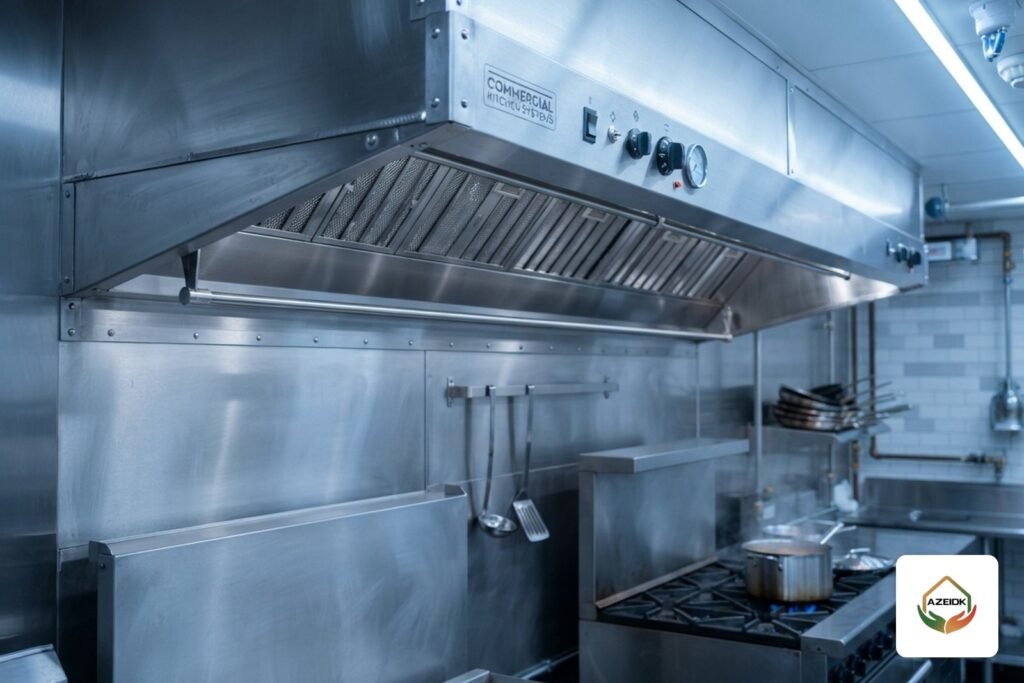
A kitchen fire suppression system in Makkah is a fixed system installed over the cooking line inside the hood. It detects fire, discharges wet chemical agent onto fryers, grills and the exhaust duct, and shuts off the gas to the appliances at the same moment. In Makkah, hotel, restaurant and catering kitchens run at full load through Hajj, Umrah peaks and Ramadan, so having the system ready before the season is a practical condition for staying open.
This guide covers what each type of Makkah kitchen needs, the systems available, installation and inspection steps, and what Civil Defense checks. AZEIDK supplies, installs and maintains these systems under its kitchen fire suppression solutions, with a showroom in Al Aziziyah, Makkah.
Key Takeaways
- The system protects appliances, hood and duct, and cuts gas and power to the appliances on discharge.
- Systems available from AZEIDK: Ansul R-102, Hood Safer, American Fire Control and Falcon Gold.
- The Saudi Building Code and Civil Defense requirements are binding; the usual international references in specifications are UL 300 for the system listing and NFPA 17A and NFPA 96 for installation and inspection, including inspection every six months.
- In Makkah, schedule inspection and recharge before the season, not during it, because shutting a kitchen at peak is costly.
- AZEIDK Makkah showroom: Al Aziziyah District, Sheikh Abdullah Al Khayyat Street, +966 54 052 0353.
In this article
- What makes Makkah kitchens different?
- Which kitchen fire suppression system suits a Makkah restaurant?
- Installing a kitchen fire suppression system in Makkah
- What does Civil Defense check in Makkah kitchens?
- When to inspect and recharge
- Gas leak detection in Makkah kitchens
- AZEIDK showroom in Makkah
- Common mistakes in Makkah kitchens
- Frequently Asked Questions
- Summary
What makes Makkah kitchens different?
| Kitchen type | How it operates | What matters in the system |
|---|---|---|
| Hotel kitchens near the Haram | Buffets and meals around the clock in season | Long hoods with many appliances; inspection before the season without a long shutdown |
| Central kitchens and catering companies | Bulk cooking for meals delivered to pilgrim housing and camps | Large fryers and kettles, gas leak detection, several hoods |
| Restaurants in Al Aziziyah, Al Awali and Al Shawqiyah | Long hours and seasonal crowds | A design that fits the existing appliance layout, with a Class K extinguisher nearby |
| Seasonal and temporary kitchens | Weeks of operation, then closure | Inspection before opening and after closing, cylinder condition checked |
| Bakeries and popular food kitchens | Grills, ovens and oil appliances | Every appliance under the hood covered per the manufacturer’s manual |
Central kitchens are covered in central kitchen and catering fire safety, and hotels on the hospitality sector page.
Which kitchen fire suppression system suits a Makkah restaurant?
The four systems AZEIDK supplies work on the same principle: fusible link detectors over the appliances, a wet chemical cylinder, nozzles placed per appliance type, and a gas shut-off valve. The differences are in design, manufacture, parts availability and what the consultant accepts:
| System | Product page | Usually chosen when |
|---|---|---|
| Ansul R-102 | Ansul R-102 | The specification or restaurant chain names it |
| American Fire Control | AFC kitchen system | An alternative offered when the consultant accepts alternatives |
| Hood Safer | Hood Safer | Restaurants and commercial kitchens per the specification |
| Falcon Gold | Falcon Gold hood system | Commercial kitchens per the specification and consultant acceptance |
Price alone should not decide. Consultants usually require a UL 300 listed system, designed per the manufacturer’s manual for each appliance. What these listings mean is explained in UL 300, NFPA 17A and NFPA 96.
Installing a kitchen fire suppression system in Makkah
- Survey: measure the hood, list the appliances and their types, locate the gas line and electrical panel.
- Design and cylinder count: nozzles and cylinders per the manufacturer’s manual, with a calculation sheet.
- Submittal: datasheet, listing certificate and drawing to the consultant or owner.
- Installation: cylinder, piping, nozzles, detectors, gas shut-off valve and a manual pull station on the exit route.
- Testing: test the release mechanism and gas shut-off without discharging agent, and record the results.
- Interface: a signal to the building fire alarm system where one exists.
Each step is detailed in kitchen suppression installation in Saudi Arabia.
What does Civil Defense check in Makkah kitchens?
When a restaurant or hotel is licensed on the Salamah platform, or during inspections, the inspector typically checks that a system covers the cooking line and its seal is intact, the last inspection tag, a suitable kitchen extinguisher, and clear access to the manual pull station. Inspections of hospitality facilities intensify in season, as in the Civil Defense rounds during Hajj 1447.
AZEIDK handles the technical report through an approved engineering consultancy office and issues the safety equipment installation certificate for systems it installs. See Civil Defense approval support.
When to inspect and recharge
- Every six months: detectors, nozzles, cylinder and gas valve, with fusible links replaced per the manufacturer’s instructions.
- Before the season: book the inspection well before Ramadan and Hajj.
- After any discharge: clean appliances and hood, recharge and reset before reopening.
- When appliances change: adding a fryer or moving a grill may require nozzle changes.
Inspection items are in kitchen suppression inspection and maintenance, and periodic inspection is part of maintenance contracts.
Gas leak detection in Makkah kitchens
A hood system deals with fire once it starts; a gas leak detector warns before that. In central and hotel kitchens running on a gas network with several cylinders or a tank, a gas detector is usually added near the appliances and gas line, with a shut-off valve that closes on alarm. AZEIDK supplies gas leak detectors for restaurants and buildings as part of its safety work, with the number and positions set by the gas type and kitchen layout. Plan the detector, suppression system and shut-off valve together rather than fitting each one separately.
AZEIDK showroom in Makkah
Makkah showroom details as listed on the contact page:
| Branch | Address | Phone |
|---|---|---|
| Makkah Showroom, Al Aziziyah | Al Aziziyah District, Sheikh Abdullah Al Khayyat Street | +966 54 052 0353 |
At the showroom you can request a kitchen survey and quotation and buy kitchen extinguishers and safety accessories. Large hotel and central kitchen projects can also be coordinated with the General Administration in Jeddah.
Common mistakes in Makkah kitchens
- Adding appliances under the hood after installation without changing nozzles.
- Postponing inspection to the middle of the season.
- Blocking the manual pull station with shelves or equipment.
- Keeping only a powder extinguisher in the kitchen instead of a wet chemical (Class K) unit.
- Hood cleaning that damages detectors or shifts nozzles.
Frequently Asked Questions
Does a small restaurant in Makkah need a kitchen suppression system?
Commercial kitchens producing grease-laden vapour under a hood usually need a fixed system; the design and Civil Defense requirements for the activity decide.
How often is a kitchen system inspected?
Usually every six months, and after any discharge or appliance change.
Does the system shut off the gas automatically?
Yes. Correctly installed, the gas shut-off valve closes on discharge, and this is tested before handover.
Is an extinguisher enough instead of a fixed system?
No. A Class K extinguisher complements the system and does not replace it.
Where is AZEIDK in Makkah?
At the Makkah showroom in Al Aziziyah, Sheikh Abdullah Al Khayyat Street, +966 54 052 0353.
What does a kitchen suppression system cost?
It depends on hood length, number of appliances and the system chosen. See kitchen suppression system price.
Summary
In Makkah, plan the kitchen system around the seasonal peak: a listed system designed for every appliance, a tested gas shut-off, inspection every six months ahead of Ramadan and Hajj, and a Class K extinguisher nearby. That keeps the kitchen ready for inspection and for service.
Fitting out a hotel or restaurant kitchen in Makkah? Send photos of the hood and the appliance list and we will arrange a survey and quotation. Contact the AZEIDK team
Related guides
- Civil Defense Fire Apparatus Access in Saudi Arabia: Fire Lanes, Outdoor Hydrant Locations and the Fire Department Connection
- Hikvision NVR 8 Channel DS-7608NXI-K1(B): PoE Budget, Hard Drive, Cameras and Recording Days
- Kitchen Fire Suppression for Fuel Station Restaurants and Highway Service Centres in Saudi Arabia
- Kitchen Fire Extinguisher (Wet Chemical Class K): Why Dry Powder Falls Short on Oil Fires, Where to Place It and How It Works With the Hood System