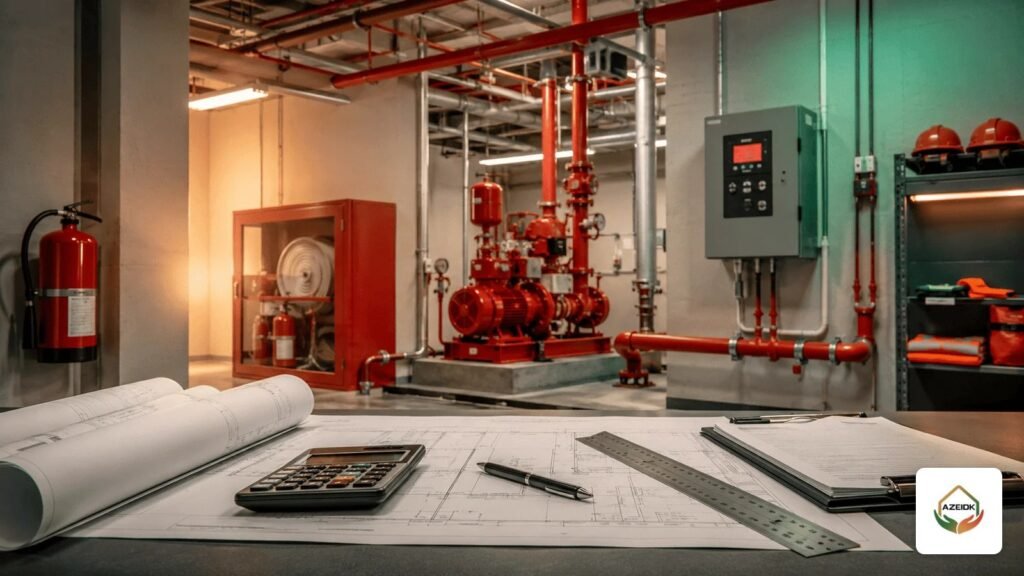
Fuel station safety requirements in Saudi Arabia come from the “Requirements for Fuel Stations and Service Centers” published by the Ministry of Municipalities and Housing, with SBC 801 and Civil Defense requirements. Key items: tank safety distances, an emergency fuel shut-off near the dispensers, explosion-proof lighting, leak detection, and extinguishers per Chapter 23 of SBC 801.
This guide gathers what the official document says on fire safety, then explains in practice what a station needs in extinguishers, foam and emergency equipment, and how this links to Civil Defense licensing through Salamah. It is for station owners, operators and engineering offices, and does not replace the official text in force or the approved drawings.
Key points
- The main reference is the Requirements for Fuel Stations and Service Centers (1445H), issued by the Standing Executive Committee for Service Centers and Fuel Stations and published by the Ministry of Municipalities and Housing.
- For extinguishing equipment, the document refers to Chapter 23 of SBC 801.
- Fuel fires are Class B, so suitable extinguishers are usually dry powder or AFFF foam, not water.
- An emergency shut-off switch near the dispenser, labelled for fuel shut-off in emergencies.
- Per Saudi Gazette (December 2023), existing stations were given 12 months from publication to comply, except site and distance requirements; the reference is the document text on the Ministry of Municipalities and Housing website.
In this article
- Who sets fuel station safety requirements?
- What are the fuel station safety requirements in the official document?
- Which fire extinguishers suit fuel stations?
- When does a fuel station need a fixed foam system?
- How does a fuel station link to Civil Defense licensing on Salamah?
- What daily and periodic checks apply to station safety equipment?
- What are common fuel station safety mistakes?
- Frequently asked questions
- Summary
Who sets fuel station safety requirements?
The updated requirements were issued by the Standing Executive Committee for Service Centers and Fuel Stations. Saudi Gazette reported in December 2023 that the committee is headed by the Ministry of Energy and includes ten other bodies, among them the Ministry of Interior represented by the General Directorate of Civil Defense. The Ministry of Municipalities and Housing publishes the document on its “Fuel station requirements” page and issues municipal licences through Balady.
On fire, the document refers to the Saudi Fire Protection Code SBC 801, to SBC 201 for building fire resistance, and to NFPA 70 and NFPA 30A for hazardous areas. Civil Defense handles safety licensing through Salamah and inspection of fire systems.
What are the fuel station safety requirements in the official document?
| Item | What the document states |
|---|---|
| Above-ground tank distances | At least 30 m from boundaries of adjacent administrative, industrial, commercial and storage buildings, and 60 m from schools, hospitals and wedding halls; halved where fire-spread prevention is provided |
| Extinguishing equipment | Provided per Chapter 23 of the Saudi Fire Protection Code |
| Tank capacity and above-ground tanks | Total capacity per zone per Chapter 23; above-ground tanks per Chapter 57 of SBC 801 |
| Emergency shut-off | Emergency disconnect switch near the dispenser, labelled for emergency fuel shut-off |
| Electrical and lighting | Explosion-proof lighting and electrical connections |
| Tanks | Leak detection, automatic tank pressure and inventory monitoring, pressure relief with flame arrester, vapour recovery during filling |
| Dispenser protection | Bollards and kerbs against vehicle impact; dispenser island kerb at least 30 cm wide on each side |
| Hazardous area | Per Chapter 5 of NFPA 70 and Chapter 8 of NFPA 30A |
| Buildings | Non-combustible materials, fire resistance per SBC 201, food outlets and pharmacies separated from vehicle workshops, separate LPG cylinder sales building |
Some items vary by station class: the emergency shut-off and leak detection, for example, appear explicitly in the clauses for compact stations (Class C), and corresponding items may appear in other classes and in the document’s chapters on safety and fire protection and protection during operation. Mobile stations (Class D) have their own items, including filling procedures per Section 5706 of SBC 801. Start by identifying your station class, then read its clauses, using the official PDF published on the Ministry’s page.
Which fire extinguishers suit fuel stations?
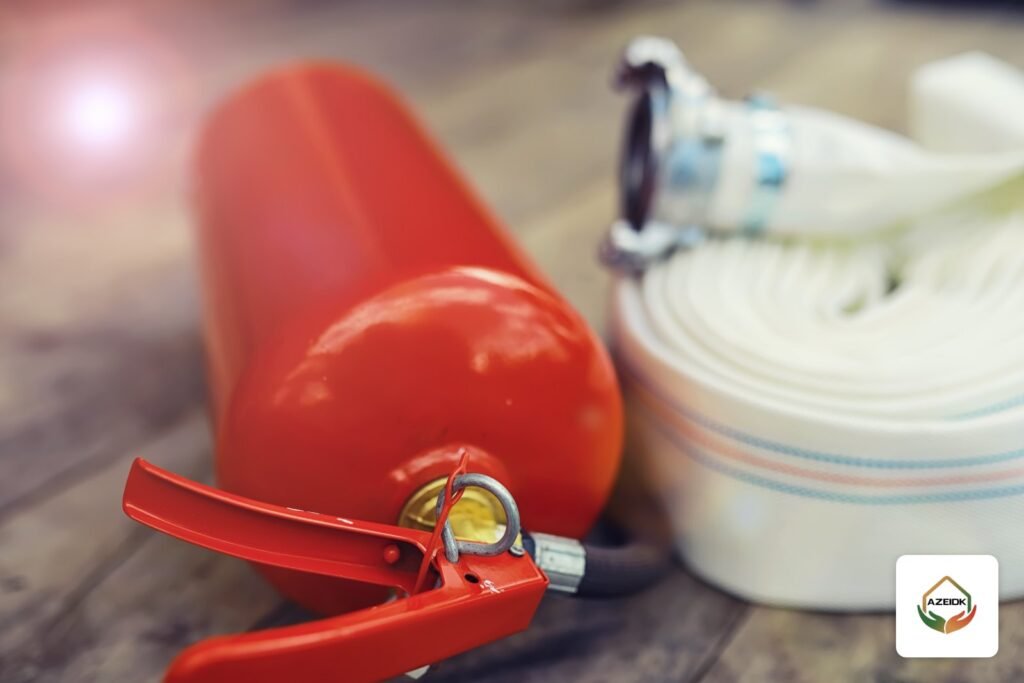
Fuel is a flammable liquid and its fires are Class B. Extinguishers are chosen for this class, and Chapter 23 of SBC 801 and the approved design set number and locations. NFPA 10 for portable fire extinguishers explains rating and distribution.
| Extinguisher | Use at the station | Note |
|---|---|---|
| Portable dry powder | Dispenser islands, offices and shop | Classes A, B, C depending on powder (ABC or BC) |
| Wheeled dry powder | Forecourt and tanker unloading area | Larger capacity for larger fires, as the design requires |
| AFFF foam | Spilled fuel fires on the ground | Forms a film over the liquid and reduces re-ignition |
| CO2 | Electrical room and control panels | Leaves no residue; limited effect outdoors |
| Water | Not used on fuel fires | May spread burning fuel |
Falcon Gold extinguishers shown on the AZEIDK site include dry powder 1, 6 and 50 kg, the 50 kg model being wheeled; the article lists places such as loading yards and fuel stations for it. It also lists a 25-litre AFFF foam extinguisher and advises requesting its datasheet to confirm foam type and operation. See Falcon Gold fire extinguishers: types and capacities. For when you need a wheeled unit instead of a portable one, our wheeled fire extinguisher guide covers 25 to 150 kg sizes, hose length and placement.
When does a fuel station need a fixed foam system?
Most small and medium stations rely on portable and wheeled extinguishers. Fixed foam systems usually appear where there are large above-ground tanks, wide unloading areas or fuel depots, as the approved design under SBC 801 and the authority require. Foam fire suppression systems covers system types and uses.
When choosing foam concentrate, check type, concentration, proportioning ratio and approval in the datasheet, and compatibility with proportioning equipment. As AFFF faces growing restrictions worldwide over PFAS, ask the supplier about fluorine-free alternatives and their acceptance in the specification. SafeGuard firefighting foam in Saudi Arabia shows the foam concentrates AZEIDK supplies.
How does a fuel station link to Civil Defense licensing on Salamah?
Safety licences are issued through Salamah, and the route depends on activity risk: some activities are licensed instantly, some follow a direct route with a report or safety-equipment invoice attached, and some follow an indirect route requiring a contract with an approved safety company and an inspection visit. The station’s classification is set on the platform when applying. Instant vs non-instant licensing on Salamah explains these routes.
Whatever the route, prepare: approved station drawings, extinguisher layout and maintenance tags, the emergency shut-off switch and its sign, emergency lighting and no-smoking signs where the drawings require them, and a safety systems maintenance contract if required.
What daily and periodic checks apply to station safety equipment?
- Daily: extinguishers in place, gauge in the green, access clear.
- Daily: emergency shut-off switch visible, sign clear, nothing blocking it.
- Monthly: documented visual check of extinguishers, seal and tag.
- Periodically: extinguisher maintenance and refilling by a specialist at the approved intervals.
- Periodically: leak detection and tank monitoring checks per manufacturer instructions.
- Always: staff trained in using extinguishers, fuel shut-off and evacuation.
What are common fuel station safety mistakes?
- Water or non-Class B extinguishers at dispenser islands.
- Emergency shut-off switch hidden or unlabelled.
- Oils and flammables stored next to the shop or restaurant.
- Ordinary electrical installations inside the hazardous area.
- Damaged or removed bollards left unrepaired.
- Staff untrained in using extinguishers or shutting off fuel.
Frequently asked questions
What is the reference for fuel station safety requirements in Saudi Arabia?
The Requirements for Fuel Stations and Service Centers published by the Ministry of Municipalities and Housing, with SBC 801 and Civil Defense requirements.
Which extinguisher is best for a fuel station?
Extinguishers suited to Class B fires, such as dry powder and AFFF foam. The approved design sets number, size and locations.
Can water extinguishers be used at a fuel station?
Not on fuel fires, as water may spread burning fuel.
What is the distance between a fuel tank and a school?
For above-ground tanks, at least 60 m from schools, hospitals and wedding halls, reducible by half where fire-spread prevention is provided. This distance is stated for above-ground tanks; check the document for your case.
How long do existing stations have to comply?
12 months from publication per Saudi Gazette, except site and distance requirements. Check the official text on the Ministry of Municipalities and Housing website.
Summary
Fuel station safety requirements start from the official document and the station class, then are met in practice with extinguishers suited to fuel fires, a visible emergency shut-off, explosion-proof electrics, leak detection, trained staff and a file ready for Salamah.
Preparing a fuel station for licensing or renewal? AZEIDK’s Civil Defense approval support team can list requirements and define the extinguishers and safety equipment needed; Falcon Gold extinguishers and foam concentrates can be supplied under a separate quotation. Contact the AZEIDK team
Related guides
- Fire-Rated Doors: How to Order and Accept Them on Saudi Projects (Ratings, Components and Checklist)
- Contractor Classification in Saudi Arabia vs Muqawil Membership: How to Verify a Fire Systems Contractor
- Shurjoint Grooved Couplings for Fire Systems: Couplings, Fittings and Valves, Pressures, Approvals and Selection
- Cla-Val Fire Pump Valves: 50B Relief Valve, 134-05 Deluge Valve and WC-1 Waste Cone