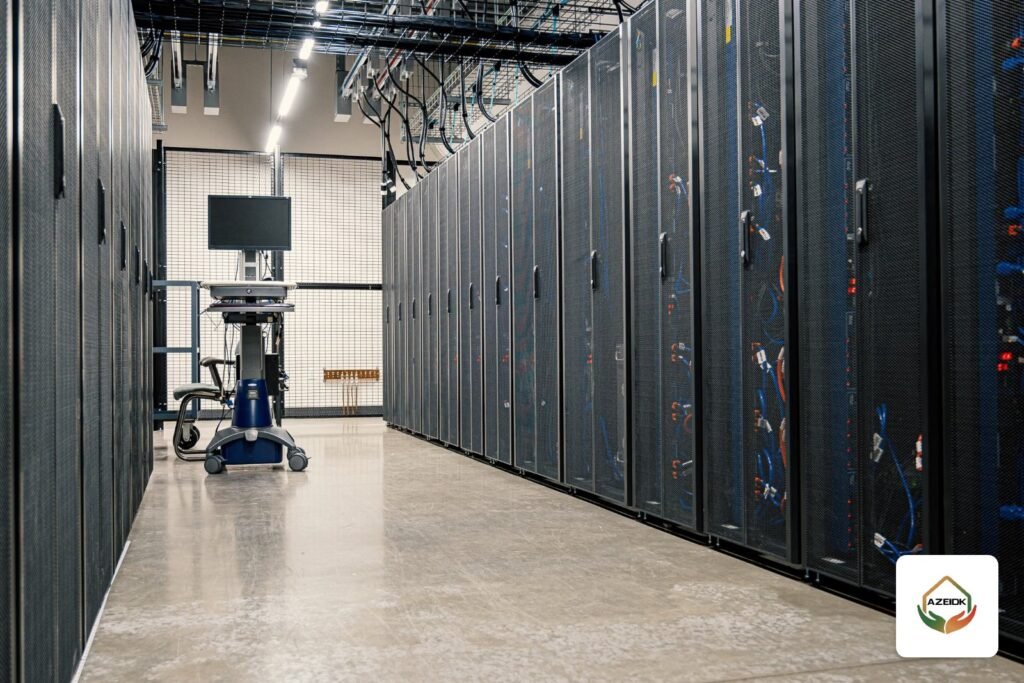
Server room fire suppression in banks usually means a clean agent total flooding system. It puts out the fire without water and without residue that damages equipment, and it can be designed for occupied rooms at the design concentration. That applies to the small network room in a branch, UPS rooms, and larger server rooms at head office. Success does not depend on the cylinder alone, but on room tightness, release logic and maintenance.
For how clean agent systems are designed, kept safe and maintained, see our FM-200 fire suppression system guide.
This guide covers when a bank needs a gas system, the agents available, room integrity testing and what to check before handover. AZEIDK supplies and installs these systems under its special fire suppression solutions and serves the sector through its banks and financial institutions page.
Key points
- A bank server room carries customer-facing systems, so downtime after a small fire, or after water discharge, can cost more than the hardware.
- Clean agent is designed as total flooding at a calculated concentration and released after two detectors confirm.
- NFPA 2001 requires the room to hold the agent at the highest level of combustibles for at least 10 minutes, verified by a room integrity test.
- Any change to the room after handover, such as a new cable opening, can weaken the system.
- Small UPS rooms in branches may need simpler solutions; the designer decides.
In this article
Where is server room fire suppression needed in banks?
Not every network cupboard in a small branch needs total flooding. The decision follows the Saudi Fire Code SBC 801, the project requirements and the bank’s own view of how critical the room is: which services stop if the room goes down, and how long it takes to restore. Common cases:
| Room | Common solution | Note |
|---|---|---|
| Small network cabinet in a branch | Smoke detection with suitable extinguishers, sometimes an automatic ceiling extinguisher | Size rarely justifies a full flooding system |
| UPS and battery room | Early detection, plus a gas system or ceiling extinguisher by size and design | Check cooling and battery ventilation |
| Server room in a main or regional branch | Clean agent total flooding | Needs a sealed room and an extinguishing control panel |
| Head office server rooms | Clean agent total flooding, possibly with pre-action sprinklers by design | Coordinated with the building design |
Automatic extinguishers for small rooms are covered in modular clean agent and CO2 extinguishers, and pre-action systems in pre-action sprinkler systems.
Which clean agent suits a server room?
The two most common agents in server rooms are HFC-227ea (known by the trade name FM-200) and FK-5-1-12. Both are stored as liquid in cylinders, vaporise on discharge and are designed to NFPA 2001. The choice depends on the project specification, space for cylinders, availability and cost. A detailed technical comparison is in our clean agent comparison.
The question bank staff ask most is whether the gas is dangerous to people in the room. The detailed answer, with evacuation time, is in is FM-200 gas dangerous to humans?
Room integrity testing: why many systems fail
Clean agent does not work if it leaks out before the fire is out. As summarised by ORR Protection, NFPA 2001 requires the agent to be held at the highest level of combustibles for at least 10 minutes, at no less than 85% of the adjusted minimum design concentration. This is verified with a door fan test, which measures the room’s leakage.
Typical leaks in bank rooms are cable openings in ceilings and raised floors, doors without proper seals, HVAC ducts and open false ceilings. Agree with the bank’s facilities team that the maintenance contractor is told about any cabling work or room change, because one new opening can defeat the system.
Release logic in a bank server room
- Two-detector confirmation: the countdown starts after two detectors alarm, to cut false discharges.
- Pre-discharge warning: sounders and beacons inside and outside, with a sign warning not to enter during discharge.
- Hold-off button: pauses the countdown if people in the room confirm there is no fire.
- Manual release: at the room exit.
- HVAC shutdown and closing of openings: at the start of the countdown so the agent is not drawn out.
- Signal to the fire alarm and monitoring point: the branch may be closed.
Where access control is fitted, check that the server room door never prevents people inside from leaving during the countdown.
Gas suppression products from AZEIDK
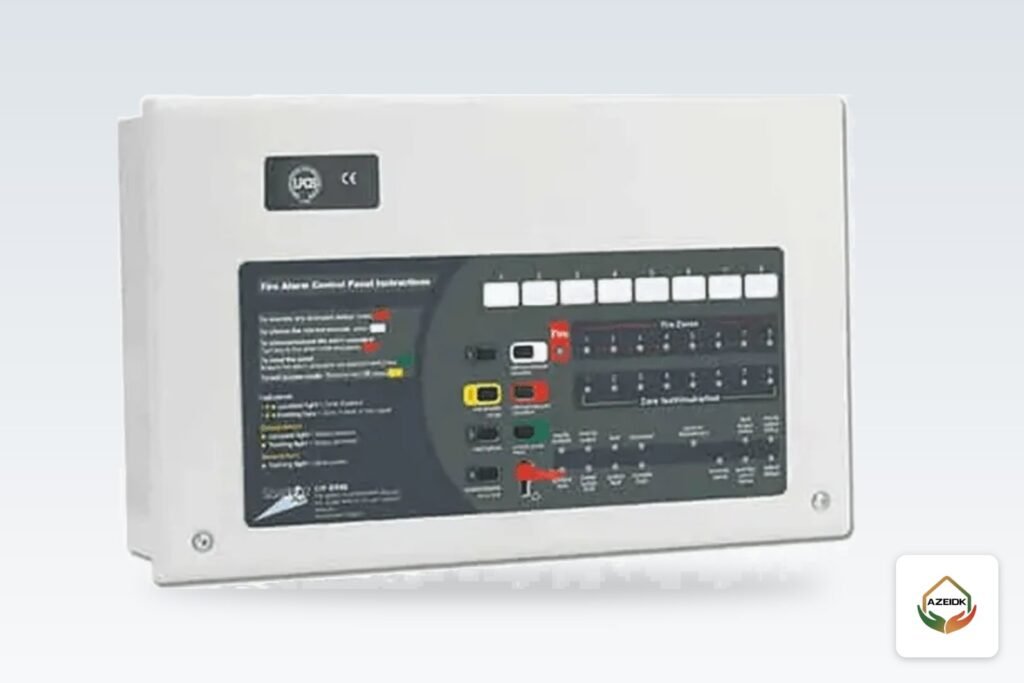
AZEIDK supplies in Saudi Arabia the Context Plus 227 (HFC-227ea) clean agent, UL listed (GARZ2.EX16152) and FM approved, complying with ASTM D6064 and NFPA 2001, with UL listed cylinders from 35 to 1,200 lb, discharge nozzles, the EP203 automatic extinguisher control panel and release and hold-off buttons. Also available are the American Fire Control FM-200 system, the SFFECO 1230 system using FK-5-1-12, and FirePro condensed aerosol. The system is selected after calculating room volume and design concentration under our engineering design and calculations service.
Maintenance after handover
The system needs routine checks of cylinders and their pressure or weight, the control panel, detectors, release buttons and the room itself. These items belong in the bank’s fire systems maintenance contract, with a clear procedure for isolating release circuits before any work on detection. AZEIDK provides this under its preventive and routine maintenance service.
Common mistakes in bank server room protection
- Sizing the agent for the room without the raised floor or ceiling void: where these voids are open to the room, they may need to be included in the calculation.
- Forgetting pressure relief: discharge raises pressure in a sealed room. The designer determines the need for pressure relief based on agent, volume and manufacturer instructions.
- Adding racks or equipment without review: expansions can change the heat load and detector positions, so review them with the maintenance contractor.
- Trusting the catalogue logo: UL listing or FM approval covers specific models and components and is checked in the datasheet and official directories.
- Untrained room owners: people working in the room must know what the first and second alarms mean, where the hold-off button is and how to get out.
FAQ
Does every bank branch server room need a gas system?
Not always. Small rooms may need simpler solutions, while critical or larger rooms are usually protected by total flooding, as decided by the designer under the code and bank requirements.
Why not rely on water sprinklers alone in a server room?
Water can damage equipment and extend downtime. Clean agent is preferred, with pre-action sprinklers added for building protection where the design requires.
What is a room integrity test?
A door fan test that measures room leakage to confirm the room will hold the agent for at least 10 minutes, as NFPA 2001 requires.
Can bank staff stop a discharge?
The hold-off button pauses the countdown when there is clearly no fire. Staff responsible for the room are trained to use it.
What is the difference between FM-200 and FK-5-1-12?
Both are NFPA 2001 clean agents. They differ in properties, design concentration and cylinder space, and the choice depends on the project.
Does AZEIDK design, supply and install the system?
Yes. AZEIDK covers calculations, supply, installation, testing, commissioning and maintenance.
Can a gas system be fitted to a live server room without shutting it down?
Usually yes. Cylinders, pipework, nozzles and detectors are installed with dust protection, and noisy work and sealing are scheduled with the bank IT team.
What happens after a discharge in a server room?
The room is ventilated according to project procedures before re-entry, equipment is checked, and cylinders are refilled or replaced so the system returns to service quickly.
Summary
A bank server room deserves protection that saves both the equipment and the service. Decide which rooms need total flooding, choose the agent, seal and test the room, programme the release logic and interfaces, then protect the system from uncoordinated changes with a clear maintenance contract. Across a branch network, using one system type and control panel in every branch room simplifies maintenance, cylinder supply and spare parts, and shortens the time to restore service after any discharge.
Need to protect a server or UPS room in a branch or head office? Send us the room dimensions, ceiling height and floor type, and we will prepare an initial calculation with datasheets. Contact the AZEIDK team