Pharmacy Civil Defense requirements in Saudi Arabia start with approval from the General Directorate of Civil Defense before operation, as set out in the Requirements for Private Healthcare Activities issued by the Ministry of Municipal and Rural Affairs and Housing, the document that lists pharmacies among its activities. Then comes the practical side: extinguishers spread out and visible, fire alarm and emergency lighting as the code requires, alcohol, sanitisers and aerosols stored away from heat, and CCTV planned around the security cameras law. This guide covers each item in practical terms and shows where Civil Defense approval support helps.
Key takeaways
- The Requirements for Private Healthcare Activities (1444 AH) list “pharmacy activities” and set a minimum area of 50 m² for a standalone pharmacy and 25 m² inside a complex.
- The same document requires approval from the General Directorate of Civil Defense, and its fire protection items are based on the Saudi Fire Protection Code (SBC 801).
- Its safety items include spacing extinguishers so that the distance between one and the next does not exceed 23 m, placing them in prominent locations, maintaining them periodically, a fire alarm system, and lit escape routes with backup power.
- Alcohol, sanitisers and aerosols are flammable; the document requires flammable materials to be kept a safe distance from heat sources and never stored in exits or stairs.
- The security cameras law covers public and private health facilities; confirm against the official text whether your pharmacy is a covered facility before designing the system.
In this article
- What are the pharmacy Civil Defense requirements?
- Fire extinguishers in a pharmacy: type and location
- Does a pharmacy need a fire alarm system?
- Emergency lighting and exit signs
- Storing alcohol and flammable products in a pharmacy
- Electrical safety and medicine fridges
- CCTV for pharmacies: what does the law say?
- Preparing a pharmacy for Civil Defense approval
- Frequently asked questions
- Conclusion
What are the pharmacy Civil Defense requirements?
In the official sources we reviewed there is no separate safety document for pharmacies alone. The municipal reference is the “Requirements for Private Healthcare Activities” issued by the Ministry of Municipal and Rural Affairs and Housing in 1444 AH, which defines a pharmacy as “the place prepared for compounding and dispensing pharmaceutical preparations”. The professional licence of a pharmacy sits with the Ministry of Health under the Law of Pharmaceutical Establishments and Preparations and its Implementing Regulations.
On safety, the municipal document requires approval from the General Directorate of Civil Defense and bases its fire prevention and protection items on the Saudi Fire Protection Code (SBC 801). Safety licences for commercial activities are then issued through the Salamah platform.
What matters for a pharmacy owner is that approval is not a paper exercise. The inspector looks at extinguishers and where they are, corridors, exits, lighting and how stock is stored.
Fire extinguishers in a pharmacy: type and location
The Requirements for Private Healthcare Activities state that extinguishers must be distributed so that the distance between one and the next does not exceed 23 m, placed in prominent and easily reached locations, installed correctly and maintained periodically. The final number is set by the code and Civil Defense according to floor area and hazard. Start with a first estimate using the fire extinguisher calculator.
| Area in the pharmacy | Common extinguisher type | Why |
|---|---|---|
| Sales floor and aisles | Multi-purpose dry powder (ABC) | Covers cardboard, plastics, flammable liquids and electrical fires. |
| Near the distribution board, medicine fridges and tills | Carbon dioxide (CO2) | Leaves no residue on equipment and displayed medicines, suitable for electrical equipment. |
| Back store room | Dry powder (ABC) | Mount it at the entrance, outside, so a fire inside does not cut it off. |
Falcon Gold dry powder and CO2 units are in AZEIDK’s fire extinguisher range, and the difference between the two types is covered in our CO2 extinguisher guide and dry powder extinguisher guide.
Does a pharmacy need a fire alarm system?
The municipal document lists a fire alarm system among its safety items and requires extinguishing and alarm systems to work and be maintained periodically. The form the system takes depends on location:
- Pharmacy inside a medical or retail complex: there is usually a building alarm system. Check that detectors in the pharmacy and store are connected to the building panel and working.
- Standalone street pharmacy: the code and Civil Defense requirements for your activity and floor area decide whether a dedicated system is needed and of which type.
Where needed we design and install the system under our fire alarm systems, from conventional panels for small units to addressable systems for larger premises.
Emergency lighting and exit signs
The document requires exit signs to be illuminated, easy to see and working for 90 minutes during a power cut, and escape routes to be lit with backup power. In a pharmacy that means an emergency light over the exit and along the corridor from the store room, plus a clear exit sign. Technical detail is in emergency lighting and exit signs.
Storing alcohol and flammable products in a pharmacy
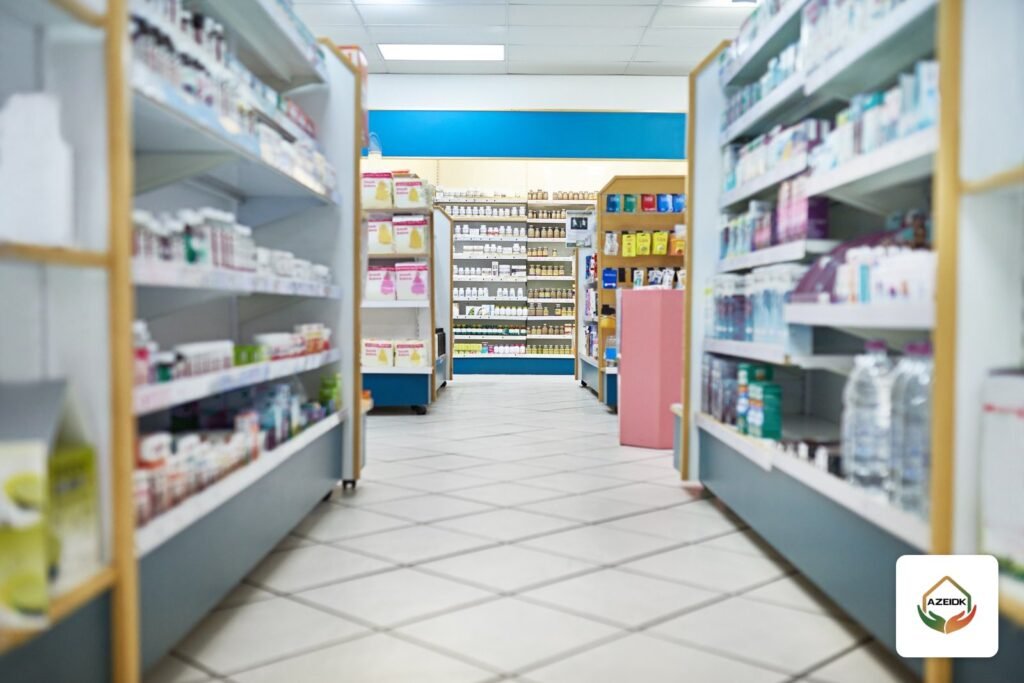
A pharmacy holds more flammable products than most people expect: medical alcohol, hand sanitisers, pressurised aerosols such as deodorants and hair sprays, perfumes and some cosmetics. It also has heat sources: medicine fridges, lighting, tills and air conditioners.
The Requirements for Private Healthcare Activities call for organised shelving for flammable and combustible liquids, a safe distance between flammable materials and heating devices or other ignition sources, no storage in exits, stairs or ramps, and dedicated cabinets for flammable and combustible liquids above 38 litres. In practice:
- Give alcohol and sanitisers their own shelf or cabinet away from fridges, air conditioners and the distribution board.
- Do not stack aerosol cartons beside the coffee machine or kettle in the staff room.
- Keep the store corridor and exit clear of cartons; it is the first place to fill up in busy seasons.
- Display sales quantities only on the floor, and keep stock in the store arranged so the extinguisher stays reachable.
Electrical safety and medicine fridges
Medicine fridges run around the clock, together with lighting, tills, cameras and air conditioning. Most electrical fires in shops start from overloaded leads or temporary wiring added after opening. The municipal document refers electrical requirements to the Saudi Electrical Code (SBC 401) for healthcare buildings. Ask a qualified electrician to give fridges suitable dedicated circuits, never run them from a shared extension lead with other appliances, and keep the distribution board closed and unobstructed.
CCTV for pharmacies: what does the law say?
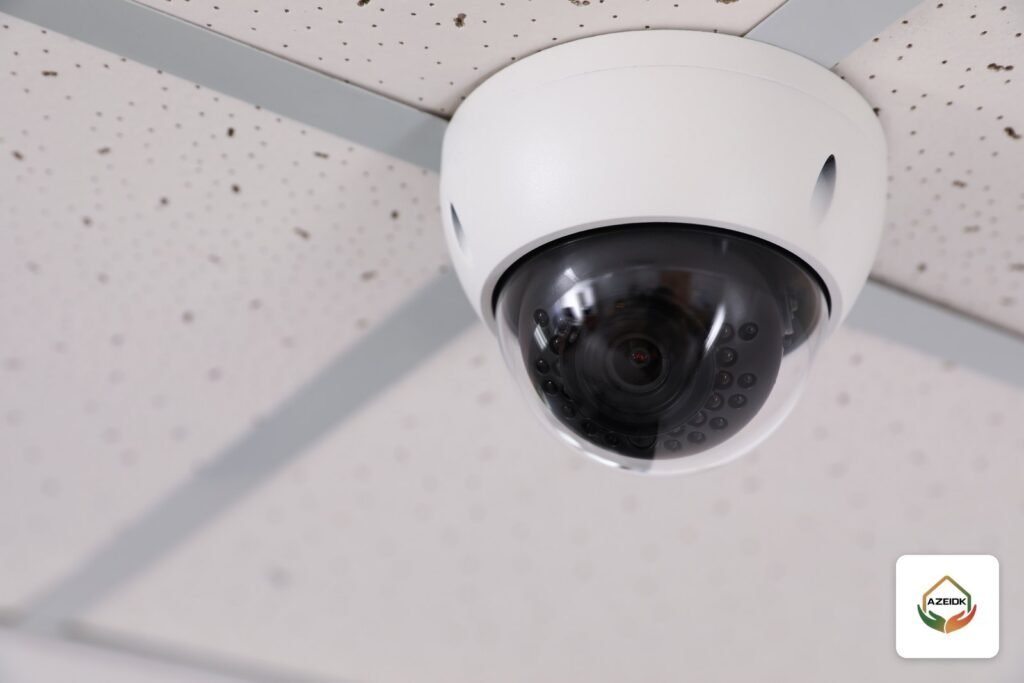
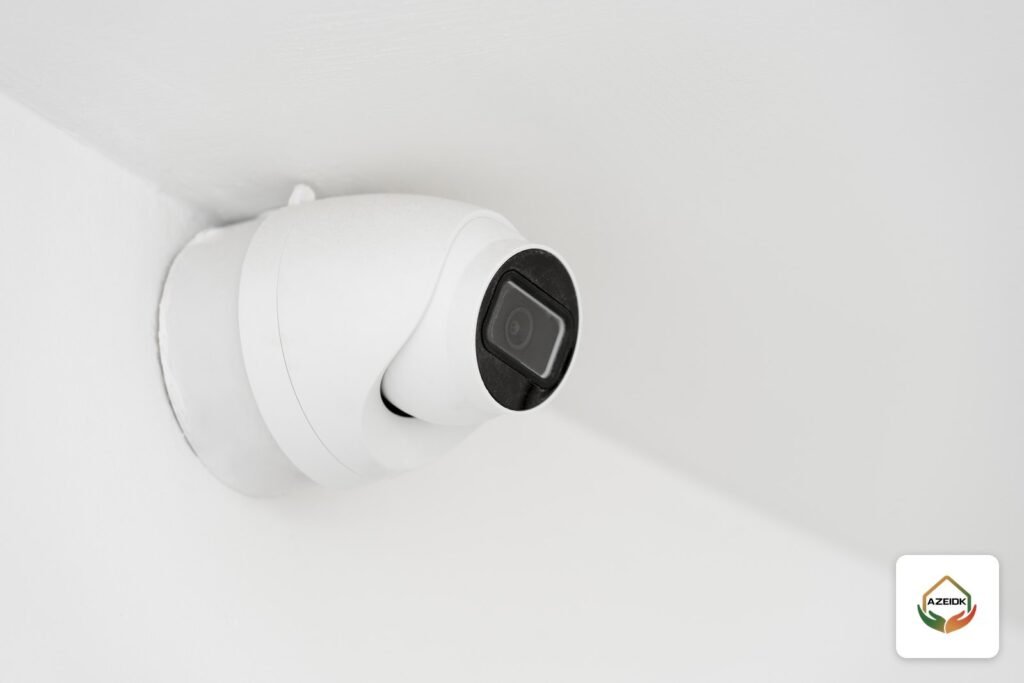
The Law on the Use of Security Surveillance Cameras was issued by Royal Decree No. (M/34) dated 7/3/1444 AH. When it was approved, Okaz reported that it obliges public and private health facilities to install cameras and bans cameras inside medical examination, inpatient, physiotherapy and changing rooms and toilets. Article 2 of the Implementing Regulation lists the places cameras must cover, such as entrances, stores and emergency exits.
The sources we reviewed do not name pharmacies, so confirm whether your pharmacy is covered using the official text and the Security Requirements Document before approving a design. Even where it is not mandatory, CCTV in a pharmacy that opens long hours usually covers:
- The entrance, with enough detail to identify faces.
- The till and prescription counter.
- The store room and receiving door.
- The emergency exit and rear corridor.
Never point a camera into a consultation room or private space, and do not enable audio recording without approval from the competent authority, as the regulation requires. We supply Hikvision and Dahua cameras with design and installation under security and surveillance systems; the legal obligations are explained in the Saudi security cameras law and its obligations, and storage sizing in the CCTV storage calculator.
Preparing a pharmacy for Civil Defense approval
- Check your activity classification and requirements on Salamah through the investor journey service.
- Mount extinguishers in prominent locations, fit emergency lighting and exit signs, and confirm the alarm works where there is one.
- Organise alcohol and flammable stock, and clear corridors and exits.
- Prepare the documents the platform asks for, such as the safety equipment invoice or the technical report.
- After opening, keep a periodic maintenance contract for extinguishers and systems, since the document requires periodic maintenance.
The technical report required on Salamah comes from an approved engineering office. AZEIDK installs the safety systems, issues the safety equipment installation certificate and coordinates with the engineering office as part of Civil Defense approval support, and maintains extinguishers and fire systems through preventive and periodic maintenance contracts. Also see the Salamah certificate guide and the Salamah inspection checklist before you apply.
Frequently asked questions
Does a pharmacy need Civil Defense approval?
Yes. The Requirements for Private Healthcare Activities, which include pharmacy activities, require approval from the General Directorate of Civil Defense.
How far apart should extinguishers be in a pharmacy?
The municipal document states that the distance between one extinguisher and the next must not exceed 23 m, with units in prominent locations. The final number follows the code and Civil Defense requirements for your floor area.
Which extinguisher is best for a pharmacy?
Typically multi-purpose dry powder (ABC) for the sales floor and store, and CO2 near the distribution board and medicine fridges because it leaves no residue.
How should alcohol and sanitisers be stored?
On organised shelving or in a dedicated cabinet away from heat and electrical equipment, never in corridors or exits. Under the municipal document, flammable liquids above 38 litres go in dedicated cabinets.
Is CCTV mandatory in pharmacies?
The law covers public and private health facilities, and the sources we reviewed do not name pharmacies explicitly. Check the official text and the Security Requirements Document to confirm whether your pharmacy is covered.
What is the minimum area for a pharmacy licence?
Under the Requirements for Private Healthcare Activities: 50 m² for a standalone pharmacy and 25 m² for a pharmacy inside a complex.
Can AZEIDK help with a Salamah certificate for a pharmacy?
Yes. We supply and install extinguishers, emergency lighting and CCTV, issue the safety equipment installation certificate, maintain fire systems, and coordinate with the approved engineering office that issues the technical report. Fees and timelines depend on the activity and the platform.
Conclusion
Pharmacy Civil Defense requirements come down to premises that can be evacuated quickly and where a fire is tackled early: visible, well spaced extinguishers, working alarm and emergency lighting, alcohol and sanitisers away from heat, and clear corridors. Add CCTV planned around the law and the pharmacy is ready for inspection and for daily operation.
Fitting out a new pharmacy or renewing its licence? Send us the floor area, city and whether the pharmacy is standalone or inside a complex, and we will specify and install extinguishers, emergency lighting and CCTV, issue the safety equipment installation certificate, and coordinate with an approved engineering office if the licence needs a technical report. Talk to the AZEIDK team
Related guides
- Safety and Fire Fighting Company in Buraydah and Qassim: Fire Alarm, Firefighting, Extinguishers and Civil Defense Licensing
- Lithium Battery Storage in Warehouses and E-Scooter Shops: Thermal Runaway Risk and Protection
- Connect CCTV to TV: HDMI from the Recorder, Wireless Options and Without a DVR
- Smoke Control and Stair Pressurization: Protecting Egress Routes