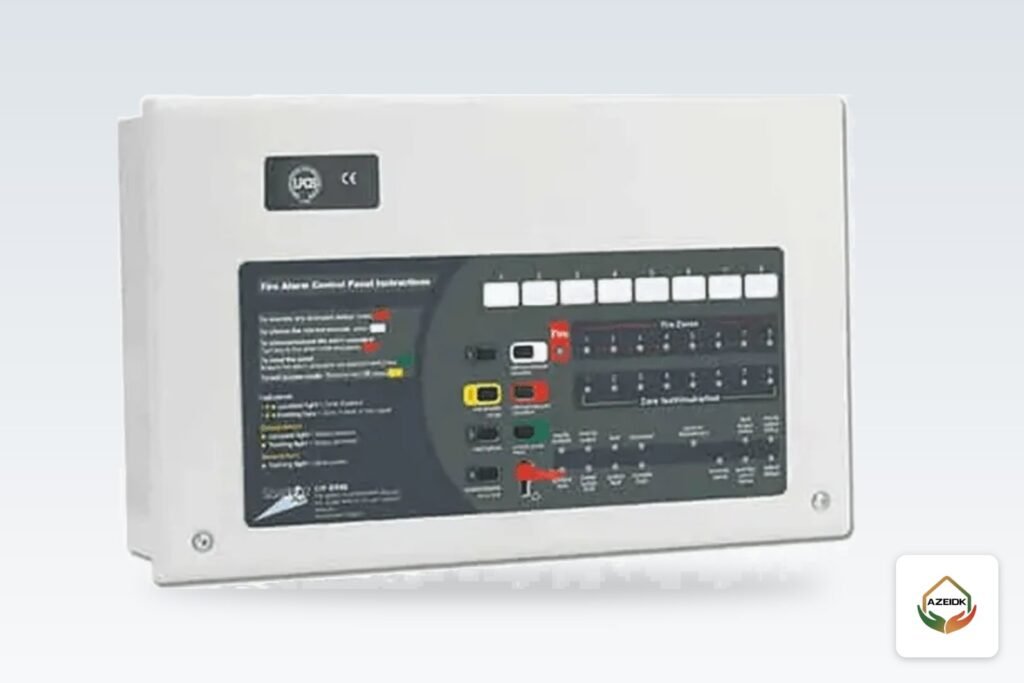
Extending an existing fire alarm system means adding detectors, sounders, modules or whole floors to a working system rather than installing a separate one. It succeeds when three questions are answered before any device is bought: does the loop or zone have room for the new load, are the batteries and power supply sufficient, and are the new devices compatible with the existing panel? Programming, reacceptance testing and updated drawings follow.
For how conventional and addressable systems compare, see our guide to choosing a fire alarm system for Saudi projects.
This article sets out the steps as they apply to commercial, residential and industrial buildings in the Kingdom, and when an extension should become a replacement. AZEIDK starts this kind of work with its assessment of existing systems and scope definition service, followed by installation and programming and systems integration.
Key takeaways
- An extension starts with a survey of the existing system: panel model, firmware version, addresses used on each loop and battery condition.
- Loop capacity, address count and voltage drop limits are set by the panel manufacturer, not estimated.
- NFPA 72 calls for secondary power of 24 hours standby followed by 5 minutes of general alarm, or 15 minutes for voice evacuation systems; recalculate after adding load.
- After the change, 100% of affected devices and functions are tested, plus a sample of unaffected devices when site software changes, and the record of completion is updated.
- If the panel is full or discontinued, an upgrade may cost less than an extension.
In this article
- When is extending an existing fire alarm system the right move?
- Step one: survey the existing system
- Does the loop have room for new devices?
- Batteries and power after the extension
- Compatibility: will the existing system accept new devices?
- Extend or upgrade? A comparison
- Programming and the cause-and-effect matrix
- Reacceptance testing after the extension
- Documents handed over after the extension
- Common mistakes
- Frequently asked questions
- Conclusion
When is extending an existing fire alarm system the right move?
- A new floor, annex or mezzanine on an existing building.
- An open area split into offices or shops, creating more rooms that need detection.
- A change of use, such as a store becoming a kitchen or a warehouse becoming a workshop, changing the detector type needed.
- Inspection comments asking for coverage of unprotected spaces, such as electrical rooms or ceiling voids.
- New control interfaces, such as doors, fans or lifts tied to the system.
Step one: survey the existing system
- Panel manufacturer, model and firmware version.
- Number of loops or zones and devices actually used on each loop.
- Cable lengths, type and routes.
- Power supply capacity, battery condition and manufacture date.
- The program file and the access level needed to change it.
- As-built drawings and the current cause-and-effect matrix.
Many buildings have no copy of the program file or the edit password, which changes the whole plan. Assessment of existing buildings is covered in fire systems assessment in existing buildings.
Does the loop have room for new devices?
On an addressable system every loop has a maximum address count, a loop current limit and a length or resistance limit. These differ by manufacturer and model, and the only source is the panel datasheet and design manual. Loop-powered sounders, beacons and output modules use up loop capacity faster than detectors.
If a loop is near its limit, the usual options are a new loop card if the panel accepts one, feeding sounders from a separate circuit or booster power supply, or moving devices to a less loaded loop. Short-circuit isolators must sit in the right places so one short does not take out both the new and existing floors. See addressable fire alarm loop design.
On a conventional system the question is the detector limit and area per zone; large additions usually need new zones.
Batteries and power after the extension
Every new device adds standby and alarm current. NFPA 72 calls for 24 hours of standby followed by 5 minutes of general alarm, or 15 minutes for voice evacuation systems, and a margin of about 20% is a common practice to allow for battery ageing. Recalculate after the extension; larger batteries or an extra power supply for sounders may be needed. See fire alarm battery calculation.
Compatibility: will the existing system accept new devices?
Addressable detectors use a manufacturer-specific protocol and normally will not work on another maker’s panel. Choose new devices from the panel manufacturer’s compatibility list and confirm the firmware supports them. If the original model is discontinued, look for the replacement the manufacturer declares compatible. More in fire alarm spare parts and panel compatibility.
Extend or upgrade? A comparison
| Factor | Extension makes sense | Upgrade is closer to right |
|---|---|---|
| Panel capacity | Spare loops, addresses or zones | Panel full, no room for extra cards |
| Device availability | Manufacturer still makes compatible devices | Model discontinued with no compatible replacement |
| Program file | File and password available | Program only reachable by full reprogramming |
| Cable condition | Healthy readings, documented routes | Recurring earth faults, unknown routes |
| System type | Addressable with spare capacity | Conventional system in a building that has grown more complex |
If an upgrade wins, see upgrading an old fire alarm system.
Programming and the cause-and-effect matrix
New devices need addresses and clear location text in the same style as the existing system, and the cause-and-effect matrix must be updated if the new area affects lifts, HVAC or emergency doors. Save the program file before and after the change so the previous version can be restored if needed.
Reacceptance testing after the extension
The binding rules in the Kingdom are the Saudi Fire Protection Code SBC 801 and Civil Defense requirements; many consultants specify NFPA 72 as the technical reference, and the values below are reference values. NFPA 72 handles changes to an existing system through reacceptance testing. Published summaries of the requirement describe it as follows:
- added devices are functionally tested, each with the appropriate physical stimulus;
- when site-specific software changes, 100% of functions known to be affected are tested, plus 10% of initiating devices not directly affected, up to a maximum of 50 devices;
- when executive software (firmware) changes, at least 10% of the system is tested, including at least one device on each input and output circuit;
- the record of completion and drawings are updated to reflect the change.
On Saudi projects, consultant and Civil Defense requirements are added according to the building. The full testing framework is in fire alarm commissioning and testing before handover.
Documents handed over after the extension
An extension is not finished when the new devices work. The owner should receive updated as-built drawings showing the added devices, addresses and cable routes, a copy of the program file after the change, the updated cause-and-effect matrix, new battery calculations and signed reacceptance test sheets. The maintenance team relies on these at the first fault, and they are requested again at safety licence renewal or any later inspection.
Common mistakes
- Buying “compatible” detectors on the market without the manufacturer’s compatibility list.
- Adding sounders to an existing loop without checking current and voltage drop.
- Not updating the cause-and-effect matrix, so lifts are not recalled for an alarm on the new floor.
- Not recalculating batteries after the addition.
- Leaving old drawings unchanged, which misleads the maintenance team later.
Frequently asked questions
Can I add another manufacturer’s detectors to my panel?
On addressable systems usually not, because the protocol is proprietary. Check the panel’s official compatibility list.
How many detectors can be added to a loop?
The panel manufacturer sets this in the datasheet and design manual, based on address count, loop current and length.
Do batteries need recalculating after extending a fire alarm system?
Yes. Every device adds standby and alarm current, and the batteries must still cover the duration required by the adopted reference.
Does an extension require testing the whole system?
All affected devices and functions are tested, plus a sample of unaffected devices when software changes; the consultant may ask for more.
When is an upgrade better than an extension?
When the panel is full or discontinued, the program file is unavailable, or the cabling is in poor condition.
Conclusion
Extending an existing fire alarm system saves time and cost when it starts with an accurate survey of loop capacity, batteries, compatibility and the program file. Then come the additions, programming, reacceptance testing and updated documents. If the survey shows the system has reached its limit, an upgrade may be the better decision.
Related reading: Mall Fire Alarm System, ZFP Fire Alarm Panel from Context Plus and Wedding Hall Fire Alarm System.
Adding a floor or area to an existing building? Send us the panel model, current drawings and the scope of the addition, and we will confirm whether an extension is possible and what it needs. Contact the AZEIDK team
To request a fire alarm system for your facility, see AZEIDK fire alarm systems.
Related guides
- Smoke Detector Sensitivity Testing and Cleaning on Addressable Systems (NFPA 72)
- Linear Heat Detection Cable: Context Plus FirePlus-LHD Temperature Grades and Where It Fits (Cable Trays, Car Parks, Conveyors)
- Emergency Assembly Point in Facilities: Location, Sign and Civil Defense Requirements
- Fire Pump Parts: Mechanical Seals, Bearings, Diesel Batteries and Filters, and Why Genuine Parts Matter