An FM-200 fire suppression system floods a closed room with HFC-227ea, a halocarbon clean agent stored as a liquefied gas, and suits rooms that people enter, such as server, telecom and control rooms, where cylinder space is tight. It protects only when the listed design, room integrity and maintenance are right, and in Saudi Arabia it now falls under the Kigali Amendment’s hydrofluorocarbon (HFC) phase-down, which affects refills.
Key takeaways
- FM-200 is a trade name for HFC-227ea, a halocarbon covered by NFPA 2001, the National Fire Protection Association (NFPA) clean agent standard; it extinguishes mainly by absorbing heat.
- Design concentration comes from the listed system’s design manual; Fike’s datasheet gives 6.25 to 10.5% for normally occupied spaces, with 5 minutes maximum exposure.
- The agent is much denser than air, so low-level leaks drain it; sealing, correctly placed vents and a door fan test decide whether it holds.
- Saudi Arabia accepted the Kigali Amendment on 10 September 2025; as an Article 5 group 2 party, its HFC limit starts at baseline in 2028 and falls to 15% from 2047.
In this article
- What FM-200 is and how a system works
- Where FM-200 fits, and when another option is better
- Design concentration and agent quantity
- Room integrity, venting and occupant safety
- Kigali and the HFC phase-down in Saudi Arabia
- Inspection, maintenance and refills
- Specifying an FM-200 system: steps and common mistakes
- How AZEIDK helps
- FAQ
What FM-200 is and how a system works
The US Environmental Protection Agency (EPA) lists FM-200 and FE-227 among the trade names of HFC-227ea, rates it acceptable for total flooding with a global warming potential (GWP) of 3,220, and says its use should follow the safety guidelines of the latest NFPA 2001 edition. Fike gives a boiling point of -16.4°C, so the agent is stored as a pressurized liquid, superpressurized with nitrogen. American Fire Control (AFC), for example, states that its AFC-227 cylinders are pressurized with nitrogen at approximately 25 bar.
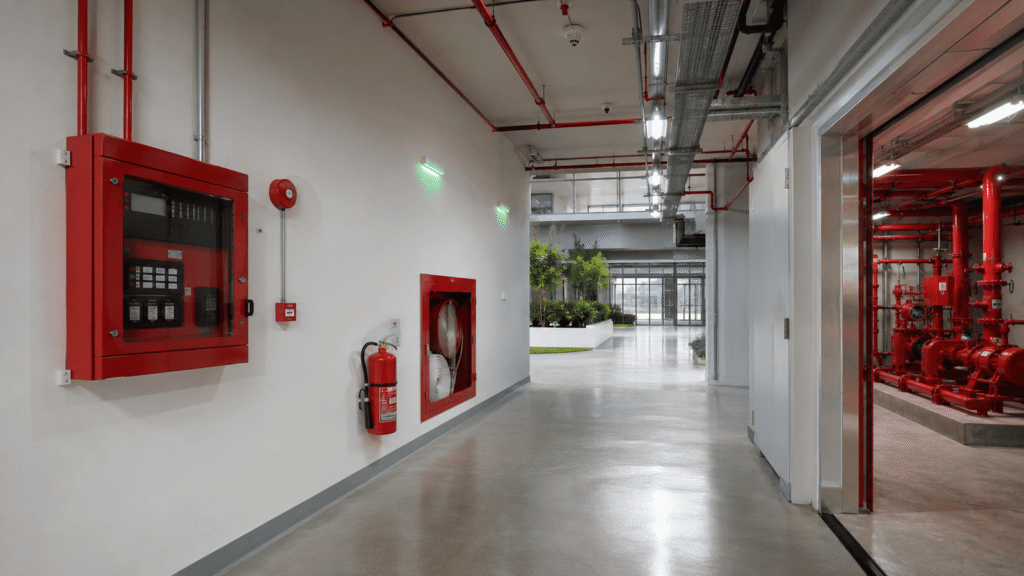
It extinguishes mainly by removing heat, is nonconducting and leaves no residue. A typical system has cylinders with valves and actuators, a manifold where several cylinders serve one hazard, piping and nozzles, detectors, and a releasing panel that runs the pre-discharge alarm, time delay, abort and manual release, plus interlocks for air handling and dampers.
Where FM-200 fits, and when another option is better
FM-200 is one of several options in our clean agent comparison guide. It is commonly considered for these rooms; the risk assessment, consultant and Civil Defense decide.
| Room or hazard | Why FM-200 is considered | What to check |
|---|---|---|
| Server rooms and small data rooms that staff enter | Few cylinders; usable in occupied spaces within exposure limits | Floor and ceiling voids, cooling shutdown and refill supply (see our data center guide) |
| Telecom, control and uninterruptible power supply (UPS) rooms | Nonconducting, few cylinders | Battery and electrical hazards (see our electrical room guide) |
| Normally occupied rooms needing more than 10.5% | Fike does not recommend HFC-227ea there | Another agent, agreed with the consultant |
| Owners with a zero-GWP or HFC-free policy | Conflicts with the policy | FK-5-1-12 (see our Novec 1230 guide), inert gases or other options |
Design concentration and agent quantity
NFPA 2001 builds the design concentration from the extinguishing concentration for the fuel, found in recognized tests, plus a safety factor for the fire class. For HFC-227ea, the listed design manual of the system you buy gives the values; Fike’s datasheet, for example, gives 6.25 to 10.5% for normally occupied spaces with 5 minutes maximum exposure, and 11.0 to 12.0% for normally unoccupied spaces with 30 seconds maximum exposure.
Consulting-Specifying Engineer (CSE) magazine (2018) notes that HFC-227ea is permitted up to 10.5% in normally occupied spaces, a limit based on physiologically based pharmacokinetic (PBPK) model data.
Quantity then follows from the net protected volume, including protected voids, and the listed calculation method; the listed flow calculation sets pipe sizes, nozzles and discharge time, and CSE’s vent-sizing example assumes a 10-second maximum for halocarbons. Never copy a quantity from another project or choose a system by cylinder count alone.
Room integrity, venting and occupant safety
HFC-227ea vapor is much denser than air; Fike gives 7.148 kg/m³ at 25°C. After discharge, Retrotec’s guidance on NFPA 2001 describes an interface with agent below and air above that descends over time, with leakage depending mainly on the leakage area in the lower part of the room. Gaps under doors and raised floor penetrations matter.
Halocarbon discharges may create positive or negative pressure, or both, depending on the agent and humidity, so peak pressure is calculated for each room and vented where it could threaten the enclosure; Retrotec advises placing vents high so that the lighter air, not the denser agent, is vented. A door fan test then predicts the hold time, for which the 2008 edition of NFPA 2001 introduced a minimum of 10 minutes, or long enough for trained personnel to respond.
Occupants should leave on the pre-discharge alarm and re-enter only after ventilation. CSE warns that decomposition products in a fire are toxic, primarily hydrogen fluoride (HF), and the EPA notes that, per US Occupational Safety and Health Administration (OSHA) requirements, self-contained breathing apparatus (SCBA) must be available if personnel must re-enter. NFPA 2001 (2025 edition), as amended by tentative interim amendment (TIA) 25-1, also requires an egress time study.
Kigali and the HFC phase-down in Saudi Arabia
HFC-227ea is listed in Annex F of the Kigali Amendment to the Montreal Protocol. Saudi Arabia deposited its acceptance of the amendment on 10 September 2025, according to the UN Environment Programme (UNEP). Decision XXVIII/2 lists Saudi Arabia, with Bahrain, Kuwait, Oman, Qatar, the United Arab Emirates and four other countries, among the Article 5 group 2 parties, which follow the later of the two Article 5 schedules:
| Period | HFC production and consumption limit (percent of baseline) |
|---|---|
| 2028 to 2031 | 100% |
| 2032 to 2036 | 90% |
| 2037 to 2041 | 80% |
| 2042 to 2046 | 70% |
| 2047 onward | 15% |
The schedule caps the country’s total HFC production and consumption; it does not name individual applications. Nationally, the Executive Regulation for Ozone-Depleting Substances and Hydrofluorocarbons requires a prior permit from the National Center for Environmental Compliance (NCEC) to import, use or store these substances or to import new equipment containing them; it bans imports of such used equipment and requires servicing staff to be licensed.
For owners, the amendment does not itself require existing systems to be removed, but refills will depend on HFC availability under the national phase-down, so avoid losing agent to leaks or needless discharges and secure a long-term refill source. Check current national requirements with the consultant, Civil Defense and the NCEC.
Inspection, maintenance and refills
Maintenance follows the adopted NFPA 2001 edition and the manufacturer’s manual; 2018-edition intervals are in the FAQ below and in our NFPA 2001 guide. The EPA adds that discharge testing should be strictly limited to what is essential to meet safety or performance requirements, and that agent should be recovered during testing or servicing and recycled or destroyed. Good practice is a door fan test and a release-sequence test without discharge, unless the specification or the authority having jurisdiction (AHJ) requires a discharge test.
For refills, confirm that the agent is accepted under your system’s listing, and as good practice use a filler the manufacturer authorizes. The Saudi Standards, Metrology and Quality Organization (SASO) Technical Regulation for Fire Control Materials and Equipment covers firefighting substances, but its annex lists ISO 14520 parts for several agents and not Part 9 for HFC-227ea, so confirm the conformity route with SASO or an accepted conformity assessment body.
Specifying an FM-200 system: steps and common mistakes
- Confirm the hazard, whether the room is normally occupied, and the adopted codes: the Saudi Fire Protection Code (SBC 801), mandatory in its 2024 edition since 30 June 2025, and Civil Defense requirements.
- Survey the room and check the owner’s and insurer’s HFC policy and refill route.
- Specify agent, cylinders, valves, nozzles, releasing panel and calculation software as one listed system.
- Ask each bidder for the design concentration with its manual reference, the flow calculation, cylinder count, vent calculation and door fan test plan.
- Agree the cause and effect matrix; at acceptance, run the door fan test and a full release-sequence test and record cylinder weights.
Common mistakes
- Leaving out sealing and vents, then failing the door fan test.
- Adding cables or ducts after handover without re-checking integrity.
- Refilling with an agent not accepted under the system’s listing.
- Treating a full discharge as the routine acceptance test.
Cost follows the net volume and concentration, the piping arrangement, sealing and vents, the releasing panel and detection, and lifetime refills.
How AZEIDK helps
Through our special fire suppression solutions, AZEIDK studies the hazard on site, supplies, installs, tests and commissions gas suppression systems and links them to the fire alarm system where required; our engineering design and calculations service supports the design submittal. For existing systems, our assessment of existing systems and scope of work definition reviews records and component condition and recommends repair or upgrade options, and our annual maintenance contracts cover the inspection program.
Brands AZEIDK supplies include American Fire Control, whose FM-200 system comes in two versions: AFC-227, with agent cylinders superpressurized directly with nitrogen, and AFC-P227, with a separate nitrogen cylinder for longer or more complex piping. AFC states that AFC-227 is UL listed and FM approved; we recommend verifying each model’s approval in its datasheet. We also supply the Context Plus EP203/CON automatic gas extinguishing control panel, backed by 16+ years in the Saudi market.
FAQ
Is FM-200 safe for people in the room?
It can be used in normally occupied rooms when the design concentration stays within the exposure limits; CSE notes that HFC-227ea is permitted up to 10.5% in such spaces, with exposure limited to 5 minutes. Still, leave on the pre-discharge alarm: decomposition in a fire produces toxic products, mainly hydrogen fluoride, so do not re-enter before ventilation.
Is FM-200 banned in Saudi Arabia?
We did not find a Saudi measure that bans new FM-200 systems. Saudi Arabia accepted the Kigali Amendment in September 2025, and as an Article 5 group 2 party its HFC limit starts at baseline in 2028 and steps down to 15% from 2047. Check current requirements and import clearance with the consultant and the NCEC.
What is the difference between FM-200 and HFC-227ea?
HFC-227ea is the agent; FM-200 is one trade name for it, and the EPA lists others such as FE-227. Because the listing covers the whole system, the practical question is whether a refill agent is accepted under your system’s listing, so ask the manufacturer in writing.
How often should an FM-200 system be serviced?
Under the 2018 edition of NFPA 2001: a visual inspection at least monthly, and agent quantity and pressure checks semiannually, with refill or replacement above 5% quantity loss or 10% pressure loss. Add the manufacturer’s procedures and confirm intervals in your adopted edition.
Can an existing FM-200 system be converted to another agent?
Not by swapping cylinders. Each agent has its own quantity, storage pressure, pipe sizes, nozzles and calculations, so changing the agent usually means redesign and approval. For an aging system, an assessment can compare maintaining it with replacing it by another listed option.
Planning or reviewing an FM-200 system? Send us the room drawings or system records, and we will review the design basis, enclosure details and maintenance history with you. Contact the AZEIDK team