Choosing fire extinguishers for wedding halls starts with two questions: what kind of fire is likely in each part of the venue, and how far a person has to walk to reach the nearest extinguisher. The guest hall differs from the kitchen, and the kitchen differs from the audio and electrical rooms. Each has its own extinguisher type and travel distance, set by NFPA 10 and the approved drawing.
To compare extinguisher types and choose the right one for each hazard, see our fire extinguishers selection guide for facilities in Saudi Arabia.
This article distributes extinguishers across the areas of a hall, explains how the quantity is calculated, where to mount units in a crowded, decorated venue, and what to check before each season. AZEIDK supplies Falcon Gold dry powder, CO2 and foam extinguishers and maintains and refills extinguishers with its own team. For the general venue requirements, see wedding hall and event hall safety requirements.
Key points
- Under NFPA 10, travel distance to a Class A extinguisher must not exceed 22.9 m (75 ft).
- The kitchen’s Class K (wet chemical) extinguisher must be within 9.1 m (30 ft) of the cooking hazard.
- Class B travel distance is 9.1 to 15.25 m depending on hazard and extinguisher rating.
- Quantity comes from floor area and travel distance together, never from a fixed number per hall.
- An extinguisher hidden behind curtains or décor might as well not be there.
In this article
- What sets the number and type of fire extinguishers for wedding halls?
- Distributing extinguishers across the hall
- How is the number of extinguishers calculated?
- A worked layout method
- What to ask the extinguisher supplier
- Mounting locations in a crowded, decorated hall
- Checks before the season and large events
- Common mistakes
- Frequently asked questions
- Summary
What sets the number and type of fire extinguishers for wedding halls?
The binding references are the Saudi Fire Protection Code SBC 801, Civil Defense requirements on the Salamah platform, and the hall’s approved drawing. The technical detail of selecting, distributing and inspecting extinguishers usually comes from NFPA 10 (Standard for Portable Fire Extinguishers), covered in our NFPA 10 guide. The standard groups fires into classes: A for ordinary combustibles such as fabric, wood and paper; B for flammable liquids and gases; C for energized electrical equipment; and K for cooking oils and fats.
Distributing extinguishers across the hall
| Area | Main hazard | Typical extinguisher |
|---|---|---|
| Men’s hall, women’s hall, entrances | A: fabrics, chairs, décor, artificial flowers | ABC powder or AFFF foam, per design |
| Stage (kosha) and DJ area | A with electrical equipment | ABC powder plus CO2 for electrical equipment |
| Kitchen and hot buffet | K: cooking oils and fats | Class K wet chemical with a fire blanket |
| Gas cylinder or tank area | B/C: flammable gas | Dry powder |
| Electrical and audio rooms | C: energized panels and equipment | CO2 |
| Parking and outdoor areas | A and B | ABC powder; a wheeled unit may suit large areas |
Halls and sections
The likely fire in a guest hall is Class A: curtain fabric, chair covers, décor and artificial flowers. ABC powder is common because it covers A, B and C, but it leaves a powder cloud that reduces visibility in a crowded room. Some designers therefore choose AFFF foam extinguishers for the halls; the difference is explained in our article on the AFFF foam extinguisher.
Kitchen: Class K in practice
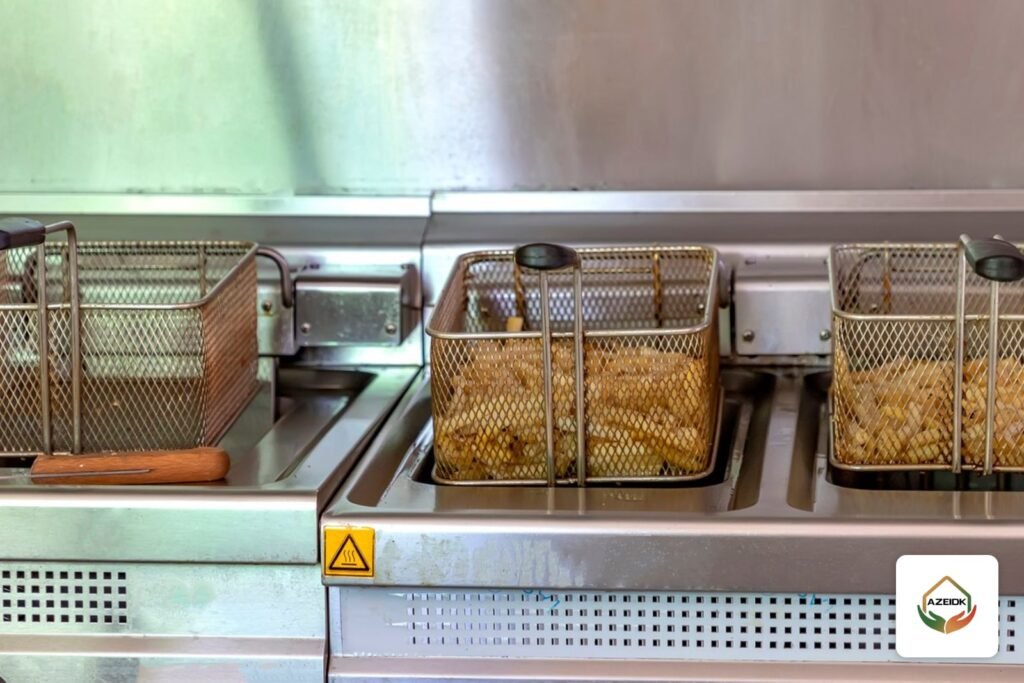
Burning frying oil cannot be put out with water, and powder may not prevent re-ignition. A Class K wet chemical extinguisher is therefore placed next to the cooking line, and NFPA 10 limits its distance to 9.1 m from the hazard. Where the kitchen has an automatic hood suppression system, the Class K unit remains the manual backup. Details in Class K kitchen fire extinguishers.
Electrical and audio rooms
CO2 is used in electrical and audio control rooms because it leaves no residue and does not conduct electricity. It is not a substitute for a Class A extinguisher in the crowded hall, since it is not intended for ordinary combustibles.
How is the number of extinguishers calculated?
Two conditions must both be met:
- Area: divide the floor area by the maximum area one extinguisher may protect for its rating and the hazard level, using NFPA 10 Table 6.2.1.1.
- Travel distance: the actual walking distance to the nearest Class A extinguisher must not exceed 22.9 m, measured along the walking route around tables, walls and partitions, not as a straight line on the drawing.
In a divided hall, treat each section as its own area, because a guest in the women’s hall will not cross into the men’s hall to fetch an extinguisher. Take the larger result of the two conditions, then add units for special hazards such as the kitchen, gas and electrical rooms.
A worked layout method
Take a venue with a men’s hall, a women’s hall, a kitchen and an outdoor gas area:
- Place an extinguisher next to every main exit door in each section.
- Trace the walking route from the furthest table to the nearest unit. If it exceeds 22.9 m, add a unit mid-section on a column or side wall.
- Check the area condition for the chosen rating and keep the higher count.
- In the kitchen, place a Class K unit beside the cooking line within 9.1 m of every fryer, plus a fire blanket.
- Add a powder unit near the gas area and CO2 at each electrical or audio room.
- Recheck after the real table layout is set, as some events change the routes.
What to ask the extinguisher supplier
Ask for the datasheet of each type with its rating (for example 2-A:10-B:C under UL or 13A/89B under EN 3), because the rating drives the area and quantity calculation; see UL listed fire extinguisher ratings. Extinguishers fall under the SASO technical regulation for fire control materials and equipment, so ask for proof of shipment conformity. For large areas such as parking or central kitchens, a wheeled fire extinguisher can be added next to portable units, not instead of them.
Mounting locations in a crowded, decorated hall
- Next to exit doors and on escape routes, because people head for the door first.
- Away from curtains and stage backdrops that change with every event, so they are never covered.
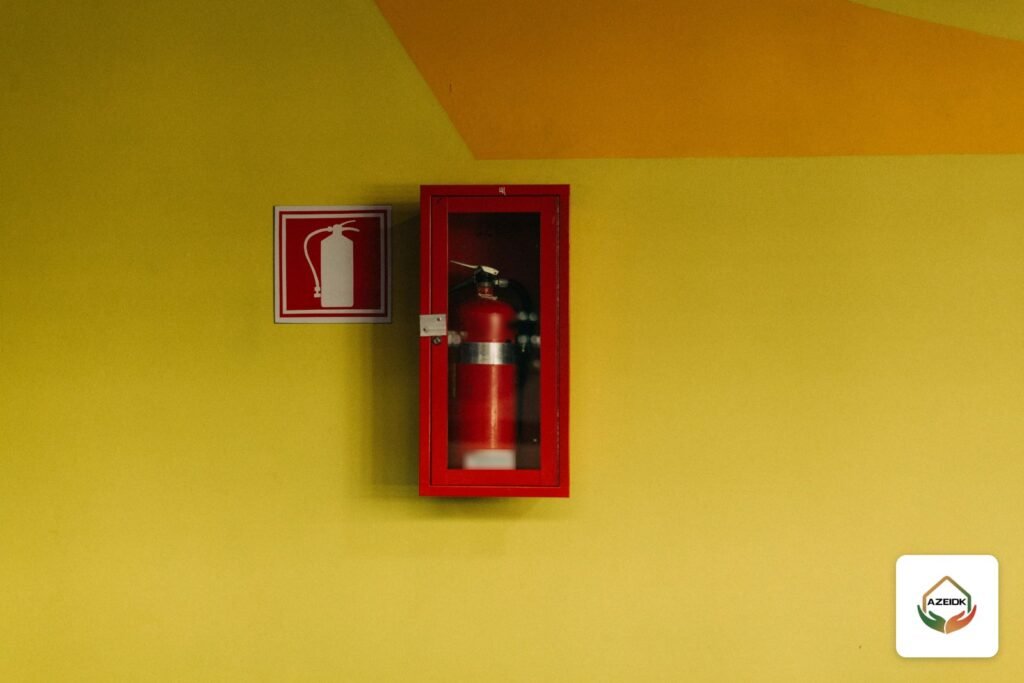
- In a recessed fire extinguisher cabinet where needed, which keeps the décor intact and discourages children from tampering.
- With a visible fire extinguisher sign above, since guests do not know the venue.
- On a fixed wall bracket, not on the floor between tables.
Checks before the season and large events
Wedding halls run at full capacity during holidays and peak seasons, the worst time to find an empty extinguisher. Check every unit before the season: gauge in the green, pin and tamper seal in place, hose intact, label readable, last service date clear. Monthly inspection, annual maintenance and refilling are covered in fire extinguisher maintenance and refilling, which AZEIDK carries out under preventive and periodic maintenance.
Record every check and refill in the fire safety log book with the unit number and location. Inspectors usually ask for these records, and they reveal units that were used or moved after events without the management knowing.
Common mistakes
- One powder extinguisher in the kitchen instead of a Class K unit.
- Extinguishers kept in the store “so they don’t spoil the décor”.
- A correct count on paper, but longer real walking distances once tables are set.
- Forgetting the women’s hall or its preparation rooms.
- A CO2 unit in the hall used as a general-purpose extinguisher.
Frequently asked questions
How many extinguishers does a 1,000 m² wedding hall need?
There is no fixed number. It is calculated from area, extinguisher rating and hazard level, then checked against the 22.9 m travel distance, plus kitchen and electrical room units.
Which extinguisher is best for an event hall?
ABC powder or AFFF foam for the halls, per design; Class K for the kitchen; CO2 for electrical rooms.
Is a powder extinguisher enough for the kitchen?
Not on its own for cooking oils. The standard calls for a Class K unit within 9.1 m of the hazard.
Can extinguishers go inside cabinets?
Yes, especially in decorated halls, provided the cabinet is visible, signed and easy to open.
When does an extinguisher need refilling?
After any use, even partial, when pressure drops, and per the maintenance schedule set by the standard and the manufacturer.
Summary
The right extinguisher for a wedding hall matches the fire class where it stands, is a short walk away, stays visible despite the décor and is checked before the season. Lay units out section by section and treat the kitchen and electrical rooms as special hazards. For more on the sector, see Entertainment and Event Halls.
Related reading: Warehouse Fire Extinguishers, Hospital Fire Extinguishers and Fire Extinguishers in Jazan.
Need an extinguisher layout for your hall? Send the drawing with each section’s area and the kitchen, and we will prepare a schedule of types and quantities, with Falcon Gold powder, CO2 and foam units, installation and maintenance. Contact the AZEIDK team
To buy an extinguisher or book its maintenance, see AZEIDK fire extinguishers.
Related guides
- Outdoor CCTV Cameras Guide: IP67 Weatherproofing, Heat, Night Vision and Vandal Resistance in Saudi Conditions
- Warehouse Mezzanine Fire Protection: Sprinklers Below the Deck, Detectors and Exits
- Car Showroom Security and Fire Protection in Saudi Arabia
- General Contracting and MEP Works in Fire Projects: Scope and Coordination