The right kitchen fire extinguisher for a commercial kitchen is a wet chemical unit rated for cooking oil and fat fires (Class K in the US system, Class F in the European one). It cools the burning oil and forms a soapy layer that seals it from the air, so the fire is far less likely to flash back than after a dry powder or CO2 discharge.
This guide explains why general-purpose extinguishers fall short on a fryer fire, where to place the kitchen extinguisher in a restaurant, how it relates to the hood suppression system and what to check on the datasheet, using the FG 6 kg wet chemical extinguisher supplied by AZEIDK as an example.
Key takeaways
- Wet chemical extinguishers are made for cooking oil fires and work by cooling and saponification of the oil surface.
- NFPA 10 limits travel distance from the hazard to a Class K extinguisher to 30 ft (9.1 m).
- Where a hood suppression system is installed, the system is the primary protection and the extinguisher is the backup, used after the system is activated.
- A placard next to the extinguisher reminds staff to activate the fixed system first.
- Inspect the extinguisher visually every month and have it maintained yearly by a qualified technician.
In this article
- What is a wet chemical fire extinguisher?
- Why is dry powder not enough for an oil fire?
- Comparison: which kitchen fire extinguisher suits an oil fire?
- Where should the kitchen fire extinguisher go in a restaurant?
- How does the extinguisher relate to the hood suppression system?
- What to read on the datasheet before buying
- Inspecting and maintaining a kitchen extinguisher
- Common mistakes with kitchen extinguishers
- FAQ
- Conclusion
What is a wet chemical fire extinguisher?
A wet chemical extinguisher is a portable unit holding an aqueous solution of alkaline salts, discharged as a fine spray. When the solution meets hot oil it reacts in a process called saponification: the oil surface turns into a soap-like foam layer that cuts off oxygen, while the water in the solution cools the oil.
Extinguisher manufacturer Amerex explains that Class K was introduced in the early 1990s after restaurant fire losses rose in the 1980s. Causes included energy-efficient fryers that hold heat for long periods and the shift from animal fats to vegetable oils, whose higher autoignition temperature makes fires harder to extinguish and secure.
Why is dry powder not enough for an oil fire?
A fryer fire is not just a visible flame. It is a large mass of oil above its autoignition temperature. Knock the flame down without cooling the oil and it can reignite within seconds or minutes. According to Amerex, the UL 300 restaurant system test was revised in November 1994 to use a real commercial fryer, with no reflash allowed for 20 minutes and no hot oil splashed onto people. None of the existing dry chemical systems passed. The same lessons went into UL 711 for extinguisher ratings, the dry chemical extinguishers then in use could not pass the full test, and the Class K rating and wet chemical extinguisher followed.
What happens with each agent on burning oil?
- Water: sinks below the hot oil, flashes to steam and throws burning oil out of the vessel, spreading the fire and burning staff.
- Dry powder: knocks the flame down quickly but does not cool the oil enough, so reignition remains possible. It is not a substitute for a kitchen extinguisher on burning oil.
- CO2: displaces oxygen briefly without cooling the oil, and its discharge force can scatter the oil.
- Foam: suits flammable liquid fires; cooking oils have their own dedicated extinguisher. See our AFFF foam extinguisher guide for comparison.
Comparison: which kitchen fire extinguisher suits an oil fire?
| Extinguisher type | On a burning fryer | Kitchen note |
|---|---|---|
| Wet chemical (K/F) | Designed for it: cooling plus soapy layer | The unit required next to oil cooking appliances |
| ABC dry powder | Knocks flame down; reignition possible | Useful elsewhere in the building, not a replacement |
| CO2 | Poor cooling, may scatter oil | Suits electrical panels |
| AFFF foam | Not the dedicated agent for cooking oils | For flammable liquids and solids |
| Water | Dangerous: burning oil eruption | Never on burning oil or fat |
Where should the kitchen fire extinguisher go in a restaurant?
The binding reference in Saudi Arabia is the Saudi Fire Protection Code, SBC 801 (the 2024 edition of the Saudi Building Code has been mandatory since 30 June 2025), together with the requirements of the General Directorate of Civil Defense. NFPA 10 is the technical reference for selecting and placing portable extinguishers, and it includes these points for cooking hazards:
- Travel distance: no more than 30 ft (9.1 m) from the hazard to the Class K extinguisher, measured along the actual walking path.
- Mounting height: for units up to 40 lb, the top no higher than 5 ft (about 1.5 m), with at least 4 in (102 mm) clearance below.
- Placard: where the hazard has an automatic system, a placard near the extinguisher states that the system must be activated before the extinguisher is used.
How many extinguishers per fryer?
Some codes tie the number to fryers. Section 906.4.2 of the Fire Code of New York State, based on the International Fire Code, requires one Class K extinguisher of at least 6 L for up to four fryers holding no more than 80 lb (36.3 kg) of cooking medium each, plus one more for every additional group of four. Fryers over 6 sq ft (0.55 m²) of surface follow the extinguisher manufacturer’s recommendations. We cite it to show the method only; the number your project needs is set by the adopted SBC 801 text and Civil Defense review.
Practical placement tips
- Place it on the escape route from the cooking line, so the user moves away from the fire to reach it.
- Do not mount it right beside the fryer or under the hood, where it may be unreachable in a fire.
- Keep it visible and clear of shelving and service trolleys.
- Train kitchen staff on the hood system’s manual pull station and the extinguisher location together.
How does the extinguisher relate to the hood suppression system?
As Amerex notes, NFPA 96 treats the automatic extinguishing system as the primary protection for grease-producing cooking appliances, with portable extinguishers as secondary backup. The extinguisher does not replace a kitchen fire suppression system covering the hood, ducts and appliances, and the system does not replace the extinguisher.
The right sequence for a fire under the hood:
- Activate the hood system at the manual pull station if it has not discharged automatically.
- Confirm gas or power to the cooking appliances is shut off.
- Use the wet chemical extinguisher to finish the job or deal with residual flames, from a safe distance, applying a gentle spray over the oil surface to avoid splashing.
- Call Civil Defense, and do not restart appliances until the system has been inspected and recharged.
AZEIDK supplies commercial kitchen systems from Ansul R-102, Hood Safer, American Fire Control and Falcon Gold. For what is checked on these systems, see kitchen fire suppression inspection and maintenance; for the full restaurant picture, see restaurant and café fire safety in Saudi Arabia.
What to read on the datasheet before buying
A “kitchen” sticker is not enough. Check the datasheet and the label for:
- Agent type: wet chemical.
- Fire rating, with a Class K or F rating shown on the label or product certificate.
- Capacity, working pressure and test pressure.
- Operating temperature range, which matters in hot kitchens.
- The certificate of conformity required for extinguishing equipment in Saudi Arabia through the SABER platform, under the SASO Technical Regulation for Fire Control Materials and Equipment.
FG 6 kg wet chemical extinguisher: specifications
Values below are from the FG datasheet published on the AZEIDK product page:
| Item | Value |
|---|---|
| Capacity | 6 kg |
| Fire rating | 13A 75B |
| Working pressure | 14 bar |
| Test pressure | 25 bar |
| Cylinder material | St12 steel |
| Valve material | Chrome-plated |
| Temperature range | -30 to +55 °C |
The product page describes the unit for oil and grease fires in commercial kitchens (Class K/F), and the 13A 75B rating shows it is also rated for solid and liquid fires. The published specifications do not include a Class K or F rating figure, so ask for the label or product certificate showing it when you submit to the consultant. Note too that some codes express capacity in litres while the datasheet uses kilograms; confirm the equivalence with the manufacturer before approval.
Inspecting and maintaining a kitchen extinguisher
Under NFPA 10, extinguishers are inspected manually when placed in service and then at intervals not exceeding 31 days. Restaurant staff can carry out the monthly check:
- Extinguisher in place, visible and unobstructed.
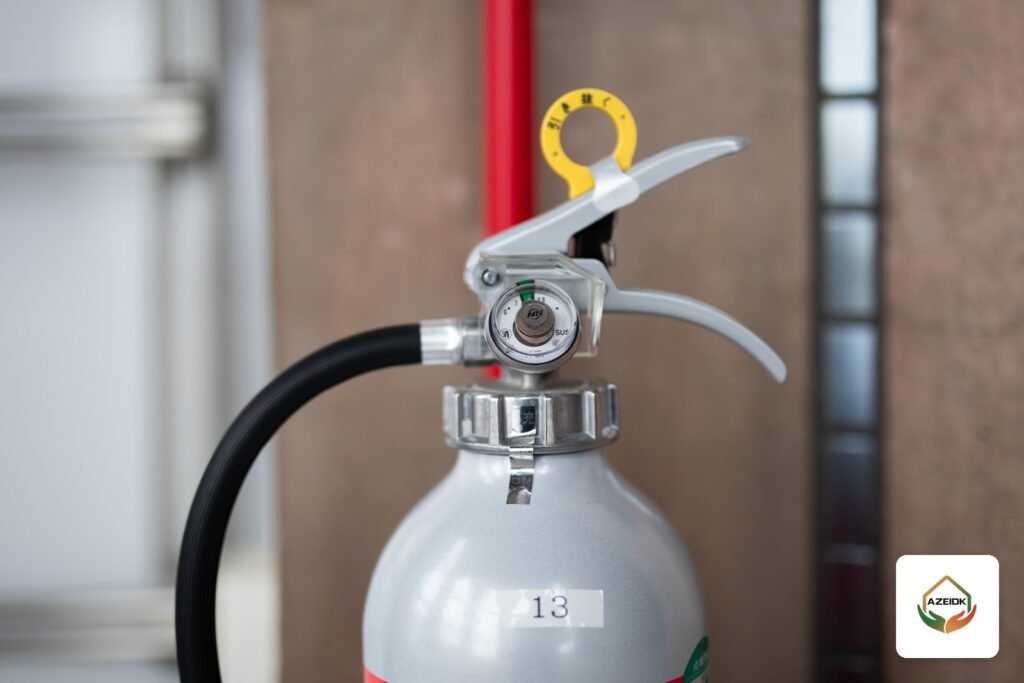
- Pressure gauge in the green.
- Safety pin and tamper seal intact.
- No corrosion, dents or grease build-up on the cylinder and hose.
- Operating instructions and placard legible.
Annual maintenance is carried out by a qualified technician and covers an external examination for damage, a check of internal examination and hydrostatic test due dates, and an updated maintenance tag showing month, year and who did the work. AZEIDK provides fire extinguisher maintenance with its own team under its preventive and periodic maintenance contracts. For intervals by extinguisher type, see fire extinguisher maintenance and recharging; for general placement rules, see our NFPA 10 guide.
After any use, even partial, send the extinguisher for recharge straight away. Never hang a partly discharged unit back on its bracket.
Common mistakes with kitchen extinguishers
- Relying on dry powder or CO2 next to the fryers.
- Mounting the unit right beside the fryer, where it is hard to reach in a fire.
- Using the extinguisher before, or instead of, activating the hood system.
- No placard explaining the sequence.
- Buying a unit marked “kitchen” without checking for a K or F rating on the label.
- Returning a partly used unit to service without recharge.
FAQ
What is the best fire extinguisher for a commercial kitchen?
For kitchens cooking with oils and fats, a wet chemical extinguisher rated Class K (or F), backed up by powder or CO2 units for other hazards such as electrical panels.
Can a dry powder extinguisher put out a kitchen oil fire?
It may knock the flame down but does not cool the oil enough, so reignition remains possible. It is not a substitute for a wet chemical unit.
How far can a Class K extinguisher be from cooking appliances?
Under NFPA 10, no more than 30 ft (9.1 m) of travel from the hazard, measured along the walking path, subject to SBC 801 and Civil Defense requirements.
Does a kitchen extinguisher replace the hood suppression system?
No. Under NFPA 96, as cited by Amerex, the fixed system is the primary protection and the extinguisher is the backup used after it.
How often is a kitchen fire extinguisher inspected?
A monthly visual inspection (intervals of no more than 31 days), yearly maintenance by a qualified technician, and recharge immediately after any use.
Conclusion
A kitchen fire extinguisher is not a general unit in a different colour. It is a wet chemical extinguisher built for oil fires that flash back after powder or CO2. Place it on the escape route within 30 ft of the cooking appliances, with a placard reminding staff to activate the hood system first, inspect it monthly and service it yearly. Check the datasheet and label before buying to confirm the rating and capacity.
Fitting out a restaurant or central kitchen? Send us the kitchen layout and the number of fryers and appliances, and we will propose the number and locations of kitchen extinguishers with datasheets, and review the hood system and maintenance contract with you. Talk to the AZEIDK team
Related guides
- Water Mist Fire Suppression in Saudi Arabia: Applications and Technical Considerations
- CCTV Recorder (NVR or DVR): How to Choose Channels, Resolution, Hard Drive and PoE Ports with Hikvision Models
- NFPA 14 Standpipe and Hose Systems: Classes, Types and Testing
- Access Controller Wiring: Reader, Maglock, Exit Button, Door Contact and Fire Alarm Lock Release