Car showroom security in Saudi Arabia covers two jobs at once: fire protection that follows the Saudi Fire Code SBC 801 and earns Civil Defense approval before licensing, and security for high-value vehicles and their keys in a glass-fronted hall that sits empty after closing. The Ministry of Municipalities and Housing requirements for vehicle showrooms explicitly call for Civil Defense approval, compliance with SBC 801, security cameras under the Security Surveillance Cameras Law, and a first-aid kit. This article turns those requirements into fire alarm, extinguishers, CCTV and intrusion alarm for each part of a showroom or dealership.
Key takeaways
- The vehicle showroom requirements (Ministry of Municipalities and Housing, 1446 AH / 2024) require Civil Defense approval before the licence is issued and refer fire protection to SBC 801.
- The same document requires security cameras under the Security Surveillance Cameras Law, a first-aid kit, and bans gas lighting inside and outside the showroom.
- An attached store is allowed for low-hazard materials only, capped at 25% of the licensed area or 150 m², whichever is smaller.
- A dealership service workshop is a different use from the showroom floor and is designed and licensed on that basis.
- CCTV, intrusion alarm and key room access control are designed together and maintained under a contract separate from fire system maintenance.
In this article
- What do Saudi car showroom requirements ask for?
- Why is a car showroom different from an ordinary shop?
- Fire alarm in the showroom, store and service area
- Extinguishers and suppression in a car showroom
- Car showroom security cameras: where do they go?
- Intrusion alarm and key protection after hours
- Protection summary by area
- Licensing and periodic maintenance
- Frequently asked questions
- Conclusion
What do Saudi car showroom requirements ask for?
The Ministry of Municipalities and Housing issued “Requirements for Vehicle Showrooms” (1446 AH / 2024), the municipal reference for licensing car showrooms. The safety and security items are:
| Clause | Requirement | What it means in practice |
|---|---|---|
| 2.1 Licensing | Civil Defense approval before the licence is issued | Safety systems are installed and inspected before opening, not after |
| 4.9 Fire protection | Refer to all requirements of the Saudi Fire Code SBC 801 | Alarm, extinguishers, sprinklers and exits come from a design to the code |
| 4.6 Ceilings | Ceilings made of fire-resistant materials | Checked with the civil and fit-out contractor |
| 4.4 Exit routes | Stairs, external walkways and ramps kept clear | Display cars are never parked in front of emergency exits |
| 4.7 Lighting | Gas lighting banned inside and outside | Electric lighting only |
| 4.8 Storage | A store for low-hazard materials up to 25% of the licensed area or 150 m², whichever is smaller | Oils and flammable materials fall outside that description |
| 5.1 First aid | A first-aid kit | Available in AZEIDK safety equipment |
| 5.4 CCTV | Security cameras under the Security Surveillance Cameras Law and its regulations | Camera count, positions and retention are planned to the law |
Note that the document does not itself set the number of extinguishers or the type of alarm system. It refers those to SBC 801, so you need a design that applies the code to your showroom.
Why is a car showroom different from an ordinary shop?
In the International Building Code (IBC), whose structure the Saudi Building Code follows, motor vehicle showrooms are listed under the Business occupancy, while motor vehicle repair garages fall under Storage. That difference explains why a dealership service workshop is treated differently from the showroom floor. The classification for your project is set by the designer from SBC 201.
In practice a showroom combines risks an ordinary shop does not:
- Vehicles with fuel in their tanks and batteries, some of them electric or hybrid.
- A large hall with a high ceiling and big glass frontages.
- High-value stock that is easy to move once someone has the keys.
- An outdoor display yard and parking for used cars or vehicles awaiting delivery.
- In dealerships: a service workshop and a store for parts, tyres and oils.
Fire alarm in the showroom, store and service area
Zone the alarm by area so the panel tells you where a fire started:
- Showroom floor: the high ceiling makes detector type and mounting height a designer’s decision. Some projects use point smoke detectors, others beam detectors, depending on height and ceiling shape.
- Offices, sales room and server room: standard smoke detectors, with a separate zone for the electrical room.
- Parts store: its own zone and early detection, because it is closed most of the time.
- Service workshop: engine exhaust can cause false alarms on smoke detectors, so designers usually choose heat detectors in work bays. See heat detector types and installation.
After closing nobody is on site, so connect the panel to an off-site notification method per the design, so the alarm reaches the manager or guard immediately. Supply, installation and programming come under fire alarm systems.
Extinguishers and suppression in a car showroom
Extinguisher layout comes from the design and Civil Defense requirements, but the practical logic for each area is:
| Area | Common extinguisher type | Note |
|---|---|---|
| Showroom floor and yard | Multi-purpose dry powder | Visible locations near exits, not behind display cars |
| Electrical and server rooms | CO2 | Leaves no residue on equipment |
| Workshop and oil store | Powder or foam depending on materials | A wheeled unit in large workshops per the design |
| Staff kitchen | A kitchen-suitable extinguisher or a fire blanket | Depends on kitchen size |
See the range in AZEIDK fire extinguishers and layout guidance in our NFPA 10 article. Sprinklers and hose cabinets are decided by SBC 801 based on area and occupancy; if the showroom has a basement car park, see car park fire protection. Installation is part of fire fighting systems.
Car showroom security cameras: where do they go?
Cameras in a showroom serve three purposes: legal compliance, protecting the vehicles, and documenting handovers with customers. Typical positions:
- Showroom entrances and exits, inside and outside.
- The display floor, with angles covering every car and no blind spots behind columns.
- The outdoor yard, fence line and vehicle gate, with cameras suited to night vision.
- The key room or key safe, cashier and accounts room.
- The delivery area, workshop entrance and parts store.
Camera count and retention period are calculated together, because retention sets the recorder’s storage. See NVR storage calculation and obligations under the CCTV law. AZEIDK supplies cameras and recorders from Hikvision and Dahua under security and surveillance systems.
Intrusion alarm and key protection after hours
A camera records what happened; an intrusion alarm tells you while it is happening. In a showroom the two are designed together:
- Door contacts on all doors, including emergency exits and workshop back doors.
- Motion detectors in the showroom and offices, active only when the system is armed.
- Glass frontage protection with suitable detectors where the security design calls for it.
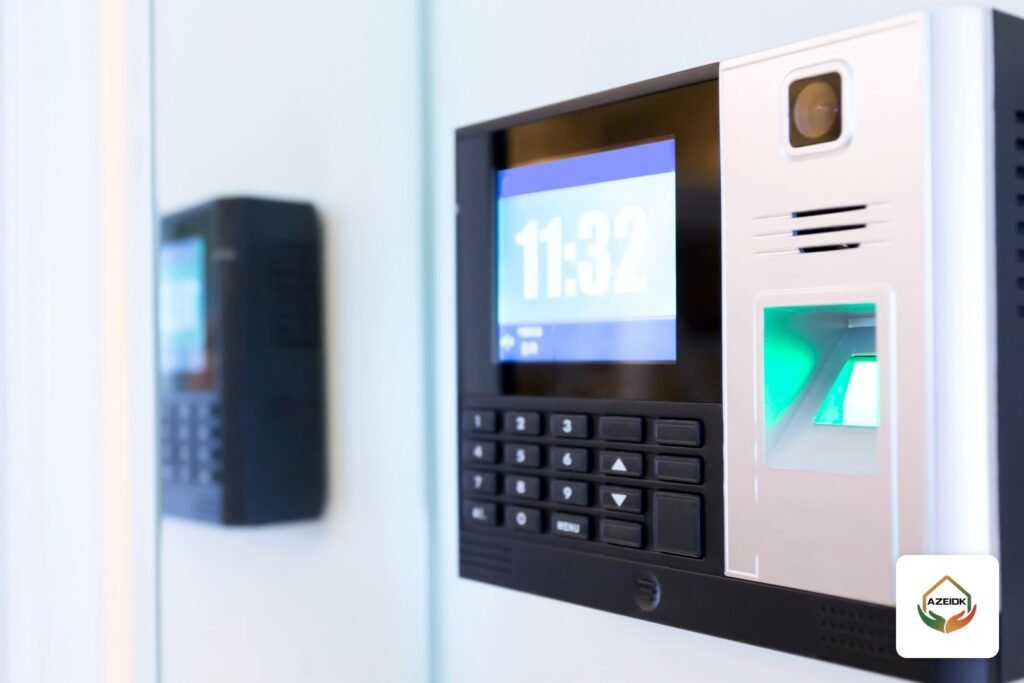
- Key room: card or fingerprint entry with a log of every access, a camera on the door, and a door contact linked to the alarm. Access control devices from ZKTeco and Hikvision are available from AZEIDK.
Wireless Ajax systems suit existing showrooms because they need little cabling, and they are managed from a phone app that sends alerts to the owner or manager. Hub choice, detector count and layout come from a site survey.
Protection summary by area
| Area | Fire | Security |
|---|---|---|
| Showroom floor | Detectors suited to the ceiling, powder extinguishers, clear exits | Cameras covering every car, motion detectors, glass protection |
| Outdoor yard | Extinguishers in visible positions | Night-capable cameras on fence and gate |
| Key room and cashier | Smoke detector | Access control, camera and door contact |
| Parts store | Separate alarm zone, low-hazard storage only | Camera on the door and door contact |
| Service workshop | Heat detectors, powder or foam extinguishers | Cameras on entrance and delivery area |
Licensing and periodic maintenance
Because Civil Defense approval comes before the licence, arrange safety works early. On the Salamah platform the technical report is issued by engineering consultancy offices, and AZEIDK issues the safety equipment installation certificate for systems it installs, as part of Civil Defense approval support. The steps are in our Salamah certificate guide.
After opening, maintenance runs under two separate contracts: one for fire, safety and alarm systems (panel, detectors, extinguishers, sprinklers) under periodic maintenance contracts, and another for CCTV, intrusion alarm, access control and network.
For commercial building projects in general, see malls and commercial buildings.
Frequently asked questions
What are the safety requirements for car showrooms in Saudi Arabia?
The vehicle showroom requirements call for Civil Defense approval before licensing, compliance with SBC 801, fire-resistant ceiling materials, clear exit routes, a first-aid kit and security cameras under the law, and they ban gas lighting.
How many extinguishers does a car showroom need?
The number comes from a design to SBC 801 and Civil Defense requirements based on area and hazard. There is no fixed number for all showrooms. They must be visible, near exits and suited to the expected fire type.
Is CCTV mandatory in car showrooms?
Yes. Clause 5.4 of the vehicle showroom requirements calls for security cameras installed under the Security Surveillance Cameras Law and its executive regulations.
What is the best intrusion alarm for an existing showroom?
Wireless systems such as Ajax suit existing showrooms because they need little cabling. The final detector choice and layout follow a site survey.
Can oils and tyres be stored in the showroom store?
The requirements allow a store for low-hazard materials only, within the area limit stated. Storing flammable materials needs a designer’s review under the code.
Is a dealership workshop treated like the showroom?
No. The workshop is a different use; in the IBC model repair garages sit in a different occupancy group from showrooms, so alarm, suppression and separation are designed for it separately.
Conclusion
A safe car showroom has Civil Defense approval for systems designed to SBC 801, an alarm panel that shows where a fire is, cameras that see every car and every door, and an intrusion alarm that warns before a car or key goes missing. Plan these systems at design stage, and keep fire maintenance separate from security maintenance so each has a clear owner.
Fitting out a new showroom or dealership? Send the layout to the AZEIDK team to define fire alarm, extinguishers, CCTV, intrusion alarm and key room access control, with the safety equipment installation certificate for licensing. Talk to the AZEIDK team