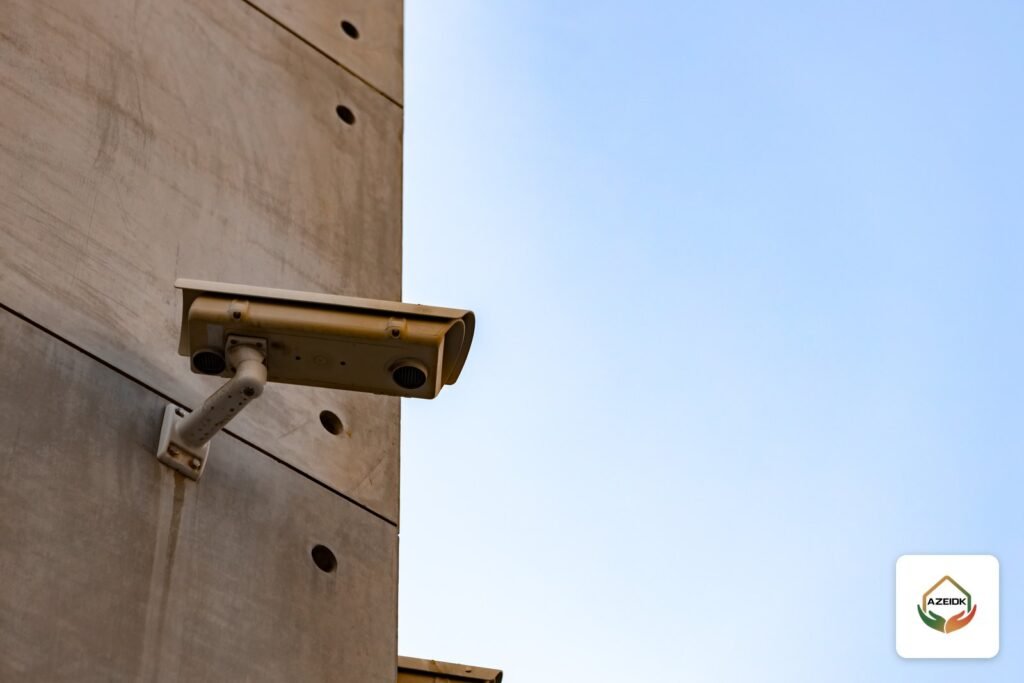
An outdoor CCTV camera goes on a villa wall, a shop front or a warehouse gate and stays there for years in sun, dust and rain, sometimes within reach of someone who wants to disable it. Resolution is only part of the question. The bigger one is whether the camera can survive where you mount it.
This guide explains how to read an outdoor camera datasheet: the IP rating for water and dust, the IK rating for impact, the operating temperature range and night vision. It then compares outdoor models from Hikvision, Dahua and EZVIZ available from AZEIDK. If you need the whole system designed for your site, that is the work of AZEIDK’s security and surveillance systems team.
Short answer: For outdoor use, choose a camera whose datasheet states IP67, or at least IP66, with an operating range up to 60°C, and IK10 if people can reach it. Pick the night vision type to suit the lighting on site, mount it so the lens does not face the sun, and protect the cable joint from water and dust.
Key takeaways
- The first IP digit covers dust (6 means dust tight); the second covers water (6 is powerful jets, 7 is temporary immersion).
- IP67 does not automatically mean the camera passed the powerful jet test. The two digits test different things.
- IK10 means the housing withstands a 20 joule impact. It is recommended for low-mounted cameras and public areas.
- Every outdoor model reviewed here is rated to operate up to 60°C, while Saudi summers approach 50°C in the shade.
- The weakest point of an outdoor install is usually the cable joint outside the camera, not the camera body.
In this article
- Outdoor CCTV camera: what to check on the datasheet before you buy
- Water and dust resistance: what IP66 and IP67 mean
- Heat and sun: can the camera handle a Saudi summer?
- Night vision CCTV outdoors: infrared or colour?
- Vandal resistance: when do you need IK10?
- Wired IP camera or outdoor Wi-Fi camera?
- Outdoor camera models available from AZEIDK and their specs
- Common mistakes with outdoor cameras
- Outdoor camera supply and installation with AZEIDK
- Frequently asked questions
- Conclusion
Outdoor CCTV camera: what to check on the datasheet before you buy
Indoor and outdoor cameras can share the same sensor and lens. The difference is the housing, protection and operating conditions, all printed on the datasheet under Protection or General.
| Datasheet line | What it means | What to ask for outdoors |
|---|---|---|
| Protection: IP66 or IP67 | Resistance to dust and water ingress under IEC 60529 | IP66 or IP67 as a minimum for any exposed camera |
| IK10 | Resistance to mechanical impact under IEC 62262 | Recommended where cameras are within reach, such as entrances and car parks |
| Operating Conditions | Air temperature and humidity range the camera works in | Upper limit of 60°C and humidity up to 95%, non-condensing |
| IR Range or White Light Range | Reach of the built-in night illumination | Longer than the farthest point you need to see at night |
| WDR | Ability to show detail when bright light and shadow share the frame | Important for gates and façades facing street lights or the sun |
| Power | Power method and maximum consumption | PoE to reduce cabling, sized on maximum consumption |
Water and dust resistance: what IP66 and IP67 mean
The IP code has two digits under the international standard IEC 60529. The first covers solid objects and dust; the second covers water. In Saudi Arabia dust matters as much as rain.
- First digit 6: dust tight. A 5 means dust protected, but not fully sealed.
- Second digit 6: protected against powerful water jets from any direction, such as wind-driven rain or hosing down.
- Second digit 7: protected against temporary immersion between 15 cm and 1 m deep, for up to 30 minutes, as RS describes it.
One point that is often missed: immersion ratings do not automatically cover jets. RS notes that a device rated IPX7 need not meet the IPX5 and IPX6 jet criteria. If the camera will be washed with pressurised water, as at fuel stations, car washes and some factories, ask the supplier to confirm both ratings in writing.
The IP rating covers the camera body as installed per the guide, not the cable joint at the wall. A junction box matched to the model, with a sealed cable entry, protects that point.
Heat and sun: can the camera handle a Saudi summer?
On 14 July 2026, Al-Ahsa recorded 50°C, as the National Center for Meteorology confirmed to Arab News. Every outdoor model whose datasheet we reviewed for this guide is rated to operate from -30°C to 60°C, with humidity up to 95%.
That 60°C figure refers to ambient air. A camera on a wall facing the midday sun, or on a metal pole, runs hotter than the air around it. So the mounting position matters as much as the model:
- Mount the camera under an overhang or canopy where possible, or on the side that gets less midday sun.
- Do not point the lens at the sun. Hikvision’s guide says plainly not to aim the lens at the sun or any other bright light. For gates facing east or west, that means allowing for sunrise and sunset.
- Choose high WDR for gates where the frame holds both an inner shadow and a sunlit street. The Hikvision and Dahua models in the table below list 120 dB.
- Keep the NVR and switch indoors or in a suitable cabinet, not in an unventilated rooftop room.
Night vision CCTV outdoors: infrared or colour?
Outdoor lighting varies widely from site to site. There are two main options:
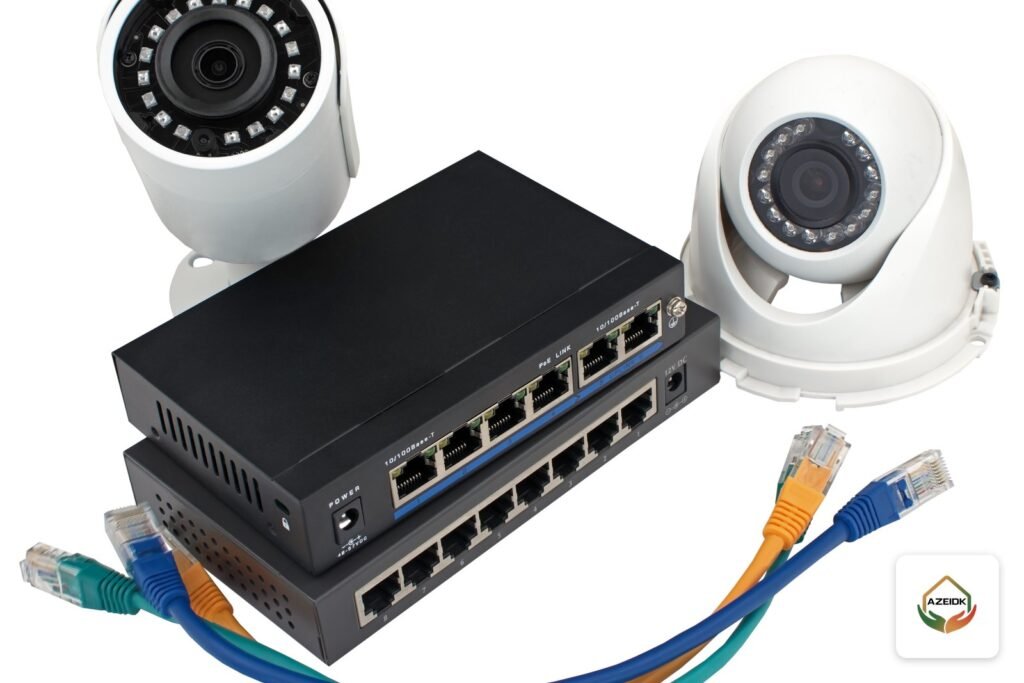
- Infrared (IR): black and white night image with no visible light. The range is on the datasheet, for example 30 m on the Hikvision DS-2CD2123G2-IS dome and 60 m on the Dahua IPC-HFW2531T-ZS bullet.
- White light (ColorVu and similar): colour images at night using a built-in white light, such as the Hikvision DS-2CD2T47G1-L with a light range of up to 30 m. Colour helps identify cars and clothing, but white light can bother neighbours.
Watch for reflection: a wall or ledge close to the camera bounces infrared back and fogs the night image. The technologies are compared in detail in our article on night vision CCTV cameras.
Vandal resistance: when do you need IK10?
The IK code measures impact resistance under IEC 62262. The highest grade commonly seen on cameras is IK10, which means the housing withstands a 20 joule impact. For comparison, IK08 is 5 joules and IK09 is 10 joules.
A camera five metres up on a warehouse rarely needs IK10. One at an entrance, in a car park or low over a shop counter can be hit or knocked off aim. That is where IK10 domes fit, such as the Hikvision DS-2CD2123G2-IS, rated IP67 and IK10.
Not every outdoor model has an IK rating. The Hikvision DS-2CD2363G2-IU turret lists IP67 with no IK grade, so it suits high mounting positions.
Wired IP camera or outdoor Wi-Fi camera?
A wired IP camera takes video and power over a single network cable using PoE and records to an NVR inside the building. It is the usual choice for shops, warehouses and projects.
An outdoor Wi-Fi camera suits a villa or small shop with only a few cameras. One example available from AZEIDK is the EZVIZ H3 2K. EZVIZ’s official product page lists it as IP67, operating from -30°C to 60°C, with microSD support up to 512 GB, 2.4 GHz Wi-Fi and a wired network port as well.
Keep in mind that a Wi-Fi camera still needs power at its location; it is only wireless for video. Wired and Wi-Fi options for homes are compared in our article on home CCTV installation.
Outdoor camera models available from AZEIDK and their specs
Figures below come from each manufacturer’s official datasheet. Details can change between model versions, so check the version in your quotation.
| Model | Type | Protection | Operating temperature | Night vision |
|---|---|---|---|---|
| Hikvision DS-2CD2T47G1-L | IP bullet, colour at night (ColorVu) | IP67 | -30°C to 60°C | White light up to 30 m |
| Hikvision DS-2CD2123G2-IS | IP dome | IP67 and IK10 | -30°C to 60°C | IR up to 30 m |
| Hikvision DS-2CD2363G2-IU | 6 MP IP turret | IP67 | -30°C to 60°C | IR up to 30 m |
| Dahua IPC-HFW2531T-ZS | IP bullet, 2.7 to 13.5 mm varifocal lens | IP67 | -30°C to 60°C | IR up to 60 m |
| EZVIZ H3 2K | Outdoor Wi-Fi | IP67 | -30°C to 60°C | IR up to 30 m, plus colour mode |
Common mistakes with outdoor cameras
- Fitting an indoor camera under a canopy. Dust and humidity still reach it.
- Leaving the cable connector exposed or taped instead of using a junction box.
- Pointing a gate camera straight east or west, so the image washes out at sunrise or sunset.
- Fitting a camera with no IK rating within reach in a car park or entrance.
- Relying on the IR range without checking for a nearby wall that reflects it.
- Skipping cleaning of the camera cover. Hikvision’s guide recommends a soft, dry cloth and no alkaline detergents.
The installation steps from site survey to handover are covered in our CCTV installation guide.
Outdoor camera supply and installation with AZEIDK
AZEIDK’s security and surveillance systems team selects the model for each point on site: mounting height, sun direction, night lighting and tampering risk. It then supplies, installs and hands over the cameras and recorders with their settings. AZEIDK holds ISO 9001, ISO 14001 and ISO 45001 certificates, with a scope covering the design, supply, installation and maintenance of CCTV and access control systems.
Frequently asked questions
What is the difference between IP66 and IP67 on a CCTV camera?
The 6 means protection against powerful water jets; the 7 means protection against temporary immersion up to 1 m. Both usually come with a 6 for dust, meaning the housing is dust tight.
What temperature can an outdoor CCTV camera handle?
The Hikvision, Dahua and EZVIZ models reviewed here are rated to operate up to 60°C air temperature. Direct sun heats the housing further, so shade and the right wall help.
Can an IP67 camera be pressure washed?
Not necessarily. The 7 covers immersion, not jets, so if the camera will be pressure washed, ask for written confirmation of IP66 as well.
Is an outdoor Wi-Fi camera good for a villa?
It works for a few cameras if the Wi-Fi signal is strong at each spot and power is available. For long perimeter walls and more cameras, a wired system with an NVR is more reliable.
What is the difference between IP and analog (HD) cameras outdoors?
An IP camera carries video and power over one network cable and records to an NVR; an analog HD camera uses coaxial cable and a DVR. The outdoor checks are the same for both.
What drives the price of an outdoor CCTV camera?
Resolution, night vision type and range, protection grade such as IK10, fixed or varifocal lens, and then cable runs, brackets and junction boxes in the installation. Cost factors are covered in our article on CCTV system cost.
Conclusion
Choosing an outdoor CCTV camera starts with the site, not the resolution. Get the right IP rating for water and dust, check the temperature range, add IK10 where people can reach, match night vision to the lighting, then seal the cable joint and keep the lens away from the sun.
Need outdoor cameras for a wall, gate or yard? Send us photos of the locations and the expected mounting height, and we will suggest the right model for each point. Talk to the AZEIDK team
Related guides
- EN 54 Fire Alarm Standard: Parts, CE Marking and Approvals
- Salamah Licence Renewal: The Maintenance Contract and Documents You Need
- Salamah Certificate for Retail Shops: Steps from Lease to Issue and the Link with the Balady Licence
- Turnstile Gates: Tripod, Flap, Swing or Full Height for Offices, Gyms and Factories