A fire system maintenance contract for fuel stations is the practical way to meet what Saudi Arabia’s Fuel Stations and Service Centers Requirements ask for: monthly checks, periodic tests and maintenance of all fire prevention and protection systems, logged in the safety record, with inspection and maintenance records kept for at least three years. A good contract turns those duties into clear visits, tasks and reports.
For what any contract should cover before you sign, see our fire system maintenance contract guide for Saudi Arabia.
This guide sets out what a station maintenance contract should cover, how a station differs from a mall or a factory, and what belongs in a separate contract. For the general rules, see fuel station safety requirements.
Key takeaways
- The requirements (clause 5.5.1) call for monthly checks, periodic tests and maintenance of all fire protection systems at the station.
- Checks are logged in the safety and fire control record; inspection and maintenance records are kept for at least three years.
- If a serious fault threatens lives or property, the requirements call for closing the station or its high-hazard part immediately, so response time matters.
- The fire, safety and alarm contract is separate from the CCTV and low-current contract.
- Extinguishers are the largest item at a station and need monthly inspection and annual maintenance.
In this article
- Why does a fuel station need its own maintenance contract?
- What does a fire system maintenance contract for fuel stations cover?
- Extinguishers: the most common item at a station
- The first visit: survey before pricing
- Monthly visits without stopping sales
- Fault response time
- The station staff’s role between visits
- What stays outside the fire contract?
- Records the station office must hold
- How to compare maintenance offers
- FAQ
- Conclusion
Why does a fuel station need its own maintenance contract?
Stations often run around the clock and combine flammable fuel, customers and service buildings on a small plot. They cannot close for hours for maintenance, and faults cannot wait. So the contract differs from a mall maintenance contract or a factory maintenance contract in three ways: short visits that do not stop sales, focus on extinguishers and emergency means on the forecourt, and records ready for any inspection.
What does a fire system maintenance contract for fuel stations cover?
| Item | Work on each visit | Handed to the owner |
|---|---|---|
| Extinguishers (powder, foam, CO2, wheeled) | Location, pressure, seal, tag and condition; annual maintenance and refilling when needed | Updated tag on each unit and a location list |
| Fire alarm system | Panel and batteries; detector, call point and sounder tests per schedule | Test report listing devices and faults |
| Hose cabinets, where installed | Hose, nozzle, valve and cabinet | Findings and repairs |
| Kitchen suppression in the station restaurant | Periodic service per manufacturer, at least every six months under NFPA 96 as a technical reference | Service tag on the system |
| Safety equipment | Fire blanket, first aid box, signage | Shortage list |
| Records | Update of the safety and fire control record | Report copies kept for three years |
Any fixed suppression systems in the approved design are added, since the requirements call for an approved suppression system per Chapter 9 of SBC 801.
Extinguishers: the most common item at a station
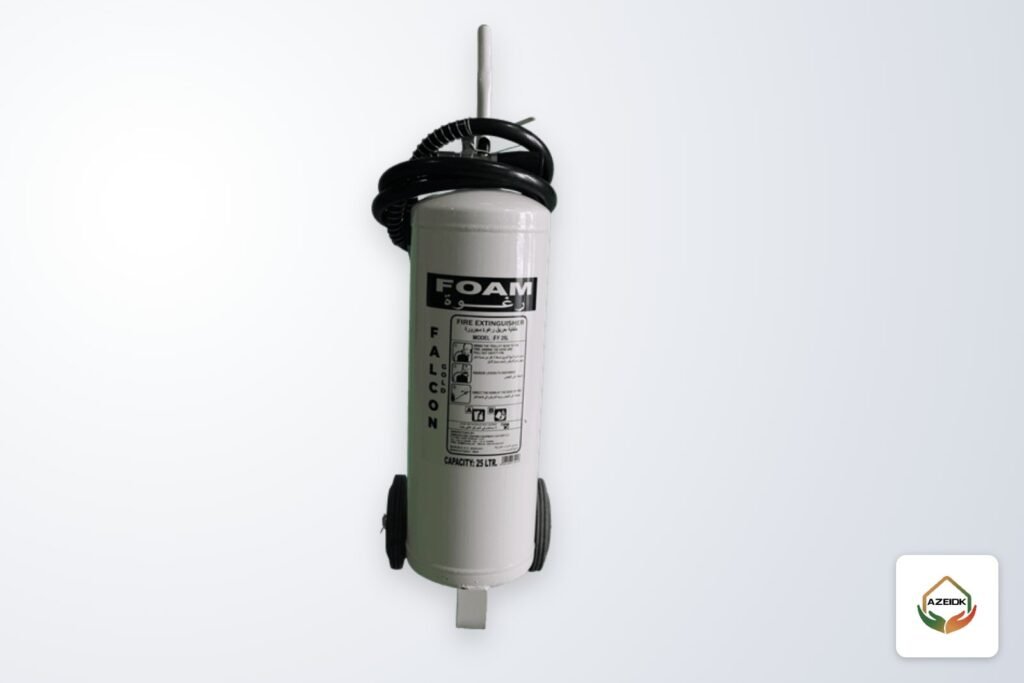
The requirements limit the distance between an extinguisher and the dispensers or tank fill openings to 22.5 m, and refer extinguisher numbers and types to Chapter 23 of SBC 801. That means units spread across the forecourt and buildings, exposed to sun, dust and tampering. The usual technical reference for their upkeep is the US standard NFPA 10, while the Saudi code and Civil Defense remain the binding rules: a monthly check that each unit is in place, visible, in the green zone and sealed, then deeper annual maintenance. AZEIDK provides extinguisher maintenance with its own team under its preventive maintenance contracts. See also extinguisher maintenance and refilling.
The first visit: survey before pricing
An accurate contract is not built on estimates. On the first visit the technician records every extinguisher by type, size and location, numbers it on a simple station plan, notes the alarm panel condition and device count, and identifies hose cabinets and any kitchen system. A list of existing defects is handed over before the contract starts: expired units, missing tags, faulty detectors or a standing panel fault. That list protects both sides. For a new station, the survey starts from the handover documents and the safety equipment installation certificate; for a station network, each site gets the same numbering so reports can be compared.
Monthly visits without stopping sales
Monthly checks do not require shutting the dispensers. The technician goes unit by unit, checks the alarm panel and records findings. Tests that sound the alarm or isolate part of a system are agreed with the station manager in advance, done at quiet hours, and announced to staff first. Ask for one clear sheet after each visit: what was checked, what was found, what was fixed, and what awaits parts or approval.
Fault response time
Clause 5.5.1 states that a high-severity fault threatening lives or property means closing the station or its high-hazard part immediately until it is repaired, so a fault can stop sales. The contract should set the emergency arrival time, target repair time and reporting method. See our article on SLAs in maintenance contracts.
The station staff’s role between visits
A contract does not replace the attendant’s daily eye. The requirements call for a safety and fire-fighting training programme and hands-on practice with portable extinguishers and spill control tools. Trained staff notice a missing or fallen extinguisher or a fault message on the panel and report it at once. Ask the contract to set one reporting number and to list every call and its closing date in the monthly report.
What stays outside the fire contract?
CCTV is required at stations: colour cameras covering the station and service centres, with off-site backup. Its maintenance, with other low-current systems, sits in a separate contract from the fire, safety and alarm contract, which keeps responsibilities clear. See our CCTV maintenance contract template. Fuel dispensers, tanks and leak detection equipment are also outside the fire contract and belong to fuel equipment specialists.
Records the station office must hold
The requirements ask the station office to keep a list of manual and fixed extinguishing equipment, a dated record of periodic maintenance and repairs, and a log of any incident. A good contract makes the provider responsible for updating its part after each visit. See the fire safety log book.
How to compare maintenance offers
- Does the offer count extinguishers by type and alarm devices, or give a lump sum?
- Are refills and spare parts included? See comprehensive vs non-comprehensive contracts.
- Is an emergency response time stated?
- Is a report issued after every visit?
- Does it cover every building, including the mosque and restaurant?
FAQ
Does a fuel station need a maintenance contract?
The requirements call for monthly checks, periodic tests and maintenance of all fire protection systems with records; a contract is the organised way to do and prove that.
How often are station extinguishers checked?
A monthly check of condition, pressure and seal, plus deeper annual maintenance per NFPA 10 and the manufacturer.
How long are maintenance records kept?
At least three years, per the requirements.
Does the contract include CCTV?
No. CCTV and low-current maintenance sit in a separate contract.
How much does a fuel station maintenance contract cost?
It depends on extinguisher and device counts, systems, visit frequency and spare parts. See contract cost factors or ask for a quote.
Can several stations share one contract?
Yes. An owner of several stations can combine the fire systems contract, with a visit schedule and a separate report for each site.
Conclusion
A fire system maintenance contract for fuel stations should turn the requirements into measurable work: counted extinguishers and devices, monthly visits that do not stop sales, a set response time, a report after each visit and records kept for three years, with CCTV under a separate contract. See the full sector offer on our fuel stations page.
Need a maintenance contract for one station or a network? Send us the extinguisher counts, systems and locations, and we will return a clear scope and offer. Contact AZEIDK
Related guides
- CCTV Camera Cable: Coax RG59 or Cat6, Maximum Distances, PoE and When You Need Fiber
- Low Current Systems in Saudi Buildings: What They Include and How to Plan Them from Design to Handover
- Business Wi-Fi Network Design: How to Size Access Points, Placement, PoE Switches and Central Management
- ISO 45001 Certification: Occupational Health and Safety Guide