The price of a fire system maintenance contract in Saudi Arabia is not a fixed rate per building. It depends on which systems are actually installed, the size of the site and how many devices it has, how many visits a year the contract covers, and whether spare parts are inside or outside the price. Two quotations for the same building can differ widely and both still add up, because each one covers a different scope.
This guide explains the factors that push the cost up or down and what a quotation must state so you can compare offers on the same basis. If you want a quotation based on a real survey of your systems, see AZEIDK’s preventive and periodic maintenance service.
Short answer: Four things drive the cost of a fire system maintenance contract: the systems covered, the floor area and device count, the number of scheduled visits, and how spare parts and emergency call-outs are handled. A quotation that does not list these items in detail cannot be compared with another one, even if it looks cheaper.
Key Takeaways
- The number and type of systems is the biggest factor: fire alarm, sprinklers, fire pumps, hose cabinets, extinguishers, special suppression and kitchen systems.
- Floor area matters, but the device count (detectors, sprinklers, valves) is a better measure of the work.
- Visit frequency follows the inspection and testing tables in NFPA 25 (2026 edition) for water-based systems and NFPA 72 (2025 edition) for fire alarm, plus what the contract specifies.
- A comprehensive contract includes agreed spare parts; a non-comprehensive one prices them when needed. The difference is who carries the risk, not the quality of service.
- Emergency call-outs and response time must be written into the contract, otherwise they are usually charged as extra work.
In this article
- What determines the price of a fire system maintenance contract?
- Systems covered: alarm, firefighting and special suppression
- Floor area or device count: which prices the work better?
- Number of visits and inspection frequency
- Spare parts: comprehensive or non-comprehensive
- Emergency call-outs and response time
- What a fire system maintenance contract quotation must include
- How to compare maintenance quotations on one basis
- Common mistakes when contracting
- Frequently Asked Questions
- Conclusion
What determines the price of a fire system maintenance contract?
A maintenance company pricing a contract is really estimating technician and engineer hours, test equipment, consumables and spare-parts risk. Each factor below changes one of those items.
| Factor | Why it affects cost | What to ask for in the quotation |
|---|---|---|
| Systems covered | Each system has its own inspection and test tasks and tools | A list of included and excluded systems |
| Floor area and number of buildings | Sets travel and walk-round time | The area used for pricing, buildings and floors |
| Number of devices | Inspection and testing are done device by device | A count of detectors, sprinklers, valves and extinguishers |
| Visits per year | Each visit means a team, time and a report | A visit schedule with the tasks for each visit |
| Spare parts | Included parts move the risk to the contractor | The list of covered parts and any cap |
| Emergencies and response time | A standby team has a cost | Number of emergency visits, response time, coverage hours |
| System condition at the start | A neglected system needs repairs before routine maintenance | An initial survey report that separates repairs from the contract |
Systems covered: alarm, firefighting and special suppression
A small residential building with an alarm panel, detectors and extinguishers is a very different job from a warehouse with sprinklers, a diesel pump, an electric pump, a jockey pump and hose cabinets. Every system adds its own tasks.
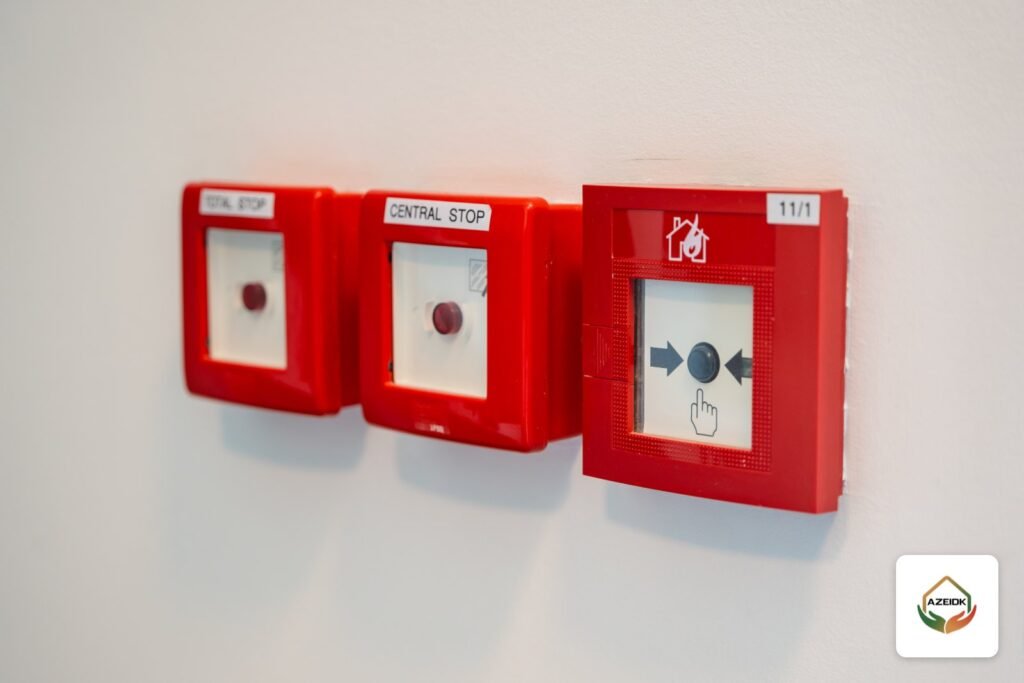
- Fire alarm: panel and battery checks, testing detectors, manual call points and sounders, and verifying interfaces with other systems. See fire alarm maintenance under NFPA 72 and SBC 801.
- Sprinklers and hose cabinets: control valves and alarm valve stations, main drain tests, hoses and reels.
- Pump room: routine pump runs, controller checks, and diesel engine fuel and batteries. Pumps such as 3PUMP sets are maintained to the manufacturer’s instructions alongside the reference standard.
- Special suppression and kitchen systems: cylinder weighing or pressure checks, nozzles and actuation devices. These need technicians trained on the specific system, which adds cost.
- Extinguishers: periodic inspection, plus recharge and testing when due. The extinguisher count feeds straight into the price.
If the contract also covers security and CCTV systems, those should appear as separate line items.
Floor area or device count: which prices the work better?
Floor area is simple and transparent, so some contractors use it, especially for factories and warehouses. AZEIDK, for example, offers a maintenance-by-area model for factories and warehouses that links the contract value to the project’s actual floor area.
Area alone does not suit every building. A mid-sized hotel can have hundreds of detectors and sprinklers in guest rooms, while a larger warehouse may have fewer devices. A serious contractor will ask for a count: detectors by type, approximate sprinkler numbers, control valves and alarm stations, and extinguishers by type. Access also counts: high ceilings that need scaffolding or a lift, and operating areas you can only enter at set times.
Number of visits and inspection frequency
Visits per year is one of the biggest cost drivers and the item where quotations differ most. The technical basis is the inspection and testing tables in the standards adopted for the project: NFPA 25 (2026 edition) for water-based systems such as sprinklers, pumps and hose systems, and NFPA 72 (2025 edition) for fire alarm, where Chapter 14 covers inspection, testing and maintenance.
These standards spread tasks over different intervals: some visual inspections are frequent, while some tests are annual or longer. NFPA 25 lets qualified on-site staff handle some simple inspections, while deeper testing stays with the maintenance contractor. That split changes the price: the more routine tasks your own team takes on, the fewer contractor visits you pay for, provided this is written into the contract and recorded in the fire safety log book.
NFPA standards are technical references adopted by the designer and the authority; they are not automatically binding on their own. The contract should name the reference standard and edition, together with the Saudi Fire Protection Code SBC 801 and Civil Defense requirements.
Spare parts: comprehensive or non-comprehensive
Under a comprehensive contract the contractor carries the cost of defined spare parts within the contract price. Under a non-comprehensive contract you pay for each part when it is replaced, and the contract covers labour and visits only. The comprehensive option looks more expensive on paper, but it fixes your annual cost.
What raises the price of a comprehensive contract:
- System age: an old panel or detectors past their service life mean a higher chance of replacement.
- Parts availability: discontinued or hard-to-source brands cost more. A single brand makes this easier, for example Context Plus panels and detectors.
- Scope of cover: detectors and batteries only, or also pump motors and main panels?
The full comparison is in comprehensive vs non-comprehensive maintenance contracts.
Emergency call-outs and response time
An emergency, such as repeated false alarms, a pump that will not start or a leak in the sprinkler network, needs a team available outside the visit schedule. Some contracts include a set number of emergency visits; others charge per visit. Price is also affected by the required response time and whether cover is business hours only or around the clock. Major repairs after a failure are usually handled as corrective maintenance under a separate quotation.
What a fire system maintenance contract quotation must include
- Facility name, location, floor area, number of buildings and floors.
- The systems covered, with a count of the main devices in each.
- The reference standard and edition for each system, the visit schedule and the tasks per visit.
- Covered spare parts and any cap, and how excluded parts are priced.
- Number of emergency visits, response time and coverage hours.
- The report format after each visit, and the certificates or reports the owner needs for the authorities.
- Clear exclusions: major repairs, design changes, recharging systems after discharge.
- Contract term, payment terms and renewal.
For other contract clauses, see fire system maintenance contracts in Saudi Arabia.
How to compare maintenance quotations on one basis
Put all quotations in one table using the eight items above as columns. An empty cell means the item is not included or not defined, so ask about it in writing before comparing. Then compare the price per actual visit, not just the total, and compare the covered spare-parts lists line by line.
If the condition of the systems is unknown, start with a survey and an assessment of existing systems. That separates the repairs needed now from routine maintenance, so they are not hidden inside the contract price.
Common mistakes when contracting
- Choosing the cheapest offer without knowing the number of visits or the excluded systems.
- Signing without a device count, then arguing later about what is covered.
- Assuming emergency visits are free because the contract is annual.
- Leaving the covered-parts list vague, such as “minor parts”.
- Not requiring a written report after every visit, even though it is what the owner shows at inspection.
- Relying on a paper contract without real work on site; inspections look at the condition of the systems.
Frequently Asked Questions
What determines the price of a maintenance contract?
The systems covered, the device count and floor area, the visits per year, spare parts and emergency call-outs. System age and condition at the start also matter.
Is a comprehensive contract always more expensive?
Its headline price is usually higher because it includes defined spare parts. Your total annual spend can still be lower if the system is old and needs frequent replacements.
Are emergency visits included in the contract?
It depends on the wording. Some contracts include a set number with a response time, others charge per visit, so ask for it to be written in explicitly.
How do I compare maintenance quotations?
Put them in one table covering systems, devices, visits, spare parts, emergencies and exclusions. Compare line by line before comparing the total.
Does Civil Defense require a formal maintenance contract?
The Salamah platform guide links contracting with a safety company and providing maintenance contracts to indirect, high-risk activities before inspection. Direct activities have different documents; see Salamah licence renewal.
How much does a Civil Defense maintenance contract cost?
There is no standard price; cost is calculated per facility from its systems, area and visit count. The right approach is to request a quotation based on a real survey of the systems.
Conclusion
The value of a fire system maintenance contract reflects the scope written into it. Define the systems and devices, ask for a visit schedule based on the adopted standard, and spell out spare parts, emergencies and exclusions. Then the price gap between offers makes sense, and you know what you are paying for.
Need a quotation with clear line items? Send us your list of systems and the building area, and we will prepare a detailed offer after a site survey. Contact the AZEIDK team
Related guides
- Choosing Fire Detectors: Smoke, Heat, Beam and Flame
- Fire Alarm Companies in Jeddah: Comparing Distributors, Consultants and Contractors
- Salamah Certificate for Malls and Shopping Centres: Building Licence, Tenant Shops and Who Is Responsible
- Fire Extinguishers in Dammam and Al Khobar: Supply and Maintenance for Workshops, Warehouses and Industrial Sites