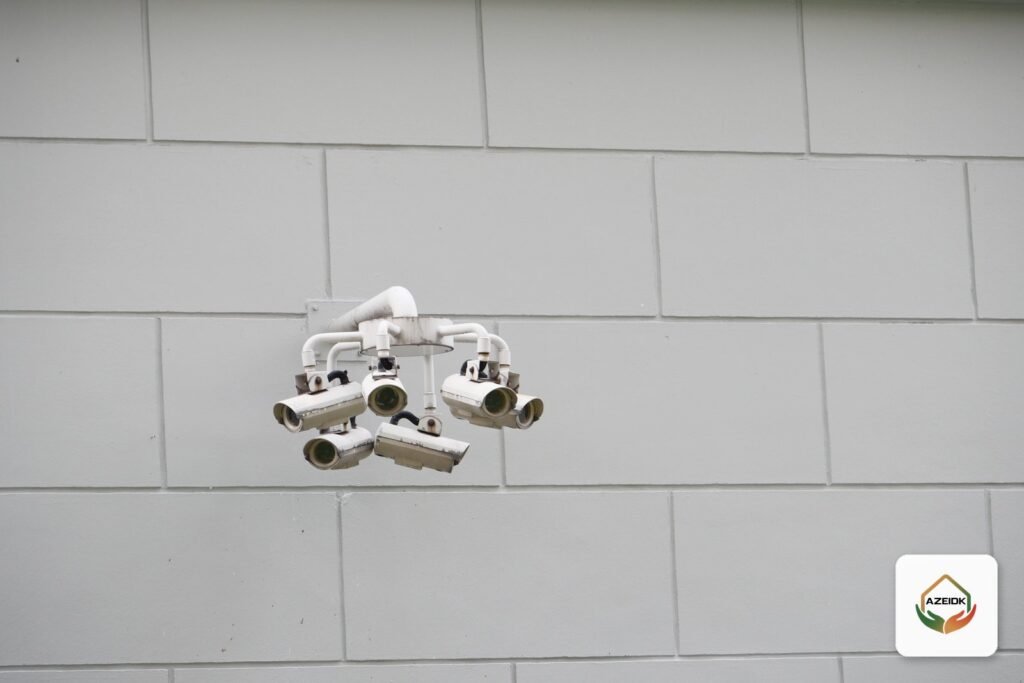
Low current systems (also called ELV, extra-low voltage systems) are the building systems that carry data, voice, video and control signals rather than power: CCTV, access control, time attendance, intercom, public address, data networks, IP telephony, intrusion alarm, turnstiles and parking barriers, and control rooms. Planning them well starts with the architectural design, not after the fit-out.
This guide answers what an owner should settle before contracting: scope, legal requirements, early infrastructure, contract model and quotation checklist. For the scope AZEIDK delivers, see our low current systems solutions.
Key takeaways
- Low current is an umbrella for security, communications, audio and control systems that share one backbone: pathways, cabling, telecom rooms and backup power.
- Security cameras in covered facilities are required under the Law on the Use of Security Surveillance Cameras (Royal Decree No. M/34). Fire alarm is governed by the Saudi Fire Protection Code SBC 801. The other systems follow the owner’s needs and the project specification.
- The costliest mistakes are rarely about devices. They are a telecom room nobody reserved, conduits not laid before the slab pour, or cable runs longer than the standards allow.
- A good quotation states, for each system, quantities, models, infrastructure, programming, testing, documentation, warranty, and who owns the integration between systems.
In this article
- What are low current systems?
- What do low current systems include in Saudi buildings?
- Which low current systems are mandatory, and which are optional?
- What infrastructure must be reserved early?
- Which systems does each building type need?
- One integrator or several vendors?
- How to plan low current systems from design to handover
- Low current quotation checklist
- Common mistakes in low current projects
- Low current systems from AZEIDK
- Frequently asked questions
- Conclusion
What are low current systems?
In the Saudi contracting market, low current means the systems that move information rather than power: a camera image, a door-open command, a call, a paging announcement, an alarm signal. Their devices typically run at low voltage from their own power supplies, or over the network cable itself using PoE. So they are drawn, routed and contracted separately from power works.
Low current is often confused with smart buildings. A smart building is the integration of these systems on one platform; low current is the systems themselves and their infrastructure. For integration layers and the integration matrix, see our article on smart buildings and low current integration.
What do low current systems include in Saudi buildings?
The table lists the systems AZEIDK includes under low current, what each does, and where to read more on our site:
| System | Purpose | Detailed guide |
|---|---|---|
| CCTV | Monitoring, recording and evidence | CCTV camera types guide |
| Access control and time attendance | Who enters where and when; working-hours records | Access control technologies |
| Video and audio intercom | Identify visitors and open doors remotely | Video intercom systems |
| Public address (PA) | Paging and background music | Public address systems |
| Data networks and structured cabling | The backbone most other systems run on | Structured cabling and networks |
| IP telephony (IP PBX) | Internal and external calls | Planned with the network |
| Intrusion alarm | Detect unauthorised entry out of hours | Intrusion alarm systems |
| Turnstiles and parking barriers | Control pedestrian and vehicle flow | Parking management and barriers |
| Control room | Operate and monitor systems from one point | Security control room setup |
Fire alarm is a life-safety system with its own code and approval route. It is designed under fire alarm systems, even where it shares pathways, control rooms and interfaces with low current.
Which low current systems are mandatory, and which are optional?
Knowing what is legally required tells you what cannot be cut when the budget is trimmed:
- Security cameras: the Law on the Use of Security Surveillance Cameras was issued by Royal Decree No. M/34 dated 7/3/1444 AH. Its implementing regulations define the covered facilities and the locations to be covered, and bar licensing authorities from issuing or renewing an activity licence unless the facility holds a certificate confirming that the camera installation requirements are met (Article 4 of the regulations). For locations and obligations, see the Saudi security cameras law explained.
- Fire alarm and voice evacuation: required by SBC 801 according to occupancy and approved by Civil Defense. They sit outside low current contractually, but any interface with them, such as releasing door locks on alarm, must be coordinated early.
- Mega developments: the Communications, Space and Technology Commission (CST) guide for Mega Development Areas (first edition, 2024) calls for all buildings to be prepared with telecom conduits and bring fibre to every building. It defines such areas by thresholds including land over 500,000 m², built-up area over 100,000 m², or one or more buildings with more than 40 floors above ground combined.
- Other systems: intercom, time attendance, PA, intrusion alarm, gates and IP telephony are usually set by the owner’s requirements, the consultant’s specification and the type of activity. A sector regulator may require some of them for a given activity, so ask your consultant.
What infrastructure must be reserved early?
Devices can be changed later. Spaces and pathways are fixed at design stage. ANSI/TIA-569 sets the design and construction requirements for telecommunications pathways and spaces: equipment rooms, telecom rooms, conduits, cable trays and entrance facilities. The key items:
Main telecom room (MDF) and floor rooms (IDF)
Structured cabling standards (ANSI/TIA-568 and ISO/IEC 11801) limit the horizontal copper channel to 100 m: 90 m of permanent link plus 10 m of patch cords. Size and place floor rooms so the furthest outlet or camera stays within that limit, or plan an extra room or fibre. Each room needs cooling, power with UPS backup, earthing, and space for racks and maintenance.
Risers, conduits and openings
The low current riser shaft, conduits cast into slabs and walls, and underground ducts to gates, barriers and perimeter fences all go in before the pour or before external works.
Control room and external device points
The control room needs space for displays and operator stations; barriers and turnstiles need foundations, power and cable routes on the site plan.
Which systems does each building type need?
A common pattern, not a legal requirement:
| Building type | Usual core systems | Added as needed |
|---|---|---|
| Residential building or compound | Entrance and parking CCTV, intercom, network | Access control, parking barriers |
| Offices | Network, IP telephony, CCTV, access control | Time attendance, PA, turnstiles |
| Hotels | Network, CCTV, PA, telephony | Control room, parking barriers |
| Malls and retail centres | CCTV, PA, control room, network | Parking management, back-of-house access control |
| Warehouses and factories | Perimeter and yard CCTV, access control | Intrusion alarm, barriers and gates, time attendance |
| Healthcare facilities | Network, CCTV, access control, PA | Intercom, control room |
One integrator or several vendors?
You can award each system separately, or give the whole package to one party for design, supply, installation, programming and integration:
| Criterion | Single integrator | Multiple vendors |
|---|---|---|
| Integration responsibility | One party accountable to the owner | Split; gaps appear at testing |
| Shared infrastructure | Designed once for all systems | Each vendor may run its own cables and pathways |
| Price comparison | Harder; needs a detailed BOQ | Easier per system |
| After-handover maintenance | One contract, one contact | Several contracts and parties |
| Dependence on one party | Higher; reduce it with open specifications and full documentation | Lower |
Either way, the specification must name who owns the integration matrix, the shared infrastructure and the end-to-end tests.
How to plan low current systems from design to handover
- Define needs: system list, sensitive areas, security level and expected growth.
- Design: device locations, telecom rooms, pathways, power and PoE loads, storage capacity.
- Shop drawings and coordination: with architectural, structural, electrical and HVAC before pours and finishes.
- Material submittals: the datasheet for each model, checked against the specification.
- Containment, then installation: conduits and cables first, devices after dusty works finish.
- Programming and integration: permissions, schedules and cross-system scenarios.
- Testing and commissioning: each system, then joint tests, plus documented cable test reports.
- Handover: as-built drawings, passwords, O&M manuals, training and a maintenance plan.
Low current quotation checklist
- A BOQ per system with model and brand, not just “or equal”.
- Datasheets for every main device.
- Infrastructure scope: conduits, trays, racks, earthing and UPS included or not.
- Cable category, test method and the test report required.
- Recording capacity and the retention period required for CCTV under the applicable requirements.
- Software licences, user counts and expansion headroom.
- Programming and cross-system integration, with exclusions stated.
- Warranty, maintenance, spare parts and response times.
- Handover documents and training.
Common mistakes in low current projects
- Leaving low current until after the fit-out, then running surface conduit and breaking walls.
- A telecom room with no cooling or backup power, or one room for a building whose distances exceed the limit.
- One flat network for cameras, staff and guests, with no segmentation.
- Buying cameras before calculating storage and the retention period required.
- Wiring door locks without coordinating their release with the fire alarm. See our article on access controller wiring and fire alarm lock release.
- Handover without as-built drawings or documented passwords.
Low current systems from AZEIDK
Through our low current solutions, AZEIDK provides engineering design, supply, installation, programming, testing, commissioning and maintenance for CCTV, access control, time attendance, intercom, PA, networks and structured cabling, IP telephony, intrusion alarm, turnstiles, parking barriers and control room fit-out. Brands we carry in Saudi Arabia include Hikvision, Dahua and EZVIZ for CCTV; Hikvision, Dahua and ZKTeco for access control and intercom; Hikvision and ZKTeco for time attendance; Hikvision and Ajax for intrusion alarm; Hikvision, Dahua, ZKTeco and BFT for gates and barriers; and AZ Link for network racks. AZEIDK holds ISO 9001, ISO 14001 and ISO 45001 certification with a scope that covers low current, CCTV and access control.
Frequently asked questions
What is the difference between low current and power systems?
Power systems feed lighting, HVAC and equipment. Low current systems carry data, voice, video and control signals at low voltage. Each has its own drawings, pathways and contracts.
Are CCTV cameras mandatory in every building in Saudi Arabia?
The obligation applies to the facilities and locations defined by the security cameras law and its implementing regulations. Check your facility’s classification before design.
Is fire alarm a low current system?
It runs at low voltage, but it is a life-safety system governed by SBC 801 and Civil Defense approval. It is designed and approved separately, and its interfaces are coordinated with the other systems.
When should low current planning start on a new project?
With the architectural design, so telecom rooms and shafts are reserved and conduits are laid before slabs are poured.
What is the best way to compare low current quotations?
Compare models, quantities, infrastructure scope, programming, testing and warranty line by line, not just the total price.
Conclusion
Low current is a set of separate systems on one infrastructure. Separate legal requirements from operational needs, reserve rooms and pathways at design stage, make integration responsibility clear, and ask for a quotation that details each system, its infrastructure, testing and handover.
Planning low current systems for a new or existing building? Send us the drawings, building type and the systems you need, and we will prepare the scope of work and BOQ with datasheets for each model. Talk to the AZEIDK team