A fire maintenance SLA (the service level agreement in a fire system maintenance contract) is what turns the contract from a general promise into measurable obligations: how fast the contractor acknowledges a call, when a technician arrives on site, when the system is back in service, how many planned visits are carried out and when their reports are delivered, and what deduction applies for delay. No single code sets these numbers. The parties agree them in the contract according to the risk of the facility and its location, so they need to be written clearly before signing.
Key takeaways
- The scope says what is maintained; the SLA says how and when, and how the contractor is held to account for delay.
- Response time, attendance time and restoration time are three different numbers, and mixing them up is the most common cause of disputes.
- Calls are ranked by priority: a system out of service is not the same as one faulty detector in an empty store.
- Planned visit frequency follows the adopted inspection, testing and maintenance standards, such as NFPA 25 for water-based systems and NFPA 72 for fire alarm, not one fixed figure for every building.
- Deductions should be tied to a measurable indicator, proven by the call log, and capped.
In this article
- Scope of a maintenance contract versus the SLA
- Ranking calls by priority
- Response time in a maintenance contract: what exactly is measured?
- Planned visits: how they are written into the SLA
- What the government O&M model contract says
- Penalties and deductions: writing them fairly
- Common mistakes when writing a fire maintenance SLA
- Frequently asked questions
- Conclusion
Scope of a maintenance contract versus the SLA
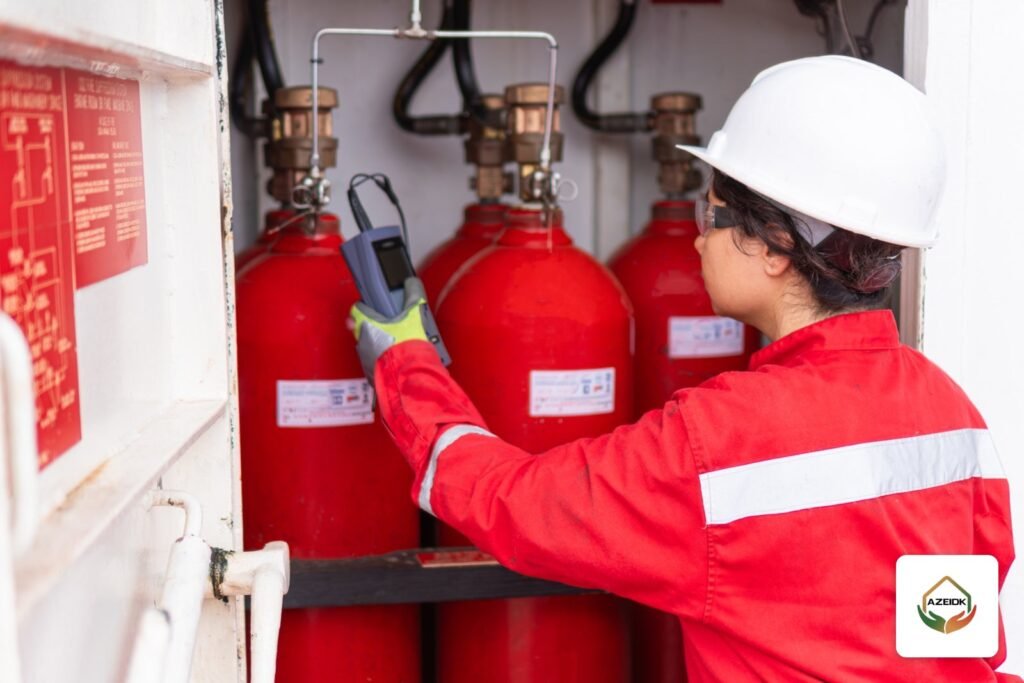
Most maintenance contracts on the market list the systems covered: fire pumps, sprinklers, hose reel cabinets, fire alarm panels and detectors, gas suppression systems and extinguishers. That is the scope, and it is detailed on our preventive and periodic maintenance page. A list of systems does not answer the owner’s real questions when something fails: who picks up the phone at 2 a.m., when the technician arrives, and who pays for the damaged part.
The SLA answers those questions with numbers and definitions. It can be an annex or a clause inside the contract; what matters is that it is binding, not a separate marketing sheet. At AZEIDK, fire system maintenance contracts are normally kept separate from low current, network and CCTV maintenance contracts, because each has its own team and standards.
Ranking calls by priority
The first step in a good SLA is agreeing priority levels and defining each one with clear examples from the facility itself. The table below is a model; the times are left out on purpose because the contract sets them.
| Priority | Examples | What the contract must set |
|---|---|---|
| Emergency (critical) | Fire pump out of service, fire alarm panel down, leak on the sprinkler network, gas suppression discharge | Acknowledgement time, 24/7 attendance time, time to restore protection even temporarily, interim protection measures |
| High | Fault on an alarm loop covering part of the building, main valve not operating, jockey pump fault | Attendance time, full repair time, when the owner is told a spare part is needed |
| Normal | One detector in fault, hose reel cabinet missing its hose, extinguisher due for refill | Repair within a set period or at the next visit, with records |
| Service request | Programming change, detector relocation after a fit-out, adding a device to the existing system | Whether it is inside the contract or a separate work order, and its lead time |
Who sets the priority? It is better for the contract to say that the person receiving the call classifies it against the definitions and that the owner may object, so the contractor cannot downgrade a call to avoid a deduction.
Response time in a maintenance contract: what exactly is measured?
“Response within two hours” can mean a phone call back, arrival on site, or the system running again. The SLA needs separate definitions:
- Acknowledgement: from logging the call until the contractor confirms receipt and issues a call number.
- Attendance: from logging the call until a qualified technician is on site.
- Restoration: until the system protects the building again, even with a temporary fix.
- Resolution: until the call is closed with a permanent repair and the part replaced.
The contract should also state whether the hours are 24/7 or working hours only, when the clock starts (the phone call or the written message), how waiting time for spare parts is treated, and whether times differ between cities or remote sites. Stopping the clock while waiting for the owner to approve a part outside the contract is reasonable, provided it is written down.
When a system is out of service for a period, the building needs interim measures such as a fire watch and notifying the parties the authority having jurisdiction requires. The contract should say who carries these out and who pays. For common panel faults and how they are diagnosed, see fire alarm panel faults and repair.
Planned visits: how they are written into the SLA
Preventive maintenance is what stops calls from happening. Its frequency is not picked at random: sprinklers, fire pumps and hose systems are inspected and tested to NFPA 25, and fire alarm systems to NFPA 72, in the edition adopted by the design and the authority. The weekly, monthly and annual tasks are covered in our NFPA 25 inspection, testing and maintenance guide and the electric fire pump maintenance checklist.
What the SLA adds is a measurable commitment:
- An annual visit schedule issued at the start of the contract and approved by the owner.
- The share of visits carried out on time, and the allowed window to reschedule a visit.
- How soon the visit report is delivered, and what it contains: what was checked, results, faults and proposed parts.
- Updating the on-site safety records after each visit, as described in our fire safety log book article.
What the government O&M model contract says
On government projects, operation and maintenance contracts start from the model contracts published by the Ministry of Finance. The Operation and Maintenance model contract, second edition, approved by Minister of Finance Decision No. 3652 dated 28/08/1441H and its amendments, does not set ready-made response times for fire systems. Many figures are left as blanks for the agency to fill in the tender booklet and its technical annexes. It does give the framework the SLA is built on:
- Definitions: it separates preventive maintenance, scheduled periodic work to avoid failures, from corrective maintenance carried out from time to time to fix any defect or shortfall.
- Performance evaluation: Article 61 provides for periodic evaluation of the contractor (monthly is the option suggested in the model) using the contractor performance evaluation form, with results recorded and used as a qualification criterion in later tenders.
- Penalties: Article 72 says penalties are graduated in proportion to the severity of the breach, including shortages of technicians, workers, materials or equipment needed for the work. Article 73 imposes a default penalty when the contractor fails its obligations, capped at a percentage of the contract value set by the agency. Article 75 caps total default and delay penalties at a figure shown in the model as 20% in square brackets, meaning it is a field reviewed in each contract.
- Reports: Article 96 requires monthly reports submitted no later than the fifth day of the following month, including the daily attendance log of the contractor’s site staff signed by the agency’s representative.
- Spare parts: parts must be for assets or systems within the scope, and replaced parts are returned to the agency’s store.
The Ministry also publishes a separate performance-based O&M model contract for administrative buildings. In practice, a contractor reads the fire system response times and indicators from the tender booklet and its schedules, and should confirm before bidding that they are achievable with the proposed team and site. Any Civil Defense work is coordinated through Civil Defense approval support where needed.
Penalties and deductions: writing them fairly
A deduction in a maintenance contract is a tool to manage performance, not income for the owner. Fair wording has a few things in common:
- Each deduction is tied to a specific indicator: late attendance on an emergency call, a missed planned visit, a report not delivered.
- The calculation is known in advance, for example a share of the monthly fee per missed indicator, rather than amounts estimated after the event.
- An overall cap per month or over the contract term.
- Clear exclusions: delay because site access was refused, waiting for owner approval, or a part outside the contract.
- One measurement source both parties accept: the call log with its numbers and times.
In return, the contractor can ask the owner for commitments: 24/7 site access, a named contact person, and approval of parts quotations within a set period. Without these the SLA becomes a one-sided burden.
Common mistakes when writing a fire maintenance SLA
- One response time for every call regardless of severity.
- No definition of “response”, so the contractor reads it as a phone call and the owner reads it as arrival on site.
- No shared call log, so every disagreement becomes one word against another.
- No line between parts included and parts needing approval, which is what separates comprehensive and non-comprehensive contracts.
- Numbers the contractor cannot meet at a remote site, so deductions become automatic and the contract loses its meaning.
For faults between visits that need fast action, AZEIDK provides corrective maintenance and technical support for fire systems, with times written into each contract to suit the site and the facility.
Frequently asked questions
What is a service level agreement in a maintenance contract?
The clauses that set, in numbers, the acknowledgement, attendance and repair times, the planned visit and report schedule, and how performance is measured and deductions applied.
What response time is right for a fire system maintenance contract?
There is no single figure for every building. It depends on call priority, the type of facility and the distance between the contractor and the site, and it is written into the contract for each priority level.
What is the difference between response time and repair time?
Response time measures how fast the contractor answers or arrives; repair time measures when the system works again. A technician may arrive within an hour and still need days for the final repair because of a spare part.
Are penalties in government maintenance contracts capped?
Yes. The Ministry of Finance O&M model contract caps total default and delay penalties as a percentage of the contract value, and the figure that applies is read from the signed contract itself.
Does a fire maintenance contract cover CCTV and networks?
They are better kept in a separate contract, because the teams, standards and spare parts differ. That is the usual practice in AZEIDK contracts.
Who proves that the contractor was late?
The shared call log with its numbers and times, together with visit reports signed by the owner’s representative. That is why the SLA must name the channel for logging calls.
Conclusion
A maintenance contract without a clear SLA leaves the most important questions to be argued about during a failure. Rank calls by priority, define acknowledgement, attendance, restoration and resolution separately, tie planned visits to the adopted inspection standards, and link deductions to indicators measured by one log, with a known cap.
Reviewing a fire system maintenance contract before signing or renewal? Send the list of systems in the facility, its location and use, and our team will propose priority levels and a visit schedule to match. Talk to the AZEIDK team
Related guides
- Fuel Station Safety Requirements in Saudi Arabia: The Official Document, Extinguishers, Foam and Salamah Licensing
- Clean Agent Fire Suppression for Equipment Rooms in Saudi Arabia
- NFPA Standards in Saudi Arabia: When Are They Binding? A Short Map of NFPA 10, 13, 20, 25, 72, 101 and 2001
- Hikvision CCTV Settings: NVR Activation, Recording Schedule, HDD and Retention