Fire sprinkler questions and answers gathered from what building owners, consultants and site engineers in Saudi Arabia ask about automatic sprinkler systems: how a sprinkler opens, which head to choose, how far apart heads go, and how the network is tested and maintained. Each answer is short and links to the detailed article.
See the fire fighting systems AZEIDK designs, supplies, installs and tests, including the sprinkler networks, valves and heads.
Key takeaways
- In a wet system only the sprinklers heated by the fire open; they do not all discharge together.
- System type, hazard class, head type and spacing are design decisions taken from NFPA 13 and the approved drawings.
- Figures quoted here come from NFPA 13 and NFPA 25 as explained in the linked articles; the final reference is the approved design and Civil Defense requirements.
Basic sprinkler system questions
1. How does a fire sprinkler system work?
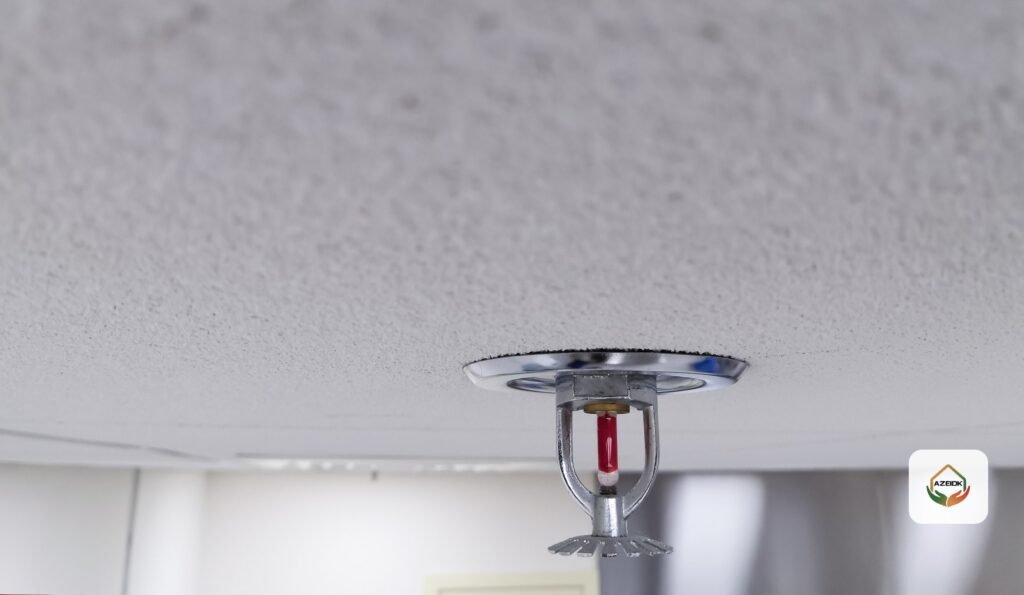
The pipework is kept full of water under pressure, and each sprinkler is held shut by a glass bulb or fusible link that breaks only at a set temperature. Only that sprinkler opens and sprays water on the fire. Details in how a fire sprinkler system works.
2. Do all sprinklers go off at the same time?
Not in a standard wet, dry or pre-action system: each head responds to its own temperature. The exception is the deluge system, whose open nozzles all discharge together when the deluge valve opens. See the deluge sprinkler system.
3. What are the main types of sprinkler system?
Wet pipe, dry pipe, pre-action and deluge. The choice depends on whether the piping can be kept above freezing, how much harm accidental water would cause and how fast a fire can spread. Compare them in wet vs dry vs pre-action vs deluge.
Questions about sprinkler heads
4. How do sprinkler heads differ, and what do the bulb colours mean?
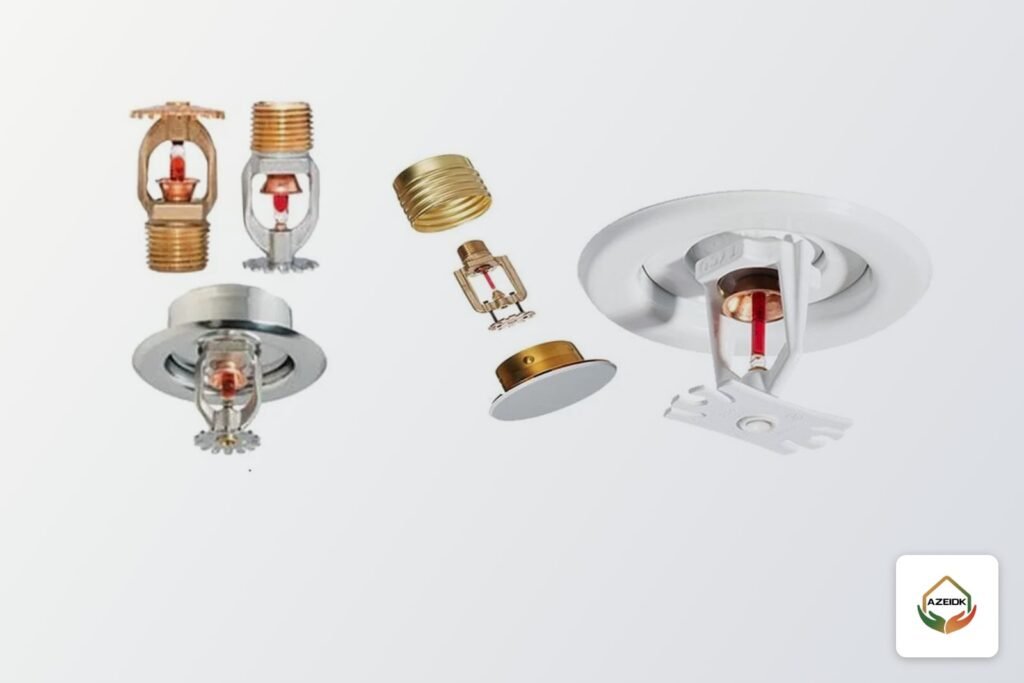
Heads differ in K-factor (how much water they discharge), temperature rating, response type and mounting position. Ordinary-rated heads open at 57 to 77 °C with orange or red bulbs, intermediate at 79 to 107 °C with yellow or green, and high at 121 to 149 °C with blue. See sprinkler head types, K-factor and temperature.
5. What is the difference between an upright and a pendent sprinkler?
Position and deflector shape: an upright sits on top of the pipe and suits exposed piping in warehouses, plant rooms and car parks; a pendent hangs below the pipe, usually through a ceiling. See upright vs pendent sprinkler.
6. What is a concealed sprinkler?
A pendent sprinkler whose body sits above the ceiling behind a flat cover plate. The plate drops at a lower temperature than the sprinkler itself, then the sprinkler operates. It is chosen for architectural ceilings. See the concealed sprinkler head.
7. How do I check that a sprinkler is UL listed or FM approved?
Approval is given to a specific model, not to a brand. Read the sprinkler identification number (SIN) on the head and search for that model in the UL and FM directories. The method is in how to verify UL and FM sprinkler approvals.
Design questions
8. What is the hazard classification in sprinkler design?
The first design decision: NFPA 13 places each area in Light, Ordinary Group 1 or 2, or Extra Group 1 or 2 hazard, based on the quantity and combustibility of its contents, and that class drives water density and area. See sprinkler hazard classification under NFPA 13.
9. How far apart should sprinklers be?
For standard upright and pendent heads in light and ordinary hazard, NFPA 13 caps spacing at 4.6 m (15 ft), with a 1.8 m (6 ft) minimum unless baffles are fitted, and the deflector no more than 305 mm (12 in) below the ceiling. Details in sprinkler spacing per NFPA 13.
10. Why are hydraulic calculations needed?
They are the only proof that water reaches the last sprinkler in the most demanding area at the required flow and pressure, and that pump, tank and pipe sizes are adequate. See sprinkler hydraulic calculations explained.
11. Can sprinklers be added to an existing, occupied building?
Yes, if the work starts with a survey of the building and its water supply, followed by a design and hydraulic calculations that respect the ceilings and services already there, and installation in phases. See sprinkler retrofit in an existing building.
Testing and maintenance questions
12. How is the sprinkler network pressure tested before handover?
The piping is filled with water and held at 200 psi for two hours with no drop on the gauge and no visible leak; where working pressure exceeds 150 psi, the test is 50 psi above working pressure. See sprinkler hydrostatic testing.
13. What is the main drain test and how often is it done?
The main drain valve on the riser is opened fully and pressure is recorded before and during flow, then compared with earlier results. Under NFPA 25 it is annual on most systems, and quarterly where the sole supply passes through a backflow preventer or pressure-reducing valve. See the main drain test.
14. How many spare sprinklers must be kept on site?
NFPA 13 requires at least 6 spares for fewer than 300 installed sprinklers, 12 for 300 to 1,000 and 24 above 1,000, of the same types and ratings, with the right wrench. See the spare sprinkler head box.
15. What should I do if a sprinkler leaks or discharges by accident?
First make sure there is no fire, smoke or unusual heat; if there is, do not close any valve, evacuate and call Civil Defense on 998 or 911. Once it is confirmed as a false discharge, the authorised person closes that zone’s control valve and a qualified technician replaces the head and restores the system. See sprinkler leak or accidental discharge.
16. Why does the sprinkler gauge show low pressure?
The cause may be the pump, but often it is in the network: a partly closed valve, a leak, a check valve that does not hold pressure or an inaccurate gauge. See low pressure in a sprinkler system.
Frequently asked questions
Are these answers enough to design a sprinkler system?
No. They are an introduction; a sprinkler design needs an engineer applying NFPA 13 and Saudi Civil Defense requirements to the real building drawings and water supply. AZEIDK offers engineering design and calculations for that step.
Who maintains the sprinkler system after handover?
The owner remains responsible for routine inspection and testing to NFPA 25, usually through an annual maintenance contract with recorded visits.
Have a question about the sprinklers in your building? Send the drawings or a short description, and the AZEIDK team will answer and handle design, supply of heads and valves, installation and testing. Request a quote from AZEIDK
Related guides
- Smart Buildings: How Low Current Systems Integrate in One Building
- Dummy CCTV Cameras: Do They Really Deter, and Why They Fail the Saudi Security Surveillance Cameras Law
- Fitting Out a New Fuel Station with Safety Systems: From Drawing Review to Installation, Handover and Salamah
- Parking Barrier and Turnstile Maintenance: Common Faults (Boom, Sensors, Loops, Motor), Periodic Checks and Contract Scope