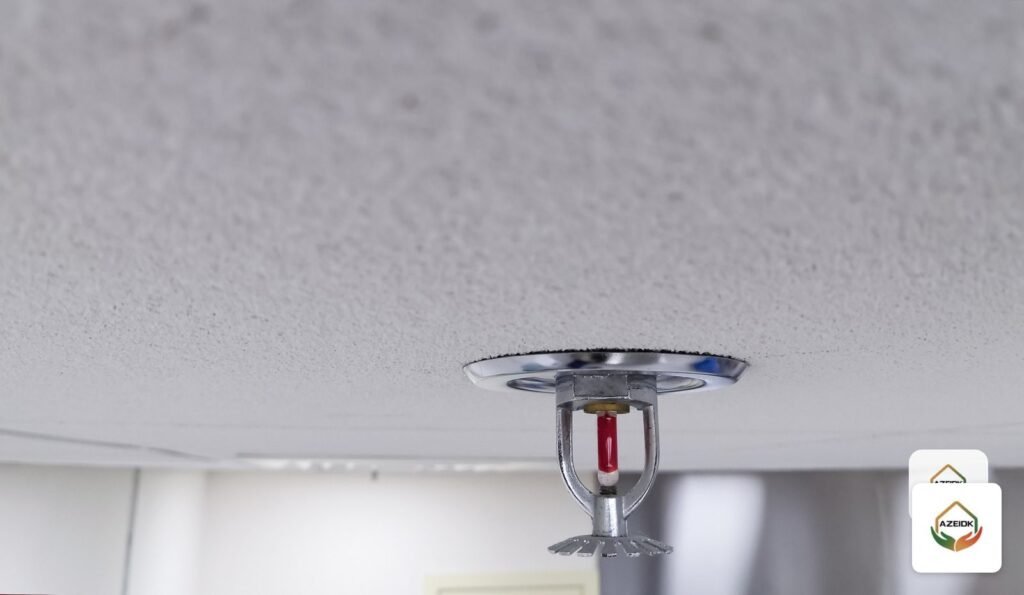
A dry sprinkler is an automatic sprinkler with a barrel that is sealed at the inlet. It connects to piping in a heated space and reaches into a freezer, cold room or exposed canopy, while water stays behind the inlet seal until the sprinkler operates. Each dry sprinkler is made to length for its location, so measurement decides whether it fits.
This guide explains exposure length versus order length, how to measure each head, and how to build an accurate RFQ for the TYCO Series DS-1 dry-type sprinklers supplied by AZEIDK. It follows the official Johnson Controls datasheet TFP500.
Key takeaways
- The TYCO DS-1 series covers three models: TY3255 pendent, TY3155 upright and TY3355 horizontal sidewall, all K5.6 and standard response.
- Each dry sprinkler is made to a measured order length, rounded to the nearest 1/4 in. (6.4 mm).
- Exposure length is the barrel section inside the heated area; the datasheet sets a minimum by temperature.
- UL, C-UL listing and FM approval cover a maximum order length of 48 in. (1219 mm).
- Install the sprinkler only in the fittings named in the datasheet. Never install it in an elbow.
In this article
- What is a dry sprinkler and how does it work?
- Where are dry sprinklers used on Saudi projects?
- What are the TYCO DS-1 models and specifications?
- What is the difference between exposure length and order length?
- How do you measure a dry sprinkler, step by step?
- Which fittings and installation rules does the datasheet set?
- How do you prepare an accurate RFQ for DS-1 sprinklers?
- Common mistakes with dry sprinklers
- How is a dry sprinkler checked after installation?
- Frequently asked questions
- Conclusion
What is a dry sprinkler and how does it work?
A TYCO DS-1 has a 5 mm glass bulb head and a galvanized steel casing holding a stainless steel water tube and spring. The inlet at the top carries a plug and sealing assembly that keeps water out in service.
When the bulb breaks at its rated temperature, the spring pushes the water tube outward and pulls the plug from the inlet, and water flows to the deflector.
A dry sprinkler is not a dry pipe system: the system is an air-filled network, while a dry sprinkler is a single head used on wet or dry systems. For the systems themselves, see wet, dry, pre-action and deluge sprinkler systems.
Where are dry sprinklers used on Saudi projects?
Datasheet TFP500 lists these typical uses:
- Sprinkler drops from a wet system into freezers and cold rooms.
- Horizontal extensions through a wall to protect unheated areas such as loading docks, overhangs and building exteriors.
- Pendent sprinklers required on dry pipe systems exposed to freezing.
- Systems that are drained seasonally to avoid freezing.
In Saudi Arabia the main use is cold rooms and freezers in food warehouses; for open canopies and docks the designer decides from the lowest expected site temperature. See also cold storage fire protection: challenges and solutions and our warehouses and logistics page.
What are the TYCO DS-1 models and specifications?
All three models share these specifications, per datasheet TFP500 (May 2024):
- K-factor 5.6 gpm/psi½ (80.6 L/min/bar½).
- Maximum working pressure 175 psi (12.1 bar).
- Inlet 1 in. NPT, or ISO 7-R 1 on request.
- Standard response and standard coverage. Temperature ratings 68, 79, 93, 141 and 182°C (182°C applies to non-recessed assemblies only).
- Approvals in the May 2024 edition: UL and C-UL Listed, FM Approved, LPCB Approved (094a/11) and CE certified (2831-CPR-S2015). The current revision (January 2025) adds VdS approval and does not print those two reference numbers, so match the required approvals to the latest edition at submittal. Coverage varies by model, escutcheon, finish and temperature (Tables A and B).
The allowable order length depends on the model and escutcheon type:
| Model | Escutcheon | Order length range | Measured to |
|---|---|---|---|
| TY3255 pendent | Standard | 2-3/4 to 48 in. (69.9–1219.2 mm) | Face of ceiling |
| TY3255 pendent | Recessed | 3-3/4 to 48 in. (95.3–1219.2 mm) | Face of ceiling |
| TY3255 pendent | Deep | 1/2 to 46 in. (12.7–1168.4 mm) | Face of ceiling |
| TY3255 pendent | None | 5 to 48 in. (127–1219.2 mm) | Per Figure 6 |
| TY3155 upright | None | 5 to 48 in. (127–1219.2 mm) | Top of deflector |
| TY3355 horizontal sidewall | Standard | 2-3/4 to 48 in. (69.9–1219.2 mm) | Face of mounting surface (wall) |
| TY3355 horizontal sidewall | Deep | 1/2 to 45-3/4 in. (12.7–1162.1 mm) | Face of mounting surface (wall) |
| TY3355 horizontal sidewall | None | 5-1/2 to 48 in. (139.7–1219.2 mm) | Per Figure 10 |
Every length starts at the face of the sprinkler fitting and is made in 1/4 in. increments. To compare DS-1 with other TYCO models, see our guide to selecting TYCO sprinklers by application.
What is the difference between exposure length and order length?
Exposure length is the barrel section inside the heated area, measured from the fitting face to the structure or insulation surface facing that area. It stops cold travelling up the barrel and freezing water in the fitting above, and applies on wet systems.
Order length is the manufactured dimension, measured from the fitting face to the point shown in the figure for that model and escutcheon. For a pendent with an escutcheon it runs to the ceiling face, so it is roughly exposure length plus insulated ceiling thickness. Both must work: order length within range, exposure length at or above the minimum.
Table C of the datasheet gives the minimum recommended exposed barrel length on wet systems. An extract:
| Cold-area temperature at discharge end | Heated area 4°C | Heated area 10°C | Heated area 16°C |
|---|---|---|---|
| -1°C | 0 | 0 | 0 |
| -7°C | 100 mm | 0 | 0 |
| -12°C | 200 mm | 25 mm | 0 |
| -18°C | 305 mm | 75 mm | 0 |
| -23°C | 355 mm | 100 mm | 25 mm |
| -40°C | 455 mm | 200 mm | 100 mm |
Values include wind up to 30 mph (about 48 km/h); between listed temperatures, use the next cooler one. According to Victaulic, NFPA 13 also has minimum exposed barrel length tables (Table 15.3.1 in the 2022 edition), so the designer compares both and applies the governing requirement for the project.
How do you measure a dry sprinkler, step by step?
- Confirm model and escutcheon for each point; they set the measurement end point.
- Fix the fitting location, then measure from the fitting face (not the pipe centerline) to the finished ceiling, wall or top of deflector, per the datasheet figure.
- Check exposure length: subtract the insulated ceiling or wall thickness and compare with the Table C minimum.
- Round to the nearest 1/4 in. (6.4 mm), stay within the model range, and do not exceed 48 in. where UL or FM is required.
- Record each sprinkler separately with a drawing tag; one length rarely suits a whole room.
Worked example: a freezer at -18°C sits inside an air-conditioned warehouse, and the void above its insulated ceiling stays at about 4°C. Table C gives a minimum exposure length of 305 mm. If the fitting face is closer than that to the insulation, raise the fitting or reroute the branch. At 10°C the minimum drops to 75 mm, so design on the lowest expected void temperature.
Which fittings and installation rules does the datasheet set?
- Permitted fittings: malleable or ductile iron threaded tees to ANSI B16.3 (Class 150), or cast iron threaded tees to ANSI B16.4 (Class 125). Install the sprinkler in the 1 in. NPT outlet or the run of the tee, and plug the unused outlet. The datasheet also names specific mechanical and CPVC fittings that are limited to wet pipe systems.
- No elbows: the inlet can contact the elbow wall; wrong fittings risk ice over the plug or thread leaks.
- On dry systems: use only the side outlet of a reducing tee of 2-1/2 in. maximum when the sprinkler is directly below the branch line. Otherwise use the arrangement shown in the datasheet to drain water fully. Piping exposed to freezing must be pitched to drain.
- Torque: 20 to 30 ft-lb (26.8 to 40.2 N·m) with non-hardening sealant such as PTFE; more can distort the inlet.
- Orientation: install pendents pendent and uprights upright, with the deflector parallel to the ceiling. On the sidewall, the word TOP on the deflector faces the ceiling, with 100 to 300 mm from the top of the deflector to the ceiling.
- Seal the clearance hole: per the datasheet, citing NFPA 13, the clearance space around the barrel between a freezing area and a wet-system area must be sealed to limit condensation and ice. TYCO describes a dedicated dry sprinkler boot for this.
How do you prepare an accurate RFQ for DS-1 sprinklers?
Per the datasheet, an order states the SIN, order length, temperature rating, sprinkler finish, escutcheon type and finish, and part number (P/N). The P/N’s last three digits give the order length (180 = 18.00 in.); prefix I means an ISO inlet. Send a schedule like this:
| Item | Example entry |
|---|---|
| Tag and location | CR-03 / Freezer 3, grid B-4 |
| Model (SIN) | TY3255 pendent |
| Escutcheon type and finish | Standard, white RAL9003 |
| Temperature rating | 68°C (red) |
| Measured order length | Inches and millimetres, rounded to the nearest 1/4 in. |
| Cold-room and heated-area temperatures | -18°C / 4°C |
| Required approval | UL, FM or LPCB per the project specification |
The schedule comes from shop drawings and coordination once routes and ceilings are fixed, and goes into the consultant submittal.
Common mistakes with dry sprinklers
- Ordering before ceilings and routes are fixed: a ceiling change means a new sprinkler.
- Confusing exposure and order length: a head that only spans the insulation.
- Measuring from the pipe centerline instead of the fitting face, or to the raw slab instead of the finished ceiling.
- Installing the sprinkler in an elbow or any fitting not listed in the datasheet.
- Leaving the clearance hole unsealed, so ice forms around the barrel.
- Picking a finish or rating outside the required approval in Tables A and B.
How is a dry sprinkler checked after installation?
Leakage from the vent hole in the bulb seat means water is passing the inlet seal: close the control valve, drain the system and remove the sprinkler to find the cause, such as poor installation or an ice plug. Replace any leaking, corroded, struck or liquid-loss sprinkler, and never paint one. The datasheet refers inspection and testing to NFPA 25 and the authority having jurisdiction.
The system is designed to the Saudi Fire Protection Code SBC 801 and Civil Defense requirements, with NFPA standards as technical references adopted by the designer.
Frequently asked questions
Can a dry sprinkler be cut or adjusted on site?
No. Each DS-1 is made to its measured order length in 1/4 in. increments.
What is the maximum length of a TYCO DS-1?
48 in. (1219 mm) for most configurations, which is also the maximum covered by UL, C-UL and FM. Some deep-escutcheon configurations have a lower maximum.
Do I need a dry sprinkler if the cold room stays above freezing?
Table C requires no extra exposure length at -1°C and above. The final choice rests with the designer.
What is the difference between TY3255, TY3155 and TY3355?
Orientation and deflector only: TY3255 is pendent, TY3155 is upright and TY3355 is a horizontal sidewall. All three share the same operating mechanism and K5.6.
Conclusion
A dry sprinkler succeeds or fails before delivery: right model and escutcheon, exposure length checked against Table C, order length measured per head from the fitting face, the correct fitting, and a sealed clearance hole.
Preparing a dry sprinkler schedule for cold rooms or canopies? Send us the drawings and the temperature of each room, and we will review lengths and models with you before you request a quotation. Talk to the AZEIDK team
Related guides
- Mall and Commercial Building Fire Safety: Engineering Guide
- Dahua in Saudi Arabia: CCTV, Access Control and Turnstiles
- Comprehensive vs Non-Comprehensive Fire and Security Maintenance Contracts: Spare Parts, Emergency Call-Outs and How to Choose
- Fire Extinguishers in Jeddah: Where to Buy and How to Choose a Supply and Maintenance Company