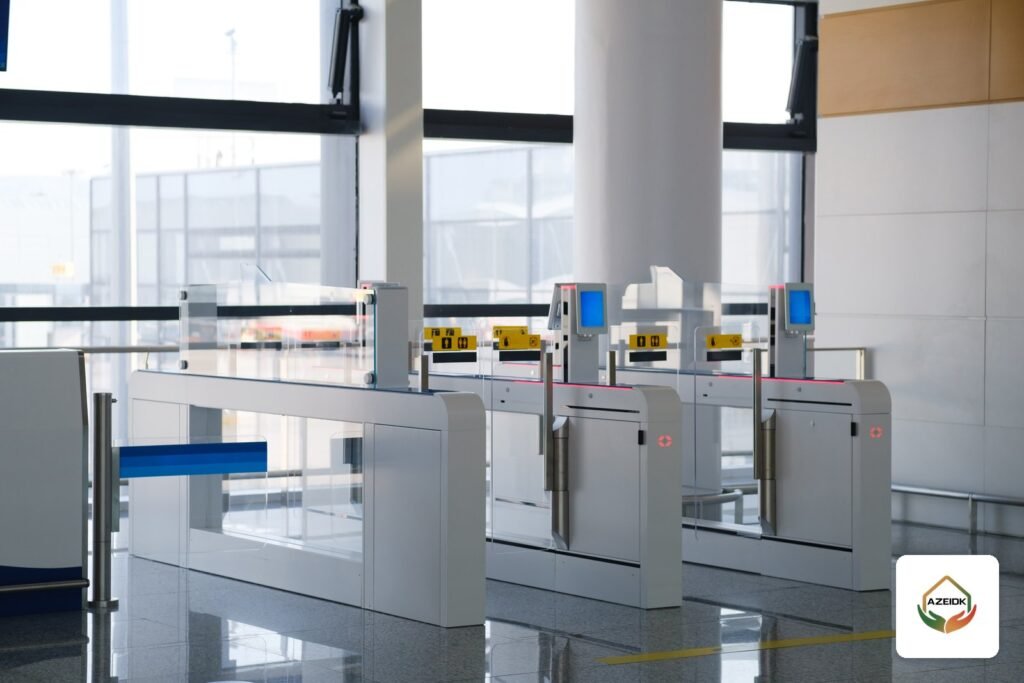
Parking barrier maintenance means periodic inspection and repair of the boom, balancing spring, motor, control board, safety devices (loops and photocells) and card readers, and the same applies to pedestrian turnstiles. Most failures start small: an unbalanced boom, a damaged loop or a dirty lens. Left alone, they end with a closed entrance or a boom coming down on a car.
This guide is for facility managers dealing with a barrier that will not close or a turnstile that ignores a valid card. It covers common symptoms and likely causes, what a periodic visit checks, what to include in a fault report and what a maintenance contract should define. If the fault is live now, AZEIDK’s corrective maintenance and technical support service starts with on-site diagnosis. Choosing a barrier model is outside the scope of this article.
Key takeaways
- Barriers and turnstiles are electromechanical devices that run thousands of cycles, so they need a periodic programme based on each model’s manual.
- The most dangerous barrier fault is loss of closing protection: a loop or photocell that no longer stops the boom from lowering onto a vehicle.
- BFT’s MAXIMA ULTRA 36 documentation requires the power supply to be cut off before any work, and states that the unit must be installed and maintained by a trained professional.
- Test gate opening on a fire alarm signal and on power loss after any programming or panel change.
- Gates are not automatically part of a CCTV maintenance contract. Name each one by model and location in the asset list and scope.
In this article
- What does parking barrier and turnstile maintenance cover?
- Common parking barrier faults: symptom and likely cause
- Turnstile faults and how to diagnose them
- Do gates have to open on a fire alarm?
- Periodic maintenance checklist for barriers and turnstiles
- What to include in a fault report
- Gate maintenance contracts: what should they define?
- Common parking barrier maintenance mistakes
- Barrier and turnstile maintenance from AZEIDK
- Frequently asked questions
- Conclusion
What does parking barrier and turnstile maintenance cover?
A parking barrier is a boom, balancing spring, motor and gearbox inside the cabinet, a control board, vehicle detection (an in-ground loop and photocells) and an identification device: card or tag reader, ANPR camera, push button or remote. A pedestrian turnstile has a rotor or wings, a motor or locking solenoid, infrared sensors, and a reader with an access controller.
Maintenance therefore has four strands:
- Mechanical: boom and its fixing, balancing spring, gears and lubrication per the manufacturer, and anchor bolts.
- Electrical and control: supply, fuses, motor, control board, limit settings and backup battery where fitted.
- Safety: loops, photocells, turnstile sensors and the unit’s response to an obstacle.
- Integration: readers and access control, the fire alarm signal and CCTV logging of movements.
For the full parking system architecture, see Parking Management and Automatic Barrier Systems.
Common parking barrier faults: symptom and likely cause
Use this table for first-line diagnosis only. Repairs are carried out with the power off and in line with the model’s manual.
| Symptom | Likely causes | Check first |
|---|---|---|
| Boom stays up and will not lower | Constant presence signal from the loop or photocell, or a stuck open command from a reader or remote | Loop detector and control board indicators; photocell lens cleanliness and alignment |
| Boom lowers then reverses | Obstacle detection, obstacle sensitivity setting or mechanical friction | Error message on the board; free movement of the boom by hand with power off |
| Slow or jerky movement, or boom sags | Spring out of adjustment or fatigued, or a replacement boom of different length or weight | Boom balance per the manual; boom matches the specification |
| No response at all | Loss of supply, a fuse, or a control board or motor fault | Supply, fuses and fault indicators |
| Valid card, barrier does not open | Reader or its cable to the board, or card permissions in the access control software | Event log, then try the push button |
| Opens or closes with no vehicle | Damaged loop, loop near metal, or crosstalk between adjacent loops | Loop status on the detector; frequency and sensitivity settings |
Boom and balancing spring
Boom balance lets the motor raise and lower without strain. BFT’s MAXIMA ULTRA 36 installation manual says the boom balance must be checked and the spring readjusted if it is out, and that the spring preload tables are indicative values for reaching the correct balance angle. Fitting a replacement boom after an impact without re-tensioning the spring is a frequent cause of slow movement and repeated faults.
Loop detectors
A loop is a wire buried in the pavement and connected to a detector in the barrier; it senses the metal mass of a vehicle above it. One loop detector manufacturer’s manual says the loop fault indicator shows when the loop is open, shorted or outside the permitted inductance range. False detection can come from a loose connection, crosstalk between adjacent loops (fixed by changing frequency), nearby metal such as gates or rebar, or a loop that is not securely set in the pavement. The same manual recommends twisting the lead-in wires, avoiding splices (soldered and in a waterproof box if unavoidable) and sealing the saw cut against moisture.
Photocells
A photocell is a second layer of protection that stops the boom lowering when the beam is broken. Dust, direct sun and a vibrating post commonly weaken or interrupt the signal. Test it by breaking the beam while the boom is actually lowering, not by watching the indicator light alone.
Motor and control board
Modern control boards report the fault type. On the MAXIMA ULTRA 36, BFT says the RGB light crown flashes to show fault categories including encoder/reverser, fuse/door, inverter, time-out or limit switch, and maintenance. Record the flash pattern before calling a technician. According to its AZEIDK product page, this model uses a three-phase motor with an inverter, oil-bath lubrication and a CSB Xtreme control unit.
Turnstile faults and how to diagnose them
Whether tripod, swing barrier or full height, turnstiles tend to fail in similar ways:
- Card accepted, gate does not open: usually the signal between the access controller and the gate board. Check the event log first to see whether an open command was issued.
- Free rotation without locking, or a lock that will not release: a locking solenoid, motor or position sensor fault, or mechanical wear in the rotor.
- False tailgating alarms or wings closing on a user: dirty or misaligned infrared sensors. The Dahua ASGB9XXS-X, for example, lists 10 pairs of IR detectors and 20 pairs of light curtains on its AZEIDK page, and every pair belongs in the check.
- Arm does not drop in emergency mode: some models support arm drop, such as the ZKTeco mTS1000 series, whose page lists “emergency mode: yes (arm drop)”. A failure here affects evacuation directly and takes priority.
For turnstile types and access control integration, see Access Gates for People and Vehicles.
Do gates have to open on a fire alarm?
A security gate must not trap people inside. In practice a relay from the fire alarm panel is wired to the gate controller, and the project’s cause-and-effect matrix sets the response: whether turnstiles release and whether parking barriers lift for vehicles. The references are the means of egress requirements of the Saudi Building Code General (SBC 201) and the project drawings approved by Civil Defense.
For maintenance, that means three tests:
- Opening on a real alarm signal from the panel, not a temporary link at the gate.
- Behaviour on power loss: opening, arm drop or manual key release, depending on the model.
- Repeating both tests after any change to fire alarm programming, a gate board replacement or re-cabling.
Periodic maintenance checklist for barriers and turnstiles
The reference is each model’s manual and its actual usage. This checklist covers a periodic visit, with frequencies set in the contract:
| Item | What is checked | When |
|---|---|---|
| Boom and spring | Balance, boom fixing, profile condition and boom lights if fitted | Every periodic visit and after any impact |
| Gears and lubrication | Per the lubrication method in the manual; oil level on oil-bath units | Per manufacturer |
| Loop | Detector indicator, sensitivity and condition of the saw cut | Every periodic visit and after paving works |
| Photocells and turnstile sensors | Lens cleaning, alignment, beam-break test during movement | Every periodic visit |
| Control board and motor | Fault log, connections, temperature and limits | Every periodic visit |
| Backup battery | Operation with mains disconnected | Per manufacturer |
| Readers and access control | Reading, removal of revoked cards, software updates | Every periodic visit |
| Fire alarm and emergency | Opening on signal and on power loss | Periodically and after any programming change |
BFT’s quick reference guide states that the MAXIMA ULTRA 36 is not a DIY product and must be installed and maintained by a trained professional, and its installation manual requires the power supply to be cut off before any work on the equipment.
What to include in a fault report
Send the technical team:
- Device type, brand, model and location (entry or exit, lane number).
- The exact symptom: what happens, when it started, constant or intermittent.
- The fault indicator colour or board error message, plus a photo or short video of the movement.
- What happened just before: a power cut, rain, paving works, an impact or a programming change.
- Whether the gate works manually and whether the entrance is currently closed.
AZEIDK’s corrective maintenance follows four steps: receiving the report and setting symptoms and priority; a site visit to inspect and identify the likely cause; repair or replacement once the client approves the procedure and cost; and testing after repair with a report of the work done.
Gate maintenance contracts: what should they define?
Gates are covered in AZEIDK’s preventive maintenance contracts alongside intrusion alarm, access control and intercom systems, but coverage is set contract by contract. As CCTV and Security System Maintenance explains, gates are not automatically part of a camera contract. The contract should define:
- Asset list: every barrier and turnstile by brand, model and location, with readers and loop detectors.
- Coverage: labour and inspection only, or specific spare parts such as booms, springs and sensors.
- Visits and checklist: attached to the contract and based on each model’s manual.
- Response time: with higher priority for a fault that closes a main entrance or disables emergency opening.
- Exclusions: vehicle impact damage, expansions and paving works that cut the loops.
- Records: a report per visit, a fault log and the result of the fire alarm opening test.
- Software: who holds the administrator account and who carries out updates.
Common parking barrier maintenance mistakes
- Disabling the loop or photocell “temporarily” to get the barrier working, then forgetting it.
- Fitting a replacement boom without re-tensioning the balancing spring.
- Cutting the loop during paving works without reinstalling and testing it.
- Treating a card test as enough, without testing opening on fire alarm and on power loss.
Barrier and turnstile maintenance from AZEIDK
In Saudi Arabia, AZEIDK supplies turnstiles and parking barriers from BFT (MAXIMA ULTRA 36, GIOTTO ULTRA 36, MICHELANGELO BT A and MOOVI), Hikvision (DS-TMG320-B, DS-TMG423-B and DS-TMG520), and Dahua and ZKTeco turnstiles, with supply, installation, preventive and corrective maintenance. AZEIDK’s ISO 9001, ISO 14001 and ISO 45001 certification scope covers the design, supply, installation and maintenance of CCTV and access control systems.
Frequently asked questions
Why won’t my parking barrier arm close?
The usual cause is a constant presence signal from the loop or photocell, or a stuck open command from a reader or remote. Check the detector and board indicators before any mechanical adjustment.
How often do parking barriers need maintenance?
There is no single interval for every model. The schedule follows the manual and actual usage, and is fixed in the maintenance contract with its checklist.
Can a barrier run without its loop or photocell?
It may run, but nothing will stop the boom coming down on a car or a person. Disabling safety devices is not a fix.
Is turnstile maintenance part of a CCTV maintenance contract?
Not automatically. Gates must be listed by model and location in the contract’s asset list and scope.
What if a turnstile does not open on a fire alarm?
Treat it as urgent because it affects evacuation. Report it, check the signal path from the alarm panel to the gate controller, then retest with a real signal.
Conclusion
Barrier and turnstile maintenance rests on a balanced boom, safety devices that actually work, and guaranteed opening on fire alarm and power loss. A contract that names every device and sets spare parts and response times makes repairs faster.
Barrier or turnstile down at your site? Send us the brand, model, symptom and a photo of the fault indicator, and we will arrange a diagnostic visit or the right maintenance scope. Talk to the AZEIDK team
Related guides
- Fire Sprinkler Hydrostatic Testing Before Handover: Pressure, Duration and Records
- Choosing Fire Detectors: Smoke, Heat, Beam and Flame
- Fire Fighting System Installation in Saudi Arabia: Sprinklers, Hose Cabinets and Pump Room
- AI CCTV Cameras: Dahua WizSense vs WizMind and Hikvision Human/Vehicle Classification