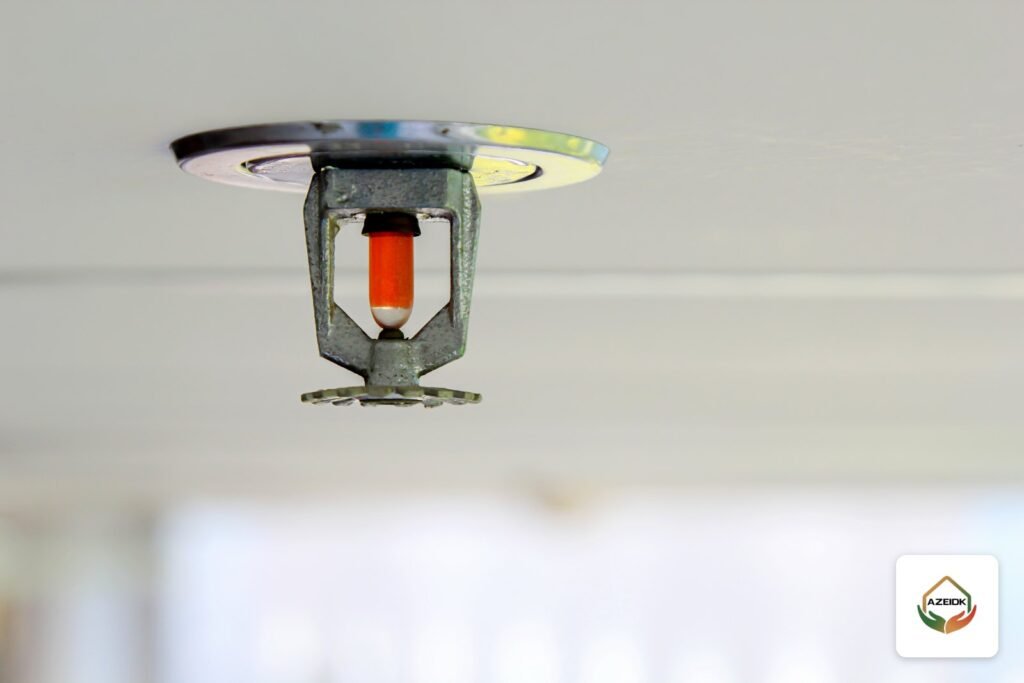
How does a fire sprinkler system work? The pipework is full of water under pressure, and each sprinkler is held shut by a glass bulb or fusible link that breaks only when it reaches a set temperature. Only that sprinkler opens and sprays water over the fire. In a standard wet system the sprinklers do not all go off together, and smoke alone does not set them off. This article answers the questions building owners, hotel staff and mall operators in Saudi Arabia ask about how a sprinkler operates, what happens when one is broken, and why nothing may hang from it.
Key takeaways
- Each sprinkler operates on its own when the heat at that head reaches its rating, for example 68 °C for the red bulb in the TYCO Series TY-B datasheet.
- Smoke, cooking vapors and steam do not operate a sprinkler, according to NFPA’s myths and facts sheet.
- The exception is a deluge system with open heads, where every head in the zone discharges together on a signal from a detection system.
- A broken sprinkler discharges at full system pressure until the control valve is closed, so staff must know where that valve is and who is authorized to close it.
- The manufacturer prohibits hanging anything from a sprinkler or painting it, and requires replacement of any head with a cracked bulb or impact damage.
In this article
- How does a fire sprinkler system work, step by step?
- If one sprinkler goes off, do they all go off?
- Can cigarette smoke set off a sprinkler?
- How much water comes out of one sprinkler?
- What happens if a sprinkler is broken or knocked?
- Why is it forbidden to hang clothes or anything else on a sprinkler?
- What should hotel and building staff know about sprinklers?
- Frequently asked questions
- Conclusion
How does a fire sprinkler system work, step by step?
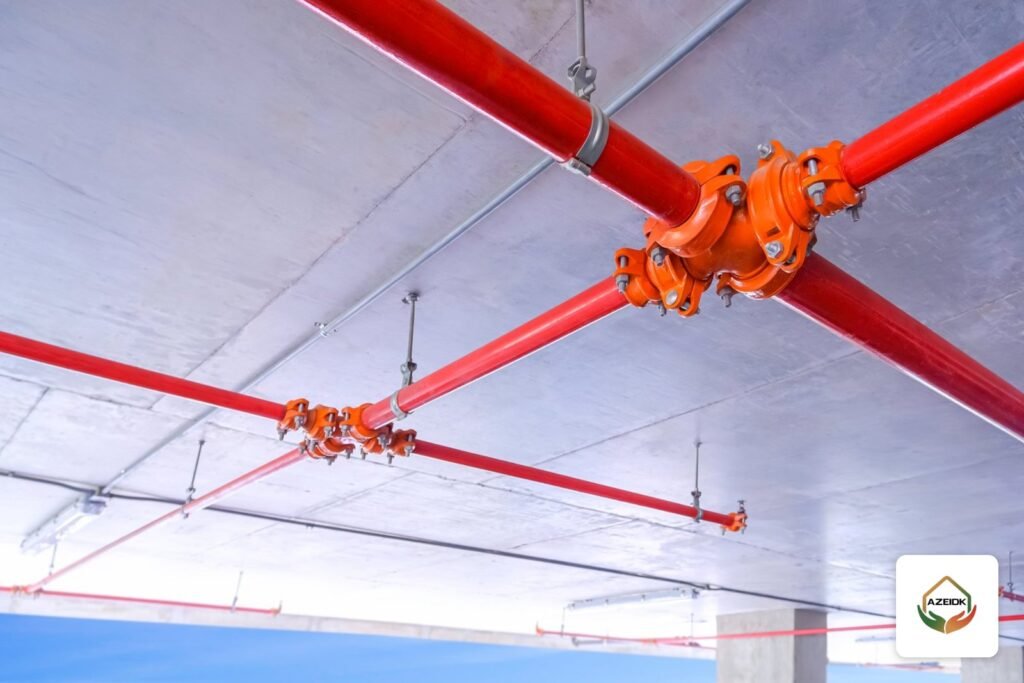
Most buildings in the Kingdom use a wet pipe system, the simplest and most common of the fire fighting systems. The pipes are always full of water, held back at each sprinkler by a seal kept in place by a glass bulb or fusible link. This is the sequence during a fire:
- Hot gases rise and collect under the ceiling above the fire, heating the nearest sprinkler.
- The liquid inside the bulb expands. TYCO datasheet TFP151 describes it expanding until it shatters the glass at the rated temperature, so the sprinkler opens and water flows.
- Water hits the deflector under the sprinkler and spreads in an umbrella pattern over the area.
- Water moving in the pipe trips the flow switch, which signals the fire alarm panel. On many projects the wet alarm check valve also operates and sounds the water motor gong.
- System pressure drops and the fire pump starts according to the approved design to maintain flow.
- Discharge continues until the zone control valve is closed after the fire is under control and with the authority’s permission. The sprinkler does not close itself.
For the role of the alarm valve and flow switch in more detail, see AFC ACV-300 wet alarm check valve and connecting flow switches and valve monitors to the fire alarm.
If one sprinkler goes off, do they all go off?
No. In wet, dry and pre-action systems each sprinkler works independently. Only the head where the heat reaches its rating opens; heads away from the fire stay closed. The film scene where the whole ceiling discharges because of a small fire is not how these systems work.
The data supports this. NFPA Journal, citing NFPA’s U.S. Experience with Sprinklers report for 2015 to 2019, states that only one sprinkler operated in 77% of structure fires where sprinklers operated, and five or fewer operated in 97%.
The one important exception is the deluge system. Its heads are open, with no bulb, and the main valve opens on a signal from a detection system, so every head in the zone discharges at once. Deluge is designed for special hazards and is not installed in hotel rooms or offices. The four system types are compared in wet, dry, pre-action and deluge sprinkler systems.
Can cigarette smoke set off a sprinkler?
No. A sprinkler is a heat-operated device, not a smoke detector. NFPA’s myths and facts sheet states that sprinklers do not operate in response to smoke, cooking vapors, steam or the sound of a smoke alarm. Cigarette smoke in a hotel room may trigger a smoke detector on the fire alarm system, but it will not open a sprinkler.
What opens a sprinkler is the bulb itself reaching its operating temperature. A direct heat source held very close to the head, such as a lighter flame or a heat gun during maintenance, can do that. This is why welding and hot work near sprinklers should only happen under a permit coordinated with the safety officer.
The liquid color in the bulb shows the temperature rating. These values come from datasheet TFP151 for the TYCO Series TY-B sprinklers:
| Bulb color | Temperature rating |
|---|---|
| Orange | 57 °C (135 °F) |
| Red | 68 °C (155 °F) |
| Yellow | 79 °C (175 °F) |
| Green | 93 °C (200 °F) |
| Blue | 141 °C (286 °F) |
The designer picks the rating from the highest expected ceiling temperature. A low-rated head above a permanent heat source can open without a fire, so a sprinkler is never swapped for one with a different bulb color.
How much water comes out of one sprinkler?
Flow is calculated with Q = K√P, where Q is flow in gpm, K is the K-factor on the datasheet and P is the pressure at the sprinkler in psi. Datasheet TFP151 lists K = 5.6 (80.6 L/min/bar½) and K = 8.0 (115.2 L/min/bar½). The table gives worked examples only; actual pressure comes from the project’s hydraulic calculations.
| K-factor | Pressure at sprinkler | Approximate flow |
|---|---|---|
| 5.6 | 10 psi (0.69 bar) | 17.7 gpm (about 67 L/min) |
| 5.6 | 20 psi (1.38 bar) | 25.0 gpm (about 95 L/min) |
| 8.0 | 10 psi (0.69 bar) | 25.3 gpm (about 96 L/min) |
| 8.0 | 20 psi (1.38 bar) | 35.8 gpm (about 135 L/min) |
In practice, one open sprinkler running for ten minutes can discharge several hundred liters. A broken head needs a fast response because the water will not stop by itself. Even so, NFPA’s sheet notes that water damage from a sprinkler is typically far less severe than damage from fire department hose lines.
What happens if a sprinkler is broken or knocked?
Breaking the bulb with a ladder, a luggage trolley or a ball opens the sprinkler exactly as a fire would. Water discharges at system pressure, the flow alarm operates and the pump may start. Suggested steps for building staff:
- Move people away and isolate power to equipment exposed to water if it is safe to do so.
- Confirm there is no actual fire. If there is, close nothing and call Civil Defense on 998.
- Notify the safety officer or authorized maintenance technician. Datasheet TFP151 states that before closing a main control valve, permission must be obtained from the proper authorities and everyone affected must be notified.
- After isolation, replace the head with an identical sprinkler of the same model, K-factor and temperature rating, then reopen the valve and confirm the system is back in service.
Do not try to plug the sprinkler with a cloth or refit the bulb. A sprinkler that has operated or been damaged is replaced, not repaired. As NFPA summarizes the NFPA 13 requirement, a stock of spare sprinklers and a sprinkler wrench must be kept on the premises: at least six where fewer than 300 sprinklers are installed, 12 for 300 to 1,000, and 24 for more than 1,000.
Why is it forbidden to hang clothes or anything else on a sprinkler?
Datasheet TFP151 is explicit: the owner must make sure sprinklers are not used for hanging any objects and are only cleaned by gently dusting with a feather duster; otherwise the sprinkler may fail to operate in a fire or may operate without one. The reasons are mechanical:
- A hanger or cord loads the frame and bulb and can break it, opening the head immediately.
- Fabric hanging over the head shields the bulb from heat, delays operation, then blocks the spray at the deflector.
- Bags and decorations distort the spray pattern and leave areas unprotected.
For the same reason the datasheet prohibits painting, plating, coating or otherwise altering a sprinkler after it leaves the factory, and requires replacement of any head that has been painted, shows leakage or corrosion, or has a cracked bulb or a bulb that has lost liquid. In hotel rooms, guests hanging clothes on the sidewall sprinkler above the door or near the wardrobe is a common problem, so a warning label near the head and housekeeping briefings help.
What should hotel and building staff know about sprinklers?
In hospitality buildings, maintenance and housekeeping teams deal with sprinklers every day. A short list of what they should know:
- Where the control valve for each floor or zone is, and who is authorized to close it.
- Where the spare sprinkler cabinet and wrench are kept.
- Not to stack goods or boxes up against sprinklers in a way that blocks the spray.
- To report at once any sprinkler that is painted, tilted, leaking or missing its escutcheon.
- To record every activation or replacement in the fire safety log and follow periodic inspection under NFPA 25.
Periodic inspection and testing of the network, valves and sprinklers is part of preventive maintenance contracts and helps catch painted or defective heads before they become a problem.
Frequently asked questions
How do fire sprinklers work?
Water is held behind each sprinkler by a glass bulb or metal link. When heat reaches the rating, the bulb breaks, that sprinkler alone opens and sprays water, and the flow alarm on the system operates.
If one sprinkler activates, do all of them activate?
No. In wet, dry and pre-action systems each sprinkler works on its own. A deluge system with open heads is the exception and is used for special hazards.
Can cigarette smoke set off a sprinkler?
No. Sprinklers respond to heat only. Smoke may trigger a smoke detector and the fire alarm, but it does not open a sprinkler.
How much water does one sprinkler discharge?
It depends on the K-factor and pressure. As a worked example, a K5.6 sprinkler at 10 psi gives about 17.7 gpm, roughly 67 L/min.
Does a sprinkler shut off by itself after the fire is out?
No. A standard sprinkler keeps flowing until the control valve is closed manually with the authority’s permission, and the sprinkler is then replaced.
Why must nothing hang from a sprinkler?
The load can break the bulb and open the head, and fabric shields the bulb from heat and blocks the spray. The manufacturer states sprinklers must not be used for hanging any objects.
Can a sprinkler be painted with the ceiling?
No. The datasheet prohibits painting or altering a sprinkler after it leaves the factory, and a painted sprinkler must be replaced.
Conclusion
A fire sprinkler system works by heat, one head at a time, over the fire only. Smoke does not set it off, a knock or a hanging load can open or disable it, and an open head keeps flowing until the valve is closed. Staff who know these points, and where the valves and spare heads are, keep damage to a minimum when something goes wrong.
Need your building’s sprinklers inspected or damaged heads replaced? AZEIDK designs, supplies, installs and maintains sprinkler systems across Saudi Arabia. Talk to the AZEIDK team
Related guides
- Civil Defense Requirements for Auto Workshops in Saudi Arabia: Extinguishers, Fire Alarm and Oil and Gas Storage Before the Salamah Licence
- MEP Fire Safety and Low-Current Integration: Coordination Guide
- Upgrading an Old CCTV System: IP, HD over Coax (PoC/Turbo HD), and What to Keep or Replace
- Approved Electrical Contractor for Commercial Projects in Saudi Arabia: Scope, SBC 401 and Electrical Works Within an Integrated MEP Package